Summary

  • Prime Minister Keir Starmer faced questions from senior MPs on a range of issues at the Liaison Committee

  • On the Iran war, Starmer says he welcomes the talks between the US-Iran, but says it would be "false comfort" to assume the war will have "a quick and early end"

  • On rising energy prices, Starmer says he's looking at support after the current energy price cap ends in June

  • The PM gave a clear indication he would prefer support to be targeted at the households that need it most - read our political correspondent's analysis

  • On the arson attack on ambulances belonging to a Jewish charity, Starmer says "the rise of antisemitic hatred is there for all to see" and reiterates that the NHS will pay to replace the ambulances

  1. Seven things we heard from Keir Starmer during Liaison Committee’s questions on Iran and energy billspublished at 17:07 GMT

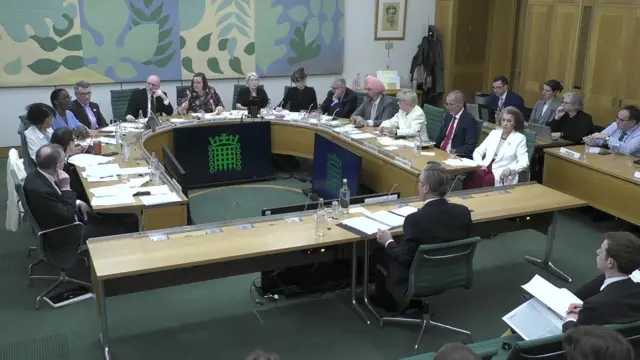
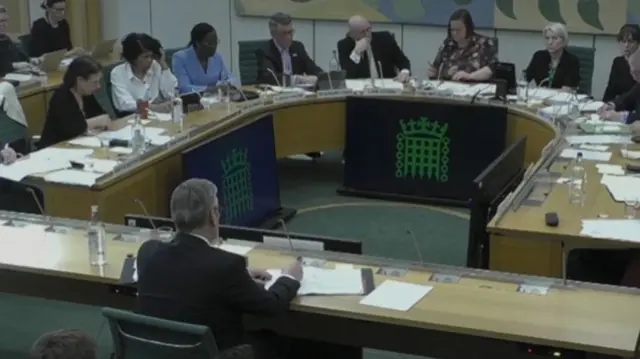
    Wide shot of Liaison committeeImage source, UK Parliament

    Prime Minister Keir Starmer faced questions from senior MPs for around 90 minutes at this afternoon's Liaison Committee session, here's what we heard:

    • Starmer began with a brief statement on the arson attack on Jewish charity ambulances - he said the vehicles will be replaced by the NHS
    • On Iran, Starmer stressed the war "could go on for some time" and told MPs the government will look at support for energy bills, as well as companies "profiteering" from the conflict at a Cobra meeting this evening
    • As rising household bills reflect the consequence of the conflict, Starmer made clear he would prefer targeted support for those most in need - our political correspondent writes
    • He stressed the conflict "is not our war", again emphasising that any UK action must have a "lawful basis"
    • We heard wrangling over a defence investment plan; which Starmer refused to commit to giving a publication date of, while Tory MP Sir Bernard Jenkin called for the government to make decisions more quickly by adopting a "war-fighting mentality"
    • The PM was also quizzed on whether oil and gas reserves in the North Sea could be utilised to mitigate the fuel crisis - he replied that these will remain "part of the mix" but renewable sources are critical to avoiding reliance on international markets
    • While Iran dominated, there were also questions on violence against women and girls, which Starmer said remains a key mission abroad despite cuts in overseas development aid

    We are bringing over coverage of the session to a close now, you can read more in our news story.

  2. Session underlined huge decisions government is likely to grapple with over next few monthspublished at 16:50 GMT

    Jack Fenwick
    Political correspondent

    Running throughout that session was a clear tension between the approach the prime minister is taking and the fact that much of this is being driven by global events that are out of his control.

    Starmer gave us the indication that he’s looking at targeted support for energy bills in July but stressed that no one knows how long this conflict in Iran, or its knock-on impacts, will last.

    Ministers will be discussing what they might have to do to help people in the months ahead when they meet this evening, but right now they simply don’t know how much support they’ll have to provide.

    Number 10 will point to the PM’s announcement about looking at “further teeth” for the Competition and Markets Authority - but again it is unclear what exactly will happen to petrol and diesel prices.

    It’s on the UK’s defensive preparedness where Starmer’s opponents are likely to be more critical of his performance today.

    He couldn’t say when a crucial defence investment plan would be published - and blamed those delays on the last Conservative government. But more than 18 months into his premiership, he’s already been accused of not making that a priority.

    And his refusal to spell out how he’d go “further and faster” on increased defence spending is likely to lead to questions from across Parliament.

    What today’s session did underline was the vast number of huge decisions that this government is likely to grapple with over the next few months.

    The answers they come up with could define how the public views them.

  3. BBC Verify

    Is UK military recruitment improving?published at 16:40 GMT

    A UK armed forces recruitment centre signImage source, Getty Images

    By Anthony Reuben

    Asked about military recruitment during the session this afternoon, Prime Minister Keir Starmer told MPs on the liaison committee: "We are now recruiting at a higher rate than was previously the case, holding on to people and retaining people for longer."

    In the most recent year for which we have figures, external, there was a significant increase in recruitment - 14,100 people joined the regular armed forces in the year to the end of September 2025, which was up 13% on the previous 12-month period. In the same period, 13,860 people left the regular armed forces, which was 8% down on the previous year.

    So, the prime minister was right that recruitment and retention were both up, but it still means there was only a net gain of 240 people over this period.

    The full-time trained strength of the UK military was 125,680 which was down 1.4% on the previous year.

  4. Session concluded with Starmer asked about Trump commentspublished at 16:28 GMT

    At the very end of the session, Starmer was asked by Dame Meg Hillier - who was chairing the committee this afternoon - about US President Donald Trump, claiming he has a record of making of making "quite rude", as well as "supportive" comments about the UK.

    She asked the PM if he had a message to the British public on how he and the country need to face these challenges.

    Starmer said he was "utterly focused" on what is best for Britain and its national interest.

  5. Liaison Committee endspublished at 16:09 GMT

    Keir Starmer's done answering questions from MPs on the Liaison Committee.

    We'll bring you a round-up of the main takeaways shortly.

  6. BBC Verify

    Is the UK spending £270bn more on defence this Parliament?published at 16:07 GMT

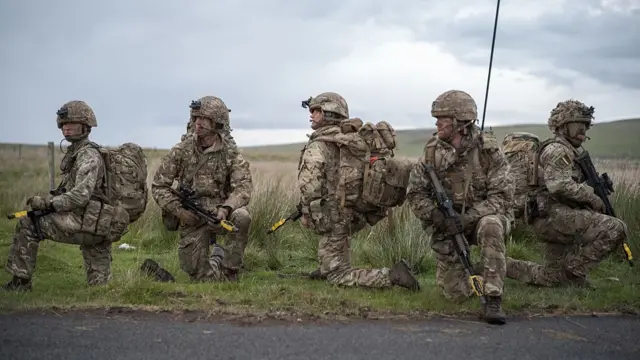
    Five British soldiers pictured on a training exercise last summerImage source, Getty Images

    By Ben Chu, policy and analysis correspondent

    Speaking about defence spending earlier, the PM told the Liaison Committee: "We’ve already committed to 2.5% [of GDP] in 2027 and we’ll hit that. That means in this parliament we’ll spend £270bn more than we would otherwise have done on defence."

    It’s correct that the government has committed to increase spending on defence, external from 2.3% of GDP in 2024-25 to 2.5% by 2027-28.

    This additional 0.2% of GDP equates to an additional £6bn a year in today’s money.

    However, the latest figures in the Spending Review, external confirm there is not an extra £270bn of planned defence spending over the Parliament.

    They show UK defence spending rising from £60.3bn in 2024-25 to £73.5bn in 2028-29, the final year of the Spending Review.

    Adding up total cumulative planned defence spending over the four years to 2028-29 is just over £272bn - but this is total spending, not additional spending due to the government’s plans.

  7. Starmer asked if tackling violence against women and girls remains a target of hispublished at 16:05 GMT

    Away from Iran, MP Sarah Champion has a few questions for Starmer on other global issues.

    The Labour MP expresses her pride at the government's efforts to tackle violence against women and girls in the UK, and asks the prime minister whether it remains a priority to also address this internationally.

    Starmer accepts that the government has needed to take "difficult decisions" on overseas development aid, but stresses that tackling violence against women and girls remains one of his missions abroad.

    The PM also says it's important that the UK stands up for its principles, when quizzed by Champion on backsliding over women's rights, for instance on abortion laws.

    MP Andy Slaughter then seeks to mop up the discussion of international law. He asks Starmer to clarify the government's legal position on the complex issues in the Middle East. The PM responds that the government has allowed the US to use its bases for "collective self defence", and no one has challenged this so far.

  8. PM: Iran is not our war and we are not getting dragged into itpublished at 16:02 GMT

    Chi Onwurah, a Labour MP, puts it to Keir Starmer that the world is on a "digital battlefield" because of the wars in Iran and Ukraine.

    She asks if the PM is concerned that the UK is too reliant on AI quantum and drone capabilities provided by foreign private companies.

    Starmer says he wants to increase drone capability, adding that the lesson from the war in Ukraine is that drone warfare has changed "considerably" in the last four years. He says the "number and capability" of drones is "huge" - something the UK needs to be "centrally part of".

    Labour MP Debbie Abrahams then asks what the PM is doing to resolve the "crisis" in Iran, and how he is showing "leadership" on the matter.

    Starmer says that for there to be any UK action "there must be a lawful basis and a viable and thought through plan". He goes on to say "that’s why we didn’t join the official strikes", and instead intervened to protect allies in the region from missile and drone strikes, and allowed the Americans to fly missions to attack Iranian missile infrastructure from UK bases on the basis of "collective defence".

    "This is not our war and we are not getting dragged into this war," the PM adds.

  9. Analysis

    As expected, Starmer's largely been asked about Iran war and knock-on impact in UKpublished at 15:48 GMT

    Jack Fenwick
    Political correspondent

    The prime minister has confirmed that he's looking at what support could be given to households after the current energy price cap expires in July.

    He gave a clear indication that he would prefer that support to be targeted at the households that need it most, rather than the sort of universal support offered by former PM Liz Truss after Russia invaded Ukraine.

    Keir Starmer also announced that he's looking at giving the Competition and Markets Authority “further teeth” so it can better protect customers from being ripped off.

    On the issue of the UK's defensive readiness, he was given a tough time by two of the committee chairs.

    Conservative MP Bernard Jenkin made an unfavourable comparison between Starmer and Winston Churchill, criticised him for being too slow to protect Cyprus from Iran and accused the prime minister of not being on a war-footing.

    Labour MP Tan Dhesi, who chairs the Defence Committee, said the UK's naval capabilities when the war broke out were embarrassing.

    Starmer reiterated a point he's previously made, that an increase in defence spending needs to happen "further and faster" - but said he couldn't currently spell out how he would make that happen.

    He also confirmed that the long-delayed defence investment plan - which is seen as vital to ensuring the UK can defend itself - is currently on his desk.

    He said the delays were down to questions over how some of the plan would be funded, which he blamed on the previous Conservative government, but refused to say when the plan would be published.

  10. Back and forth on oil and gas resources in the North Seapublished at 15:41 GMT

    Next up, Liberal Democrat MP Jamie Stone raises the topic of oil and gas in the North Sea, suggesting the government's net-zero target could still be achieved while tapping into these resources.

    Starmer says oil and gas "will be a part of the mix" for many years to come, and that the government is "working at speed" to extract further from existing gas fields. But he says renewable energy is the only source that "truly" moves the UK away from relying on international markets.

    The pair then discuss nuclear energy, with Starmer agreeing that it would be a sensible plan to set up a network of small modular reactors across the UK. The PM adds, though, that the SNP government is currently vetoing this plan in Scotland.

    Labour's Liam Byrne then moves the conversation onto economic security more widely. He asks whether the government is clear enough to businesses about its ability to develop independently, and therefore encourage investment.

    Starmer agrees more needs to be done, but says the government has seen more investment arrive in the past 18 months.

  11. Oil profiteering, price gouging, National Grid reforms - Starmer answers more questionspublished at 15:31 GMT

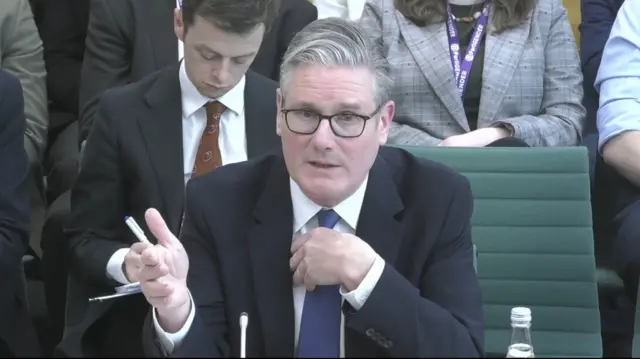
    Starmer speaks to Liaison CommitteeImage source, UK Parliament

    Back to Labour's Bill Esterson, who highlights a column in the Sunday Times written by Lord Richard Walker, who was last month announced as the government's "cost of living champion".

    In the article, Esterson says Walker suggests a short-term government intervention to prevent profiteering in surging oil fuel prices. Asked if he'll follow this advice, Starmer says he plans to meet Walker to discuss these proposals urgently.

    "I want to see more on price gouging or profiteering," says Starmer, who adds that the UK must "absolutely" bear down on this.

    Esterson says it costs £40bn to support energy bills in 2022, and asks Starmer if he is considering targeted support now given how expensive it was last time. Starmer says he's aware of the cost, and that the government is looking at all options.

    Chair Meg Hillier then jumps in to ask Starmer about the National Grid, and plans to reform it. Starmer says it was under-invested for years, and that he'll write to the committee with full details on the work the government's doing.

  12. Asked for update on defence investment, PM says he wants to avoid 'over-commitment' and 'under-funding'published at 15:22 GMT

    Tory MP Bernard Jenkin asks Keir Starmer to give an update on the government's defence investment plan, which he says was expected before Christmas.

    Jenkin, who chairs the Statutory Instruments Committee, also asks how the plan can be created without the Treasury committing to support it.

    The PM responds, saying he doesn't want to set out commitments without being clear where money is coming from.

    Jenkin jumps back in, suggesting the government needs to adopt a "war-fighting mentality" to push the Treasury to commit to spending.

    Starmer then says he's trying to move away from a model of "over-commitment" and "under-funding".

  13. What exactly is the Liaison Committee?published at 15:13 GMT

    Keir Starmer facing questions from the Liaison Committee. He sits at a wooden table with MPs sat opposite around a horseshoe shaped table.Image source, UK Parliament

    For each government department (Home Office, Ministry of Defence, Department for Transport, etc), there's a select committee of cross-party MPs who scrutinise the department's work.

    The Liaison Committee is made up of MPs who chair those individual committees.

    It's this committee's job to quiz the PM on public policy, usually three times a year.

    The topics that Keir Starmer's now being asked about are decided ahead of time - hence how we knew there'd be a focus on the Middle East war and the UK economy.

  14. Starmer pushed on UK's response to Middle East conflictpublished at 15:06 GMT

    Next up, Labour MP Bill Esterson says Liquefied Natural Gas (LNG) production in the Middle East has been "severely damaged" during the war. He also says this could have a "profound effect" on prices beyond the end of June, and ask What the government's doing to deal with that.

    Starmer says he is "looking at what support can be put in", and that "all the appropriate levers" are being examined. But he adds that it is "a little bit early to be too concrete".

    Tan Dhesi, also a Labour MP, then asks about reports suggesting the US is "significantly ramping up" its military presence around Iran. Dhesi says the UK's deployment response to the war was embarrassing, and asks if Starmer felt embarrassed.

    Starmer pushes back, saying assets had been pre-deployed to the region before the conflict began. Referring specifically to HMS Dragon, the PM says it normally takes six weeks "for the loading onto and deployment of relevant capability".

    The PM also says the UK has embedded airspace battle management specialists into the region and is working with the industry to distribute air defence missiles to Britain's Gulf partners. UK defence, he goes on, is "constantly" assessed, and military and intelligence services are "working 24/7" to keep the UK and its citizens safe.

  15. Iran war 'could go on for some time' - PMpublished at 14:50 GMT

    Labour MP Liam Byrne asks the first Iran-related question - specifically he wants to know when Starmer believes the conflict will end.

    The prime minister says he wants the war to stop as quickly as possible, and that he welcomes reported talks between the US and Iran that Donald Trump hailed as productive on Sunday. Starmer adds that the UK was aware of these discussions.

    Asked about the impact of the war on businesses, and how far ahead they should plan for the war to continue, Starmer acknowledges that the war "could go on for some time". He says he's told his team not to fall into the "false comfort" that there could be a "quick and early end".

    On energy bills specifically, Starmer says the government doesn't have concerns over energy supplies, and reiterates energy bills will be cut and held until the end of June. He also says the government has been working to ensure nobody is "profiteering" from the conflict, and will be considering a wider set of measures for the economy at a Cobra meeting scheduled for later.

  16. Starmer makes brief statement about arson attack on Jewish charity ambulancespublished at 14:41 GMT

    Before taking questions, Keir Starmer makes a short statement about the arson attack on ambulances belonging to a Jewish community charity in north London.

    The PM expresses his "disgust" at the "horrific" attack, which took place in the early hours of Monday.

    He says the ambulances will be temporarily replaced by Tuesday, and that the NHS will then provide a permanent replacement. Starmer adds that "the rise of antisemitic hatred is there for all to see".

    • We have a separate live page taking in updates on the arson attack, which is being investigated by counter-terrorism police - you can follow that here
  17. Watch live: Starmer's Liaison Committee session beginspublished at 14:32 GMT
    Breaking

    The PM is in his seat, and this afternoon's session is under way.

    You can watch live at the top of the page as the PM faces questions for the next 90 minutes or so, and we'll bring you all the key lines from his responses here.

  18. Analysis

    Middle East, energy prices, Trump - Starmer faces questions on an array of issuespublished at 14:32 GMT

    Jack Fenwick
    Political correspondent

    We can expect the prime minister to be grilled on various things related to the ongoing conflict in the Middle East during this hearing.

    The chair of the Defence Committee will likely ask Keir Starmer about the UK’s involvement in the conflict - and whether Iran is capable of firing a ballistic missile at the UK.

    Ministers keep saying that the UK will not get dragged further in and will only take part in what they call “defensive operations”, but the government hasn’t been clear about the distinction between defensive and offensive - expect that to come up.

    The chair of the Energy Security committee will also be involved in today’s session. There is widespread worry around Westminster about the increasing price of petrol - and what could happen to household energy bills after the energy price cap expires in July.

    Senior ministers will meet later to discuss that, so let’s see if Starmer gives any suggestion about what support the government is considering.

    And then there’s Donald Trump. The foreign affairs committee chair isn’t at today’s hearing as she’s on parliamentary trip to Greenland - but the prime minister’s relationship with the US president will surely come up anyway.

  19. Before the session, Starmer says he's looking at ways to deal with price rises caused by warpublished at 14:21 GMT

    Keir Starmer says he's looking at "every lever that's available to government" to deal with cost of living pressures caused by the Iran war.

    After facing the Liaison Committee, Starmer is due to chair an emergency "Cobra" committee, which will be attended by Bank of England governor Andrew Bailey and senior ministers.

    Housing Minister Matthew Pennycook says a "range of options" are being assessed, telling the BBC this would include on the issue of "profiteering that we're potentially seeing from fuel retailers".

    Ministers will also discuss the impact on business and supply chains, alongside the international response to the conflict in the Middle East.

    Starmer earlier told broadcasters: "I am asking for every lever that's available to the government to deal with the cost of living to be discussed at Cobra, hence we've got the Bank of England and others there."

    • There's more on the Cobra meeting - which will also be attended by Chancellor Rachel Reeves - in our news story
  20. The panel questioning the PMpublished at 14:16 GMT

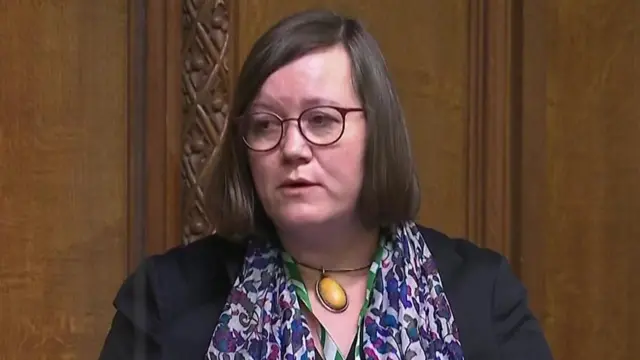
    Dame Meg Hillier speaking in the House of CommonsImage source, UK Parliament/PA
    Image caption,

    The Liaison Committee is chaired by Dame Meg Hillier, a Labour MP

    Here are the MPs who'll sit alongside Hillier - as well as the Commons committees they chair:

    • Debbie Abrahams (Labour MP) -Work and Pensions
    • Liam Byrne (Labour MP)-Business and Trade
    • Sarah Champion (Labour MP) - International Development
    • Tan Dhesi (Labour MP) - Defence
    • Bill Esterson (Labour MP)- Energy Security and Net Zero
    • Patricia Ferguson (Labour MP) - Scottish Affairs
    • Sir Bernard Jenkin (Conservative MP) - Statutory Instruments
    • Dame Chi Onwurah (Labour MP) - Science, Innovation and Technology
    • Andy Slaughter (Labour MP) - Justice
    • Jamie Stone (Liberal Democrat MP) - Petitions