Summary

  • Today is the one-year anniversary of Donald Trump's swearing in as the 47th president of the United States

  • To mark the anniversary, we are answering your biggest questions about Trump's second term - submit a question here

  • His presidency has had major global impact, including negotiating a ceasefire in Gaza, implementing sweeping tariffs on trading partners, seizing the leader of Venezuela, and pushing for US to control Greenland

  • Domestically, Trump touts his administration's success in clamping down on illegal migration, and has claimed to have boosted the economy

  • Looking ahead, the midterm elections this year will be a true test of how Americans have viewed his second term in the White House

Media caption,

Ros Atkins on…A year since Trump’s election victory

  1. Who will be Trump's Maga successor?published at 01:42 GMT

    Bernd Debusmann Jr
    White House reporter
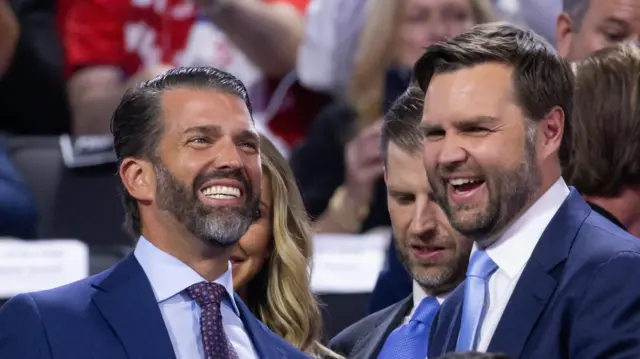
    Donald Trump Jr (left) and JD Vance (right) standing next to each other and laughingImage source, JUSTIN LANE/EPA-EFE/REX/Shutterstock

    Joe from the US asks: who might be next in line after Trump?

    At the White House, US President Donald Trump often muses - jokingly - about the possibility of a third-term, with the addendum that it's "pretty clear" that's not possible.

    His shadow, however, will loom large, and he'll still play a vital role by endorsing someone to be his successor should the Republicans keep the White House in 2028.

    For many observers, 41-year-old Vice President JD Vance is the most likely option. While a one-time critic of Trump's, Vance remains something of a Maga darling and represents an "America First" worldview that broadly appeals to large swathes of Trump's base.

    As things stand, polling also suggests he would be the front-runner.

    But he's not the only option. Secretary of State Marco Rubio - who is also national security adviser, among other things - has also been floated as a potential successor.

    The 54-year-old one-time senator - another former Trump critic - is considered increasingly influential in the Trump White House. This is particularly true when it comes to foreign policy issues in Latin America, including the US stance towards Venezuela and ongoing strikes on alleged drug boats.

    Some within "Maga world" have also mentioned the possibility of Donald Trump's eldest son, Don Jr. While he is himself said that he has "zero interest" in the job, he has not ruled it out entirely.

    And for many Trump supporters, his name - and his aggressive support of his father's policies - may be enough.

    Washington insiders will also be keeping their eye on other figures, including Florida Governor Ron DeSantis, Texas Senator Ted Cruz or even long-shot bids by Republican governors or current cabinet members.

    With that, we are ending our question-and-answer session.

    You can stay up-to-date on some of the news we covered in this page below:

    Lyse Doucet: Trump is shaking the world order more than any president since WW2

    Carney says old world order 'is not coming back'

    Confronted over Greenland, Europe is ditching its softly-softly approach to Trump

    Minnesota officials subpoenaed in immigration obstruction investigation

    Thank you for joining us.

  2. Could Europe hit back with tariffs?published at 01:38 GMT

    Jonathan Josephs
    BBC business reporter

    YVYBBC

    Trump's tariff threats against Nato allies was on the minds of several readers. John, Denis, Vernon, Chris and Les all asked how European nations might hit back with their own tariffs.

    Less than six months ago, the US and the EU agreed a deal that was supposed to stabilise transatlantic trade and provide certainty to businesses and consumers.

    European Commission President Ursula von der Leyen came away from President Trump's golf course in Scotland with tariffs of 15% on everything the EU sells to the US - far better than the 30% America had threatened.

    Along the way, Brussels also prepared a package of tariffs that would come into force if it was unable to reach an agreement with the US.

    It included tariffs on everything from livestock to aircraft parts to whiskey, totalling €93bn (£80bn; $108bn) worth of goods that the US sells to the EU.

    The high-level agreement meant those taxes were suspended while details were worked out, and the European Parliament was set to ratify the EU-US trade deal next week.

    But within hours of Trump's threat, influential German MEP Manfred Weber said approval was "not possible at this stage".

    Without the EU signing off on last year's deal or extending the suspension, the tariffs on billions of euros worth of American goods will kick in on 7 February.

    That risks a political backlash in the US for Trump from companies that export to Europe.

    As for his threats of tariffs on some but not all EU countries, the commission said while it was technically possible, it would be very difficult to implement given the number of times goods cross EU borders before they are exported to the US.

    European Commission spokesperson Olof Gill said Brussels would do "everything necessary to protect EU economic interests" - but ultimately, tariffs would only serve to harm businesses and consumers on both sides of the Atlantic.

  3. Trump's first year: law and orderpublished at 01:36 GMT

    In his first year, President Trump's law and order policies have included deploying thousands of National Guard troops, Marines, and Immigration and Customs Enforcement agents to US cities like Washington DC, Chicago, Minneapolis and Portland.

    The BBC's Ros Atkins explains more here.

    Media caption,

    Trump’s first year: law and order

  4. Gratitude in Florida's ‘Little Venezuela’published at 01:25 GMT

    Clare Richardson
    BBC News correspondent in Florida

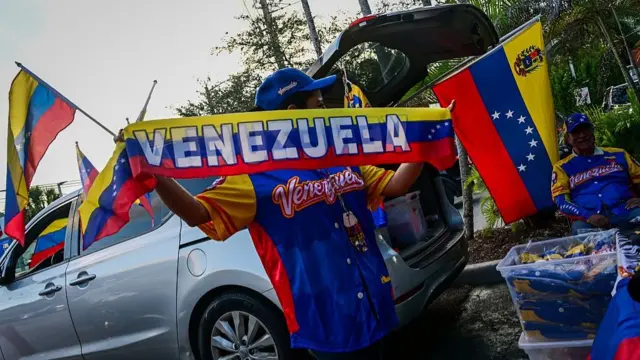
    People celebrate in Miami's large Venezuelan community after the US's arrest of Nicolas MaduroImage source, Getty Images
    Image caption,

    People celebrate in Miami's large Venezuelan community after the US's arrest of Nicolas Maduro

    More than two weeks after the US seized President Nicolás Maduro and his wife Cilia Flores, there’s still jubilation in the Miami suburb known as “Little Venezuela.” In Doral, eyes light up when you ask about President Trump’s record one year on.

    For many here, it’s by far his greatest achievement – eclipsing any concerns about the cost of living, ICE raids, or the termination of temporary legal status in the U.S. for about 600,000 Venezuelans.

    The fact that the Venezuelan regime remains largely intact, with Maduro’s vice president Delcy Rodríguez now at the helm as interim president, hasn’t dampened spirits.

    “This year has been phenomenal for us,” arepa business owner David Roa said.

    Yet appetite for further U.S. military intervention is more limited. Members of the Venezuelan diaspora we spoke with said seeing Maduro marched into a federal court was enough – for now.

  5. BBC Verify

    What impact could Trump’s latest tariffs over Greenland have on UK firms?published at 01:19 GMT

    Vernon, Chris and Denis asked about Trump's new tariffs, and how it could impact UK businesses.

    By Ben Chu, BBC Verify policy and analysis correspondent

    The new tariffs US President Donald Trump has threatened to impose on the UK over Greenland have created more fear and confusion among British businesses.

    Official data shows around 39,400 individual UK firms exported to the US in 2024.

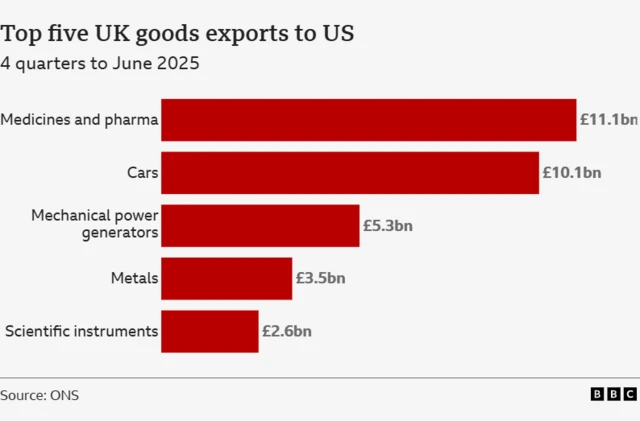
    And the UK as a whole exported around £64bn worth in goods to the US in the year to June 2025 - around 17% of our total goods exports over that period.

    The largest categories of UK goods exported to the US were medicines and pharmaceuticals (£11bn) cars (around £10bn) and machinery (£5bn).

    These are the sectors - and those who work in them - that are in the line of fire if these threatened 10% US tariffs (rising to 25% from June) are imposed.

    What would happen to the US-UK trade agreement agreed last year under those circumstances is unclear.

    Among other things that agreement meant UK car manufacturers could export 100,000 vehicles a year to the US at a preferential 10% tariff rate.

    It’s possible the deal would survive and these new tariffs would be imposed on top. If the agreement unravelled then US concessions granted to UK car, aerospace and steel exporters could end.

    A chart showing top five UK goods exported to the US. Medicines, Cars, mechanical power generators, metals and scientific instruments are included.
  6. A year in: Ukrainepublished at 01:12 GMT

    Bernd Debusmann Jr
    White House reporter

    Ukrainian soldier firing a mortar roundImage source, Getty Images
    Image caption,

    Trump has so far been unable to secure a ceasefire or lasting peace between Russia and Ukraine.

    After campaigning with a promise to bring the war between Russia and Ukraine to a swift end, success has continued to elude Donald Trump's peacemaking efforts in the conflict after a year in office.

    The conflict is also one in which Trump's public statements have at times contradicted each other, or abrupty reversed course.

    Early on in his administration, for example, he at times said that he believed the war's end was only weeks away, only to later say that the two warring parties may have to "fight it out".

    His comments on Volodomyr Zelensky and Vladimir Putin have also changed, sometimes quickly.

    In February, for example, Trump described Zelensky as a "dictator" who has "done a terrible job", only to later express optimism about the Ukrainian president.

    Earlier this January, however, he again described Zelensky as being an impediment to the peace process.

    The US president has also described various conversations with Putin, as well as their meeting in Alaska as "good" or "productive" - but these have so far led nowhere.

    He has sometimes been complimentary of Putin, although he has also described him as going "absolutely crazy" following particularly intense periods of air and missile attacks on Ukraine.

    As the world rapidly approaches the fourth year of the war, it remains unclear how much influence Trump has to alter the course of the conflict - and how much patience he has for the demands of Putin and Zelensky.

  7. How has Trump's media presence changed this term?published at 01:01 GMT

    Nomia Iqbal
    News correspondent who covered two Trump presidencies

    YVYBBC

    Sam from Newcastle-Upon-Tyne asks whether Trump's language and use of the media is stronger in this term as president than the first, noting that 2016-2020 felt like the term of "fake news", but now there seems to be no acknowledgement of an alternative story, just only one truth - whatever the White House says.

    First thing to say is this time round the cultural moment has shifted. When Trump won in 2016, there was shock. Second time round, he could not be dismissed as some sort of fluke.

    Not only did Trump win all swing states but he won the popular vote. And so now emboldened in his return to power, Trump has gone harder in trying to delegitimise any reporting that challenges him by literally trying to control the narrative.

    For example, the White House took control of the presidential press pool, pulling that role away from the White House Correspondents’ Association. It now includes reserved space for "new media voices".

    I’ve been in the press pool and those voices are very pro-Trump. Over at the Pentagon, reporters from more than 30 news outlets cleared out after refusing to comply with new government-imposed reporting restrictions.

    These would leave journalists vulnerable to expulsion if they tried to report on information - classified or otherwise - that had not been approved by Defence Secretary Pete Hegseth for release.

    So, all of that is a real structural shift because it changes who gets to be in the room for key moments and how they report it.

    There is also the matter of President Trump taking out multiple lawsuits against major news networks with varying degrees of success - press-freedom groups warn that repeated defamation or damages lawsuits can discourage challenging reporting.

    Of course, major outlets still publish investigations and fact-checking and paradoxically Trump remains an incredibly accessible president who speaks to the press regularly. But the overall effect of all these practical changes is that the White House is certainly working hard to make sure its narrative is the one that dominates.

  8. Trump's first year: the Epstein filespublished at 00:53 GMT

    Trump's stance on the the Epstein files has been inconsistent to say the least - after campaigning on a promise to release all the files, he then resisted their release once in office, but eventually signed a law ordering their full release.

    Yet, more than a month after the deadline for the Justice Department to release all its Epstein files, a large majority are still under wraps.

    Media caption,

    Trump’s first year: the Epstein files

  9. Is Canada making investments in Greenland?published at 00:44 GMT

    Jessica Murphy
    BBC News, Toronto

    YVYBBC

    Graham from Brighton, UK asks: Why does Canada not seem to want to make investments in the future of Greenland, which would be of benefit to both and stop Trump and his bullying tactics?

    Prime Minister Mark Carney hasn’t been silent on Greenland. He has spoken is recent weeks in support of Greenland and Denmark, as well as the Nato alliance, and has met his Danish counterpart early this month.

    Canada’s position is that decisions about the future of Greenland are for Greenland and Denmark to decide.

    This past weekend, responding to a question about Trump’s tariffs on eight European countries, he said Canada is "concerned about this escalation" of the situation. Canada is of course, part of Nato.

    Carney on Sunday said he’d had discussions in recent weeks about how the alliance is "going to further enhance that security umbrella" on both its western and northern flanks.

    There are also reports that Canada is considering sending some soldiers to Greenland , externalas a show of Nato solidarity.

    Canada has confirmed it will open a consulate in Nuuk in the coming weeks - something that was planned a couple of years ago but has taken on new relevance.

    But Ottawa is also under pressure - including domestic pressure - to shore up the security and sovereignty of its own Arctic, which is sandwiched between the US state of Alaska and Greenland.

  10. Why can't the US just use it's existing Greenland base?published at 00:39 GMT

    Frank Gardner
    Security correspondent

    FILE PHOTO: A view of Pituffik Space Base (formerly Thule Air Base) in Greenland, October 4, 2023.Image source, Reuters
    Image caption,

    Pituffik Space Base

    Tony from Spain asks why the US needs more than its existing military presence in Greenland.

    This very valid question is one that many in Europe are asking. Under a postwar treaty with Denmark, the US already has a base at Pituffik in the far north of Greenland. Known as the space base, it has a long runway, 100-200 US troops and the US is already free to bring in more troops by agreement if it chooses.

    Donald Trump’s stated argument is that this is not enough to fend off Russia and China, which are both taking an increased interest in Arctic trade routes and possible bases now that the polar ice cap is melting at an unprecedented rate.

    Trump is correct that Denmark, which looks after defence and foreign policy for the semi-autonomous territory of Greenland, has not done enough to shore up the island’s defences.

    Belatedly this is now being addressed by Denmark and its European allies.

    But most people agree that any attempt by the US to seize control of Greenland against the wishes of its people, Denmark and the rest of Nato would have a catastrophic effect on Western and transatlantic security.

  11. A year in: White House visits from foreign leaderspublished at 00:30 GMT

    Bernd Debusmann Jr
    White House reporter

    Zelensky and TrumpImage source, Getty Images
    Image caption,

    Zelensky and Trump during their infamous February Oval Office shouting match.

    President Trump has had a busy year at the White House - including with visits from foreign leaders to the White House, and occasionally to his his property at Mar-a-Lago in Florida or other locations in the US.

    Trump began his second term of office with a flurry of visits, including from Israeli Prime Minister Benjamin Netanyahu, Jordan's King Abdullah, French President Emmanuel Macron and Ukraine's Volodomyr Zelensky coming to the White House in the first five weeks alone.

    Other notable visits have included El Salvador's Nayib Bukele, Britain's Keir Starmer, Italy's Giorgia Meloni and Canadian Prime Minister Mark Carney, as well as Germany's Friedrich Merz, South Africa's Cyril Ramaphosa, Qatari Prime Minister Salman bin Hamad Al Khalifa and Rwanda's Paul Kagame.

    Some of these visits are reflective of Trump's foreign policy objectives, particularly the repeated meetings with Zelensky and European leaders that have focused on Ukraine, or with Netanyahu and Arab leaders on Gaza.

    Others are more reflective of domestic or economic concerns. The visit by Bukele, for example, focused in part on the role El Salvador plays in Trump's deportation agenda.

    These meetings have, for the most part, been cordial - even when clear disagreements exist between Trump and his foreign counterpart.

    But as Zelensky and Ramaphosa both found, this White House is by no means shy about putting disagreements - which were once closed-door affairs - out in the open for the world to see.

  12. What has changed with Greenland since the Cold War?published at 00:20 GMT

    Joe Inwood
    World news correspondent

    YVYBBC

    Ake, from Spain, and Richard from Dartford, England, both ask about the US having a larger military presence in Greenland during the height of the Cold War, and what has changed since the 1951 Greenland Defense Agreement.

    There already are US flags flying in Greenland.

    Indeed, under a 1951 agreement between the US and Denmark, it is mandated that Stars and Stripes are present in military bases.

    The "Defence of Greenland Agreement" gives Washington extensive access to the island, including the right to build bases and facilities, deploy more forces and generally operate as they see fit.

    There are very few restrictions on what the US military can do, so long as they do not impinge on the national interest of Denmark or the local population.

    US personnel are even exempt from local taxation, as is all imported equipment.

    In short, the argument that the US would not be able to build bases or deploy forces necessary for the defence of Greenland, or the rest of the continent, is not backed up by the document signed by both governments.

    The 1951 treaty concludes by saying that the agreement shall remain in force for as long as the Nato alliance survives.

    It is this final point which is looking the least certain.

  13. Trump's first year: economypublished at 23:55 GMT 20 January

    The US economy was growing under Biden, and it has continued that progression under Trump.

    Still, since Trump was elected, consumer prices are up, energy costs are up, and groceries are up, the BBC's Ros Atkins explains.

    Media caption,

    Trump’s first year: the US economy

  14. Trump was lavishly welcomed on his international visitspublished at 23:48 GMT 20 January

    Leaders around the world have given Trump the royal treatment during his international visits over the past year - including presenting him with crowns and medals, rolling out a lavender carpet, showcasing welcome ceremonies, and inviting him to dine with the UK's royal family at Windsor Castle.

    Trump sitting down at a lavish table beside the Princess of Wales and King CharlesImage source, Getty Images
    Image caption,

    King Charles III delivers a speech to Trump during a state dinner at Windsor Castle in September 2025

    Trump shaking hands with a line of men and soldiers in a white palaceImage source, Getty Images
    Image caption,

    Trump was honored with an arrival ceremony at the Amiri Diwan, the official workplace of the emir, in May 2025 in Doha, Qatar

    a long purple carpet rolled out on a tarmac, with Air Force One behind it, as guardsmen line the walkwayImage source, Getty Images
    Image caption,

    A lavender carpet was rolled out alongside members of the honour guard for Trump's arrival in Saudi Arabia where he met Crown Prince Mohammed bin Salman

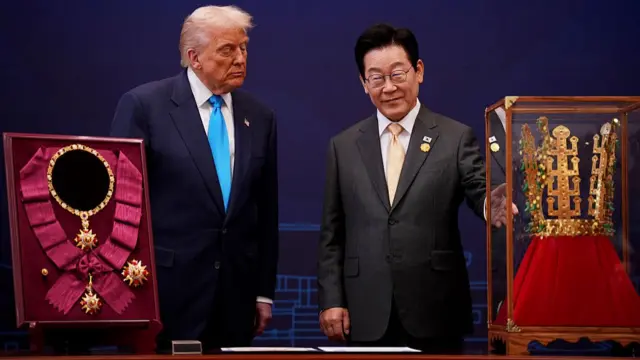
    Trump standing beside South Korean president, beside a golden crown and a medalImage source, Getty Images
    Image caption,

    South Korean President Lee Jae Myung presented Trump with the Grand Order of Mugunghwa and the Silla gold crown in Gyeongju in October 2025

  15. Will global confidence in US financial markets take a hit?published at 23:37 GMT 20 January

    Natalie Sherman
    New York business reporter

    YVYBBC

    Jack from Texas asks: At what point does political pressure on the Federal Reserve stop being "rhetoric" and start materially undermining global confidence in US financial markets?

    If I knew the answer to this, Jack, I am pretty sure I would have a different job earning millions on Wall Street.

    Suffice to say, we have not reached this point. The dollar has dropped over the last year and at times, we’ve seen movements in the interest rates for long-term government debt that suggest the issue is on people’s minds.

    But the news of the criminal probe was met with a relatively muted reaction.

    Analysts have told me that they think investors are unlikely to react in a serious way until the Fed’s policies themselves start to make less sense, given the economic facts.

  16. Could Trump be impeached?published at 23:24 GMT 20 January

    Anthony Zurcher
    North America correspondent

    YVYBBC

    Both Adolfo and Deb asked if, and when, could Trump be impeached.

    With Republicans controlling the House of Representatives, the chances that Donald Trump is going to be impeached anytime soon are close to zero.

    That all could change next year, if Democrats do well in November’s congressional mid-term elections. There are certainly some in the party who would support impeaching Trump for any number of alleged misdeeds – although it is far from certain that the party’s leadership would want to press ahead with such a strategy.

    Part of the reason why is practical. Even if Democrats win a majority in the House and impeach Trump, it is extremely unlikely they get anywhere close to the 60 seats in the Senate that would be necessary to convict and remove the president from office.

    The other reason is political. Democrats may decide that a higher priority if they return to power is advancing their agenda and setting the groundwork for taking back the White House in 2028.

    They may fear that voters will view an impeachment push as a waste of time – particularly after the two previous impeachment efforts, in 2019 and 2021, ended in Senate acquittal and did little to dent Trump’s political strength.

  17. Trump's first year: foreign policypublished at 23:09 GMT 20 January

    Trump's year in foreign policy has been marked by an aggressive stance toward maintaining US dominance on the global stage - including taking over Venezuela's oil production, an ongoing attempt to annex Greenland, and brokering ceasefire deals in multiple wars.

    BBC Analysis Editor Ros Atkins has more here.

    Media caption,

    Trump’s first year: US foreign policy

  18. Could Trump disrupt the upcoming midterms?published at 22:54 GMT 20 January

    Bernd Debusmann Jr
    White House reporter

    YVYBBC

    Maureen from West Sussex asks if Trump could, in theory, delay, cancel or corrupt the upcoming midterm elections later this year.

    Democrats have certainly expressed concern that this could be the case, or that Trump - as he did in 2020 - could attempt to pressure lawmakers to tamper with the results.

    Some, including Democratic National Committee chairman Ken Martin, have also mused that deployments of federal agents could be used to suppress voting in Democrat-run cities.

    The White House has strongly pushed back on these suggestions, dismissing them as fear-mongering.

    In a recent interview with Vanity Fair, Chief of Staff Susie Wiles called the claims "categorically false".

    Trump, for his part, has repeatedly pointed out that midterms often go badly for the party in power - a trend that, in his case, he describes as inexplicable.

  19. Will countries boycott the World Cup?published at 22:50 GMT 20 January

    Dan Roan
    BBC sports editor

    YVYBBC

    Rachel asks whether, in light of the US threatening to raise tariffs and perceived issues of safety due to immigration enforcement, the EU should next look at pulling teams out of the forthcoming World Cup and also if necessary the next Olympics?

    Despite claims from the US authorities that the World Cup will be a welcoming event, some concerns are being raised over President Trump’s immigration and foreign policies.

    Last week the European Democratic Party wrote to Fifa, warning it may ask national football federations to consider pulling out of the tournament if safety guarantees for visiting fans are not forthcoming, as I wrote about here.

    A group of MPs in the UK Parliament have also called on sporting bodies to consider expelling the US from major international events, saying they “should not be used to legitimise or normalise violations of international law by powerful states".

    However, governments have shown little appetite for boycotting international sport in recent years, insisting they are ineffective and unfairly punish athletes. Amid calls from Ukraine to do so, no teams refused to go to the 2018 World Cup, despite Russia annexing Crimea four years earlier. Equally, no teams boycotted the Qatar 2022 World Cup amid concerns over the safety of LGBTQ+ supporters.

    With both Fifa and the IOC insisting they are duty-bound to remain politically neutral, few expect either will take any action against the country set to host their biggest events. However, if fan representatives, participating athletes and national football associations or Olympic committees start to express concerns, the pressure could ramp up.

  20. Could Congress rein in Trump's expanding powers?published at 22:35 GMT 20 January

    Nomia Iqbal
    News correspondent who covered two Trump presidencies

    YVYBBC

    Matt from Cambridgeshire and Bruce from Chicago both ask why Congress hasn't stepped in to rein in Trump's enthusiastic use of executive powers?

    Put quite simply, most of Congress are his allies. The House and Senate are controlled by Republicans, most of whom have never shown much of an appetite for challenging Donald Trump since he swept into office in 2016.

    They fear his retribution. For example, five Republicans did actually break with the White House and support the war powers resolution – which demands the president gets congressional approval before committing the US to war.

    Trump then took to Truth Social, namechecked them and said they should not be elected to Congress again. The war powers resolution soon failed in the final vote.

    President Donald Trump himself has never been particularly interested in institutions or in America’s constitutional infrastructure, sparking a bigger question: Does Congress even have any power anymore?

    Congress is meant to be be an equal branch to the executive government but critics ponder if it has become subordinate to the presidency in this Trump era. However there have been moments that give pause. Take the Epstein files Transparency Act. President Trump tried to pressure Republicans privately to kibosh it, but was outmanoeuvred by some key pro-Trump Republicans and eventually made it into law.

    We may see more of this fracturing because Republicans know this is an election year and Democrats will be campaigning hard to get control of the House and Senate. If that happens, Trump will essentially be a lame duck president in the last two years of his term.

    And given he can't run for a third time, it may be then Republicans turn away from him in a bid to boost their own presidential credentials for 2028.