Summary

  1. Energy price cap rise pushes up inflation to 2.9% - but food price rises slowpublished at 09:57 BST

    Adam Goldsmith
    Live reporter

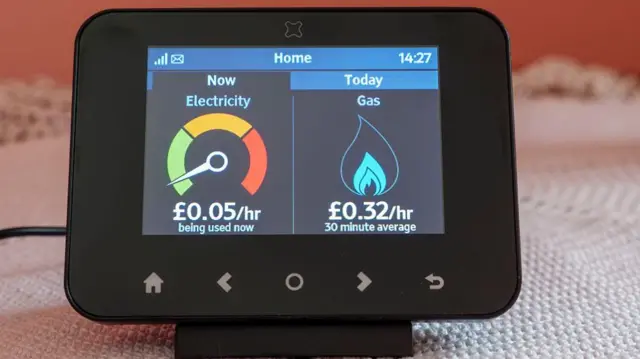
    A close up of a smart meterImage source, Universal Images Group via Getty Images

    Today's inflation figures saw the UK's rate rise to 2.9% in the year up to July, up from 2.6% the month before.

    It's been largely put down to a rise in energy bills, after energy regulator Ofgem's 13% increase in the price cap on household gas and electricity bills took effect on 1 July - which will add £221 to the typical household's annual bill.

    Despite the change, each person will likely feel the impact on their own pocket differently, our cost of living correspondent writes.

    That's because the ONS calculates the UK's monthly inflation rate by measuring the cost of 760 goods in an attempt to create a representative sample - how it impacts you will depend on the purchases you make.

    And although the ONS says the UK has seen "the largest rise in gas prices for almost four years", the inflation rate for the price of food - 1.3% - is at its lowest for close to five years.

    UK Chancellor John Healey insists the UK's economy is "resilient" in the face of continued pressure from the war in Iran, but shadow chancellor Mel Stride says prices are "accelerating once again" and criticises "Labour's mismanagement".

    Our deputy economics editor writes that the inflation rate rise is more modest than some analysts had feared earlier in the year - she's looked at how today's figures could impact interest rates here.

    We're closing our live coverage there, but we've more on today's inflation rate figures in our news story.
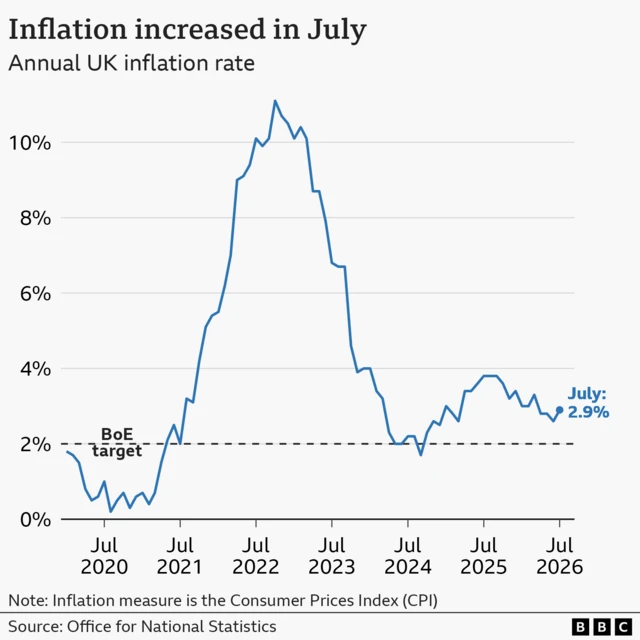

    Line chart of the UK's Consumer Price Index annual inflation rate, from January 2020 onwards In the year to January 2020, inflation was 1.8%. It then fell close to 0% in late-2020 before rising sharply, hitting a high of 11.1% in October 2022. It then fell to a low of 1.7% in September 2024 before rising again. In the year to July 2026, prices rose by 2.9%
  2. Rate of rent inflation rises while growth of house prices slows in latest ONS figurespublished at 09:56 BST

    The average cost of UK private rent has increased 3.7%, to £1,393 in the year to July - an increase from the 3.3% in the 12 months to June 2026, reports the Office for National Statistics.

    While the average UK house price increased by a provisional 2.0%, to £272,000, in the 12 months to June 2026, up from 3.0% in the 12 months to May.

    The ONS says this is partly due to weaker house price growth following April 2025's stamp duty land tax changes in England and Northern Ireland.

    These figures were released today alongside the Consumer Prices Index (CPI) inflation figure we've been focusing on, but are not included in how CPI is measured.

  3. More energy price rises could be on the waypublished at 09:45 BST

    Kevin Peachey
    Cost of living correspondent

    As we’ve mentioned, rising domestic energy prices have been significant reason behind the increase in the inflation rate.

    But, according to a new forecast published today, those prices are set to rise again in October.

    Analysts at the energy consultancy Cornwall Insight expect regulator Ofgem’s quarterly price cap to raise prices by another 4%.

    That would hit as temperatures drop and the days shorten – with an impact on individuals and the economy.

  4. Three key takeaways from July's inflation figurespublished at 09:33 BST

    Dearbail Jordan
    Senior business and economics reporter

    • The inflation rate rose to 2.9% in the year to July, up from 2.6% in June, and the highest level since March and the early days of the Middle East conflict

    • Inflation accelerated mainly because of a 13% increase in the price cap on household gas and electricity bills which came into force on 1 July

    • The pace of food price rises slowed to the lowest rate in nearly five years, but experts warn it may not last as the summer's extreme weather may impact the production of fruit, veg and cereals
  5. Inflation rate of goods bought by UK manufactures falls to 4.9%published at 09:30 BST

    In addition to the inflation of everyday household items, the Office for National Statistics (ONS) also calculates the cost of goods bought and sold by UK manufacturers.

    In the 12 months to July, the cost of raw materials and fuels bought by UK manufacturers increased 4.9%, down from 7.4% in the year to June.

    The ONS says this is partly due to the 18% fall in the price of crude oil between June and July.

    While the price of goods being sold by UK manufactures rose by 3.1% in the year to July, down from the 3.5% reported for June.

  6. Mortgages and returns on savings can still move even when the Bank's interest rate doesn'tpublished at 09:23 BST

    Kevin Peachey
    Cost of living correspondent

    Many analysts aren’t expecting a change in interest rates by the Bank of England despite inflation heading further from its 2% target.

    But, even if the base rate stays at 3.75%, savings providers and mortgage lenders shift their own rates on a fairly regular basis.

    Yesterday, Treasury-backed National Savings and Investments (NS&I) announced it will change its prize rate on Premium Bonds in September.

    This hugely popular savings product doesn’t pay interest. Instead, the chances of winning get better.

    But don’t get too excited. The odds of winning have only shortened from 22,000 to one, to 21,000 to one.

  7. Food price inflation eases - but it may not lastpublished at 09:05 BST

    Dearbail Jordan
    Senior business and economics reporter

    One of the more surprising - and welcome - points in today's data is that food price inflation in July was the lowest since September 2021.

    But that may not last.

    "It could be the lull before the storm," says Susannah Streeter, chief investment strategist at advisory firm Wealth Club. "Worries are intensifying that prolonged heat and drought across the UK and Europe are threatening crop yields, with concerns over supplies of cereals, fruit and vegetables."

    She adds: "If shortages build, higher agricultural costs could eventually feed through to supermarket shelves, putting renewed pressure on food prices later this year and into 2027."

  8. Pensioner says their energy bill goes up and down like a yo-yopublished at 09:02 BST

    Priya Patel
    Economics correspondent

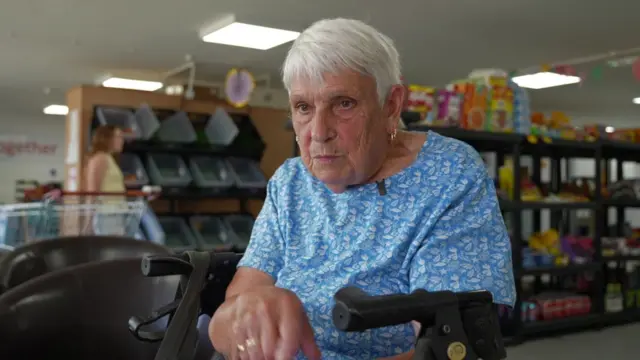
    Rose pictured in the foodbank. She has short white hair and wears a blue t-shirt

    Rose Jennifer Harvey is a pensioner who uses the Second Chance Medway community hub to manage her food bills.

    She says it's hard because other things are still going up.

    "My main utility bill is my electric, which goes up and down like a blooming yo-yo," she says.

    "As my direct debits come out, I have to make sure I’ve got enough from my pension to cover them. It throws you out all over the place, so you have to work everything out.

    "As you get older, with food prices going up like they have, and you’ve still got your utility bills to pay, things can become a struggle. I find that I have to think much more carefully and put a certain amount away to cover everything.

    "I’m sure lots of people my age have to do that, and families too. I honestly don’t know how some of them manage from one month to the next."

  9. With energy prices up, experts advise preparing for winterpublished at 08:54 BST

    Kevin Peachey
    Cost of living correspondent

    Higher domestic energy prices are the driving force in the latest inflation figures. The cost of each unit of energy rose by 13% under regulator Ofgem's price cap at the start of July.

    But before and since, the country has been gripped by a heatwave. The idea of finding ways to save on heating feels a distant concern.

    Experts say people should remind themselves of good habits – blocking draughts, taking short showers, locating the key to bleed radiators.

    Energy suppliers offer a host of support schemes to anyone struggling to pay, or who is likely to find it difficult.

    The trade body for the sector, Energy UK, has a list of these schemes, external. But it stresses that companies can often only help if you get in touch with your supplier to tell them you are unable to pay.

  10. 'Meat of cows' and breaded chicken reduce food price inflationpublished at 08:46 BST

    Dearbail Jordan
    Senior business and economics reporter

    Black and white cows in a fieldImage source, Getty Images

    In an interesting turn of phrase, the ONS says that one area where food price growth has slowed is for "meat of cows" - or as everyone else might call it "beef".

    Prices for beef and veal rose by 2.5% in the year to July, down from 5.1% in the 12 months to June.

    The statistics office also said that breaded chicken contributed to an overall slowdown in food price inflation which hit 1.3% in the 12 months to July, the lowest in nearly five years.

  11. How has inflation hit the cost of these everyday items?published at 08:32 BST

    This Riddle post cannot be displayed in your browser. Please enable Javascript or try a different browser.

  12. Analysis

    What the inflation rate could mean for interest rates and mortgagespublished at 08:27 BST

    Dharshini David
    Deputy economics editor

    Among the bills many households have to contend with are mortgages and rent - so where do the latest inflation figures leave the Bank of England?

    Remember, interest rate changes take a while to impact prices, with the Bank setting rates to influence future inflation.

    And there is little in these figures to change its belief that, in the medium term, inflation will come down to its 2% target.

    Actually, the fact that the likes of food inflation has remained muted may give it hope price pressures remain fairly contained.

    Yesterday’s flat jobs and moderate wage growth figures also may lead the Bank to think that firms have little opportunity to get away with hiking up prices.

    That’s why some economists think rates may not rise this year after all.

    But there are still risks of a rise - if inflation does rise by more than analysts expect later in the year, or if the war Iran drags on, threatening more upheaval for energy costs.

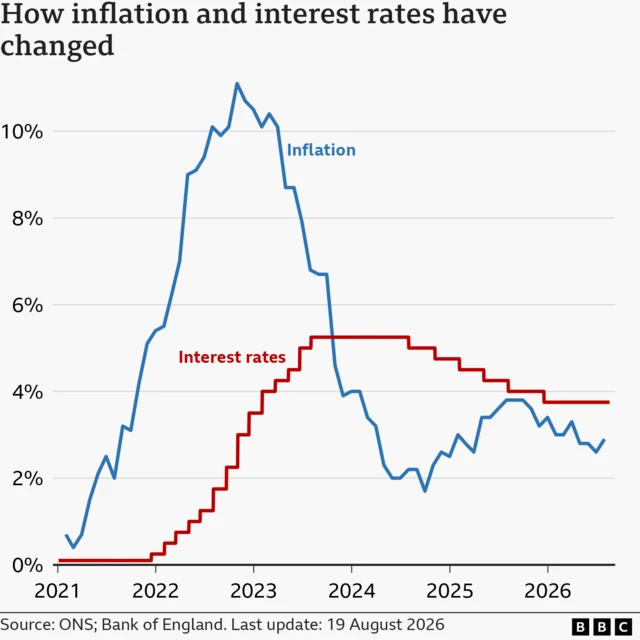
    A reminder: Interest rates are a key tool the Bank of England can use to keep inflation on track with its 2% inflation target. It can raise interest rates to reduce inflation, and lower them to stimulate growth.

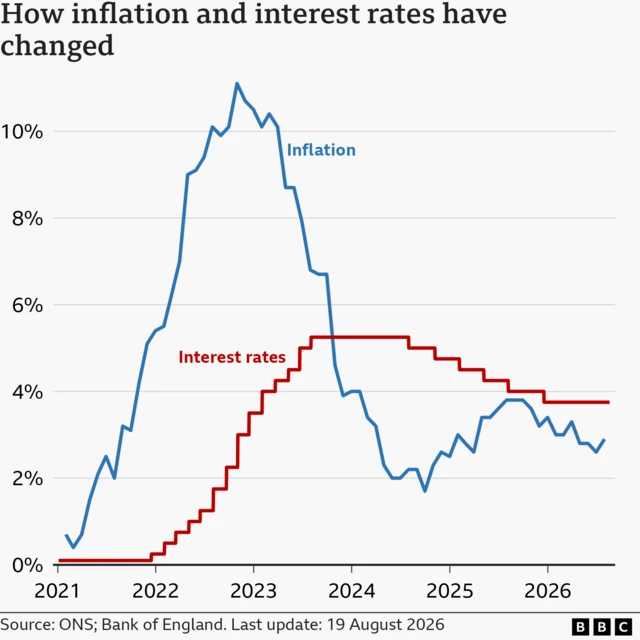
    "A line chart showing interest rates and CPI inflation in the UK, from January 2021 to June 2026. Interest rates were at 0.1% in January 2021. They were increased from late-2021, reaching a peak of 5.25% in August 2023.They were then lowered slightly to 5% in August 2024, to 4.75% in November, to 4.5% on 6 February 2025, to 4.25% on 8 May 2025, to 4% on 7 August, and to 3.75% on 18 December. At the Bank of England's latest meeting, rates were held at 3.75%. The inflation rate was 0.7% in the year to January 2021. It then rose to a peak of 11.1% in October 2022, before falling again to a low of 1.7% in September 2024 and then starting to rise again. In the year to March 2026, it was 3.3%, up from 3.0% the previous month. However, the picture has changed since then and in the year to July 2026 the inflation rate was 2.9%."
  13. Rayner says government is focused on tackling inflationpublished at 08:08 BST

    Angela Rayner

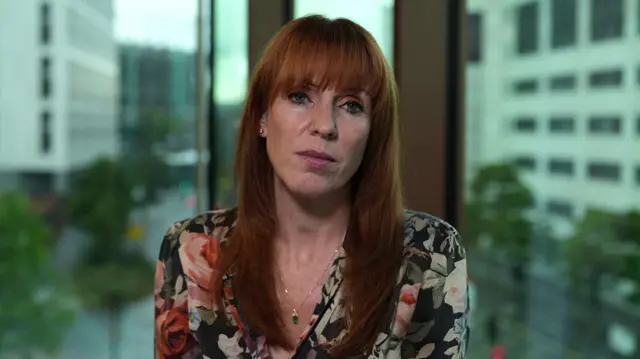
    Housing Secretary Angela Rayner says "it's always a concern when inflation increases", as she reacts to the latest figures when speaking to BBC Breakfast.

    Rayner says tackling inflation "has been a focus" of the Labour government, and lists measures set out by Prime Minister Andy Burnham including VAT cuts on electricity bills and a bus fare cap.

    She cites the impact of the war in the Middle East as raising price rates for goods globally, due to the fact shipping through the crucial Strait of Hormuz waterway remains at lower levels than before the conflict began.

    "What the prime minister is relentlessly focused on at the moment is how we can help families and help people who at the moment see not enough wage at the end of their month because their everyday costs are going up," she adds.

  14. Prices are changing, and so is the way we paypublished at 08:02 BST

    Kevin Peachey
    Cost of living correspondent

    Today’s figures will again focus everyone’s mind on how much we are paying for goods and services.

    But the way we pay is changing too.

    An annual report, published today by banking trade body UK Finance, shows that we are increasingly pulling our smartphones out of our pockets when we get to the till in a shop or café.

    Two-thirds of adults were registered to use a mobile wallet last year, the data shows. Those in the 20s and 30s are the most likely, but older age groups are catching up.

    Yet, that doesn’t mean cash is dead. In fact, the pace of decline is slowing when it comes to the proportion of payments made with notes and coins.

    Why? One reason is that many people find it easier to budget with cash when money is tight.

  15. An ease in price rises at the pump - but costs are still up, and still increasingpublished at 07:51 BST

    Dearbail Jordan
    Senior business and economics reporter

    Price growth at the pump slowed in the year to July, the ONS said, keeping a lid on the overall rate of inflation.

    Motor fuel price rises eased to 15.5% compared to an increase of 21.3% in the 12 months to June. This was mainly because of diesel, according to the ONS, although petrol price growth also slowed.

    However, the cost of filling up a motor last month was still much higher than it was in 2025.

    The ONS says the average price of diesel was 167.6p per litre in July 2026. Last year, it was 143.3p, according to the RAC motoring organisation.

    For petrol, the average price was 152.2p per litre last month. Last year, it was 135.7p, RAC data shows.

  16. Which of these items are used to measure inflation?published at 07:46 BST

    This Riddle post cannot be displayed in your browser. Please enable Javascript or try a different browser.

  17. Analysis

    Everyone has their own inflation ratepublished at 07:42 BST

    Kevin Peachey
    Cost of living correspondent

    Remember, today’s figures cover a lot of goods and services. There are 760 in the virtual inflation basket used in calculations by the Office for National Statistics.

    Of course, individuals don’t buy all those items.

    So, your own personal inflation rate depends on the purchases you make and the services you use.

    That’s why the price of food and fuel are so crucial. They are essentials, bought by everyone. And, for those with smaller incomes, that takes up a bigger chunk of what you have to spend.

  18. Conservatives blame 'Labour’s mismanagement' for inflation rate risepublished at 07:37 BST

    Conservative Party shadow chancellor Sir Mel Stride delivers a speech on the economy at Victory Services Club, central London. Picture date: Monday June 29, 2026Image source, PA Media

    Conservative shadow chancellor Mel Stride says prices are "accelerating once again" under Labour.

    "We left inflation bang on the 2% target, now it has been above that level for 22 months in a row," he writes on X.

    "Labour’s mismanagement has left us unprepared for global shocks. It is ordinary people who are left paying the price."

    "A line chart showing interest rates and CPI inflation in the UK, from January 2021 to June 2026. Interest rates were at 0.1% in January 2021. They were increased from late-2021, reaching a peak of 5.25% in August 2023.They were then lowered slightly to 5% in August 2024, to 4.75% in November, to 4.5% on 6 February 2025, to 4.25% on 8 May 2025, to 4% on 7 August, and to 3.75% on 18 December. At the Bank of England's latest meeting, rates were held at 3.75%. The inflation rate was 0.7% in the year to January 2021. It then rose to a peak of 11.1% in October 2022, before falling again to a low of 1.7% in September 2024 and then starting to rise again. In the year to March 2026, it was 3.3%, up from 3.0% the previous month. However, the picture has changed since then and in the year to July 2026 the inflation rate was 2.9%."
  19. Hot weather appears to have raised prices for gardening tools and summer clothingpublished at 07:34 BST

    Dearbail Jordan
    Senior business and economics reporter

    As well as household energy bills contributing to the rise in inflation, furniture and household goods as well as clothing and footwear lifted the overall rate, according to the ONS.

    It says that prices for furniture and household goods usually fall around this period. Not this time - in the year to July they rose by 1%.

    It looks like people were investing on gardening and doing up their houses during the warm spell - prices rose for tools and equipment for the home and gardens. Inflation for goods and services for routine household maintenance also increased.

    Meanwhile, inflation on clothing and footwear increased by 0.5% after falling in June. Retailers had brought forward their summer sales as there were fewer discounted items in July.

    The ONS says: "Some recent media reports have also suggested that the warm weather in July led people to spend more on clothing than might otherwise have been the case."

  20. 'The cost of living crisis is here to stay,' says founder of crisis support centrepublished at 07:32 BST

    Priya Patel
    Economics correspondent

    Penny is pictured in a flowery shirt in a foodbank with supplies behind her

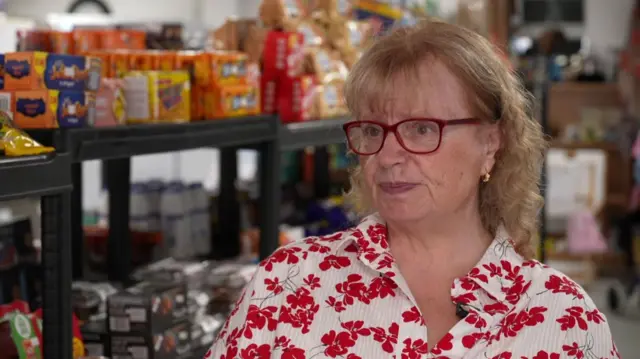
    Penny Keevil founded crisis support centre Second Chance Medway which runs a discounted food pantry two days a week.

    Speaking before today's announcement, Penny says the cost of living crisis is here to stay: "I think it’s going to get worse because of the weather and the pressure that puts on farmers."

    "Energy bills are still far too high and wages and incomes aren’t keeping up. There will always be a need for food banks, community supermarkets and pantries to help families feed themselves affordably," she says.

    Some people attend the food bank on a daily basis, she says.

    "It’s not just people on benefits. It's working people, homeless people, people in part-time work, people on benefits and everybody in between. The need for affordable food now reaches across every part of the community."