Summary

  • US President Donald Trump says he's "not happy" with the UK after Keir Starmer said it would not be drawn into a "wider war" over Iran

  • Trump repeats his call for other nations to assist in securing the Strait of Hormuz after earlier warning it would be "very bad for the future of Nato" if allies don't help secure the key oil shipping route

  • German Chancellor Friedrich Merz says this war "is not a matter for Nato", while Nato says "allies have already stepped up to provide additional security in the Mediterranean" - here's how other countries have responded

  • Earlier the Israeli military said it had begun "a wide-scale wave of strikes" in the cities of Tehran, Shiraz and Tabriz, with BBC Verify seeing videos of damage in Iran's capital

  • Qatar says it intercepted a second wave of missiles from Iran following an attack earlier, while in the UAE drone attacks caused fires at a large oil industrial area in Fujairah - the latest attacks at a glance

  1. Drone strike causes fire at a UAE oil field, officials saypublished at 18:45 GMT

    Officials in the Emirati capital of Abu Dhabi say they are fighting a fire caused by a drone strike on a nearby oil field.

    No injuries have been reported, the Abu Dhabi media office reports.

    Shah oil field, located 230km south of Abu Dhabi, is a large oil project operated by the state-owned Abu Dhabi National Oil Company (ADNOC).

    According to its website, the field has a production capacity of 70,000 barrels of oil per day.
  2. Israel's troops 'dismantle weapons in Lebanon' as defence minister warns displaced not to return homepublished at 18:32 GMT

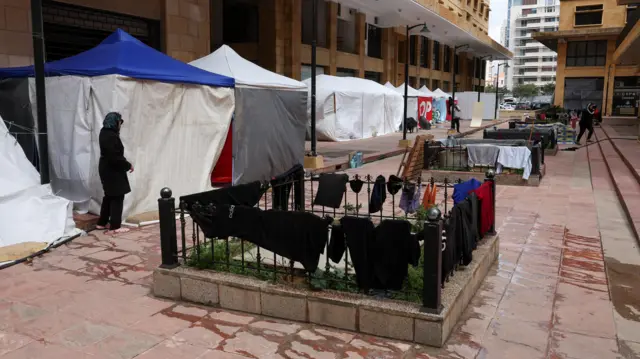
    Clothes of displaced people hang on a fence next to tents they use as shelter in BeirutImage source, Reuters
    Image caption,

    Some in Lebanon's capital Beirut have been forced to flee their homes as a result of Israel's operations against Hezbollah

    As Israel continues its operations against Hezbollah in neighbouring Lebanon, Defence Minister Israel Katz says Lebanese people displaced by the fighting will not be able to return home until the north of Israel is secure.

    Israel has been sharing evacuation warnings to residents in southern Lebanon, and today the Israel Defense Forces (IDF) says its troops are "operating in evacuated areas that were used by Hezbollah terrorists to exploit civilian infrastructure for terrorist activity".

    It says these "limited, targeted" operations have located weapons and "incitement materials", while IDF soldiers were also able to dismantle a weapons cache in southern Lebanon.

    Israel's ground offensive has, though, drawn criticism from Turkey.

    In a statement, the Turkish Embassy in London says "strongly condemn Israel’s attacks on Lebanon", which it says has resulted in the "displacement of approximately one million people".

    The embassy says it will continue to support the Lebanese population, and says Israel's attacks "threaten Lebanon’s territorial integrity and sovereignty".

  3. Message by Iran’s Supreme Leader published on Iranian outletspublished at 18:12 GMT

    Ghoncheh Habibiazad
    Senior reporter, BBC Persian

    Iran's new Supreme Leader Mojtaba Khamenei has instructed officials appointed by his father, late Supreme Leader Ayatollah Ali Khamenei, to remain in post and continue working under existing directives, according to the message published by Iranian outlets.

    “I hereby announce that, for the present, none of them requires the renewal of their appointment. It is crucial that they continue their work in accordance with the directives received during the lifetime” of Ayatollah Khamenei, says the message.

    Khamenei who was chosen as the successor of his father on 8 March has yet to be seen in-person - nor filmed or photographed - since being named as the new supreme leader.

    A message from him was read by the presenter on state-run news channel on 12 March. US Defence Secretary Pete Hegseth said on 13 March, without providing evidence, that Khamenei had been "wounded and likely disfigured" in one of the first air strikes on Tehran that killed Khamenei's father

    Son of Iranian President Masoud Pezeshkian, Yousef Pezeshkian, said in a message on 11 March he had "heard reports" that the supreme leader had been injured. "I asked several friends who had relevant contacts, and they said that: by the grace of God, he is safe and there is no problem," Pezeshkian said.

  4. Analysis

    Trump frames Strait of Hormuz efforts as test for Natopublished at 17:52 GMT

    Helena Humphrey
    Reporting from Washington

    President Trump is framing efforts to reopen the Strait of Hormuz as a test of Nato allies.

    The president says the United States does not necessarily need help securing the vital shipping route - but implies it would be revealing to see which countries 'rise to the challenge'.

    The task itself is significant: the Strait of Hormuz is one of the world’s most important energy chokepoints, through which a large share of global oil supplies normally pass.

    When asked during a White House media conference which countries had refused to help, Trump declined to name them.

    Instead, he joked about rating leaders’ performances - saying that “on a scale of zero to ten” French President Emmanuel Macron was “an eight - not perfect, but it’s France”.

    Trump also pointed out that the US receives only a small share of its oil through the Strait of Hormuz - singling out other countries such as Japan, which relies on the Middle East for about 95% of its oil imports.

    But the fact that he is asking other nations to help reopen the waterway - even while insisting the US does not necessarily need it - underlines the scale of the task now facing the administration.

  5. Five things we learned as Trump pushes allies for Strait of Hormuz supportpublished at 17:42 GMT

    Donald TrumpImage source, EPA

    Donald Trump took some time to address Iran while speaking at a White House event - here's what he had to say:

  6. Analysis

    A bullish Trump, but questions remainpublished at 17:35 GMT

    Bernd Debusmann Jr
    Reporting from the White House

    Trump sounded characteristically upbeat today, and bullish on the prospects of military success in this conflict.

    As he often has in the weeks since Operation Epic Fury, Trump was quick to repeatedly point to the damage that the US and Israel have inflicted on Iran's military.

    There are, however, several issues in which the president has been far less clear.

    For one, Trump still has not detailed what the end of the conflict looks like, or who he believes can run the country if not Iran's current Supreme Leader.

    Additionally, Trump seemed to suggest that his administration will remember which countries came to help secure the Straight of Hormuz and which did countries did not. He specifically mentioned the UK, several times.

    He did not name the countries that will participate in that operation - nor why that continues to be necessary if, according to him, Iran's ability to threaten shipping has been obliterated.

  7. Trump finishes speakingpublished at 17:19 GMT

    Trump has now finished speaking in Washington DC. We'll bring you a summary of what he said on Iran shortly.

  8. 'I was not happy with the UK... they should be involved enthusiastically'published at 17:17 GMT

    Donald Trump at Kennedy Centre Board lunchImage source, Getty Images

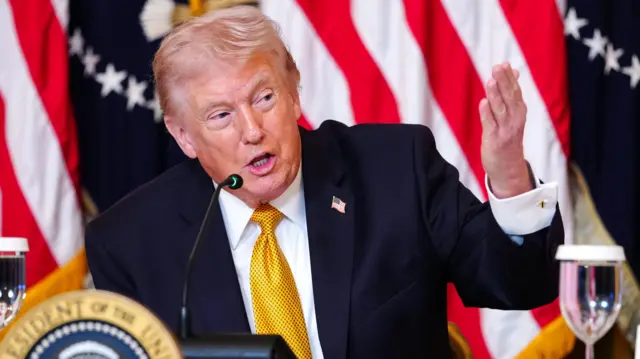
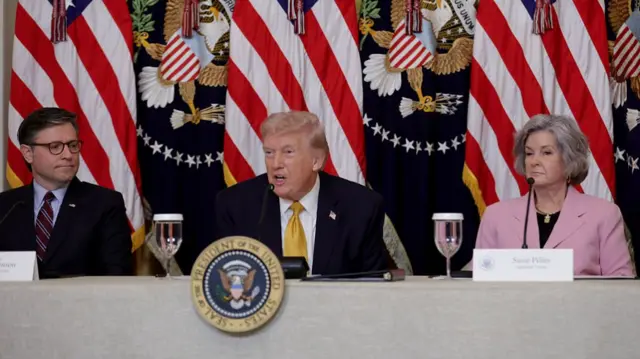
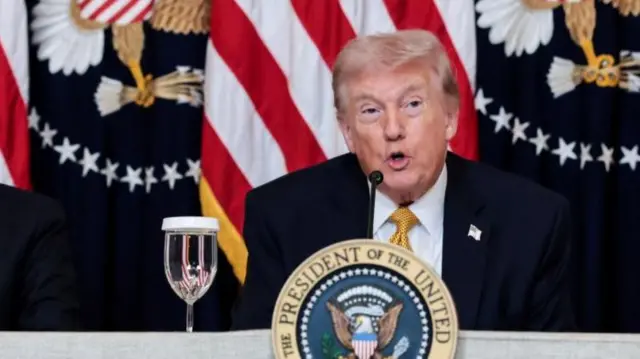
    The US president says he was "very surprised" with the attitude of the United Kingdom towards the war.

    "Two weeks ago I said 'why don't you send some ships over' and he [Keir Starmer] really didn't want to do it," Trump says.

    Trump says he told Starmer, "you're our oldest ally" and stresses that he's supported the UK's efforts in Ukraine.

    "Then they tell us that we have a mine ship around and they don't want to do it, I think it's terrible," he adds. "We requested two aircraft carriers which they have and he didn't really want to do it."

    Trump then suggests that Starmer eventually offered to send aircraft carriers to the Middle East, but says this was already "after the war had ended".

    "I was not happy with the UK," he says. "I think they'll be involved maybe, but they should be involved enthusiastically."

  9. Trump says he asked other countries for help 'because I want to find out how they react'published at 17:13 GMT

    Trump says he asked other nations to help out in the Strait of Hormuz "not because we need them, but because I want to find out how they react".

    He then repeats a claim he has made before, that the US is always protecting other countries, but other countries won't protect us when we need it.

    Moving on to speak about Mojtaba Khamenei, Iran's new supreme leader, Trump says he's he's heard reports from his advisors and the media that he has been disfigured as a result of attacks, or that he has lost a leg.

    "We don't know if he's dead or not," Trump says. "Nobody's seen him which is unusual."

    It was reported by Reuters news agency, citing an unnamed Iranian official, that Khamenei was "lightly injured", but there have been no details.

  10. Marco Rubio to announce countries who will aid US in Iran, Trump sayspublished at 17:07 GMT

    Back to Donald Trump, who is now taking question from reporters.

    He's asked first about which countries will be supporting US efforts in Iran. He says Secretary of State Marco Rubio will be making that announcement soon, and that some countries are local to the area and others are further away.

    A reporter asks the president if he has spoken to Emmanuel Macron about getting France's help to open the Strait of Hormuz.

    Trump says he has spoken to Macron, adding he rated him an eight out of 10 in terms of his support level. He says he thinks France will help.

  11. Germany's Merz says 'war in Iran is not a matter for Nato'published at 17:03 GMT

    Friedrich MerzImage source, Reuters

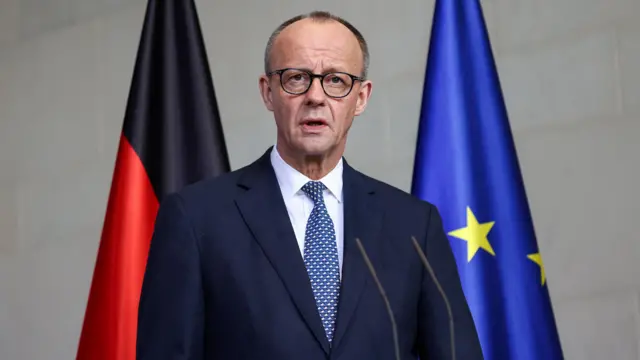
    German Chancellor Friedrich Merz has ruled out his country's participation in the US-Israel war against Iran, according to Reuters news agency.

    "We lack the mandate from the United Nations, the European Union or Nato required under the Basic Law. It was therefore clear from the outset that this war is not a matter for Nato," Merz has told a Berlin press conference.

    He says Germany was not consulted by either the US or Israel before they began their campaign.

    This means, Merz says, that there has never been a discussion of "whether" German troops should be involved.

    "That is why the question of how Germany might become militarily involved here does not arise," he says.

  12. Trump still speaking, but Iran remarks appear to have wrappedpublished at 16:43 GMT

    Trump has moved on and is addressing other topics in this media appearance.

    We're monitoring to see if the president says more about Iran - if he does, we'll bring you an update in this page.

  13. 'A number' of leaders support securing Strait of Hormuz, Trump sayspublished at 16:35 GMT

    The US president now lauds the US's own oil production capacities.

    Trump again calls for countries to assist the US in ensuring ships can cross the Strait of Hormuz safely, and says he has this support from "a number" of leaders.

    But, he refuses to name those who have offered help, saying: "I'd like to say their names but frankly I don't know if they would want me to or not, because maybe they don't want to be targeted."

  14. Trump says other nations not 'enthusiastic' about assisting US in Strait of Hormuzpublished at 16:33 GMT

    The US is "hammering" Iran's capacity to threaten commercial shipping in the Strait of Hormuz, Trump says.

    All of Iran's 30 mine-laying ships have been destroyed, Trump says, but adds that he doesn't know if Iran has laid any mines in the strait.

    Trump says "we've already taken care of Iran", and urges other nations "to come and help us with the strait".

    Numerous countries are already on their way to help, he says.

    But he has derided nations that aren't as "enthusiastic" about assisting the US: "They said we'd rather not get involved ... I know that we'll protect them, and if we ever needed help, they won't be there for us."

  15. US has hit 7,000 targets in Iran - Trumppublished at 16:27 GMT

    Trump says the US has hit 7,000 targets and sunk more than 100 ships so far in the war.

    "They have been literally obliterated," the president said, adding that the country's air force and navy is gone, their leaders are gone, and their anti-aircraft technology has been "decimated".

    The US and Israel are "doing what should have been done many years ago", he says. He adds that the US has today struck three plants in Iran where drones and missiles were being manufactured.

    He also referenced the US bombing of Kharg Island last week, saying they destroyed everything besides "the pipes" where they keep the oil. But the president made it clear he could change his mind, adding that destroying the oil would only take "minutes".

  16. Trump touts successes in Iran and urges allies to help in Strait of Hormuzpublished at 16:24 GMT

    Bernd Debusmann Jr
    Reporting from the White House

    Trump has made brief remarks concerning the war in Iran at the top of his event, saying - as he often does - that Iran's military capacity has been "obliterated" and touting US and Israeli success in the campaign.

    The US president has also pointed to what he said were significant reductions in the number of Iranian drones being launched at its neighbours, as well as ongoing targeting of manufacturing sites and naval targets.

    Additionally, he has again called on other countries to "come and help us" with the Strait of Hormuz - an issue with enormous global economic impact as well as important domestic political considerations for the administration.

    The US, Trump seems to be suggesting, will remember which countries came to the aid of the US in this conflict.

    There has so far been very little new information in his remarks - he covered much of this with reporters travelling back with him from Florida last night.

  17. US President Donald Trump speaking at White Housepublished at 16:18 GMT

    TrumpImage source, Reuters

    Donald Trump has just started speaking in Washington.

    We're expecting to hear some comments on the conflict with Iran - we'll bring you key lines right here, or you can watch live above.

  18. Analysis

    Why some Nato allies have had a blunt response to the warpublished at 16:05 GMT

    Paul Adams
    Diplomatic correspondent

    Throughout his two terms in office, Donald Trump hasn't been shy to criticise – even to attack – Washington's Nato allies.

    But his latest suggestion – that failing to secure the Strait of Hormuz would be "very bad for the future of Nato" – implies an understanding of the alliance's purpose that has already raised eyebrows.

    "Nato was created as a …defensive alliance," Gen Nick Carter, former chief of the defence staff, told the BBC on Monday.

    "It was not an alliance that was designed for one of the allies to go on a war of choice and then oblige everybody else to follow," he said.

    Coming from a president who only two months ago was making strident claims to Greenland, the sovereign territory of a fellow Nato member, there's more than a little irony in his latest remarks.

    This perhaps helps to explain why some responses have been fairly blunt.

    In Germany, a government spokesman said the war with Iran "has nothing to do with Nato", while the country's Defence Minister Boris Pistorius seemed to pour scorn on the idea that Europe's modest navies could make a difference.

    "This is not our war. We have not started it."

    But none of this should hide the fact that there's now an urgent, and growing, need for a solution to the crisis in the Gulf. Iran's effective blocking of the Strait of Hormuz – except for a handful of vessels carrying its own oil to allies like India and China – has left western governments scrambling to find a solution.

    It may be a crisis triggered by Donald Trump's decision to go to war, but it's one that needs to be fixed quickly, before the impacts on the global economy get any worse.

  19. Debris, shrapnel from Iranian missiles land in Jerusalem's Old Citypublished at 15:53 GMT

    Jon Donnison
    Reporting from Jerusalem

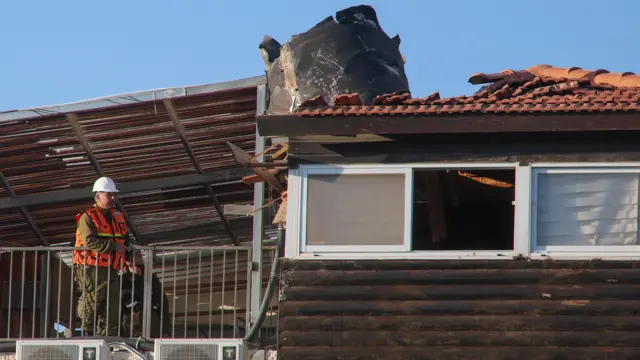
    A piece of shrapnel sticks out of a rood as a worker looks onImage source, Reuters
    Image caption,

    Large pieces of shrapnel have fallen in East Jerusalem

    Debris and shrapnel from Iranian missiles and Israeli interceptors has landed in Jerusalem’s Old City.

    One piece was maybe half a metre across and it fell close to the Church of the Holy Sepulchre, one of the world’s holiest sites for Christians.

    It is only a short walk away from the Al Aqsa Mosque, one of Islam’s holiest sites. Large pieces of shrapnel also fell in East Jerusalem, including close to the British Consulate.

    On one of the main shopping streets near our hotel, smouldering metal could be seen in the road.

    The residents in Israeli-occupied East Jerusalem are primarily Palestinian, the vast majority of whom do not support Israel’s war against Iran.

    Unlike most Israelis, few Palestinians have bomb shelters in their homes.

    Shrapnel also fell close to Israel’s parliament, the Knesset. There are no reports of any serious injuries.

    The local municipality says three people were lightly injured.

  20. Attacks reported across the Gulf - what to knowpublished at 15:40 GMT

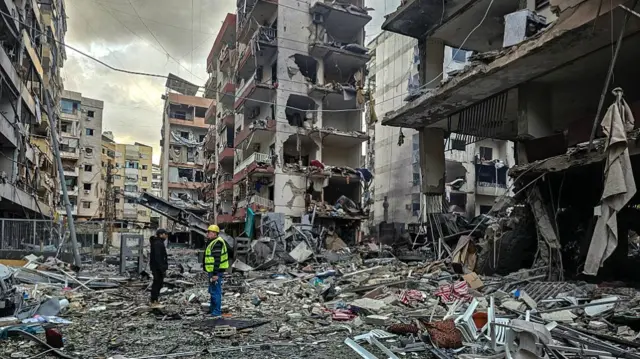
    Men standing around in piles of rubble amid destroyed and damaged buildingsImage source, AFP via Getty Images
    Image caption,

    Men inspect a site of overnight Israeli airstrikes in the southern suburbs of Beirut

    Israel has launched a fresh wave of strikes on multiple Iranian cities, including the capital, Tehran. In the Gulf, nations including the United Arab Emirates and Qatar have reported intercepting Iranian missiles.

    Here's what to know about the strikes around the region today:

    • The IDF says it began a "wide-scale wave of strikes" targeting the Iranian regime's infrastructure in Tehran, Shiraz, and Tabriz - Israel says it struck a space-related compound in the capital
    • The Israeli military also says it carried out "limited and targeted" operations against Hezbollah in southern Lebanon
    • In Israel, sirens sounded around the country because of incoming Hezbollah missiles in the north and Iranian missiles in the south
    • Qatar says it has intercepted a second wave of missiles from Iran following an attack earlier in the day - the BBC's Maryam Moshiri in Doha says she heard four explosions
    • In the UAE, drone attacks caused fires at a large oil industrial area in Fujairah, and at a building in Umm al-Quwain, and a Palestinian civilian was killed in Abu Dhabi after a missile fell in a civilian area, authorities say
    • Saudi Arabia says it downed dozens of drones overnight and Iraq and Kuwait have reported new attacks, the BBC's Middle East correspondent reports from Jerusalem