Summary

  1. 'There is no fear' Iranians tell BBC at Turkey border crossingpublished at 13:19 GMT

    A man, carrying a sack on his back, leaves Iran with his suitcases at the TurkeyIran border in Van, Turkey, on March 14, 2026,Image source, Getty Images
    Image caption,

    Iranians have been speaking to BBC Persian on the Turkish side of the Kapikoy-Razi border crossing

    “There is no fear. Iran is our country, and we are returning there,” an Iranian man tells BBC Persian at the Turkey-Iran border.

    He is returning to his hometown in the north-west of Iran: “All of our loved ones are there. There is nothing to be afraid of.”

    He says his family and friends back home have told him the situation was “calm” following “one or two nights” of intense bombing.

    “God willing, whatever happens will be for the best. I don’t really know what else to say.”

    Another man, who had travelled to the border from Hamadan in western Iran, tells us that “life is continuing as normal”.

    “Yes, there were some damaged areas along the way… [but] most of the places that were targeted were military centres,” he says.

    He says he lived through the Iran-Iraq war, and so conflict has become “somewhat familiar”, adding that this “doesn’t mean we welcome it, but we are not overwhelmed with fear of war”.

    A woman, travelling from Urmia - near the border with Turkey - to Istanbul, says “everyone is continuing their lives normally and we are not afraid of anyone”.

    She says many lived through the Iran-Iraq war and so “we have experienced everything, so people are not really afraid”.

  2. UAE says 7 killed, 145 injured in country since war beganpublished at 13:10 GMT

    Smoke seen through perimeter fence at Dubai airportImage source, Getty Images
    Image caption,

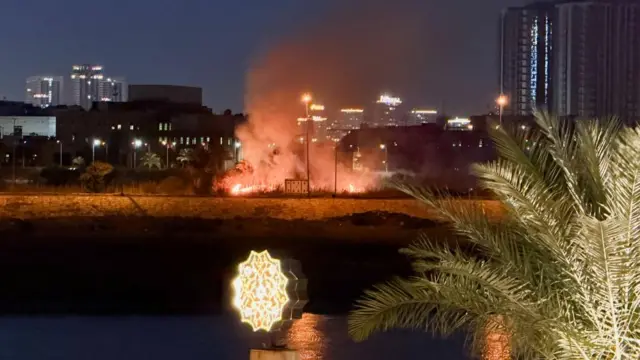
    A plume of smoke could be seen rising above Dubai airport after a drone-related incident

    The United Arab Emirates' ministry of defence has just published an update which lists the nationalities of those injured and killed following strikes by Iran.

    It says a total of seven people have been killed. This includes two members of the UAE armed forces, as well as five civilians - they are foreign nationals from Pakistan, Nepal, Bangladesh and one Palestinian.

    A further 145 people have been injured, ranging from moderately to severely. The ministry of defence says the list of those hurt includes citizens of Sweden, Turkey, Nigeria, India and Ghana, among others.

    Since the onset of the war in Iran, the UAE says its air defences have so far engaged 304 ballistic missiles, 15 cruise missiles and 1,627 UAVs.

  3. We heard four explosions in succession here in Dohapublished at 12:59 GMT

    Maryam Moshiri
    Chief presenter, reporting from Doha

    Here in Doha, more explosions have been heard as the Qatari defence forces intercepted missiles sent from Iran.

    Moments earlier an alert was issued through mobile phones warning people to stay indoors and away from windows.

    We heard four explosions in succession - one of which was very loud.

    The Qatari government gave a press conference earlier urging Iran to stop attacks and threats against civilian targets.

  4. Qatar's foreign minister says diplomacy only possible if Iran's attacks endpublished at 12:47 GMT

    Barbara Plett Usher
    Reporting from Doha

    Majed al-AnsariImage source, Getty Images

    I’ve been to the foreign ministry's weekly press briefing in Qatar and the message is loud and clear: diplomatic talks are only possible if Iran stops its attacks.

    "If they stop the attacks, then we can find a way out with diplomacy. But as long as our countries are being attacked, this is not the time to establish committees,” says the spokesman, Majed al-Ansari.

    “It's the time to take a very principled position protecting our countries and for them to stop attacking us immediately."

    The committee al-Ansari referred to was proposed by Iran’s foreign minister Abbas Araqchi at the weekend to investigate attacks on civilian infrastructure in Gulf states, which Iran has denied targeting. Al-Ansari flatly rejects that.

    Since the war started “the threats and attacks on civilian targets have not stopped,” he says, noting that a missile intercepted on Saturday was aimed towards a residential neighbourhood in Doha.

    The decision to issue evacuation orders at the time was partly due to warnings in Iranian media that “specific companies and specific geographies” would be attacked in residential and commercial areas, he says.

    US companies such as Google, American Express and Microsoft were located in the evacuation zones.

    Al-Ansari says Qatar is working to try and de-escalate the crisisbut he is not aware of any official mediation between the US and Iran right now.

  5. Israel says it has struck 'heart of Tehran'published at 12:37 GMT

    Israel's military says it has destroyed a compound belonging to the Iranian regime in "a strike in the heart of Tehran".

    "The Israeli Air Force, acting on precise IDF intelligence, dismantled a space-related compound belonging to the Iranian terror regime that was used to develop attack capabilities against satellites, posing a threat to Israel’s satellites and to space assets of other countries around the world," the Israel Defense Forces says in a statement.

  6. German foreign minister does not see role for Nato in Strait of Hormuzpublished at 12:29 GMT

    Bethany Bell
    Reporting from Vienna

    German Minister for Foreign Affairs Johann David Wadephul attends a joint press conference. He is seen putting a microphone into his ear and getting ready to speak into a microphone at a podiumImage source, EPA

    The German Foreign Minister Johann Wadephul says he doesn’t see a role for Nato in dealing with the blockade of the Straits of Hormuz.

    "I don't see that Nato has made any decision in this direction or could assume responsibility for the Strait of Hormuz. If that were the case, then the Nato bodies would address it accordingly,” he says.

    He has been speaking ahead of a meeting of EU foreign ministers in Brussels.

    Wadephul says despite the volatile situation in the Middle East, Ukraine remained Europe’s top security priority. When the prices for oil and gas rise, he says, it contributes to Russia's war chest. He says that easing sanctions is the wrong path.

  7. Analysis

    UK government plans targeted package instead of open ended promisespublished at 12:21 GMT

    Faisal Islam
    Economics editor

    The size of the UK PM's intervention is what is most notable here and indicates the limited scope of any future, more general, intervention.

    Having £50m spread throughout the UK via existing council resilience funds will help those suffering from heating bill hikes, but it is not large and it is very targeted.

    This is in contrast to what happened four years ago during the Russia-Ukraine energy shock.

    One of the reasons for this is that it is early days.

    The Strait of Hormuz blockage clearly does have the potential to be a bigger energy shock than Ukraine. It is not yet, and the PM stressed the need for de-escalation.

    But there is some strategy here too. The UK’s effective government borrowing costs have shot up during the Israel-US-Iran war, in line with some G7 countries, but more than others, amid fears about sticky inflation in the UK.

    Any open ended promise to cushion energy prices for all households, in any circumstance, would be very challenging in fiscal terms at this stage. Before the war, the UK seemed to have started to turn the corner on bond market worries.

    The mood music in government therefore is about preparing a more targeted package, if required, using data that was not available four years ago. A more general package costing tens of billions of pounds seems very unlikely.

  8. Analysis

    The domestic and international considerations Starmer is makingpublished at 12:06 GMT

    Chris Mason
    Political editor

    Keir StarmerImage source, Reuters

    There were two key strands from the prime minister’s news conference.

    Firstly, domestic — helping what the government describes as "vulnerable" households with the cost of heating oil, which has spiked in price in the last few weeks.

    Around £50m has been set aside for it. People in England can apply for help via their local authority. In Scotland, Wales and Northern Ireland the devolved governments will be involved.

    Then there is the international picture and in particular the Strait of Hormuz, that pinch point for the delivery of energy supplies in the Middle East.

    The prime minister said both that the UK would not be drawn into the wider conflict but it did recognise the importance of keeping the Strait open and was working with allies to work out what to do. So what might that amount to?

    We don’t know yet. We know Donald Trump wants significant support, including military support. But the logic of the PM's position suggests this is unlikely.

    But, as the PM told me, the domestic and international elements of all this are connected. What happens if the Straits remain blocked? What help might the government feel able to offer if the impacts of the war persist for months and months?

    In recent years we have seen colossal government interventions following the pandemic and the war in Ukraine.

    They had colossal impacts on the public finances. What might be affordable this time?

    Starmer acknowledged a central truth in all this — he doesn’t know, we don’t know, how long this is going to go on, and with what consequence. They are responding day to day and week to week, just like the rest of us.

  9. More go offline as Iran's internet crackdown continuespublished at 11:58 GMT

    Ghoncheh Habibiazad
    Senior reporter, BBC Persian

    It is still very difficult to contact those inside Iran during the internet outage that has been in place since the start of the war, but tech-savvy residents have been using SpaceX's Starlink devices and sharing their connection with others.

    Using Starlink in Iran carries a punishment of up to two years in prison and authorities have reportedly been searching for Starlink dishes to stop people from connecting to the internet.

    “I might have to turn my Starlink device off for a day or two. I need to be cautious,” a twenty-something man in the capital said today, adding that some of the connections he had created via Starlink and a local connection port are not working anymore since yesterday.

    Internet monitoring group NetBlocks said it has tracked “a collapse in connectivity” on a key telecoms network which it said had remained partly online as part of ”reserved state infrastructure”.

    “They are arresting Starlink users. I can't send many messages, they'll track me and go after person [who owns Starlink]. I need to turn my connection off soon,” a woman in her twenties in Tehran said last night.

    Iranian police have arrested a person in the southern Fars Province over allegedly setting up a network to sell "unfiltered" internet via Starlink, according to a report by the semi-official Mehr news agency on 12 March.

  10. BBC Verify

    Satellite images show damage at airport on Iran’s Kharg Islandpublished at 11:44 GMT

    By Emma Pengelly

    BBC Verify has identified at least 12 locations struck by the US on Kharg Island last Friday that appear in footage published by US Central Command (Centcom), external.

    The island, which is about 17 miles (27km) off the coast of Iran, is vital for the country’s oil exports and handles about 90% of shipments.

    Locations we see in the US military footage include an airport runway, control tower and bunkers, but no oil facilities.

    Centcom said it had “successfully struck” more than 90 Iranian military targets on the island but oil infrastructure was “preserved”.

    The morning after the bombing two new tankers began loading crude oil from one of the island’s jetties, monitoring group TankerTrackers said.

    This Flourish post cannot be displayed in your browser. Please enable Javascript or try a different browser.

    BBC Verify has been reviewing satellite images taken on 14 March which show some of the strike impacts.

    There appears to be damage from strikes in a total of three locations on the runway at Kharg Island airport, two of which can be seen in the top image.

    The third can be seen in the 14 March satellite image below, near an airport hangar with damage to its roof.

    This Flourish post cannot be displayed in your browser. Please enable Javascript or try a different browser.

  11. Nato says allies are talking with the US about Strait of Hormuzpublished at 11:40 GMT

    Jonathan Beale
    Defence correspondent

    A Nato official says "allies have already stepped up to provide additional security in the Mediterranean".

    It follows comments from US President Donald Trump, who has said he is talking to "about seven" countries about "policing" the Strait of Hormuz - a crucial waterway for oil shipments.

    Now, a Nato official says: "We are aware that individual allies are talking with the US and others on what more they might do, including in the context of security in the Strait of Hormuz”.

    For context: President Trump earlier said it would be "very bad for the future of Nato" if allies don't help secure the critical waterway for global oil shipping.

  12. Analysis

    The challenge of securing the Strait of Hormuzpublished at 11:25 GMT

    Frank Gardner
    Security correspondent reporting from Riyadh

    This is not a new problem. It’s just that everyone had rather hoped it had gone away.

    There are currently several threats to maritime traffic passing through this narrow chokepoint, which is why comparatively so little oil and gas is getting through at the moment.

    Iran has threatened to attack any ship it considers linked to its US adversary in any way. That threat stems from short-range drones and missiles that Iran can launch from caves on its rocky coastline or from fast speedboats zipping along these waters.

    Then there are sea mines, of which Iran is believed to have around 5,000, although it is unclear if they have been deployed yet.

    Finally there is maritime piracy, mostly conducted by Somali pirates, which has tended to occur further from the Gulf, out in the Arabian Sea.

    During the 1980s and 1990s, Britain had a strong naval presence in the Gulf with its Armilla Patrol. In 2018 the UK re-established a permanent Royal Navy base in Bahrain at HMS Juffair but it no longer has any minehunting vessels stationed in the region.

    This handout photo taken on March 11, 2026 and released by the Royal Thai Navy shows smoke rising from the Thai bulk carrier 'Mayuree Naree' near the Strait of Hormuz after an attack.Image source, AFP PHOTO / ROYAL THAI NAVY
    Image caption,

    Smoke billows from a Thai ship near the Strait of Hormuz after an attack on 11 March

  13. What did Starmer announce in Downing St?published at 11:20 GMT

    Keir Starmer.Image source, EPA

    UK Prime Minister Starmer has just finished his news conference from No 10.

    If you're just joining us, or are in need of a quick catch up, here are some of the key points:

    • Starmer says the UK is working with allies on a viable plan to reopen the Strait of Hormuz, but says it will not be a Nato mission
    • On the US-Israel war with Iran, Starmer says his first priority is to protect "our people in the region"
    • The prime minister outlined outlined steps his government will take to tackle the cost of living including capping energy bill to the end of June, extending a fuel duty cap until September, and a £53m package to support people exposed to rising heating oil prices
    • He adds that the best way to combat the cost of living is to de-escalate the conflict

    We'll be bringing you the latest updates and analysis from the Middle East next.

  14. Starmer says he has 'a good relationship' with Trumppublished at 11:07 GMT

    Starmer is asked about whether he will commit to keeping the Strait of Hormuz open following Trump's request for support in securing the shipping route.

    The prime minister says he spoke with President Trump on the phone yesterday.

    There have been discussions on a viable plan, he says, but adds it's not easy or straightforward.

    A reporter then asks Starmer how he would rank his relationship with Trump from zero to 10.

    He says "it's a good relationship" and adds they had "a good discussion yesterday about the Straits". "We are strong allies; have been for decades."

    "But it is for me to act in what I consider to be the best interest of Britain," Starmer adds.

    "If you're prime minister, you don't get to come back a week later and say - oops I made a mistake about that war, can I back out of it now?"

    Starmer's news conference has now finished but we'll be bringing you a short recap shortly and all the latest updates from the US-Israel war with Iran.

  15. De-escalating Iran war is the most effective way to tackle cost of living - PMpublished at 11:02 GMT

    Starmer is asked by the BBC's politcal editor Chris Mason if he feels constrained by the state of public finances over the amount of support the UK government will be able to provide if war in Iran drags on.

    The prime minister says his instinct is to "protect people form the cost of living", adding that this is why the government has implemented measures such as the energy bills cap.

    As to what might happen in three to six months, Starmer says he's not going to pretend he knows what the situation will be like in the future.

    He says the best approach is to de-escalate the conflict, as this will be the most "simple and effective" way to combat the cost of living.

  16. Deciding whether to deploy UK troops is the toughest question for any PM - Starmerpublished at 10:57 GMT

    Starmer says that deciding whether to deploy UK troops is the toughest question for any prime minister.

    He continues by saying if he's going to send troops into harm's way, they deserve to know they can do so on a legal basis with a "properly thought out plan".

    Starmer continues to describe how he sees his leadership, saying it is "about standing firm for the British interest, no matter the pressure".

    "I believe time will show that we have the right approach," he adds, before opening the floor to questions.

  17. PM announces £53m support for vulnerable households relying on heating oilpublished at 10:53 GMT

    Keir Starmer standing behind podium.Image source, PA Media

    Starmer says his government has brought stability back to public finances. He adds that the UK economy is in a better place today than it was at the start of Russia's full-scale invasion of Ukraine. The PM then outlines five steps he says his government is taking to tackle the cost of living.

    First - he says, energy bills will be capped to the end of June, saving the average household £170. He adds this is in addition to the £150 warm homes discount for the most vulnerable.

    Second - the fuel duty cap has been extended until September.

    Third -Labour will support rural communities with the cost of heating oil

    Fourth - after announcing a £53m support package for the most vulnerable households who rely on heating oil, Starmer adds the UK will be pushing ahead with its long-term plan to build Britain's energy security

    Fifth - his government will continue to work towards a swift resolution of conflict in the Middle East. "Ending war is the quickest way to reduce cost of living," he says.

  18. Starmer says the UK's working with allies to bring a viable plan to reopen Strait of Hormuzpublished at 10:45 GMT

    The prime minister says it is clear the US operation has "massively weakened" the military capability of the "abhorrent regime in Iran".

    But after the conflict Starmer says there is going to need to be some sort of "negotiated agreement" limiting Iran's ability to rebuild their nuclear programme and secure international shipping.

    He says the Strait of Hormuz must be reopened to "ensure stability in the markets".

    "That is not a simple task," he says, which is why the UK is working with "all of our allies" to bring a "viable plan" to restore freedom of navigation to the region.

  19. War in Middle East cannot be allowed to become a windfall for Putin - Starmerpublished at 10:43 GMT

    Keir Starmer standing behind podium.Image source, PA Media

    The prime minister gives an update on the UK's activities in the Middle East, saying over 92,000 British nationals have returned to the country on commercial and government charter flight.

    Work is continuing to support British citizens in Lebanon, Starmer says.

    The UK has "thousands of service men and women in Cyprus", three squadrons of fighter jets and counter-drone teams to help intercept Iranian attacks, he adds.

    Turning to UK diplomatic efforts, Starmer says Foreign Secretary Yvette Cooper has been in the region in recent days. Starmer says he has met Canadian Prime Minister Mark Carney earlier this morning and will be meeting President Volodymyr Zelensky soon.

    "It's vital that we continue to focus on supporting Ukraine," he says, adding that the war in the Middle East cannot be allowed to become "a windfall for Putin".

  20. UK's first priority is to protect our people in the region - Starmerpublished at 10:38 GMT

    Starmer begins his Downing Street speech by setting out how the UK is responding to the war in Iran.

    He says the country has clear and constant objectives and the first priority is to protect "our people in the region".

    Starmer continues by saying the UK will not be drawn into the wider war.

    He adds that the UK will keep working on a swift resolution to stop the Iranian threat.