Summary

Media caption,

Reeves: 'Our plan is the right one'

  1. ‘Rent takes up all my money - there’s never any spare’published at 15:37 GMT

    Eleanor Shearwood
    BBC Newsbeat

    Left Kelsey, standing next to a friend in front of a cafe
    Image caption,

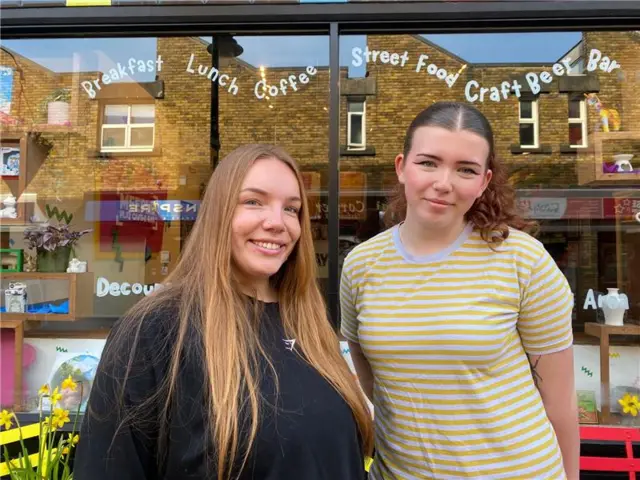
    Kelsey (left) says rent takes up most of her income, and wants more help for people in her position

    One area of the UK economy that we got an update on from the Office for Budget Responsibility concerned the impact on house prices - which it says are due to rise "broadly in line with growth in average incomes".

    Some say stability in this area has led to competition between mortgage lenders to attract first-time buyers, and eased some of the pressure on the cost of renting.

    But BBC Newsbeat has been speaking to people in Southampton who think more needs to be done.

    Kelsey Coxall works as a full-time barista and has lived independently for seven years, but says rent takes up most of her income.

    “There’s never really any spare for myself,” the 25-year-old says.

    She wants to see the chancellor offer more help to people in her position.

    “A lot of people my age that I know are in a position where they still have to stay at home because there is no other option," she says. “Even if they were to move out, it’s not doable.”

  2. 'There is more to do, but our plan is working', says Starmerpublished at 15:30 GMT

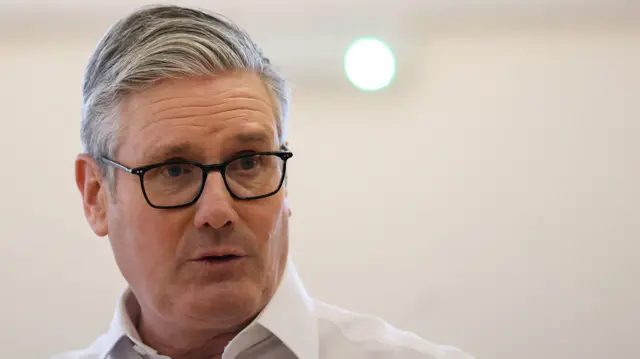
    Keir StarmerImage source, Reuters

    Prime Minister Sir Keir Starmer has shared a few words of support for the chancellor's Spring Statement in an article on Substack. , external

    He says he's been focusing on "national security and the safety of British people" amid events in the Middle East.

    "Security and strength for our country starts with a strong economy – and a stronger economy puts us in a place to better withstand global tensions," he says.

    The government is "at a turning point in our economic plan", he says, pointing to lower inflation, energy bills and borrowing costs. "I know there is more to do. But our economic plan is working."

    "While I fully understand that people are not feeling the impact of all this yet, I am confident that over time more people will," he says, pledging that his government will provide an "economy that works for working people".

  3. Businesses say Chancellor’s growth message feels ‘at odds with reality’published at 15:18 GMT

    Rachel Clun
    Business reporter

    The chancellor’s “low-key” Spring Statement is unlikely to offer comfort to industries that have been seeking help to take pressure off their bottom lines, according to Kate Hayward, UK managing director of accounting software firm Xero.

    “The chancellor’s pro-growth message is likely to feel at odds with reality, particularly for small businesses who are still managing the fall-out of a difficult winter and likely bracing for another year of uncertainty,” she says.

    Tina McKenzie, policy chair at the Federation of Small Businesses points out there is less than a month until some business costs - including employment costs and business rates - go up.

    “The chancellor missed the chance today to address the costs stack about to hit small firms,” she says.

    Meanwhile, the head of the British Retail Consortium, Helen Dickinson, says the government must overhaul the business rates system to ease pressure on firms and help boost the economy.

    “Retail has unparalleled reach across the country, and stands ready to work with the government to ‘spread’ and ‘unlock’ opportunity in every part of Britain,” she says.

  4. Analysis

    Could more policy announcements come in following weeks?published at 15:11 GMT

    Henry Zeffman
    Chief political correspondent

    While Rachel Reeves’s speech today did not contain new policy, she did appear to promise new policy in just a fortnight’s time.

    In a lecture in the City of London, the chancellor said she would “set out three major choices that will determine the course of our economy into the future” - citing “our global relationships”, how to “back innovation and harness the power of AI”, and “transforming our economic geography” to “unlock opportunity in every part of Britain”.

    In government, this is being talked up as a very significant speech designed to demonstrate the chancellor’s plan to grow the economy.

    But a clear risk is that it is eclipsed between now and then by the economic impact of developments in the Middle East.

  5. Rise in borrowing but similar fiscal outlook compared to post-Budget forecast - OBR committee memberpublished at 15:01 GMT

    Tom Josephs, who also sits on the OBR's budget responsibility committee, says the fiscal outlook is very similar to what the OBR forecast in November.

    Going into the details, Josephs says around £4bn a year increase in borrowing is expected as a result of policies announced since the Budget - and mainly includes support for local authorities and further funding for SEND.

    Overall, borrowing is forecast to be around £8bn lower than forecast in November. But Josephs says this is a "very small change" in the context of the current uncertainty in the Middle East.

    He says the conflict creates a "very significant" risk for the UK and global economy - for instance when it comes to rising oil prices.

    Josephs says an energy price shock would be expected to have a negative short-term fiscal impact as it pushes up the cost of welfare, debt interest and departmental spending.

  6. OBR economist says growth last year 'disappointingly weak'published at 14:50 GMT

    More now from Miles, who says growth at the end of last year was "disappointingly weak" and "doesn't seem to have picked up very strongly" in the first few months of this year.

    He says he wants to emphasise "just how much of the extremely challenging fiscal position the UK is in" and "reflects low growth in recent history".

    Miles also highlights the OBR's forecast that inflation will reach the Bank of England's target of 2% by the end of the year.

    He acknowledges that "there must be more uncertainty about that now", given the ongoing conflict in the Middle East, but adds that the spot prices for oil and gas - which have soared over the past couple of days - are not necessarily the most relevant prices for inflation.

  7. Government faces 'very challenging' fiscal situation - OBR economistpublished at 14:47 GMT

    Members of the Office for Budget Responsibility (OBR)'s budget responsibility committee are holding a news conference about the forecasts released today - you can watch live at the top of the page.

    David Miles, a member of the Budget Responsibility Committee, says today serves as "an interim update" on the state of the economy ahead of the next Budget, and is not about providing a "pass/fail judgement" on the government.

    Miles says that recent events in the Middle East "illustrate how quickly the economic environment can change", but adds that "it's not right" to assume that changes in the market over the last week will all result in more difficult economic outcomes.

    He mentions that both stock prices and gilt yields are still higher than they were when the OBR took its "estimate of market determinance" that it uses for its forecast.

    What remains the same, he says, is that the government "faces a situation that is very challenging fiscally".

  8. Tax take to hit 'historic high' by 2030-31, OBR sayspublished at 14:42 GMT

    Katie Williams
    Live reporter

    More now from the Office for Budget Responsibility (OBR)'s forecasts.

    It says the government's total tax take is forecast to hit a "historic high" by 2030-31, rising to almost 43% of GDP. That's up from around 39% of GDP in 2024-25.

    This number refers to the total money received in taxes across all UK taxpayers.

    One of the reasons the figure is rising is that personal tax thresholds have been frozen until 2031, after an announcement as part of the most recent Budget to extend the policy for another three years.

    Many households will find themselves paying more tax over the coming years as a result. This is a phenomenon known as fiscal drag - when you are dragged into a higher tax band as your wages increase with inflation.

  9. BBC Verify

    Are you going to be £1000 better off by the next election?published at 14:30 GMT

    By Anthony Reuben

    One of the chancellor’s more eye-catching claims was: “By the next election, after accounting for inflation, people are forecast to be £1000 better off per year.”

    That sounds good, but you’ve already benefited from most of that.

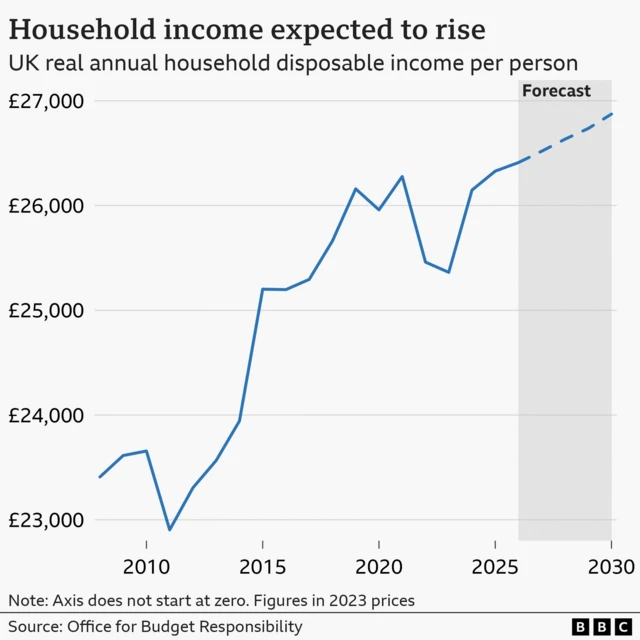
    She’s talking about a measure called Real Household Disposable Income (RHDI) per person. The Office for Budget Responsibility said today, external that measure had grown strongly in 2024-5 (broadly the first year after the general election). It has grew by 3.1%.

    In 2025-26, RHDI per person is expected to grow by much less - only 0.1% - and then average 0.5% growth a year until 2029, when the next election is likely to happen.

    The OBR says RHDI per person was £25,500 in 2023-24 and it does indeed predict that it will be a bit more than £1000 higher than that by the time of the next election, but you've already had most of that increase.

    A line chart showing UK real household disposable income per person each year from 2008 to 2030, in 2023 prices. Figures from 2026 to 2030 are forecasts. Disposable income was around £23,400 in 2008 and fell slightly to under £23,000 in 2011. Income then rose consistently up to £26,200 in 2019, before dropping to £25,400 in 2023. Income reached £26,300 in 2025 and is forecast to increase steadily to £26,900 in 2030.
  10. Analysis

    Normally forecasts would be a sign of future interest rate cuts, but now it's far more uncertainpublished at 14:27 GMT

    Kevin Peachey
    Cost of living correspondent

    On the face of it, the latest forecasts would be welcome news for households in terms of the supermarket shop, prices and the cost of living.

    The rate of inflation was expected to hit the target level of 2% later this year. This is a far cry from the peak in October 2022 when prices were rising at a rate of 11.1% a year.

    Normally that would heighten expectations of interest rate cuts, making borrowing money cheaper (although returns on savings would be lower too).

    However, all those forecasts are now far more uncertain – potentially even redundant – if the impact of the US-Israel war with Iran lasts for some time.

  11. House prices to rise 'broadly in line with average incomes'published at 14:23 GMT

    Katie Williams
    Live reporter

    Today's OBR forecast touches on many different parts of the economy - including house prices.

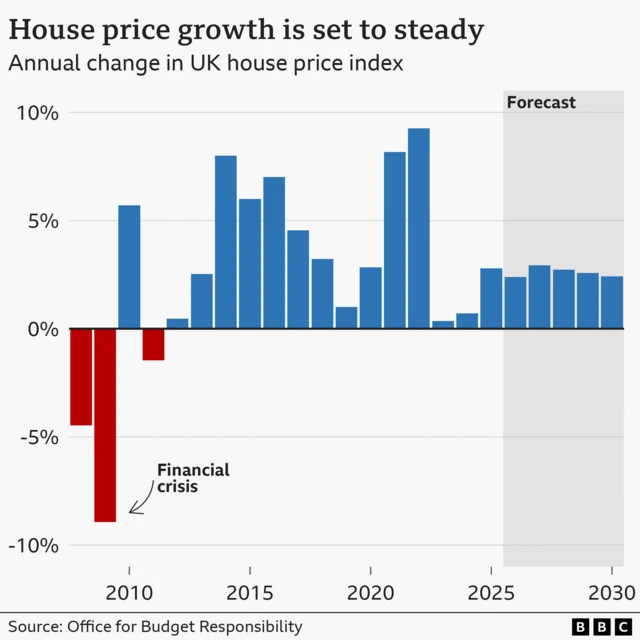
    They are expected to rise by just over 2.5% over the rest of the forecast period, which covers the five years to 2030-31, the OBR says.

    This is "broadly in line with growth in average incomes", it says.

    For those trying to get on the housing ladder, it means prices shouldn't race ahead of your wage growth.

    It is worth noting though that the housing market can vary significantly from one part of the country to another.

    To help put this into context, data from HM Land Registry, external shows average London house prices fell by 1% in the year to December 2025, while average prices in Northern Ireland increased by 7.5%.

    A bar chart showing the annual change in the UK house price index, with forecasts by the OBR. Prices fell by 8.9% in 2009 after the financial crisis. It then peaked in 2022, when it rose by 9.3%. The forecasts are 2.4% for 2026, 2.9% in 2027, 2.7% 2028, 2.6% in 2029, and 2.4% in 2030.
  12. By-election result shows voters want bolder action against sky-high bills and rent - Green MPpublished at 14:16 GMT

    Sian BerryImage source, House of Commons

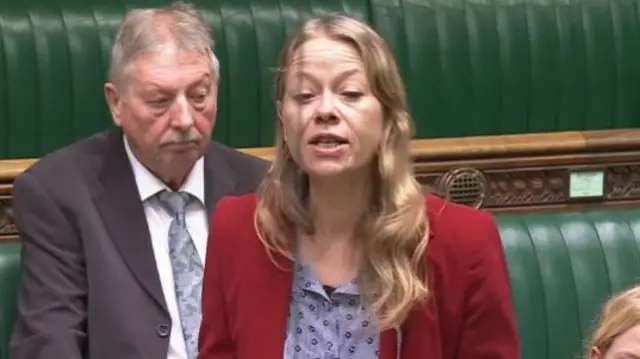
    Green MP Sian Berry says the result of last week's Gorton and Denton by-election - which her party won, with the seat having previously been held by Labour - shows that voters want bolder action against sky-high bills and rent.

    Berry asks Reeves whether she will scrap her "dysfunctional" fiscal rules, as well as getting rid of the family benefit cap, which she says is preventing over 200,000 children from escaping "needless grinding hardship".

    In response, Reeves says she believes in fair taxes and that the wealthy should pay their fair share - but in a credible way that delivers for constituents.

  13. Reform MP compares chancellor to a 'rogue landlord'published at 14:12 GMT

    Back in the Commons, MPs are still to responding to the chancellor's Spring Statement - you can watch live at the top of the page.

    Reform UK's economic spokesman Robert Jenrick says Rachel Reeves is "like a rogue landlord who keeps squeezing the tenant with higher and higher rent. All the while, the property is going to wrack and ruin".

    She should go out and speak to people who are worried about their bills, he says.

    Jenrick then mentions a planned easing of fuel duty cuts, and pushes Reeves if she will give relief to the "hard working" people who drive to work.

    Reeves responds by saying Jenrick's former party - the Conservatives, which he defected from in January - was planning to get rid of fuel duty support when Jenrick was still in the party.

  14. Analysis

    Come the next Budget, there could be need for more tax or spending changespublished at 14:00 GMT

    Dharshini David
    Deputy economics editor

    Safe - but for how long?

    Relief for the chancellor as the official forecasts deem she's still on track to meet her main target for the public finances, with a slightly larger amount left to spare than previously thought.

    The impact of weaker than expected growth on the public finance forecasts has been more than balanced out by lower borrowing costs, higher share prices and a bigger tax take.

    But at just shy of £24bn, that safety margin, the amount by which her revenues are expected to exceed day-to-day public spending in a few years time, remains smaller than the historical average.

    And the OBR were mindful of the tension in the Middle East building as it put the finishing touches on its predictions. That has since exploded - investors may have been watching the gyrations of energy markets more closely than the chancellor.

    It is highly uncertain how long the volatility in energy prices will last. But if sustained, economists are already speculating that the chancellor will, at the least, struggle to end the freeze on fuel duty come the Budget.

    Add in the risks of higher inflation, interest rates and dent to activity and that margin, the headroom could be wiped out.

    That may not happen - but as the OBR flags, there are other risks this year alone - pressures to bump up defence and health spending, the cost of housing migrants.

    The OBR is paid to be cautious. But it means that, come the autumn Budget, there could still be a need for tax or spending changes - if the sums on the public finances are to add up.

  15. Key takeaways from the OBR forecastspublished at 13:42 GMT

    Rachel Clun
    Business reporter

    Less than one hour ago, the Office for Budget Responsibility (OBR)'s latest forecasts for the UK economy were published.

    It’s important to note that these forecasts were finalised before the US-Israeli war with Iran began.

    Here are the key figures:

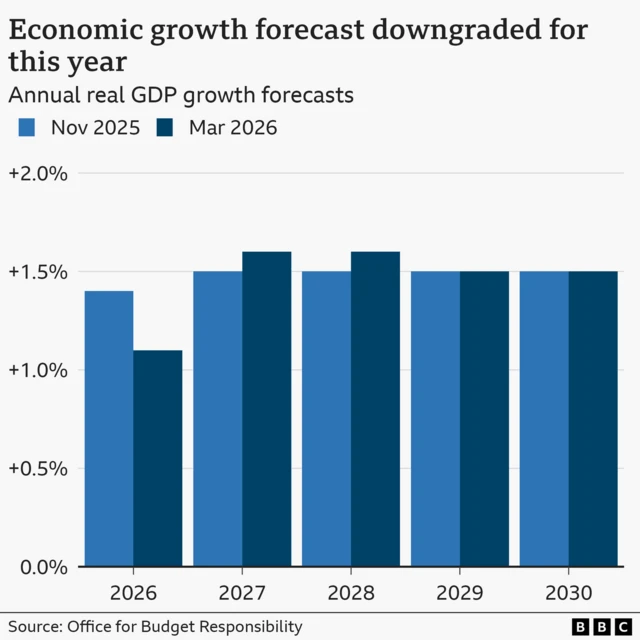
    • The economy is expected to grow by 1.1% in 2026, down from the 1.4% originally forecast in November
    • Inflation is forecast to fall faster than previously thought, reaching 2.3% during 2026 before reaching the Bank of England's target of 2% by the end of the year
    • Unemployment is expected to now peak at 5.3%, up from a 4.9% peak forecast at the Budget
    • And the government’s fiscal headroom - its buffer in the case of economic shocks - has risen, from £21.7bn to £23.6bn
    A bar chart showing UK economic growth forecasts from November 2025 and March 2026. According to the latest OBR forecast, GDP is set to rise by 1.1% in 2026, 1.6% in 2027, 1.6% in 2028, 1.5% in 2029, and 1.5% in 2030. In November 2025, the growth forecasts were 1.4% in 2026, 1.5% in 2027, 1.5% in 2028, 1.5% in 2029, and 1.5% in 2030.
  16. Analysis

    What does the unemployment forecast mean if you're looking for work?published at 13:34 GMT

    Rachel Clun
    Business reporter

    The OBR has updated its forecast for unemployment, and it now expects the unemployment rate - that is the number of people out of work but actively looking for a job - to rise to 5.3% this year.

    It means that things are going to get a bit worse for jobhunters before they get better.

    The OBR also noted in its updated forecasts that one of the key issues in the jobs market was “entrants into the labour force struggling to find work amid subdued hiring demand”.

    That is, people trying to get a job for the first time are having difficulty finding employment.

    The Bank of England has previously predicted the unemployment rate will reach a peak by the middle of the year.

    For some light at the end of the tunnel, it should start falling slowly after that.

  17. BBC Verify

    Fact-checking Reeves’s inflation claimpublished at 13:31 GMT

    By Tom Edgington, BBC Verify

    Setting out Labour’s economic record, Rachel Reeves said “inflation has fallen”.

    Whether that is correct depends on the time frame being used.

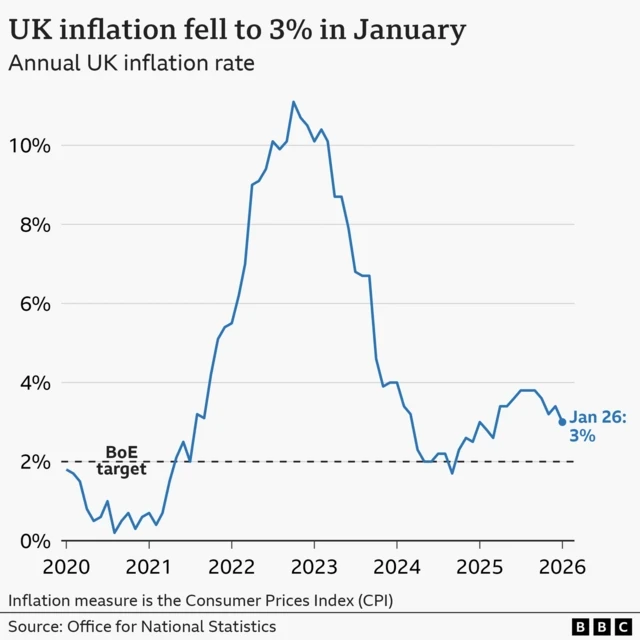
    The latest official figures show inflation stood at 3% in the 12 months to January 2026. That is down from 3.4% in December., external

    However, inflation is still higher today compared to when Labour took power. In June 2024 - the final month before the change in government - inflation was running at 2%.

    That 2% figure is also the Bank of England’s target rate, which is intended to keep price rises low and stable.

    Line chart showing UK inflation rate from 2020 to 2026. In the latest update, January 2026, it decreases slightly to 3%.
  18. Lib Dems 'pleading' with chancellor to focus on European trade dealpublished at 13:27 GMT

    Daisy Cooper, from the Liberal Democrats, is next to speak

    She says her party are "pleading" with the chancellor to "put a laser-like focus on getting a better trade and defence deal with Europe".

    The chancellor "could have" used today's speech to announce the government's intention to negotiate a new EU-UK customs union to "kick start growth", she argues.

    The OBR projections will "soon be out of date", Cooper says, adding that she believes US President Donald Trump's actions in Iran will be felt in "people's pockets right here in Britain".

    She also requests the government reform the student loan system, as graduates are currently being "ripped off"

    Media caption,

    Lib Dems: 'Graduates are being ripped off'

  19. Tories 'the arsonists, not the fire brigade' - Reevespublished at 13:25 GMT

    Chancellor Rachel Reeves returns to the despatch box smiling, and says that today's performance is "yet another reminder of how irrelevant the Conservative Party now is".

    She says Stride and Tory leader Kemi Badenoch have been wrong about the economy "time and time again".

    The chancellor admits that more needs to be done on youth unemployment, but blames the Tories for slashing the numbers of young people in apprenticeships.

    "They are the arsonists, not the fire brigade," she says. "They gave us 14 years of barely-managed decline and we are fixing it."

  20. Reeves' plan 'not working', says shadow chancellorpublished at 13:21 GMT

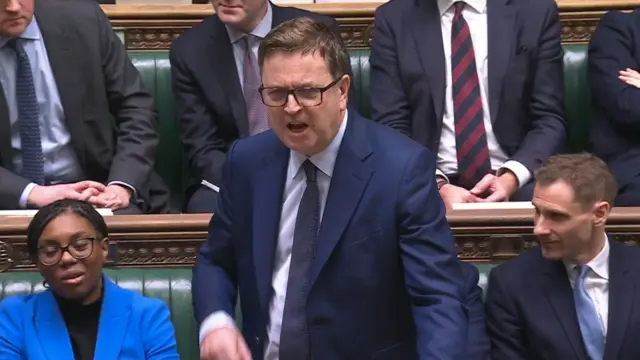
    Shadow chancellor Mel Stride says that Rachel Reeves "is fond of saying she is simply asking people to pay a little more" when it comes to tax.

    He tells the Commons the government's tax policy means staff are being laid off and people are leaving the UK for other countries.

    There have been "almost 100,000 job losses" in the hospitality sector since the government came to office, Stride says.

    The shadow chancellor says while Reeves says today that her plan is working, in reality inflation, borrowing, spending, taxation, welfare and unemployment are all up.

    The chancellor's plan "is not working", Stride says.

    Screen grab of shadow chancellor Mel Stride responds to Chancellor of the Exchequer Rachel Reeves’s spring statement to MPs in the House of CommonImage source, House of Commons
    Image caption,

    Mel Stride responding to Rachel Reeves in the House of Commons