Summary

  1. Here's a look at recent eventspublished at 00:00 BST 15 April

    We are pausing our live coverage for now. Here's a wrap up of recent developments:

    • A "historic" meeting between Israel and Lebanon in the US concluded with both parties agreeing to "direct" negotiations
    • Israel's ambassador to the US said the talks showed the three nations "are on the same side of the equation", while the Lebanese ambassador said they were "productive"
    • The US and Iran could resume talks "over the next two days", President Donald Trump has said, following the failed negotiations in Pakistan over the weekend
    • The US said no ships have passed through its blockade of Iranian ports and coastal areas in the first 24 hours. Tracking data, verified by the BBC, showed four Iran-linked ships crossed the Strait of Hormuz after the blockade began
    • China has condemned the blockade, calling it "dangerous and irresponsible". Iran said it is a "grave violation"of its sovereignty

    You can read more here about Trump hinting that talks to end the war could resume soon

  2. Iranian outlets report explosion in Tehranpublished at 23:39 BST 14 April

    Ghoncheh Habibiazad
    Senior reporter, BBC Persian

    Iranian outlets have reported an explosion in the capital Tehran.

    Mohammad Balideh, the IRGC (Islamic Revolutionary Guard Corps) commander for Tehran's District 10, said in a video message that a "minor explosion" had been caused by "traitorous and unpatriotic elements", without specifying who was behind it.

    He says the situation is "under control".

    In a separate report published after the video message, the IRGC-affiliated Fars News Agency said the explosion was caused by "two homemade explosive packages based on liquefied gas".

    It says three people sustained "minor injuries" from the explosion, which "shattered the windows of three houses and caused minor damage to two vehicles".

  3. Iran war has caused 'major supply shock', says Bank of England governorpublished at 23:11 BST 14 April

    Rachel Clun
    Business reporter

    The Iran war has caused a "major supply shock", according to Bank of England governor Andrew Bailey, who says that central bankers will have to closely monitor its economic impacts.

    Speaking at an event at the University of Colombia in the US, Bailey would not be drawn on what that means for interest rates set by the bank.

    Some analysts believe the bank could raise interest rates later this year, as UK inflation was 3% in the year to February and is expected by the IMF to near a peak of 4%. The bank's target for inflation is 2%.

    In its World Economic Outlook, the IMF cautioned central banks against raising interest rates too prematurely.

  4. President Xi says world slipping into 'law of the jungle'published at 22:35 BST 14 April

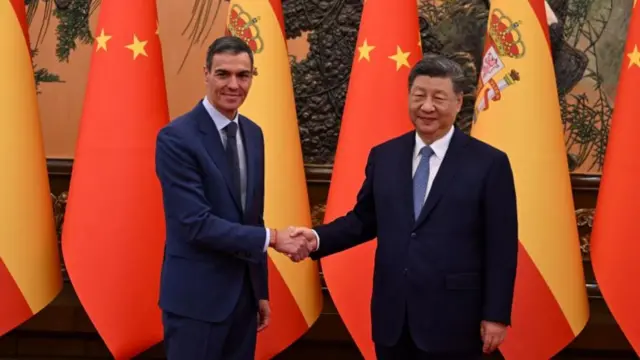
    Spanish Prime Minister Pedro Sánchez and China's President Xi shake handsImage source, Reuters
    Image caption,

    China's President Xi is hosting Spanish Prime Minister Pedro Sánchez in Beijing

    China's President Xi Jinping has warned that the world is regressing to the "law of the jungle", in comments reported by Chinese state news agency Xinhua.

    Xi made the comments to his Spanish counterpart Pedro Sánchez - who is visiting China. In apparent reference to the war in the Middle East, the agency says he told Sánchez that the world is "in turmoil" and facing a "contest between the rule of law and the rule of power".

    It says Xi asked to strengthen cooperation with Spain to oppose what he described as a slip into the "law of the jungle", and defend "international order based on international law".

  5. What's the latest?published at 22:14 BST 14 April

    Nabiha Ahmed
    Live reporter

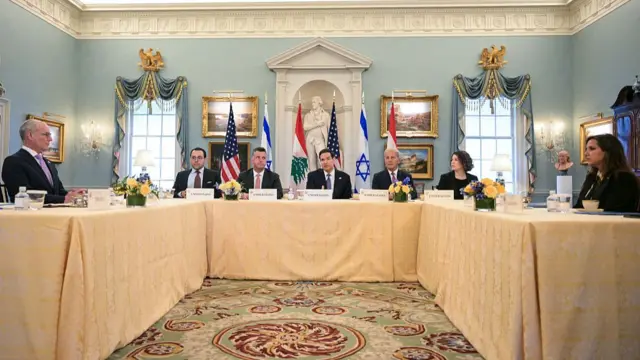
    US Secretary of State Marco Rubio (C), alongside US State Department Counselor Michael Needham (3L) and US Ambassador to Lebanon Michel Issa (3R), speaks during a meeting with Lebanon's Ambassador to the US Nada Hamadeh Moawad (R) and Israeli Ambassador to the US Yechiel Leiter (L) at the State Department in Washington, DCImage source, Getty Images
    Image caption,

    Israel and Lebanon agreed to launch direct negotiations after talks today in Washington DC

    Israel-Lebanon talks conclude, with more to follow.

    • Israel and Lebanon have agreed to launch "direct" negotiations, after concluding what the US State Department called an "historic" meeting between both sides in Washington

    Trump says US-Iran talks may resume this week.

    The US naval blockade of Iranian ports remains in force.

    US to revive full sanctions on Iranian oil.

  6. BBC Verify

    Video shows damage to Lebanon hospital following reported strikepublished at 21:53 BST 14 April

    By Paul Brown

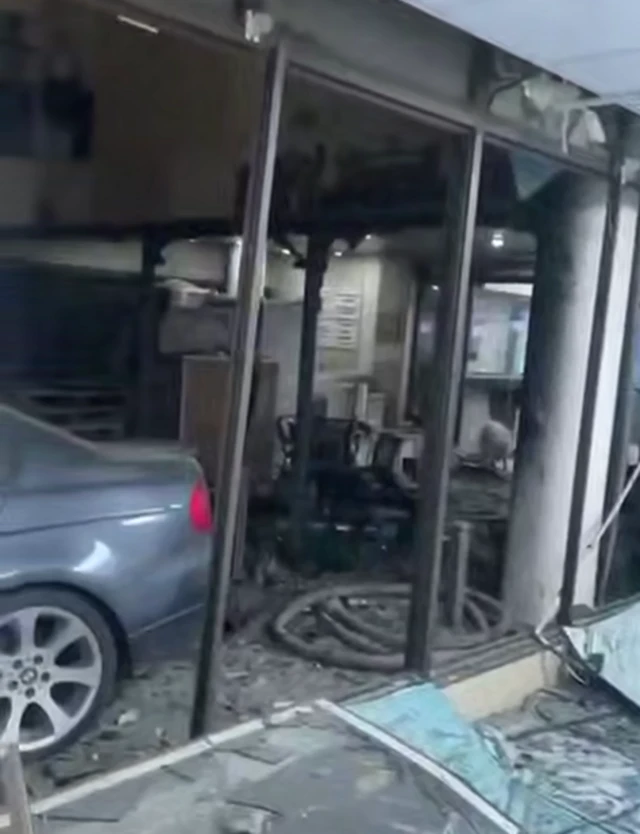
    BBC Verify has checked footage showing damage to a hospital building in southern Lebanon following a reported Israeli strike last night.

    One video opens inside Tebnine Government Hospital, showing broken glass and rubble among beds and other medical equipment.

    The person filming then moves outside to a car park to document more debris, as well as damage to vehicles and the hospital’s facade.

    A screenshot showing glass panelled windows blown out and debris lying aroundImage source, Telegram

    Another clip shows the same car park, before turning away from the hospital towards a row of buildings which have suffered more extensive damage, suggesting this area bore the brunt of the strike. But it is not possible from the footage to say what was targeted.

    The Israeli military has told BBC Verify it is “checking” the details of the incident.

    The hospital is located in the town of Tebnine about five miles (6km) north of Bnit Jbeil, where Israeli forces are currently operating on the ground.

    A post from 12 March on the hospital's Facebook page said it had previously provided shelter to displaced people, who had since been moved elsewhere leaving only staff at the site.

  7. 'Bit of pain' worth long-term security from Iran, Bessent tells BBCpublished at 21:33 BST 14 April

    US Treasury Secretary Scott Bessent tells the BBC a "small bit of economic pain" is worthwhile for long-term international security.

    As the International Monetary Fund (IMF) warns the US-Israel war with Iran could plunge the global economy into recession, Bessent says the conflict was intended to eliminate the threat of Iranian nuclear strikes on Western capitals.

    "I wonder what the hit to global GDP would be if a nuclear weapon hit London... I am saying that I am less concerned about short-term forecasts, for long-term security," he says.

    Iran does not have nuclear weapons, and he UK government has said there is "no assessment" that Iran was trying to target Europe with missiles. As the BBC has previously reported, the threat of Iranian ballistic missiles being targeted at London is remote.

    Media caption,

    IMF: Oil prices and war could derail global growth

  8. Meeting with US and Israel 'productive', says Lebanese ambassadorpublished at 21:09 BST 14 April

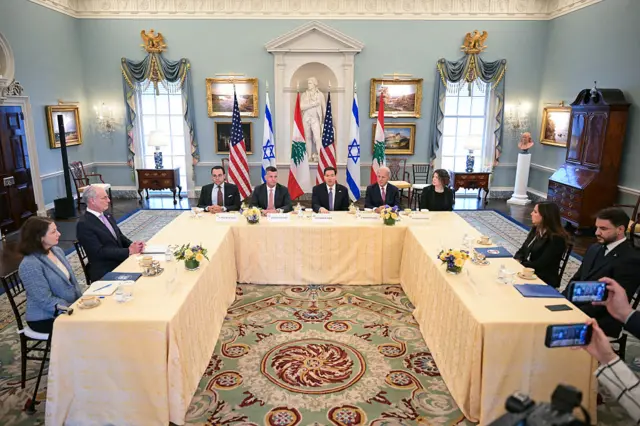
    Lebanon's ambassador the the United States, Nada Hamadeh Moawad, has called the preliminary talks with the US and Israel "productive".

    In a statement she says she called for the "urgent need for the full implementation" of the November 2024 cessation of hostilities agreement.

    This was an agreement reached following 13 months of fighting between Israel and Hezbollah, which gave the Iran-backed group 60 days to end its armed presence in southern Lebanon.

    Moawad adds that she also called for a ceasefire and for the return of displaced persons to their homes.

    She says she emphasised Lebanon's "full sovereignty over all Lebanese lands" and called for measures to alleviate the "acute humanitarian crisis" caused by the conflict.

    The date and venue for further talks will announced at a later date, she concludes.

    People seated around a u-shaped table with the flags of the US, Israel and Lebanon in the backgroundImage source, Getty Images
  9. Several ships cross strait and leave Iranian ports since start of US blockadepublished at 20:48 BST 14 April

    The efficacy of the US naval blockade of Iranian ports has remained largely unclear during its first full day, with our security correspondent Frank Gardner suggesting a lack of preparation and transponder interference as possible explanations.

    Shipping data analysed by BBC Verify shows that at least four Iran-linked ships, including two that visited Iranian ports, crossed the Strait of Hormuz on Tuesday.

    A further three ships that were not linked to Iran were seen to have crossed the strait after the blockade started at 10:00 ET (14:00 GMT) on Monday.

    Despite this, US Central Command said no ships have made it past the blockade in its first 24 hours, adding that more than 10,000 military personnel, along with dozens of warships and aircraft, have been involved in the tactic.

    It said that six merchant vessels turned around and re-entered an Iranian port after complying with "direction from US forces" - while ship tracking data analysed by BBC Verify showed two Iran-linked ships changing direction after travelling through the strait off the back of the blockade being imposed.

  10. US oil sanctions reinstated to maintain 'maximum pressure' on Iran - Treasurypublished at 20:27 BST 14 April

    More now on the US Treasury's decision not to renew its lifting of sanctions on select Iranian oil.

    The move was done to maintain "maximum pressure" on Iran, the department says on social media.

    It adds in a post on X that the department is prepared to deploy secondary sanctions against foreign financial institutions that "continue to support Iran's activities".

    Treasury Secretary Scott Bessent said last month the permit was applicable to the sale of crude oil and petroleum products of Iranian origin currently loaded on vessels, with the authorisation lasting until 19 April.

    He said the move would quickly bring about 140m barrels of oil to global markets.

    About a fifth of the 100m barrels of oil that the world consumes every day usually travels via the Strait of Hormuz.

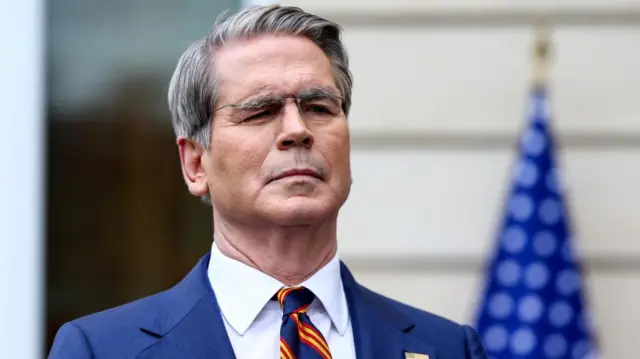
    Scott Bessent looks beyond the camera while wearing a navy suit, white shirt and striped tie. A flag for the United States of America can be seen in the blurred backgroundImage source, Reuters
    Image caption,

    Bessent announced the temporary easing of select Iranian oil last month

  11. Israel and Lebanon will launch direct negotiations following meeting, says USpublished at 20:26 BST 14 April

    Israel and Lebanon have agreed to launch direct negotiations after talks today in Washington DC, according to the United States, whose representatives also attended the meeting.

    US state department deputy spokesman Tommy Pigott says in a statement the meeting between the countries' ambassadors and US Secretary of State Marco Rubio was "historic", adding the US hopes the new engagement will lead to a long term peace deal brokered by the US.

    Both Israel and Lebanon agreed to work towards reducing the influence of Iran-backed Hezbollah, Pigott says, and the Lebanese government "plans to restore the monopoly of force and to end Iran's overbearing influence".

    The Lebanese side also called for a "ceasefire and concrete measures to address and alleviate the severe humanitarian crisis" in the country.

    Israel reportedly agreed to work with Lebanon to dismantle "all non-state terror groups" and "achieve a durable peace", but did not appear to directly agree to stop strikes on the country.

    "The United States expressed its support for Israel's right to defend itself from Hezballah's continued attacks," the statement says.

    The meeting marked the first direct talks between the two countries' governments since 1993.

  12. US Treasury will not renew easing of Iran oil sanctionspublished at 20:15 BST 14 April
    Breaking

    The US Treasury will not be renewing its temporary easing of Iran oil sanctions, which was set to expire later this week.

    The government department says in a post on X that the short-term authorisation permitting the sale of Iranian oil currently stranded at sea "will not be renewed" after it expires on 19 April.

  13. 'Glimmers of hope' for peace driving further oil price fallspublished at 20:01 BST 14 April

    Jemma Crew
    Business reporter

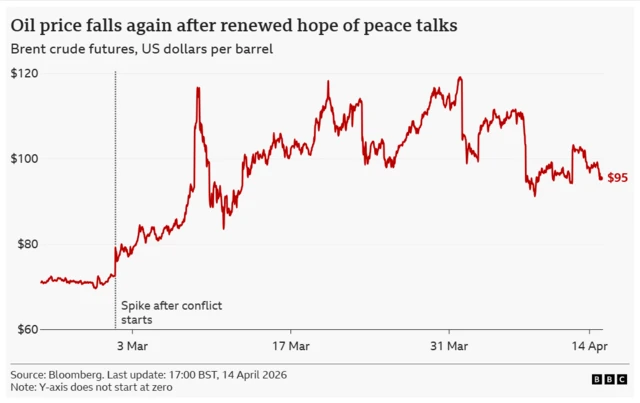
    A chart shows fluctuating oil prices since 3 March

    Further falls to oil prices on Tuesday are "based on glimmers of hope that both sides remain keen to make a lasting peace deal", according to an analyst.

    The price of global benchmark Brent crude dropped 4.5% to a low of $94.87 a barrel on Tuesday, before recovering slightly.

    "News of a potential second round of talks has been helpful in soothing markets, alongside the suggestion that Iran will not test the US blockade, instead opting to pause shipments to avoid a military confrontation," says Lindsay James, investment strategist at Quilter.

    She says traders may also have been encouraged by signs that several sanctioned tankers "appeared to make it through the Strait of Hormuz earlier today but have since turned back".

    It could be that incorrect locations had been shown in tracking data, or indicate that US military pressure is being wielded beyond the Strait, she says.

  14. The difficulty in uncoupling Hezbollah from Iran in peace talkspublished at 19:44 BST 14 April

    Nada Tawfik
    Reporting from US State Department

    Talks at the state department lasted a little more than two hours. A US official here wanted to stress that for the Americans, there is no link between the negotiations between the United States and Iran in Islamabad and the Israel-Lebanon talks.

    "Iran will not be allowed to dictate the future of Lebanon any more. These talks are part of that effort," the official says.

    However, Iran insists that Hezbollah in Lebanon must be included in any agreement. And many experts, including Professor Shibley Telhami from the University of Maryland and the Brookings Institute, believe it's hard to uncouple one from the other in this environment.

    "I think it’s impossible for Iran to have a ceasefire without Hezbollah, for its internal credibility, its legitimacy and its strategic goals," he tells the BBC.

  15. 'New era of peace' - Israeli ambassadorpublished at 19:12 BST 14 April

    Leiter goes on to describe more about his conversation with Lebanese ambassador to the US Nada Hamadeh at the US state department.

    "We talked about a number of things, most importantly the long-term vision, where there'll be a clearly delineated border between our countries, and the only reason we'll need to cross into each other's territory will be in business suits to conduct business or in bathing suits to go on vacation."

    "We made it clear that the security of our civilians is not up for negotiation," Leiter adds.

    "This was a victory for sanity for responsibility and for peace," he says.

    Hezbollah is "as weakened as it's ever been," Leiter says, promising to continue to "rid" the region of the group's "malignant" threat.

    Israel's fighting in Lebanon has weakened Hezbollah to the point in which it's possible for the Lebanese government to "move into a new era of peace", Leiter says.

    The three parties spoke for two-and-a-half hours, he says, with a joint statement expected to be released soon.

    We have not yet heard from the United States or Lebanon on the meeting.

  16. All three countries 'on the same side of the equation' - Israeli ambassadorpublished at 19:02 BST 14 April

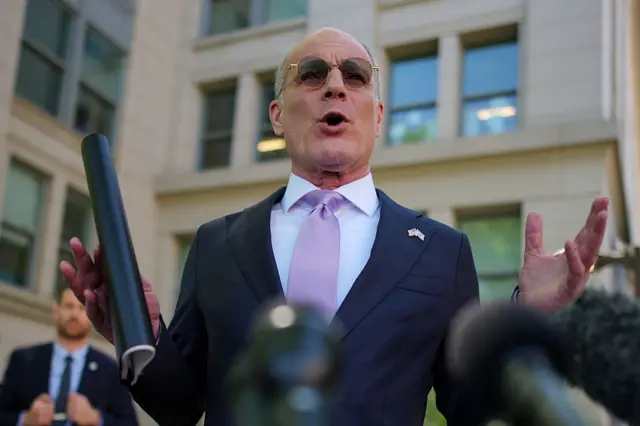
    The Israeli ambassador to the US wears a dark suit, white shirt, lilac tie and dark glasses as he speaks to mediaImage source, Getty Images

    After talks between Israel, Lebanon and the United States in Washington on Tuesday, Israeli Ambassador to the US Yechiel Leiter tells gathered reporters that representatives from all three countries "discovered today that we are on the same side of the equation and that's the most positive thing we could have come away with."

    He adds: "We are both united in liberating Lebanon from the occupation power dominated by Iran called Hezbollah."

  17. Israel confirms talks with Lebanon have endedpublished at 18:57 BST 14 April

    The Israeli Embassy in Washington have also confirmed that the talks with Lebanon and the United States have concluded.

  18. BBC Verify

    Two Iranian ships leave port in defiance of blockadepublished at 18:55 BST 14 April

    By Alex Murray

    Ship tracking data analysed by BBC Verify has found further evidence of ships leaving Iranian ports in apparent defiance of a US naval blockade.

    The cargo ship Ashkan3 appears to have left the vicinity of Iran's Chabahar port - which is hundreds of kilometres east of the strait of Hormuz - on 13 April unladen with cargo. It is currently sailing eastwards near to Pakistan.

    Another vessel, a container ship called Shabdis, left the vicinity of Chabahar port on 13 April, again unladen with cargo. After the US blockade came into effect, it began sailing eastwards and is now near India. It is transmitting its destination as Zhuhai in China.

    Neither of these ships crossed the strait after the blockade started. Both are sailing under the Iranian flag.

  19. Israel-Lebanon-US talks in Washington have ended - Lebanese mediapublished at 18:41 BST 14 April

    Talks between Israel, Lebanon and the United States being held in Washington DC have ended, according to Lebanon's state-run National News Agency.

    It says they lasted about two hours.

    We've not had any word from the US or Israeli delegations yet.

  20. 'It is time for diplomacy over escalation', says UN headpublished at 18:32 BST 14 April

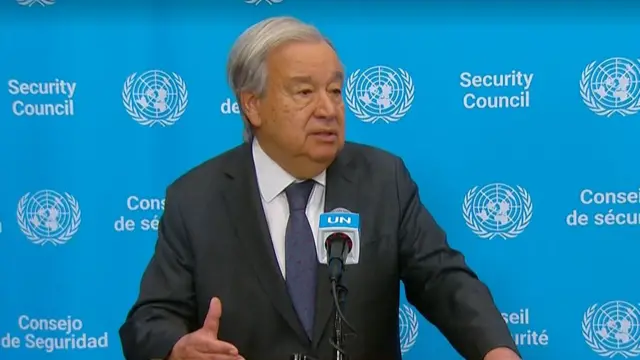
    Guterres speaks at press briefingImage source, Pool VIA Reuters

    UN Security-General António Guterres is speaking to press in New York about the war in the Middle East.

    Asked about a report that Iran and US may resume talks in the next two days, he says: "The indication we have is that it is highly probable that these talks will restart."

    On negotiations between Israel and Lebanon, he says that "nobody expects" these talks today to "solve all the problems" - but they are "very important" to "create conditions" to change the situation.

    He also warns that respect for international law - around the world, and "starkly in the Middle East" - is being "trampled".

    The secretary-general says "too many are choosing to turn a blind eye to justice", with rules governing use of force ignored and civilians "exposed to intolerable harm".

    He says international law "applies to all states without exception", adding that it "applies urgently to the conflict in the Middle East".

    Guterres says "serious negotiations" must resume and the ceasefire "must be preserved and extended as necessary", and that "international navigational rights and freedoms – including in the Strait of Hormuz – must be respected by all parties."

    "It is time for restraint and responsibility. It is time for diplomacy over escalation. It is time for a renewed commitment to international law," he says.