Summary

  1. What we heard at the Munich Security Conference todaypublished at 18:58 GMT

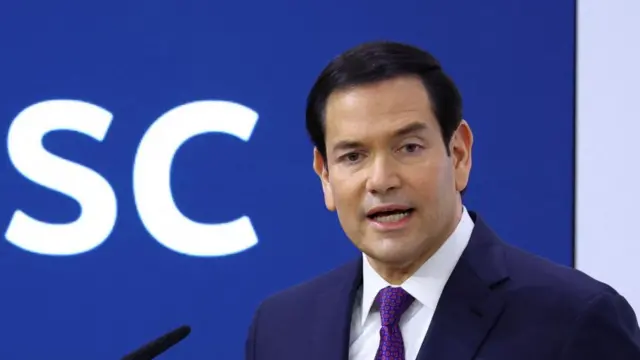
    Rubio speaks into a microphone on stage at the security summitImage source, Reuters

    The future of Greenland, the US-European alliance, and the war in Ukraine were all high on the agenda as world leaders met for the second day of the Munich Security Conference.

    Here's an overview of the day:

    US does not want to 'separate' from Europe: Last year's conference saw US Vice President JD Vance criticise European leadership, but Secretary of State Marco Rubio took a different approach this time around, saying it was "neither our goal nor our wish" to end the transatlantic partnership and that the US and Europe "belong together".

    Starmer on closer EU ties: The UK PM called for deeper links and cooperation, including economic ties, between the UK and EU. Europe must be able to "stand on its own two feet" and be ready to fight to protect its people and way of life, he said.

    US 'too often' focused on Ukrainian concessions: Speaking about US-led talks aimed at ending the war, Ukraine's President Volodymyr Zelensky said the focus was too often on concessions from Ukraine and not Russia.

    Trump still 'very serious' about Greenland: That's how Danish Prime Minister Mette Frederiksen described the situation when asked if the Greenland crisis had passed. "I think the desire from the US president is exactly the same. He’s very serious about this," she said.

    Stronger together: Frederiksen said the unified response Europe gave Donald Trump last month over Greenland shows: "When we stand together, the markets react." We also learned more about the Arctic Sentry Nato operation, set up to respond to situations in the area "in a way which is appropriate", in the words of German Defence Minister Boris Pistorius.

    We're pausing our live coverage now. You can read more in our news stories:
  2. 'When we stand together, the markets react,' says Frederiksenpublished at 18:37 GMT

    Frederiksen says there's now an obligation for Europe to use Greenland's wake up call to build a new strategy on security.

    The Danish prime minister adds that the unified response the continent gave Donald Trump last month is a key lesson to draw from.

    "When we stand together, and when we are able to respond as effectively as others, then the markets react," she says.

    "And then changes will be seen in the political messages from the US."

    This brings the panel to an end.

  3. Arctic defence is about 'joint security', says Germanypublished at 18:36 GMT

    German Defence Minister Boris Pistorius is now asked what Germany is planning to do on defence to engage more in the Arctic in the future.

    Pistorius says this is about "joint security". Nato needs a "360 degree view" on threats in the world, he says, adding that the war in Ukraine shows what happens if you don't pay attention to what is going on in the world.

    He adds that he is "convinced" that a 3.5% target for defence spending "will never be enough". "We need to be able to deter our adversaries," he says.

    Danish Prime Minister Mette Frederiksen then weighs in with a "tough message" to Europeans. "We need to be able to tackle more crises at the same time," she says, adding that the "old world is not coming back".

  4. Panel asked how to address China's threat in Arcticpublished at 18:25 GMT

    The panel is now fielding questions from members of the public, starting off on what's the best approach to address China's threat in the Arctic without increasing the tension.

    Alaska Senator Lisa Murkowski says cooperation is the solution but there's a need for shared commitment as well as investment.

  5. Talks about acquiring Greenland 'takes eye off real issue' - senatorpublished at 18:24 GMT

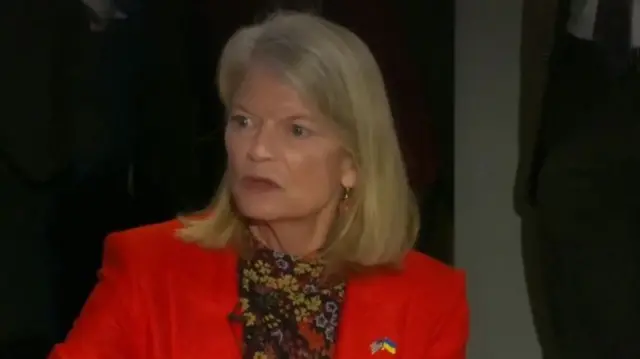
    Alaska Senator Lisa Murkowski wearing a red suit jacket and floral patterned shirt

    Alaska Senator Lisa Murkowski is now asked about her recent visit to Greenland. She says that Greenlanders are "proud", "strong" and "resilient" people.

    It underscored why the self-determination of the people there should be respected, she says.

    She adds that the conversation about acquiring Greenland has "distracted" from other important conversations.

    Arctic nations have been talking about security in the region "for years", she says, before accepting that countries, including the US, do need to "move quicker".

    "It takes the eye off the real issue, the real threat, which is Russia" and "what it is doing with China", she says.

    "We have shared challenges", including things like the economy, she adds, saying there is more that needs to be spoken about.

    On the threats over Greenland, she says: "This is not the way the US should lead."

  6. 'We cannot lower our shoulders,' says Greenland's leaderpublished at 18:17 GMT

    Asked whether he's confident negotiations can appease Trump, Nielsen says "we cannot lower our shoulders".

    The desire to control Greenland is there, he says, but talks are now happening and there have been good steps within Nato.

    Moving back to Pistorius, the German foreign minister is asked whether Nato "dropped the ball" on the Arctic.

    He says Nato has to address the problem of security in the region, "not anybody else". He says threats from one Nato ally to another "damage" the alliance and he thanks European members for their strong reaction to Trump's demands.

  7. Greenland's prime minister calls Trump's threats 'outrageous'published at 18:14 GMT

    Greenland's Prime Minister Jens-Frederik Nielsen holds a microphone while speaking at a conference. He is wearing a navy suit and tie

    Greenland's Prime Minister Jens-Frederik Nielsen says Trump has been "transparent" about his desire to acquire Greenland. "I don't think it's an elephant in the room [anymore]," he says.

    Greenlanders live in a "harsh environment" and are "resilient", he says. "We live in a land where nobody could live... there's reason why we are the ones left," he says, prompting laughter.

    But this is "not just about us", he says, asking: "Imagine a Nato country acquiring an ally... where would the world stand if that happened?"

    He calls Trump's threats "outrageous", but adds that there have been steps in the "right direction" with dialogue channels now open.

    On the threat from Russia and China, he says the "paradox" is that the Greenlandic people never felt threatened until they were threatened by the US.

    What has Trump said about Greenland?

  8. Territorial integrity can't be compromised, says Danish PMpublished at 18:07 GMT

    Frederiksen repeats that she thinks threats to Greenland from the US remain but that the pressure is "unacceptable".

    She says Denmark and Greenland have been clear "there are things you can't compromise on" including territorial integrity.

    The Danish prime minister says there's an existing agreement between the US and Denmark that allows Washington to have a "strong footprint" on the island, "and we have always been a very strong, reliable partner" ready to work with the US.

    She says there is now a working group negotiating but there are clear red lines.

  9. Real concern about Russia and China in Arctic, says Alaska senatorpublished at 18:05 GMT

    Alaska Senator Lisa Murkowski is asked about the threat from China. She responds by saying there is real concern about both Russia and China working together in the Arctic.

    "The map hasn't changed... but the threats have," she says, referencing Alaska's close proximity to Russia.

    Climate change is opening up new avenues of commerce and threats to infrastructure, she says, adding that growing cooperation between Russia and China is also a threat.

    She says this is why a strong Nato alliance and a strong Norad are needed, adding: "There is much that must be done."

  10. Geopolitical environment 'shifting rapidly' in Arctic, says Canadian FMpublished at 18:02 GMT

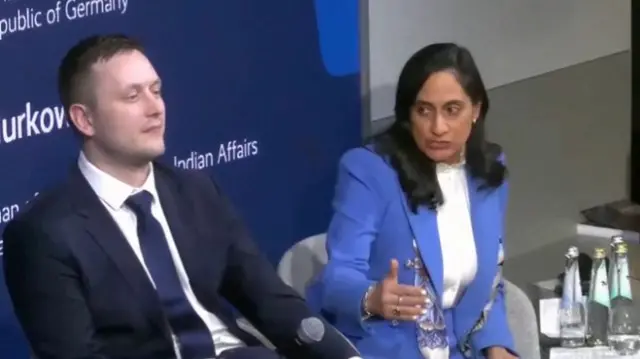
    A man in a suit and tie sat beside a woman in a blue suit, speaking while gesturing her hand

    Back to the panel now, and Canadian Foreign Minister Anita Anand is discussing how the geopolitical environment is "shifting rapidly" in the Arctic.

    This is particularly important for a nation where 40% of its land mass interfaces with the Arctic, she notes.

    Anand tells the summit that Canada's investment in the Arctic didn't happen overnight, and they've in fact been creating policies around the region for years now.

    On the US, she says Canada is "very closely partnered" with them in terms of continental defence.

    She also highlights Canada's recent efforts to further diplomatic channels in the region, noting how earlier this month they opened a consulate in Nuuk, Greenland.

    A consulate in Anchorage, Alaska, she says, will also open soon.

  11. What is Arctic Sentry, the Nato training exercise?published at 18:00 GMT

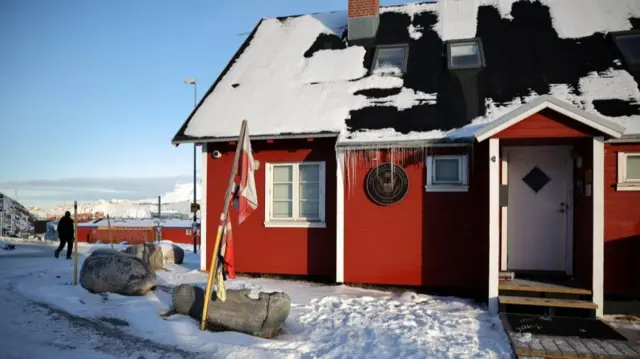
    A person walks near the US Consulate in Nuuk, GreenlandImage source, Reuters
    Image caption,

    After US pressure over Greenland, Nato is bolstering its defences in the Arctic and High North

    We've just heard the panel discuss a Nato training exercise in the Arctic, which Finnish president Alexander Stubb earlier said would involve 20,000 soldiers.

    The exercise, known as Arctic Sentry, will "further strengthen" Nato's position in the region, according to its Allied Command Operations (ACO).

    While Nato members have had a presence in the Arctic since the alliance was founded, this operation will focus on cohering existing activities in the region into "one overarching operational approach", ACO says.

    The operation will "leverage Nato’s strength to protect our territory and ensure the Arctic and High North remains secure," says Nato's top general in Europe, Alexus Grynkewich.

  12. Arctic Sentry will allow Nato to react to variety of situations, says Pistoriuspublished at 17:57 GMT

    German Foreign Minister Boris Pistorius is asked to expand a bit more on what the Arctic Sentry framework entails.

    He says it's a system that will allow Nato to react to a variety of situations in the area "in a way which is appropriate".

    He says Nato has long been concerned about the security of the region, not only Greenland, and the new framework shows there is a commitment to secure it.

  13. Greenland is 'willing to do more' with Nato allies, says PMpublished at 17:55 GMT

    Greenland's Prime Minister Jens-Frederik Nielsen is up next. He says his country "has been at the centre of attention for quite a long time now".

    He says people in the region have been "living in peace and low tension for many, many years", but that they recognise there are "no low-tension areas in the world anymore".

    He adds that Greenland has to play a role in surveillance and security in the region.

    Nielsen says he is happy to have a Nato operation in the region, Arctic Sentry, calling it a "step in the right direction".

    He says Greenland is "willing to do more" with allies in the Nato alliance.

    Atlantic cooperation and the international rule of law are something Greenland is "truly committed on", he says.

  14. Nato more invested in Arctic security than ever before - Danish PMpublished at 17:51 GMT

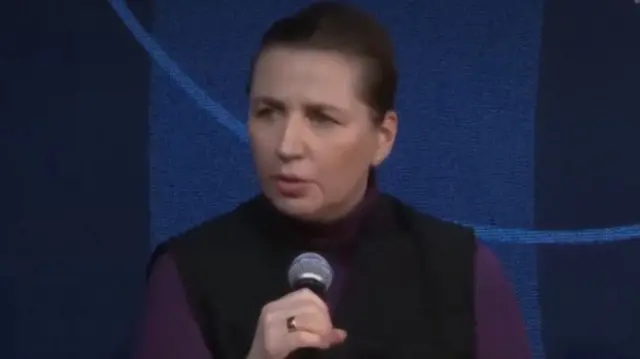
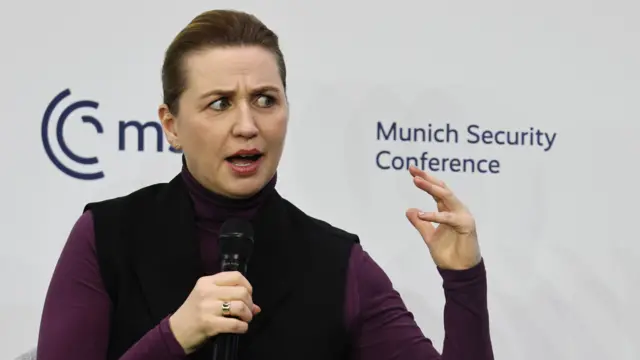
    Danish Prime Minister Mette Frederiksen speaking into a microphone at a press conference. She is wearing a purple long sleeved top with a black polo neck jumper

    Danish Prime Minister Mette Frederiksen begins the remarks on Arctic security by saying that she is "satisfied" that Nato is now more invested in the security of the region than ever before.

    She says that Denmark has been asking for this for "several years", noting that they've asked that Nato have a permanent presence there, but also in and around Greenland.

    Frederiksen stresses that the world is changing - and so is the weather, which she attributes to climate change.

    She notes that because of this, we should be aware of what Russia and China will do around Greenland - "but we are not there yet".

  15. Watch and follow live as Arctic nations discuss region's securitypublished at 17:42 GMT

    One of the final panels that we're hearing from today will spotlight an issue that we've heard quite a lot about already: that is, Arctic security.

    Danish PM Mette Frederiksen and Greenland's PM Jens-Frederik Nielsen will be joined by Canadian Foreign Minister Anita Anand and German Defence Minister Boris Pistorius.

    Alaska Senator Lisa Murkowski - representing US interests in the Arctic region - will also join the panel, which will be moderated by Courtney Kube, a senior national security correspondent with NBC News.

    We'll be keeping an ear out for any key lines from the discussion, but you can also follow along by pressing watch live above.

  16. What has Trump said about Greenland?published at 17:32 GMT

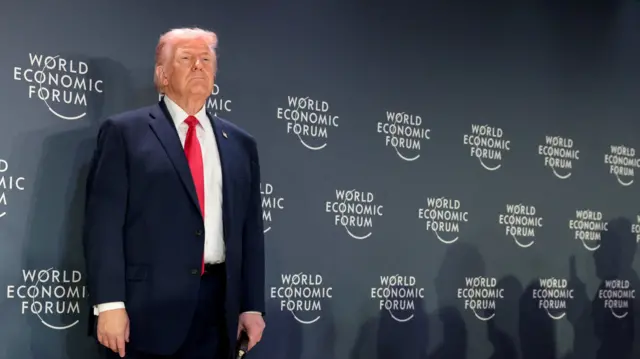
    US President Donald Trump attends a reception with business leaders during the 56th annual World Economic Forum (WEF), in Davos, Switzerland, 21 January 2026Image source, Reuters
    Image caption,

    Trump at the World Economic Forum in Davos earlier this year

    Earlier this year, US President Donald Trump sparked a diplomatic crisis when he spoke again of wanting to "own" Greenland for security reasons. And he threatened eight European allies, including the UK, with tariffs over their opposition to the move.

    Initially, the White House indicated that all options were on the table, including the use of force. But at the World Economic Forum in Davos, Trump changed course, saying he wouldn't use "excessive force".

    "We would be frankly unstoppable. But I won't do that," the president said.

    Trump later revealed that the US was exploring a "framework of a future deal" on Greenland after talks with Nato, and backed off from tariff threats against European allies.

    Conversations are ongoing between the US, Denmark and Greenland to try to resolve the impasse, including US concerns around what it describes as a security threat from Russia and China.

    Denmark and Greenland have made it clear that Greenland's sovereignty is a red line for them in any deal. Meanwhile, Nato allies have tried to reassure the US that they will boost security in the Arctic.

  17. Recap: What we've heard from the security summit todaypublished at 17:02 GMT

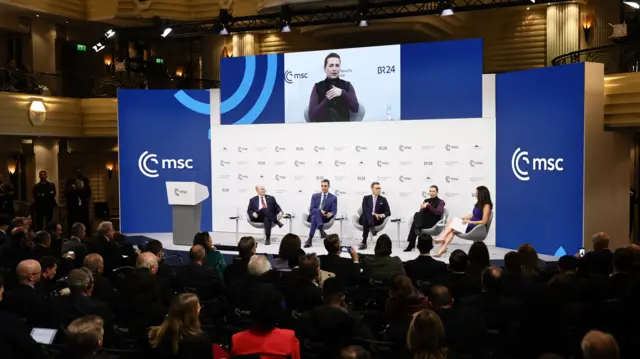
    Danish Prime Minister Mette Frederiksen (on screen) during debate with Spain's Prime minister Pedro Sanchez, President of Republic of Finland and Alexander Stubb during the 62nd Munich Security Conference (MSC)Image source, EPA

    US and Europe 'belong together' - Rubio

    "I think the Europeans sighed with relief," the EU's top diplomat, Kaja Kallas, said after US Secretary of State Marco Rubio's speech.

    Rubio said the US and Europe "belong together", but he also hit out at the region's energy and migration policies, was critical of the UN, and said the US doesn't want allies "who are weak".

    It comes after US Vice President JD Vance's speech last year, which was critical of Europe's policy direction. But our security correspondent Frank Gardner writes that the overriding message from Rubio's remarks is that the US still wants to be an ally of Europe.

    UK to deploy warships to the Arctic

    Keir Starmer announced that the UK will send a fleet of warships and fighter jets to the Arctic in 2026, as Nato allies bolster defences in the region.

    He also called for "deeper links" with the EU, arguing that moving closer to the single market in certain areas would bolster security.

    Zelensky says US too focused on Ukrainian concessions

    Ukraine's President Volodymyr Zelensky called for Europe to have a "common defence policy", saying European unity is the "best interceptor against Russia's aggressive plans".

    Speaking about ongoing talks aimed at ending the conflict, Zelensky said that too often when the US discusses the need for concessions, it is in the context of Ukraine and not Russia.

    Trump still 'very serious' about Greenland

    Danish PM Mette Frederiksen, when asked if the Greenland crisis had passed, said she doesn't believe so, adding Trump is "very serious" about acquiring the island territory.

    "I think the desire from the US president is exactly the same. He’s very serious about this," she said.

  18. Zelensky says peacekeeping force should remain in Ukraine for 20 yearspublished at 16:53 GMT

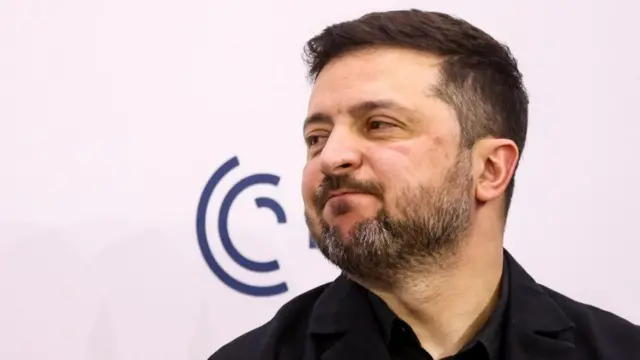
    Zelensky turns to the side and smiles while on stage at the conferenceImage source, Reuters

    We've just heard again from President Volodymyr Zelensky who has been answering questions from reporters about the negotiations to end the war in Ukraine.

    • On the issue of Ukraine joining the European Union ... Zelensky says that Ukraine must be ready to join by 2027 as it is a key part of his country's security guarantees. If there isn't a date agreed to, Russia will block its membership in the future, he says
    • On the peace talks in Geneva next week... he says that he was surprised to learn that Russia had decided to change the leadership of its negotiating team - "it's because they want to postpone decisions", he claims
    • On future security guarantees... Zelensky reiterates the need for a foreign presence after a peace deal is reached to deter any future aggression by Russia. The US, he says, has floated that this peacekeeping force would remain for 15 years after the war, but Ukraine wants a deal for 20 years or longer, he says
  19. Trump still 'very serious' about Greenland, Danish PM warns ahead of panelpublished at 16:35 GMT

    Danish Prime Minister Mette Fredericksen mid-speech, a mic in her right hand as she gestures with her left one. She's in a black button-up vest and purple crew neck shirtImage source, EPA

    In the next hour, we're expecting to hear once more from Danish PM Mette Frederiksen at the Munich Security Conference.

    At 17:30 GMT (18:30 CET), Frederiksen will be joined by her Greenlandic counterpart, Jens-Frederick Nielsen, to discuss Arctic security.

    Among the topics we expect to come up for discussion will be Greenland - and US President Donald Trump's interest in acquiring the world's largest island.

    Earlier today, the Danish PM was asked whether the crisis has passed now that negotiations are taking place between Copenhagen and Washington, to which she replied that she doesn't believe so.

    "I think the desire from the US president is exactly the same. He’s very serious about this," she said.

    She's also reiterated it isn't possible to put a price on the island and that sovereignty needs to be respected - adding that the Greenlandic people have already signalled they do not want to be American.

  20. Machado rejects suggestion she has been sidelined by the USpublished at 15:53 GMT

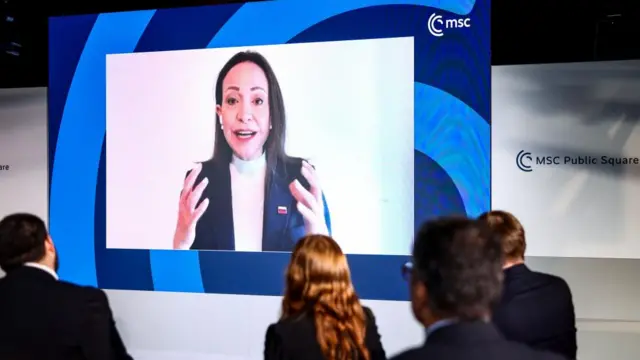
    Venezuelan opposition leader Maria Corina Machado takes part in the Munich Security Conference via videolinkImage source, Reuters
    Image caption,

    Machado takes part in the Munich Security Conference via videolink

    Sticking with the Venezeualan opposition leader, Machado is asked whether she has been sidelined by the US. It's put to her that she is not physically in Venezuela and the US seems to be driving the agenda.

    • As a reminder, Trump said his administration would run Venezuela until a "safe, proper and judicious transition" could take place and it would "indefinitely" control the sale of its oil. Delcy Rodríguez, who was Maduro's vice president before the US raid, is now the acting president.

    The opposition leader says this is an accusation she's heard for many years.

    But she says that even for the 16 months she's been in hiding, she's remained connected to Venezuela.

    Through a network of people on the ground in the country - both "inside and outside" - she says she continues to be a presence in Venezuela and rejects the assertion that she's been sidelined.

    "We never stopped working, organising and communicating."

    When pressed about when general elections could take place inside the country, Machado doesn't give a precise timeline.

    But she says there is enthusiasm inside the country for free and fair elections and they should happen "as soon as possible".