Summary

  1. Israel and Hezbollah in Lebanon exchange firepublished at 04:50 GMT

    We're into the third day of the widening US-Israeli strikes on Iran.

    Here is what has happened in the last few hours:

    We're continuing our live coverage on this page - join us there.

  2. Iran's 'scorched earth policy' shakes Gulf business modelpublished at 04:33 GMT

    Suranjana Tewari
    Asia Business Correspondent

    The strikes across the Gulf - forcing airport closures, disrupting port operations and sending shockwaves through financial markets - mark the region’s most widespread business disruption since the pandemic.

    “Iran has adopted a scorched earth policy. It has attacked airports in the Gulf and will likely continue to do so,” said aviation analyst Shukor Yusof.

    Cities such as Dubai, Abu Dhabi and Doha have spent decades diversifying beyond oil and gas, building economies centred on aviation, tourism, finance and logistics, supported by large expatriate workforces and international investment.

    Dubai alone recorded about 20mn international overnight visitors last year, according to the government.

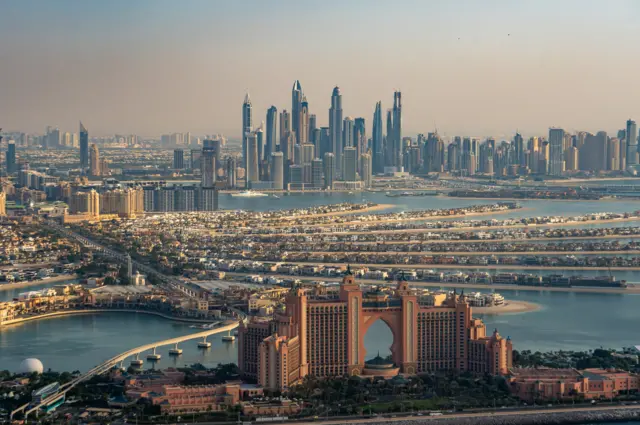
    Strikes hitting residential areas around Dubai Marina and Palm Jumeirah - setting the Fairmont The Palm ablaze and damaging the Burj Al Arab - underscore the exposure of the emirate’s real estate and hospitality sectors.

    Higher oil prices may cushion producers like Saudi Arabia and Qatar, but trade, logistics and tourism - particularly in the UAE - face mounting pressure.

    Airspace closures threaten the Gulf’s role as a reliable transit hub linking Asia, Europe and Africa, while cancelling the communal meals that break and begin the daily fast during the holy Islamic month of Ramadan will disrupt the networking culture that underpins business across the region.

    An aerial view over Dubai skyline, from the Palm island to the Dubai Marina.Image source, Getty Images
  3. Marco Rubio to brief House and Senate leaders at 16:00 ET on Tuesdaypublished at 04:26 GMT

    Earlier we reported that US Secretary of State Marco Rubio is set to brief Congress on Iran on Tuesday.

    We can now confirm that the briefing will take place at 16:00 ET (21:00 GMT). He is set to speak to House and Senate leaders on Capitol Hill, according to his public schedule.

  4. 'It's absolutely miserable,' man fleeing southern Lebanon tells BBCpublished at 04:04 GMT

    Alice Cuddy
    Reporting from Beirut

    We’ve just received voice notes from a man from southern Lebanon as he flees with his family.“It’s absolutely miserable,” said the 55-year-old shop owner. "We were just sitting at home and then suddenly this happened. We were shocked and we quickly packed and woke up the kids and got in the car. Now we’re stuck on blocked roads because of the massive displacement from the south.”

    The father of three, who asked not to be named, says he is driving “without knowing where we are heading or where we will end up”.

    He added that his parents, living in the southern Beirut suburb of Dahieh were also “stuck and trying to get out”.

    "We are worn out having to leave our homes and our land time and time again,” he said.

    The Israeli military has called on people in dozens of villages in eastern and southern Lebanon to evacuate ahead of possible further strikes.

  5. Evacuations in Lebanon as Israel orders dozens of villages to leavepublished at 03:58 GMT

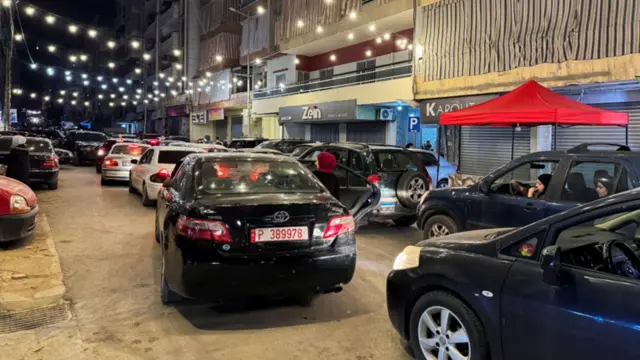
    It is currently approaching 06:00 local time in Lebanon, and people are leaving their homes after the IDF told residents of more than 50 villages to evacuate.

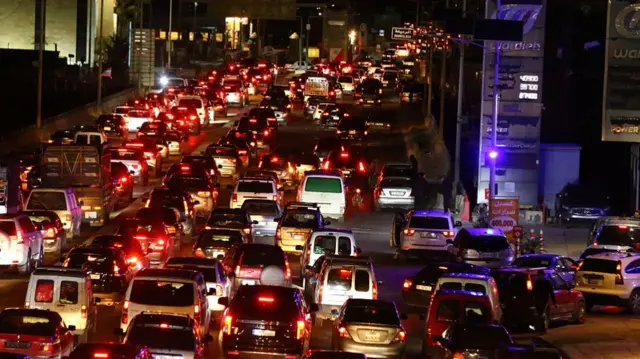
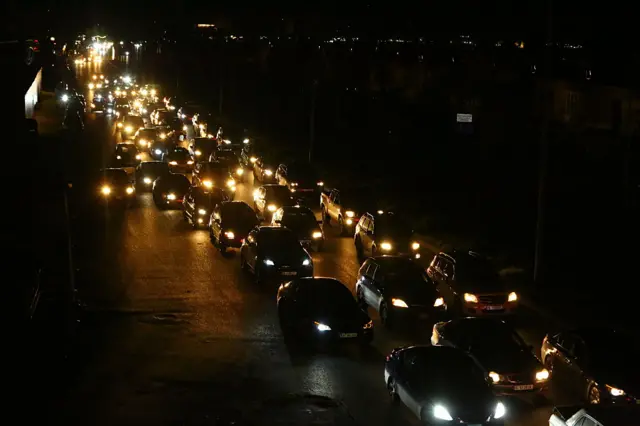
    Below are images of traffic jams in Beirut and Sidon as people leave.

    A queue of cars on a brightly lit street in BeirutImage source, Reuters
    Image caption,

    People evacuate from southern Beirut on their cars.

    Rear view of a logjam on in Sidon LebanonImage source, Getty Images
    Image caption,

    Elsewhere, in Sidon, people evacuating has caused traffic jams/

    Rear view of a logjam on in Sidon LebanonImage source, Getty Images
    Image caption,

    The evacuation order was issued in the early hours of Monday morning.

  6. Israel tells residents of more than 50 villages in Lebanon to evacuatepublished at 03:27 GMT
    Breaking

    Israel has told residents of more than 50 towns and villages in Lebanon to evacuate, as it warned of attacks.

    People in the identified areas must move at least 1,000 metres away to open areas.

    "For your safety, you must evacuate your homes immediately and move at least 1,000 metres away from the villages to open areas," the warning says.

    "Anyone who is near Hezbollah members, its facilities or its military assets is putting their life at risk."

    The villages listed are: Sarifa, Maaroub, Selaa (Tyre), Debaal, Bafliyeh, Barish, Arzoun, Qlayleh, Al-Shahabiya (Tayr Zibna), Dardghaya, Bastiyat, Arab Salim, Housh al-Rafqa, Yahmar (West Bekaa), Maydoun, Dalafi, Ain Qana, Knisseh, Mansouri (Tyre), Majdal Zoun, Mazraat Buyout al-Sayyad, Jabal al-Butm, Zibqin, Al-Samaya, Aytit, Qana, Al-Bayyada (Tyre), Deir Aames, Aita al-Jabal (al-Zout), Hanine (Bint Jbeil), Haris, Haddatha, Mahrouna, Beit Lif, Yater (Bint Jbeil), Shaqra, Houla, Baraachit, Bint Jbeil, Jmaijmeh, Aitaroun, Safad al-Battikh, Al-Bazourieh, Aaynata, Hanawiya, Jannata, Burj al-Shamali, Maarakeh, Siddiqine, Al-Majadel, Wadi Jilo, Drouiss (Baalbek), and Mais al-Jabal.

  7. Iran hit neighbours where it hurts most: Airportspublished at 03:00 GMT

    Osmond Chia
    Business reporter

    As well as the oil industry, the widening conflict is impacting the region's aviation sector.

    Iran has struck its neighbours where it hurts most: their airports, which serve as vital transit hubs for global trade and travel.

    Airports are an economic cornerstone for Gulf countries, bringing in food, their mostly expatriate workforce and facilitating global trade.

    Notably, flights at Doha’s Hamad International Airport - one of the world’s busiest transport hubs - have been halted. The disruption could impact the significant volume of air cargo shipments that pass through the airport to destinations worldwide.

    It is still unclear how long the disruptions will last - and how long countries can afford to bleed.

    We're seeing the effects of these strikes play out in the sinking airline share prices in some Asia Pacific countries as their markets opened this morning.

    Shares of Australia's Qantas Airways, Singapore Airlines and Japan Airlines all dipped by more than 5% on Monday.

    Iran has also targeted seaports and shipping routes, disrupting the Strait of Hormuz - the world’s most critical oil choke point.

  8. Oil prices rise - but 'the market isn't panicking'published at 02:37 GMT

    Peter Hoskins
    Business reporter, Singapore

    Global oil prices have risen after at least three ships were attacked near the Strait of Hormuz, as Iran continues to launch strikes across the Middle East in response to ongoing attacks by the US and Israel.

    Two vessels have been struck, and an "unknown projectile" was reported to have "exploded in very close proximity" to a third, the UK Maritime Trade Operations Centre (UKMTO) said.

    Iran has warned ships not to pass through the strait, which carries about 20% of the world's oil and gas.

    In early trade in Asia on Monday, global oil prices jumped by more than 10% before those gains eased during the morning.

    At 02:00 GMT, Brent crude was more than 4% higher at $76.16 (£56.53) a barrel, while US-traded oil was also up by around 4% at $69.67.

    "The market isn't panicking", Saul Kavonic, head of energy research at MST Marquee, told the BBC.

    "There is more clarity that so far, oil transport and production infrastructure hasn't been a primary target by any side," he added.

    Read more here

  9. What we know as US-Israeli war with Iran enters day threepublished at 02:19 GMT

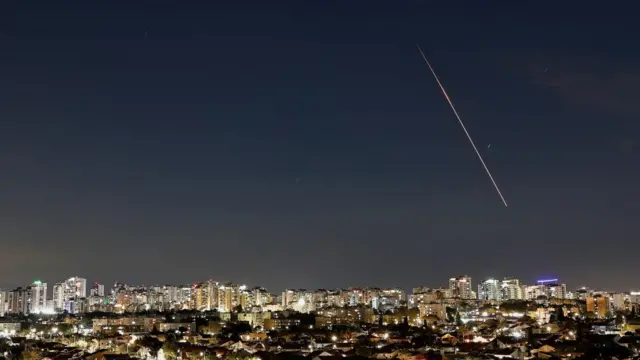
    Huge stream of light in the sky as Israeli anti air defence system kicks inImage source, Reuters
    Image caption,

    Israel's anti air defence system in Ashkelon

    The US-Israeli war with Iran has entered its third day with all sides launching large scale airstrikes.

    Here are the latest developments:

    • Donald Trump has said "combat operations" against Iran will continue "until all of our objectives are achieved" in a video address
    • He said there would "likely be more" US casualties after US Central Command confirmed that three US service members have been killed and five seriously wounded in an Iranian attack
    • In the early hours of Monday Israel began launching strikes on what it said were Hezbollah targets in Lebanon, after the militant group fired rockets at Israel
    • Iranian officials have reported at least 153 people were killed after a strike on a girls' school, with Iran's President Masoud Pezeshkian calling the incident a "barbaric act"
    • Iranian missiles have struck the city of Beit Shemesh killing at least nine people, according to Israel's ambulance service, the Magen David Adom. It is the deadliest attack on Israel since this war began
  10. Beirut residents wake to sound of explosionspublished at 01:59 GMT

    Alice Cuddy
    Reporting from Beirut

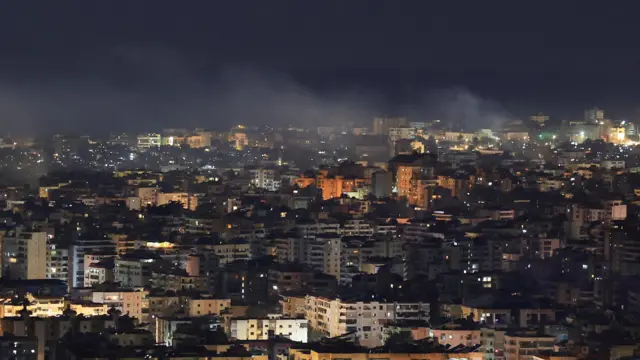
    Smoke is visible over the Beirut skylineImage source, Reuters

    Here in the Lebanese capital Beirut people were woken by a series of explosions that sounded through the city shortly before 03:00 local time, as the Israeli military began striking Hezbollah targets after the Iran-backed group fired rockets at northern Israel.

    In a statement, Hezbollah said it was acting in retaliation for the killing of Iran’s Supreme Leader Ayatollah Ali Khamenei, calling it a “legitimate act of self-defence”.

    It said it had launched a “salvo of precision rockets and a swarm of drones” at a missile defence site in northern Israel. The Israeli military confirmed that it had launched strikes in response, saying it was operating “against Hezbollah’s decision to join the campaign” and would not allow the group to "constitute a threat to the state of Israel and harm the civilians of northern Israel”.

    Israel and Lebanon agreed to a US-mediated ceasefire in 2024, ending more than a year of fighting with Hezbollah that culminated in heavy Israeli strikes on the Iran-backed group. Since then, both sides have accused each other of violating the truce.

    Despite the deal, which followed 13 months of conflict, Israel has carried out near-daily strikes on Lebanon, on targets it says are linked to the group.

  11. Traffic jams as people leave Beirut's southern suburbspublished at 01:44 GMT

    Samantha Granville
    Reporting from Beirut

    Social media video shows plumes of smoke rising over Beirut’s southern suburbs, known as Dahieh.

    Videos show bumper-to-bumper traffic stretching along the airport road and onto the main highways leading north, forming long lines late into the night. Honking has replaced the sound of explosions, but it’s still going to be a long night in Beirut.

    Other pictures online show impact at the main road leading to the airport. Damaged cars and broken glass line the street but it’s unclear the extent of the damage.

  12. Hezbollah says it has launched missiles, drones towards Israelpublished at 01:29 GMT

    A little earlier, we reported a statement from the Israeli military saying it was striking targets in Lebanon in response to projectile fire from Hezbollah.

    Hezbollah has confirmed it has launched missiles and drones from Lebanon towards Israel.

    The group says it's in retaliation for the killing of Iran's supreme leader, Ali Khamenei.

    The projectiles fell in open areas in Israeli territory, according to the Israeli military.

    A Shia Muslim political and military group, Hezbollah has strong backing from Iran and opposes Israel's right to exist.

  13. RAF responding to suspected drone strike at UK base in Cyprus, MoD sayspublished at 01:20 GMT
    Breaking

    A British RAF base in Cyprus was targeted by a "suspected drone strike" on Sunday night, the British Ministry of Defence has said.

    The MoD said the armed forces were responding to the attack at RAF Akrotiri in Cyprus at around midnight local time (22:00 GMT). The BBC understands there were no casualties in the suspected strike.

    "Our force protection in the region is at the highest level and the base has responded to defend our people," the MoD said.

    It comes as Defence Secretary John Healey said British troops and civilians in the Middle East were being put at risk from "indiscriminate attacks" by Iran after the Supreme Leader Ayatollah Ali Khamenei was killed during US and Israeli air strikes.

  14. Lebanese PM warns against launching rockets from southern Lebanonpublished at 01:12 GMT

    Lebanon's prime minister, Nawaf Salam, has just posted a statement on X, warning against launching rockets from southern Lebanon.

    "Regardless of the party standing behind it, the launching of rockets from southern Lebanon is an irresponsible and suspicious act that endangers Lebanon's security and safety and provides Israel with pretexts to continue its attacks on it," he says.

  15. IDF accuses Hezbollah of acting on behalf of Iranpublished at 01:07 GMT

    Samantha Granville
    Reporting from Beirut

    As we just reported, the Israeli military says it has begun striking targets belonging to Hezbollah across Lebanon, in response to projectile fire launched toward Israel.

    In a statement, the Israel Defense Forces accused Hezbollah of acting on behalf of Iran and targeting Israeli civilians.

    It said it would act against the group’s “decision to join the campaign” and would not allow Hezbollah to pose a threat to northern Israel.

    The IDF added that Hezbollah’s actions risk bringing further destruction to Lebanon and said it would respond forcefully to continued attacks.

  16. Israel striking targets in Lebanon, military sayspublished at 01:03 GMT
    Breaking

    The Israeli military has just announced it has begun striking Hezbollah targets in Lebanon.

    The action is "in response to Hezbollah's projectile fire" towards Israel, a statement says.

    Witnesses have reported strikes in Beirut's southern suburbs, according to the Reuters news agency.

  17. US allies in the Gulf bear brunt of Iran attackspublished at 00:39 GMT

    Frank Gardner
    Security correspondent

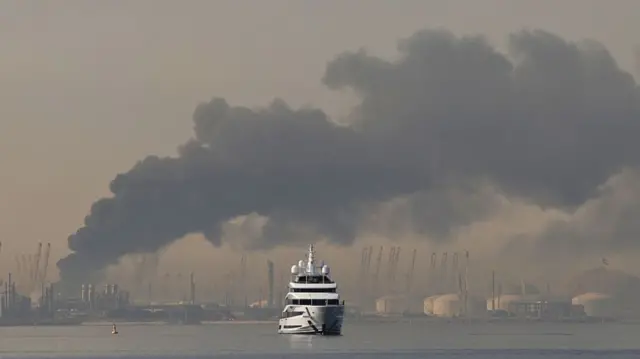
    A yacht sails past a plume of smoke rising from the port of Jebel Ali following a reported Iranian strike in Dubai on March 1, 2026.Image source, Getty Images

    In the clear blue skies above Abu Dhabi, white contrails streak high above the sand-coloured villas and well-watered gardens.

    These are no incoming Dreamliners or Airbuses bringing in the next manifest of tourists and guest workers. They are incoming ballistic missiles, launched by the Emirates' giant neighbour just across the Gulf: Iran.

    As of Sunday afternoon, the United Arab Emirates (UAE) defence ministry said it had so far "dealt with" 165 incoming ballistic missiles, two cruise missiles and 541 Iranian drones.

    These are not familiar scenes in this region, but since this conflict began on Saturday morning, Iran appears to have expanded its target set from just hitting military targets.

    Red more here.

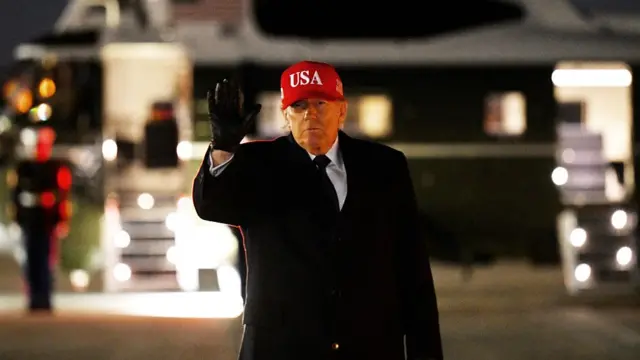
  18. Trump ignores questions on Iran as he returns to White Housepublished at 00:28 GMT

    Donald Trump has ignored questions on Iran shouted by reporters as he arrived back at the White House.

    The US president, who had been at his Florida home, Mar-a-Lago, instead commented on two new statues in the Rose Garden.

    An elderly man in a dark coat, gloves and red baseball cap raises his hand in front of an aeroplane at night timeImage source, Getty Images
    Image caption,

    Donald Trump waves after disembarking from Air Force One earlier

  19. Blasts heard in Tehran as internet remains restrictedpublished at 00:16 GMT

    Ghoncheh Habibiazad
    Senior reporter, BBC Persian

    I was having a chat just now with a Tehran resident who could hear explosions in the distance as we spoke.

    He said his “biggest fear” was that the US would make a deal with the current Iranian leadership. “Khamenei’s death was not enough, they [officials] all need to go,” he said.

    He also said that he has seen security presence in streets on Tehran, but that the streets are mostly empty of people.

    Due to internet restrictions right now, it’s very difficult to have a clear picture of what is going on inside the country.

  20. ‘I see a light go up and boom’ - Erbil resident describes attacks on citypublished at 00:08 GMT

    Gabriela Pomeroy
    Live reporter

    Earlier, I spoke to a British-Kurdish woman who lives in Erbil, Iraq, and works for a local NGO. She asked to remain anonymous, “as we don’t want to attract more attention from the Iranians.”

    “I have seen seven or eight attacks since this morning, and I am a bit shocked,” she says.

    Most of the missiles were intercepted, but one hit a target on Sunday evening, which led to “10-15 minutes of constant explosions.”

    US Central Command has said Erbil’s international airport is among Iran’s targets.

    “I have never seen anything like this - it is very scary,” she says.

    “I have a panoramic view of the city from my two balconies, and we overlook the airport. I see a light go up and boom.”

    “I went to the market today, and people were out shopping as normal, but then suddenly we saw a missile interception above us. It was like in the movies.”

    She says she lives in a compound that is usually bustling with cafes in the evenings, but tonight no one is out.

    “We heard explosions on Saturday when my kids were in the playground - but Sunday was much more intensive.”