Summary

  1. Analysis

    This is a war of choice, US and Iran see it as an opportunity not to be missedpublished at 12:29 GMT
    Jeremy Bowen
    International Editor

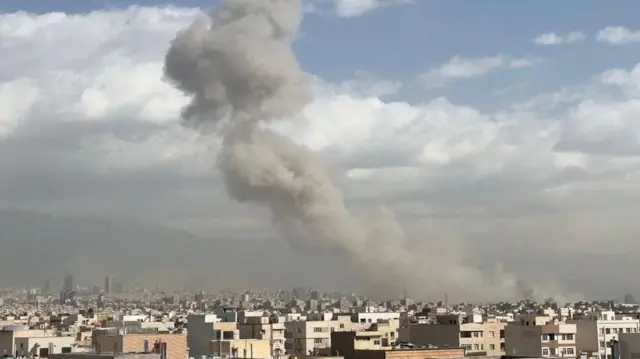
    Smoke rises above Tehran after a strikeImage source, Reuters
    Image caption,

    Smoke rises above Tehran after a strike

    The decision by the United States and Israel to plunge into a new war with Iran creates a highly dangerous moment with unpredictable consequences. Israel used the word "pre-emptive" to justify its attack.

    The evidence is that this is not a response to an imminent threat, which the word pre-emption implies.

    Instead, it is a war of choice.

    Israel and the United States have calculated that the Islamic regime in Iran is vulnerable; dealing with a severe economic crisis, the fallout from the brutal crackdown on protesters at the start of the year and with defences still badly damaged by last summer's war. Their conclusion seems to have been that this was an opportunity that should not be squandered.

    It is also another blow to the tottering system of international law.

    In their statements, both President Donald Trump and Prime Minister Benjamin Netanyahu said that Iran was a danger to their countries - Trump said it was a global danger.

    The Islamic regime is certainly their bitter enemy. But it is hard to see how the legal justification of self-defence applies given the huge disparity of power between the US and Israel on one side and Iran on the other.
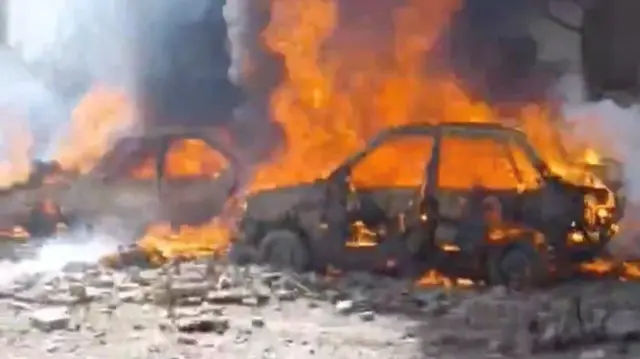
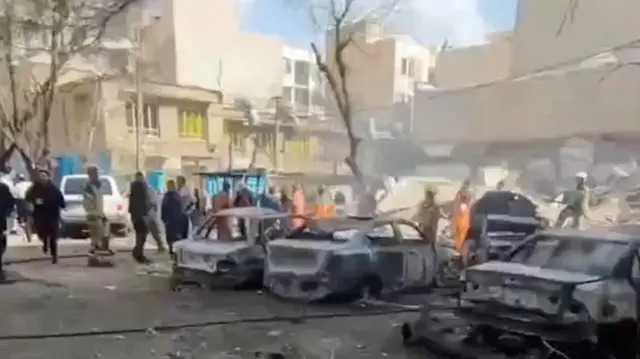
  2. The aftermath of strikes in Iranpublished at 12:22 GMT

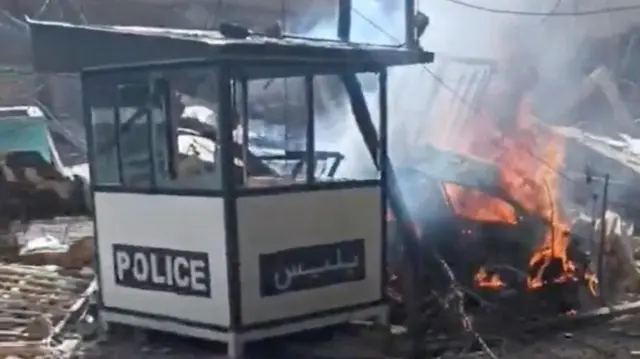
    These images, sourced from social media and verified by Reuters news agency, show the scene in Tehran after US and Israeli strikes:

    Cars burn in Tehran, Iran, fire rages above the vehicleImage source, Reuters
    People gather near a row of burnt vehicles in Tehran, IranImage source, Reuters
    Flames rise in an area in Tehran, as a small structure that says police lies empty in IranImage source, Reuters
  3. Debris fired into air as video captures moment strike hits Bahrainpublished at 12:12 GMT

    Merlyn Thomas
    BBC Verify correspondent

    Media caption,

    Video shows moment missile strikes Bahrain

    Videos are emerging of Iran's retaliatory strikes across the Middle East. There are US airbases across the region, which are likely targets.

    Bahrain is one of several countries in the Gulf to have been hit. One verified clip, filmed from a moving vehicle, shows the moment a missile strikes. An explosion follows, sending fragments and debris into the air. People inside the vehicle can be heard shouting "oh my God" as it speeds down the road.

    It's rare to see footage showing the exact moment of impact. Most videos we analyse show the immediate aftermath or damage, but this clip shows exactly how quickly events can turn.

    Bahrain's National Communication Centre says the service centre of the US Navy’s Fifth Fleet has been "subjected to a missile attack". It is responsible for operations across the Gulf, Red Sea, Arabian Sea, and parts of the Indian Ocean.

    Other verified footage from Bahrain shows dark plumes of smoke rising as sirens sound across the city.

    Tasnim news agency, which is affiliated to the Islamic Revolutionary Guard Corps, has said that "all US bases and interests in the region have been targeted by Iranian missiles".

  4. Arab allies fear Iranian state could collapsepublished at 12:07 GMT

    Barbara Plett Usher
    Reporting from Doha

    We continue to hear explosions in Doha and they are being reported around the region.

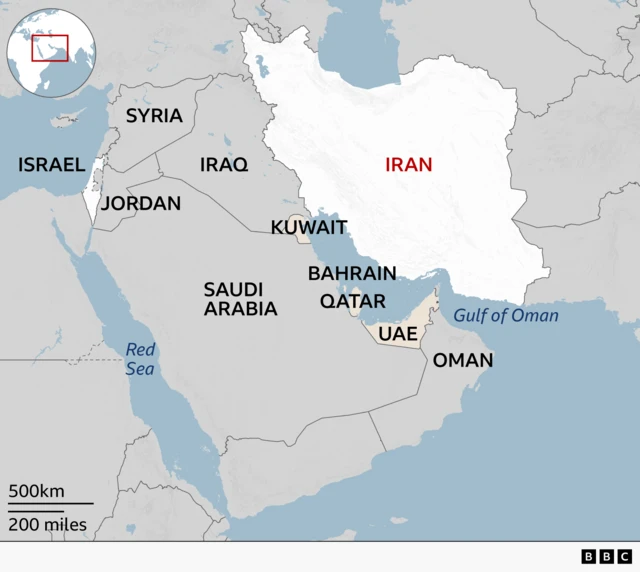
    The Qataris, the United Arab Emirates, Kuwait, Bahrain and Jordan say they are intercepting missiles fired from Iran at US military bases on their territory.

    Some of them have said they reserve the right to respond, but they would almost certainly calculate that move very carefully.

    This is exactly the outcome that regional leaders have been working very hard to prevent over the past weeks, throwing themselves into efforts to mediate between Iran and the United States.

    It’s clear now that the Trump administration took advice from Israel rather than that of its Arab allies.

    The Arabs are concerned that the US and Israeli air strikes will destabilise the region and draw it into the war.

    They fear that Iran could strike not only the US targets on their soil, but also infrastructure such as gas and oil facilities, or possibly close the Strait of Hormuz through which oil exports are shipped.

    In a worst case scenario, they worry that the Iranian state could collapse, leading to a flow of refugees and weapons across their borders, especially as Trump has made clear the aim of the operation is regime change.

  5. Panic in the streets, but relief for some: The mood in Iranpublished at 12:02 GMT

    Baran Abbasi
    BBC Persian

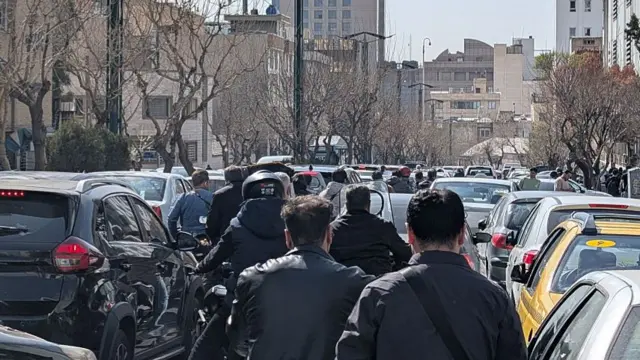
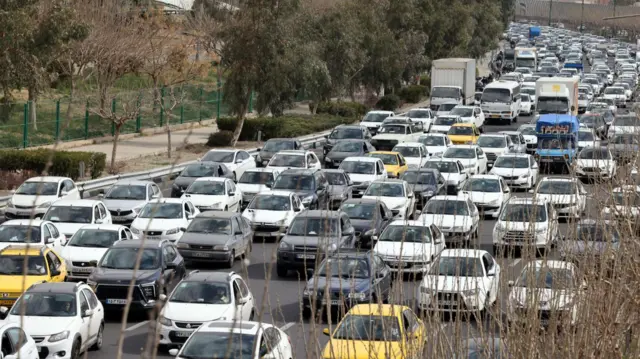
    Iranians try to clear a street amid heavy traffic in Tehran, Iran.Image source, Getty Images

    In Iran, the response to the attacks has been deeply mixed, with scenes of panic in some areas and relief in others at the prospect of the regime’s downfall.

    It was around 09:40 when Iranians in several cities reported hearing loud explosions.

    Videos circulating on social media show people near the blast sites running in panic, with the sounds of screams and crying in the background.

    But, at the same time, there appears to be a sense of relief - even celebration - among those who believe the regime’s downfall can only come through military intervention.

    Many people had been anticipating a possible US attack. Reactions to it by Iranians have been deeply mixed.

    "If I die, don’t forget that we exist too - those of us who oppose any military attack, those of us who will become just a number in reports of the dead," one Iranian wrote on social media.

    Another wrote: "Damn the Islamic dictatorship that caused this war. We have already endured three wars."

    Many Iranians who lived through what has been described as one of the bloodiest crackdowns on civilians in modern history say they now welcome regime change - even if it comes through military intervention and the killing of senior officials.

    Others, however, fear that airstrikes alone may not bring about the regime’s collapse. They worry it could survive and, in response, become even more brutal towards its own people.

  6. 'Legitimate right of self-defence': Iran issues statement to Gulf statespublished at 11:47 GMT

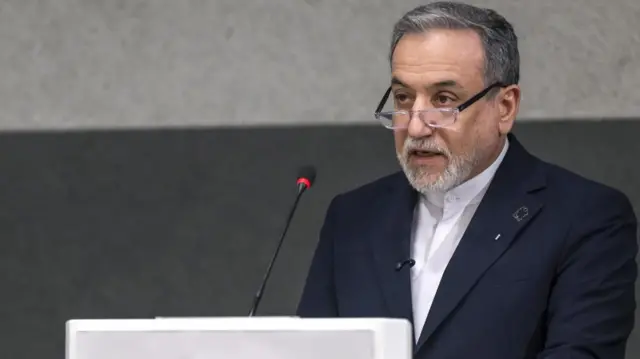
    Abbas AraghchiImage source, EPA

    Iran's Foreign Minister Abbas Araghchi says the country will use all its military means under its right of self-defence to protect itself.

    A statement says Araghchi has made phone calls with counterparts in countries including Saudi Arabia, the UAE, Qatar, Kuwait, Bahrain and Iraq, telling them Iran will use "all its defensive and military capabilities under legitimate right of self-defence" to protect the integrity of Iran.

    Araghchi also "reminds" these countries of "their responsibility to prevent the misuse of their facilities and territories" by the US and Israel to attack, according to the statement.

  7. How world leaders are reactingpublished at 11:28 GMT

    Following US and Israel's strikes on Iran - and Tehran's retaliation - we've been hearing from world leaders:

    EU Commission President Ursula von der Leyen reminds us that the European bloc has adopted "extensive sanctions" in response to Iran’s "murderous regime". "We call on all parties to exercise maximum restraint, to protect civilians, and to fully respect international law."

    Italy’s Prime Minister Giorgia Meloni’s office expresses solidarity with Iran’s civilian population, saying it continues to demand respect for civil and political rights. The office adds that Meloni will consult allies and regional leaders to support efforts to ease tensions.

    Australia’s Prime Minister Anthony Albanese says his country "stands with the brave people of Iran in their struggle against oppression" and supports the US in efforts to prevent Iran from obtaining a nuclear weapon.

    Meanwhile, Russia’s foreign ministry describes the US and Israel’s actions as "reckless", saying they violate international law. Russia calls for a return to political and diplomatic solutions.

    Earlier, a UK government spokesperson said the country does "not want to see further escalation into a wider regional conflict", adding, "we stand ready to protect our interests".

    Queues of cars in Tehran earlier on SaturdayImage source, EPA
    Image caption,

    Queues of cars in Tehran earlier on Saturday

  8. Airlines halt flights to Middle Eastpublished at 11:22 GMT

    Marc Ashdown
    Business correspondent

    All the major airlines have diverted or cancelled flights to the region, citing safety, and apologising to customers.

    Virgin Atlantic said it had cancelled its VS400 service from London Heathrow to Dubai and warned that flights to the Maldives, India and Saudi Arabia might experience longer flight times due to re-routing.

    British Airways has cancelled flights to Tel Aviv and Bahrain until Wednesday, and today's service to Amman is grounded too.

    The BA123 service from Heathrow to Doha, which took off on time at 8pm last night, was also ordered to turn around a third of the way into the trip. A few hours later the 200 plus passengers found themselves back on the tarmac in London.

    Wizz Air confirmed that it has suspended all flights to and from Israel, Dubai, Abu Dhabi and Amman with immediate effect up until and including next Saturday. Flights to and from Saudi Arabia will be cancelled until Tuesday.

    Emirates has temporarily suspended its operations. Lufthansa, Air India and Turkish Airlines are other carriers to have announced cancellations for the region.

    A regional map highlighting Iran in white with its name in red. Countries that have come under fire from Iran are labelled in beige - Kuwait, Bahrain, Qatar, UAE. Surrounding countries are labeled in grey, neighbouring Iraq to the west and other Middle Eastern countries including Syria, Jordan, Saudi Arabia and Oman. Bodies of water such as the Red Sea and the Gulf of Oman are marked in blue.
  9. BBC Verify

    'They hit hard': Videos show aftermath of strikes on Tehranpublished at 11:14 GMT

    By Merlyn Thomas and Paul Brown

    Several verified videos from Tehran show large plumes of smoke rising above the capital.

    One clip, filmed at a busy intersection, shows traffic slowing as drivers and pedestrians look up at the sky. In the footage, one person can be heard saying: "They hit it hard. Where did they hit? They’re saying it’s Khamenei’s residence."

    We have located this video within a kilometre of Leadership House, the office of Iran’s Supreme Leader, Ayatollah Ali Hosseini Khamenei. It’s not clear from the video angle if it was a direct hit on the building.

    Another verified photo from the same area shows thick, dark columns of smoke rising above residential buildings and small grocery shops. There are also reports of strikes elsewhere in the country.

    BBC Verify is continuing to analyse and verify videos and pinpoint exactly which locations have been hit and what exactly has been targeted.

  10. I asked Trump about strikes yesterday - he said he wouldn't give me the 'scoop'published at 11:04 GMT

    Bernd Debusmann Jr
    Reporting from West Palm Beach

    It's early morning in West Palm Beach, where President Donald Trump is for the weekend.

    I was travelling with Trump yesterday to an event in Corpus Christi, Texas, where Trump - despite repeated questions from the travelling press pool - gave no indication that anything was imminent.

    In fact, at one point I very specifically asked him about the potential timeline of when he believed he would decide on strikes.

    "I'd rather not tell you," he replied. "You would have had the greatest scoop in history, right?"

    Most of the reporters travelling with Trump speculated that attacks were imminent, but unlikely to happen once darkness had already fallen in the US.

    Before the strikes took place, the only plan today was a MAGA Inc dinner in the evening. During the day, there were no public events planned, and I expected we would spend much of the day at a nearby golf course where he often spends his weekend.

    We have yet to hear otherwise, but that is very likely to change.

    Already, reaction is coming in from US lawmakers such as South Carolina Senator Lindsey Graham, who wrote on X that "the biggest change in the Middle East in a thousand years is upon us".

    "This operation has been well-planned. It will be violent, extensive and I believe, at the end of the day, successful," he added.

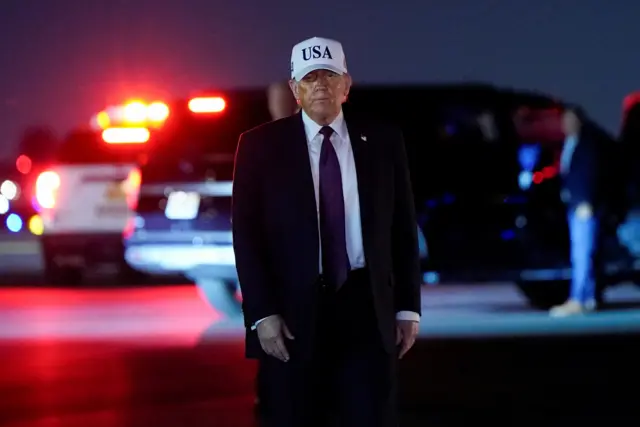
    Donald Trump stood on the tarmac at Palm Beach International Airport, there are red car lights behind him and he is wearing a cap that says 'USA'Image source, Reuters
    Image caption,

    President Donald Trump at Palm Beach International Airport on Friday before the strikes

  11. Analysis

    This conflict could still get a whole lot worsepublished at 10:59 GMT

    Frank Gardner
    Security correspondent

    From up and down the Gulf reports are coming in of explosions, sirens, air defences going into action and plumes of smoke.

    Iran always said it would retaliate against US bases in the region and it has, wasting little time before sending a volley of missiles at America’s Gulf Arab allies.

    "It’s really scary", a British expat resident in Bahrain tells me as he watches a Patriot missile battery intercepting an incoming missile right overhead.

    This is not the first time that the Gulf states, which include the UAE’s hugely popular destination of Dubai, have experienced war.

    There was the Iran-Iraq war in 1980-88, Desert Storm in 1991, the Iraq invasion in 2003 and last year Iran briefly targeted the US airbase in Qatar.

    But this is different. It’s bigger and more dangerous than anything previously.

    Which is why the leaders of Oman, Qatar and Saudi Arabia earlier urged the Trump administration not to attack their big neighbour across the water.

    This conflict could still get a whole lot worse.

  12. 'I thought I remembered how terrifying this is,' Jerusalem resident tells BBC from bomb shelterpublished at 10:52 GMT

    Mallory Moench
    Live reporter

    A resident in Jerusalem, who asked to remain anonymous, tells me she has been inside her bomb shelter for three hours, since the first alert from the government around the time Israel announced it had launched an attack on Iran.

    For the past hour or so, she has heard sirens, tons of impacts that seemed like interceptions from Israel's defence system, and planes overhead.

    "I had thought I remembered how terrifying this situation is from the last time, but I'm unpleasantly surprised by how frightening this is. The knowledge that there is a real threat that a missile could kill me or my loved ones is terrible, and I had forgotten how terrible it feels," she said.

    "I have the convenience of staying here comfortably, which so many Israelis don't have, although I know that this room will not protect me in the case of a direct hit. So I'm trying to figure out if I should go to the public shelter which may be slightly better at withstanding a direct hit," she wrote in a message on WhatsApp.

    About her reaction to Israel's attack on Iran today, she said: "I feel a huge amount of distrust towards my government. I don't believe that they are acting in my interest as a citizen or in the interests of anyone other than themselves in their own fight to remain in power.

    "In short I'm feeling afraid and also extremely angry that we are once again being put in this position - expendable pawns in this absurd jostling for power."

  13. Iranian Supreme Leader's office reportedly hit in strikespublished at 10:46 GMT

    Jiyar Gol
    BBC Persian

    Numerous explosions have been heard in Tehran and number of cities across Iran.

    The office of Iran’s Supreme Leader and the presidential office in Tehran were also reportedly targeted.

    Military sites have been targeted in Kermanshah, Qum, Isfahan, Tabriz, Karaj and as well as at Iranian naval facilities in Kenarak in the south of the country. A video we have received from the small city of Kamyaran in Kurdish region, showsan IRGC base is bombed.

    The Israel Defense Force warned Iranian civilians to evacuate areas near military sites and installations ahead of the strikes.

    There are images from Tehran shows that a residence in Narmak neighbourhood of Tehran, where former president Mahmoud Ahmadinejad lives, has been hit. It is not clear whether the former president is hurt.

    The Iranian interior ministry said the security forces are ready to keep the situation calm and many hospitals across the country are on standby.

  14. UAE says one person killed by debris after Iranian missiles interceptedpublished at 10:38 GMT
    Breaking

    The defence ministry of the United Arab Emirates says in a statement that the country has been subjected to a "blatant attack involving Iranian ballistic missiles".

    "UAE air defence systems dealt with the missiles with high efficiency and successfully intercepted a number of missiles," it adds.

    However, the ministry says debris fell on a residential area in Abu Dhabi, causing some material damage and killing a civilian with Asian nationality, who it does not name.

    It condemns the attack as “dangerous escalation” and “cowardly act”, and stresses that the UAE “reserves its full right to respond".

    The US Air Force operates from Al Dhafra Air Base, south of Abu Dhabi, along with the UAE Air Force.

  15. Trump says he wants 'freedom' for the Iranian peoplepublished at 10:35 GMT
    Breaking

    US President Donald Trump has said his main concern is “freedom” for the Iranian people, and that the US is working to make Iran a place that’s “safe.”

    “All I want is freedom for the people,” Trump has told the Washington Post, speaking with the newspaper in a brief phone call just after 04:00 local time (09:00 GMT) on Saturday.

    Pressed by the Post on what he hoped the legacy of the military operation would be, he says: “I want a safe nation, and that’s what we’re going to have.”

  16. Explosions heard as Al-Udeid US air base appears to be targetedpublished at 10:25 GMT
    Breaking

    Barbara Plett Usher
    Reporting from Doha

    Here in Doha we’ve been hearing explosions as Qatar’s defence ministry said it intercepted several missiles, apparently targeting the al Udeid air base, the largest American military base in the region.

    The interior ministry said the attacks caused no damage.

    We’ve been getting emergency alerts on our phones warning people to stay indoors. There’s still traffic on the roads, but less than on other days.

    Explosions have also been heard in the United Arab Emirates, Bahrain and Kuwait.

    The UAE’s state news agency said one person had been killed after the Emiratis intercepted Iranian missiles.

    In Bahrain the state news agency announced that missiles had struck the US naval base, headquarters of the US Fifth Fleet.

    It’s not clear what the damage was. Iran had vowed to target US bases in the region if it was attacked and its carrying out its threat.

  17. Iran's top security body vows 'crushing response' to US-Israeli strikespublished at 10:18 GMT

    Soroush Negahdari
    BBC Monitoring

    Iran's Supreme National Security Council (SNSC) has promised a "crushing response" following joint US and Israeli air strikes on Iran, noting the attacks occurred "once again during negotiations" with Washington.

    It added that the "enemy" wrongly assumed the Iranian people would "surrender to their petty demands through such cowardly actions".

    The SNSC said Iran's armed forces had already begun retaliatory measures and pledged to "continuously keep the dear people informed".

    It warned that operations by the US and Israel could continue in Tehran and other cities, urging citizens, "while maintaining calm", to travel to safer areas where possible to avoid danger.

    The council also reassured the public that the government had "prepared all societal needs in advance" and that there was "no concern regarding the supply of essential goods", advising people to avoid crowded shopping centres.

    Schools and universities will remain closed until further notice, banks will continue services, and government offices will operate at 50% capacity, the SNSC said, adding further updates would be announced in due course.

  18. Iran says it knew US and Israel had 'intentions' to carry out strikespublished at 10:12 GMT

    Ghoncheh Habibiazad
    BBC Persian

    Iran's foreign ministry says in a statement that although Iran was aware of the "intentions" of the US and Israel to carry out attacks, they entered the negotiations regardless.

    It acknowledges that the strikes happened "while Iran and the United States were in the midst of a diplomatic process".

    The third round of indirect nuclear talks between Iran and the US was held two days ago, on 26 February, in Geneva - without any breakthrough.

    Iran and the US also held five rounds of talks also without progress in May last year, and a sixth round scheduled for June 2025 was cancelled after Israel launched surprise strikes on Iranian targets, triggering a 12-day conflict in which the US hit three key Iranian nuclear sites.

  19. Explosions heard in Doha, as Qatar says it 'countered several attacks'published at 10:05 GMT
    Breaking

    David Gritten
    BBC News Middle East

    Explosions and air raid sirens have been heard in Qatar’s capital, Doha.

    Qatar’s defence ministry said it had "successfully countered a number of attacks targeting the country's territory", according to state media.

    A Qatari official told AFP news agency that a US-made Patriot battery had intercepted an Iranian missile.

    Qatar hosts Al Udeid Air Base, the largest US military facility in the region.

  20. UK not involved in attack, BBC understandspublished at 09:58 GMT

    It is understood that the UK did not participate in the US-Israeli strikes on Iran.

    Prime Minister Keir Starmer is expected to chair a meeting of the government's emergency Cobra committee on Saturday.