Summary

  1. Iran continues to launch missiles at Israel, says IDFpublished at 13:59 GMT

    A few minutes ago, the Israel Defense Forces said Iran has launched missiles towards Israel and warning alerts have been activated.

    This is the seventh alert from the IDF Telegram channel since this morning, with the first one issued at 10:09 local time (08:09 GMT).

  2. What’s going on in Tehran now after strikes?published at 13:55 GMT

    Ghoncheh Habibiazad
    Senior reporter, BBC Persian

    With internet access in Iran almost impossible due to the outage, I was on a video call with someone in the capital connected via satellite internet Starlink.

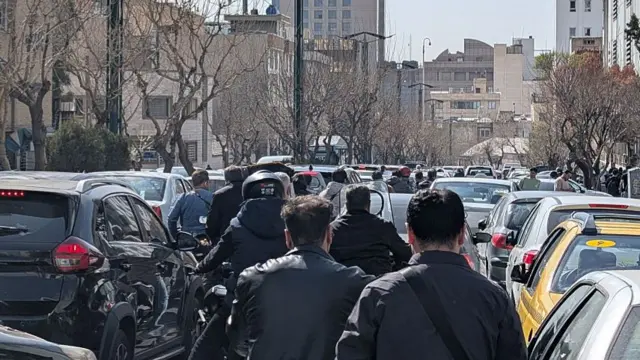
    They showed me streets in Tehran that were quieter than usual, while there were queues at petrol stations across the city, likely made up of those wanting to flee after the strikes.

    They also said there was a heavy security presence on streets leading to the compound of the Leadership House, the office of Iran’s Supreme Leader, Ali Khamenei.

    The driver's seat view of a car driving along an Iranian road
  3. Iranian state media denies reports senior officials and army chief killedpublished at 13:47 GMT

    BBC Monitoring

    Iranian state media have denied reports that senior political officials and the country's army chief were killed in a wave of US-Israeli strikes on the country today.

    President Masoud Pezeshkian is safe, his executive deputy, Mohammad Jafar Qaempanah says in a post on X, external. The president's son, Youssef Pezeshkian, writes on Telegram, external that "this time their assassination attempts have not succeeded".

    The army has denied the death of its commander Maj Gen Amir Hatami, and the hardline Fars News Agency says Parliament Speaker Mohammad Baqer Qalibaf and the head of the Supreme National Security Council (SNSC) Ali Larijani remain unharmed.

    The Israel Defense Forces (IDF) has said its strikes in Tehran targeted locations where senior political and security figures were gathered.

  4. Iranian official says girls' school death toll rises to 53 - reportpublished at 13:31 GMT
    Breaking

    The death toll after a strike on a girls' school has risen to 53, according to Iran's state-run Islamic Republic News Agency (IRNA), which cites a spokesperson for the country's ministry of education.

    Ali Farhadi tells the agency the school was "targeted by three missile attacks" today. He also says that an additional 63 people were also injured in the attacks.

    The spokesman added that the school is being cleared of debris to search for other possible victims.

    The BBC has not been able to independently verify this - international news organisations are often refused visas to Iran which severely limits their ability to gather information about what’s going on inside the country.

  5. Images from motorway in Kuwait show aftermath of reported strikepublished at 13:20 GMT

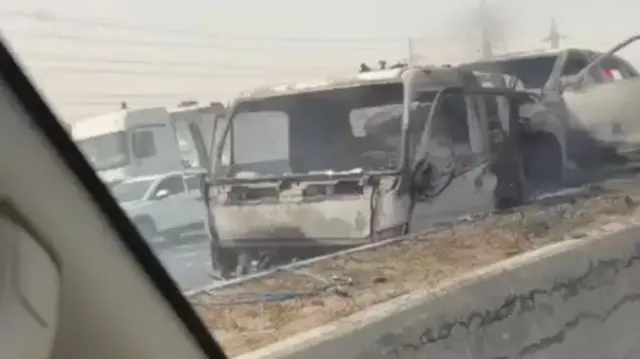
    Burned out truck, in image taken from road in Kuwait following apparent strike

    The BBC has received images taken on a motorway in Kuwait, which appear to show the aftermath of a reported strike.

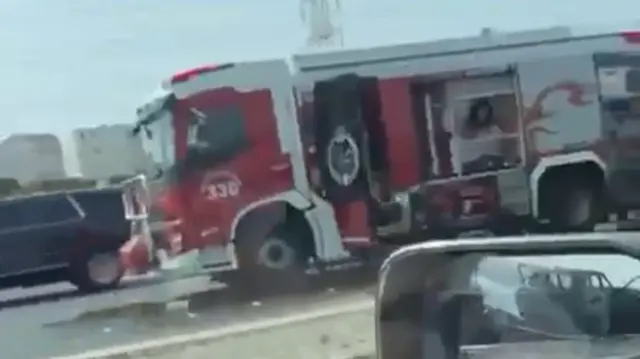
    A burned-out truck can be seen, as well as what appears to be a fire engine.

    Earlier, Col Saud Abdulaziz Al-Atwan, the spokesperson for Kuwait's Ministry of Defence, posted on X that the Ali Al-Salem airbase (where the US air force has a presence) had been targeted by a number of ballistic missiles, but that Kuwaiti air defence forces had successfully intercepted them.

    He says this resulted in debris and shrapnel falling in the vicinity of the base.

    Vehicle that appears to be fire truck, in image taken from road in Kuwait following apparent strike
  6. Analysis

    No answers from White House on when press can meet with Trumppublished at 13:13 GMT

    Bernd Debusmann Jr
    Reporting from West Palm Beach

    It's now just after 08:00 (13:00 GMT) in Florida, where US President Donald Trump is travelling for the weekend.

    The reporters with him on the trip - which includes the BBC - have been pressing the White House for clarity on if, or when, we might hear from him or have chance to ask questions.

    We so far have had no answers.

    Originally, reporters were told to prepare to gather early this morning, ahead of what we initially anticipated would be a rather straightforward golf outing.

    That time has now been pushed back repeatedly. If we do meet with him, we would first have to be "swept" by US Secret Service agents.

    That process is often long and thorough, meaning it's likely that we wouldn't be able to see him until slightly later in the day.

    Of course, we may well hear from him earlier via Truth Social or in another video post, and things often change quickly on these trips if there is breaking news.

  7. Strikes targeted Iran's senior political, security figures - IDFpublished at 13:06 GMT
    Breaking

    The Israel Defense Forces (IDF) says its strikes in Tehran targeted locations where senior political and security figures were gathered.

    In a statement, the IDF says it had prepared for the operation with a months-long plan, focusing its military intelligence agency's efforts to seize an opportunity when Iran's ruling elites assembled.

    It also says that striking in the morning rather than overnight achieved "tactical surprise".

    The IDF is now assessing the results of the strike, the statement adds.

  8. Jordan shoots down two ballistic missilespublished at 13:03 GMT

    Jordan, which borders Israel, says its armed forces shot down two ballistic missiles targeting its territory.

    Minister of Government Communication and Official Spokesperson Mohammad Momani said in remarks to Petra that debris fell in various locations across the Kingdom.

    He said it was dealt with by relevant authorities, which took the necessary measures.

    He said Jordan was closely monitoring developments in the region, reiterating that the Kingdom's top priority was safeguarding its security and the safety of its people.

  9. Iranian says locals have 'sixth sense' for US attackspublished at 12:53 GMT

    Hamidreza Gholamzadeh, director of Diplo House, a think tank on Iranian foreign policy, earlier told BBC Weekend programme that he heard fighter jets and two explosions early in the morning from his office in northern Tehran.

    Speaking to the BBC before the US confirmed its involvement in the strikes, Gholamzadeh described the atmosphere as tense, adding that there was "a sense of war in the air".

    The Iranian people were anticipating the attacks, he said. Gholamzadeh said over the weekend he saw long queues at fuel stations, with people shopping and stocking up on canned food.

    "When the news came out that Trump was saying he wants a deal with Iran, many people were saying it seemed dangerous and a cover for a possible attack against Iran," he says.

    "We see that the sixth sense of people in Iran is correct when it comes to the distrust they have of the United States."

    Gholamzadeh said there is no such thing as a limited attack against the country. "Any limited attack will be treated as an all-out war."

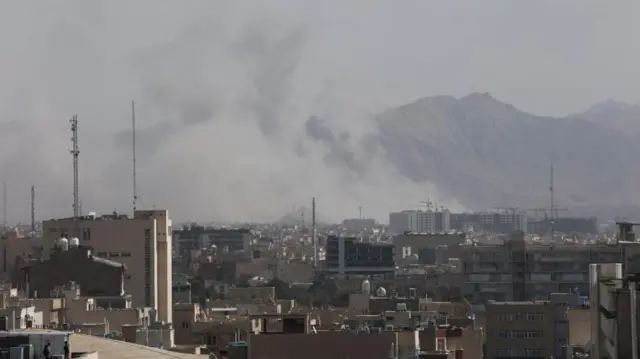
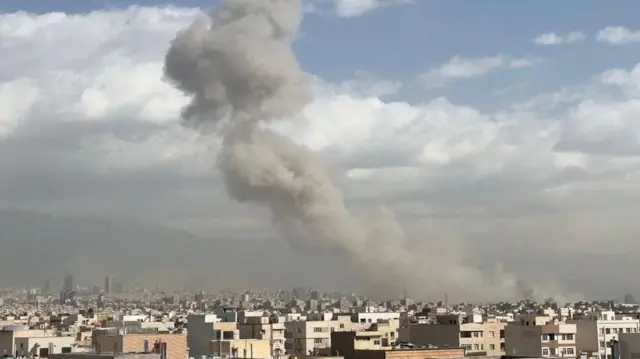
    Smoke rising above Tehran earlier after US-Israeli strikesImage source, Reuters
    Image caption,

    Smoke rising above Tehran earlier after US-Israeli strikes

  10. US-Israeli strikes 'wholly unprovoked, illegal and illegitimate' - Iranian foreign ministerpublished at 12:44 GMT
    Breaking

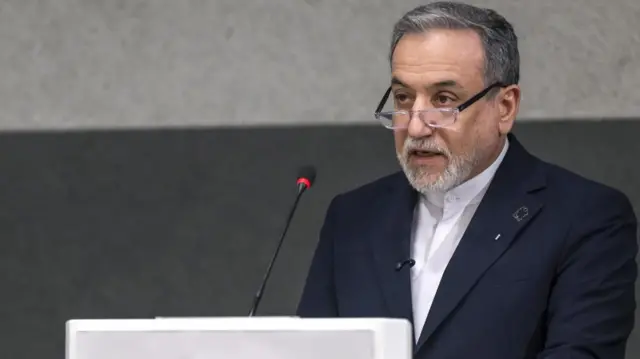
    Iran's Foreign Minister Abbas Araghchi has called the joint US and Israel strikes "wholly unprovoked, illegal, and illegitimate".

    In a post on X he adds that Donald Trump has turned "America First into Israel First - which always means America Last".

    He adds that Iran's powerful armed forces "are prepared for this day and will teach the aggressors the lesson they deserve".

  11. Iran says 40 killed after strike on girls' school - reportspublished at 12:38 GMT

    BBC Monitoring

    A local official has told state-run IRNA news agency that 40 people were killed in an Israeli strike on a girls' primary school in Iran’s southern Minab county in Hormozgan province on 28 February.

    Governor Mohammad Radmehr said that 48 others were wounded and the death toll from the attack on the Shajareh Tayyebeh girls' school was rising.

    The BBC has not been able to independently verify this - international news organisations are often refused visas to Iran which severely limits their ability to gather information about what’s going on inside the country.

    Separately, there is a "near-total" internet blackout in Iran, as well there having been an earlier cyber attack.

  12. Analysis

    This is a war of choice, US and Iran see it as an opportunity not to be missedpublished at 12:29 GMT

    Jeremy Bowen
    International Editor

    Smoke rises above Tehran after a strikeImage source, Reuters
    Image caption,

    Smoke rises above Tehran after a strike

    The decision by the United States and Israel to plunge into a new war with Iran creates a highly dangerous moment with unpredictable consequences. Israel used the word "pre-emptive" to justify its attack.

    The evidence is that this is not a response to an imminent threat, which the word pre-emption implies.

    Instead, it is a war of choice.

    Israel and the United States have calculated that the Islamic regime in Iran is vulnerable; dealing with a severe economic crisis, the fallout from the brutal crackdown on protesters at the start of the year and with defences still badly damaged by last summer's war. Their conclusion seems to have been that this was an opportunity that should not be squandered.

    It is also another blow to the tottering system of international law.

    In their statements, both President Donald Trump and Prime Minister Benjamin Netanyahu said that Iran was a danger to their countries - Trump said it was a global danger.

    The Islamic regime is certainly their bitter enemy. But it is hard to see how the legal justification of self-defence applies given the huge disparity of power between the US and Israel on one side and Iran on the other.

  13. The aftermath of strikes in Iranpublished at 12:22 GMT

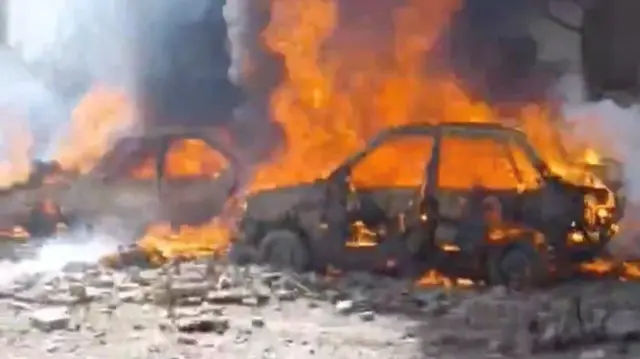
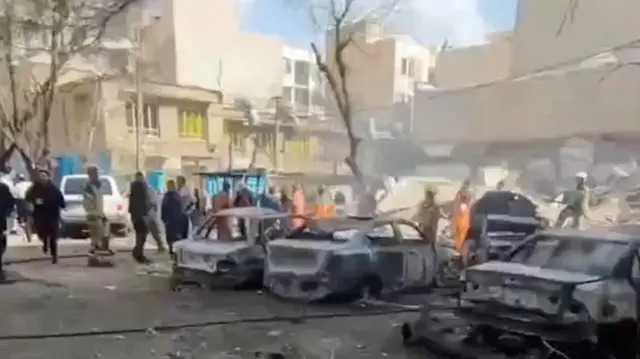
    These images, sourced from social media and verified by Reuters news agency, show the scene in Tehran after US and Israeli strikes:

    Cars burn in Tehran, Iran, fire rages above the vehicleImage source, Reuters
    People gather near a row of burnt vehicles in Tehran, IranImage source, Reuters
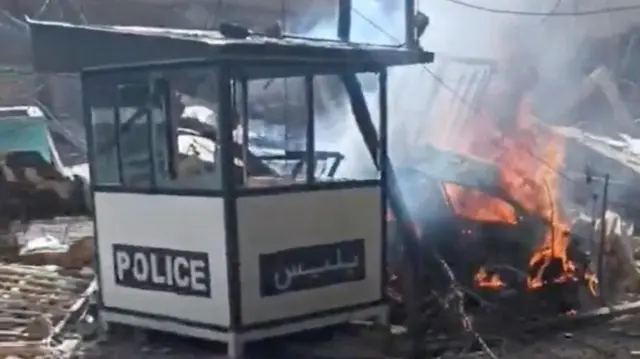
    Flames rise in an area in Tehran, as a small structure that says police lies empty in IranImage source, Reuters
  14. Debris fired into air as video captures moment strike hits Bahrainpublished at 12:12 GMT

    Merlyn Thomas
    BBC Verify correspondent

    Media caption,

    Video shows moment missile strikes Bahrain

    Videos are emerging of Iran's retaliatory strikes across the Middle East. There are US airbases across the region, which are likely targets.

    Bahrain is one of several countries in the Gulf to have been hit. One verified clip, filmed from a moving vehicle, shows the moment a missile strikes. An explosion follows, sending fragments and debris into the air. People inside the vehicle can be heard shouting "oh my God" as it speeds down the road.

    It's rare to see footage showing the exact moment of impact. Most videos we analyse show the immediate aftermath or damage, but this clip shows exactly how quickly events can turn.

    Bahrain's National Communication Centre says the service centre of the US Navy’s Fifth Fleet has been "subjected to a missile attack". It is responsible for operations across the Gulf, Red Sea, Arabian Sea, and parts of the Indian Ocean.

    Other verified footage from Bahrain shows dark plumes of smoke rising as sirens sound across the city.

    Tasnim news agency, which is affiliated to the Islamic Revolutionary Guard Corps, has said that "all US bases and interests in the region have been targeted by Iranian missiles".

  15. Arab allies fear Iranian state could collapsepublished at 12:07 GMT

    Barbara Plett Usher
    Reporting from Doha

    We continue to hear explosions in Doha and they are being reported around the region.

    The Qataris, the United Arab Emirates, Kuwait, Bahrain and Jordan say they are intercepting missiles fired from Iran at US military bases on their territory.

    Some of them have said they reserve the right to respond, but they would almost certainly calculate that move very carefully.

    This is exactly the outcome that regional leaders have been working very hard to prevent over the past weeks, throwing themselves into efforts to mediate between Iran and the United States.

    It’s clear now that the Trump administration took advice from Israel rather than that of its Arab allies.

    The Arabs are concerned that the US and Israeli air strikes will destabilise the region and draw it into the war.

    They fear that Iran could strike not only the US targets on their soil, but also infrastructure such as gas and oil facilities, or possibly close the Strait of Hormuz through which oil exports are shipped.

    In a worst case scenario, they worry that the Iranian state could collapse, leading to a flow of refugees and weapons across their borders, especially as Trump has made clear the aim of the operation is regime change.

  16. Panic in the streets, but relief for some: The mood in Iranpublished at 12:02 GMT

    Baran Abbasi
    BBC Persian

    Iranians try to clear a street amid heavy traffic in Tehran, Iran.Image source, Getty Images

    In Iran, the response to the attacks has been deeply mixed, with scenes of panic in some areas and relief in others at the prospect of the regime’s downfall.

    It was around 09:40 when Iranians in several cities reported hearing loud explosions.

    Videos circulating on social media show people near the blast sites running in panic, with the sounds of screams and crying in the background.

    But, at the same time, there appears to be a sense of relief - even celebration - among those who believe the regime’s downfall can only come through military intervention.

    Many people had been anticipating a possible US attack. Reactions to it by Iranians have been deeply mixed.

    "If I die, don’t forget that we exist too - those of us who oppose any military attack, those of us who will become just a number in reports of the dead," one Iranian wrote on social media.

    Another wrote: "Damn the Islamic dictatorship that caused this war. We have already endured three wars."

    Many Iranians who lived through what has been described as one of the bloodiest crackdowns on civilians in modern history say they now welcome regime change - even if it comes through military intervention and the killing of senior officials.

    Others, however, fear that airstrikes alone may not bring about the regime’s collapse. They worry it could survive and, in response, become even more brutal towards its own people.

  17. 'Legitimate right of self-defence': Iran issues statement to Gulf statespublished at 11:47 GMT

    Abbas AraghchiImage source, EPA

    Iran's Foreign Minister Abbas Araghchi says the country will use all its military means under its right of self-defence to protect itself.

    A statement says Araghchi has made phone calls with counterparts in countries including Saudi Arabia, the UAE, Qatar, Kuwait, Bahrain and Iraq, telling them Iran will use "all its defensive and military capabilities under legitimate right of self-defence" to protect the integrity of Iran.

    Araghchi also "reminds" these countries of "their responsibility to prevent the misuse of their facilities and territories" by the US and Israel to attack, according to the statement.

  18. How world leaders are reactingpublished at 11:28 GMT

    Following US and Israel's strikes on Iran - and Tehran's retaliation - we've been hearing from world leaders:

    EU Commission President Ursula von der Leyen reminds us that the European bloc has adopted "extensive sanctions" in response to Iran’s "murderous regime". "We call on all parties to exercise maximum restraint, to protect civilians, and to fully respect international law."

    Italy’s Prime Minister Giorgia Meloni’s office expresses solidarity with Iran’s civilian population, saying it continues to demand respect for civil and political rights. The office adds that Meloni will consult allies and regional leaders to support efforts to ease tensions.

    Australia’s Prime Minister Anthony Albanese says his country "stands with the brave people of Iran in their struggle against oppression" and supports the US in efforts to prevent Iran from obtaining a nuclear weapon.

    Meanwhile, Russia’s foreign ministry describes the US and Israel’s actions as "reckless", saying they violate international law. Russia calls for a return to political and diplomatic solutions.

    Earlier, a UK government spokesperson said the country does "not want to see further escalation into a wider regional conflict", adding, "we stand ready to protect our interests".

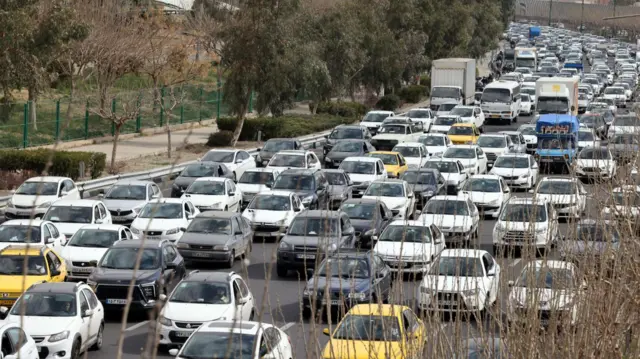
    Queues of cars in Tehran earlier on SaturdayImage source, EPA
    Image caption,

    Queues of cars in Tehran earlier on Saturday

  19. Airlines halt flights to Middle Eastpublished at 11:22 GMT

    Marc Ashdown
    Business correspondent

    All the major airlines have diverted or cancelled flights to the region, citing safety, and apologising to customers.

    Virgin Atlantic said it had cancelled its VS400 service from London Heathrow to Dubai and warned that flights to the Maldives, India and Saudi Arabia might experience longer flight times due to re-routing.

    British Airways has cancelled flights to Tel Aviv and Bahrain until Wednesday, and today's service to Amman is grounded too.

    The BA123 service from Heathrow to Doha, which took off on time at 8pm last night, was also ordered to turn around a third of the way into the trip. A few hours later the 200 plus passengers found themselves back on the tarmac in London.

    Wizz Air confirmed that it has suspended all flights to and from Israel, Dubai, Abu Dhabi and Amman with immediate effect up until and including next Saturday. Flights to and from Saudi Arabia will be cancelled until Tuesday.

    Emirates has temporarily suspended its operations. Lufthansa, Air India and Turkish Airlines are other carriers to have announced cancellations for the region.

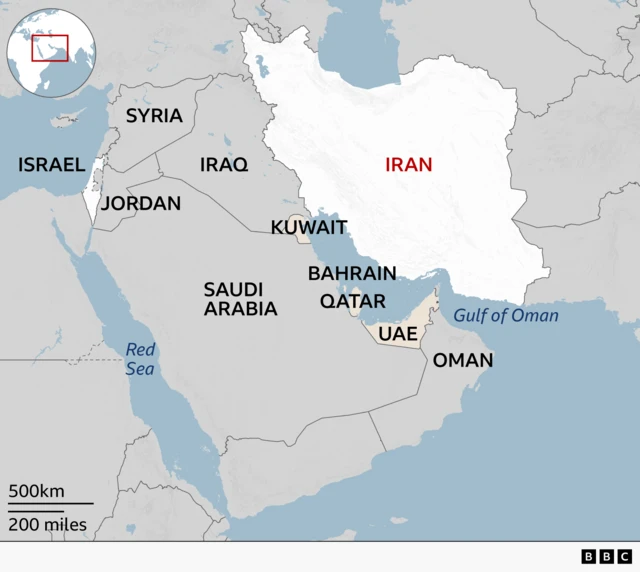
    A regional map highlighting Iran in white with its name in red. Countries that have come under fire from Iran are labelled in beige - Kuwait, Bahrain, Qatar, UAE. Surrounding countries are labeled in grey, neighbouring Iraq to the west and other Middle Eastern countries including Syria, Jordan, Saudi Arabia and Oman. Bodies of water such as the Red Sea and the Gulf of Oman are marked in blue.
  20. BBC Verify

    'They hit hard': Videos show aftermath of strikes on Tehranpublished at 11:14 GMT

    By Merlyn Thomas and Paul Brown

    Several verified videos from Tehran show large plumes of smoke rising above the capital.

    One clip, filmed at a busy intersection, shows traffic slowing as drivers and pedestrians look up at the sky. In the footage, one person can be heard saying: "They hit it hard. Where did they hit? They’re saying it’s Khamenei’s residence."

    We have located this video within a kilometre of Leadership House, the office of Iran’s Supreme Leader, Ayatollah Ali Hosseini Khamenei. It’s not clear from the video angle if it was a direct hit on the building.

    Another verified photo from the same area shows thick, dark columns of smoke rising above residential buildings and small grocery shops. There are also reports of strikes elsewhere in the country.

    BBC Verify is continuing to analyse and verify videos and pinpoint exactly which locations have been hit and what exactly has been targeted.