Summary

  1. Israel strikes southern Lebanese town of Qantara, state media reportspublished at 11:28 BST

    Lebanese media says Israeli forces have hit a town in southern Lebanon, with state-run National News Agency reporting in Arabic a "bombing operation" in the town of Qantara.

    Earlier, the Israel Defense Forces (IDF) said it struck a Hezbollah rocket launcher overnight in the Kfarkela area of south Lebanon - around 5 miles (8.5km) from Qantara.

    The IDF is yet to comment on the latest reported attacks.

    A ceasefire between Lebanon and Israel came into effect on at midnight between 16 and 17 April.

    As part of it, Lebanon must take "meaningful steps" to prevent Hezbollah and all other "rogue non-state armed groups" from carrying out attacks against Israeli targets. The IDF said its forces remained deployed in south Lebanon due to "ongoing terrorist activities by the Hezbollah organisation".

    A man in a tracksuit and a cap takes a photograph on a phone of two men sitting in a pile of rubble among buildings attacked by strikesImage source, Reuters
    Image caption,

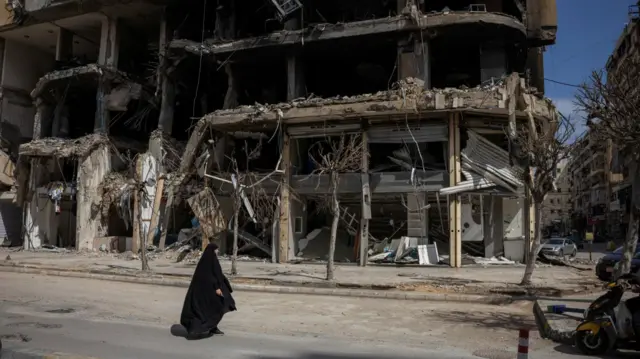
    These buildings in Tyre, southern Lebanon - where a Lebanese civil defence member photographs two of his colleagues earlier today - were hit by Israeli attacks just before the ceasefire came into effect on Friday

  2. Analysis

    There is zero trust between the US and Iranpublished at 10:47 BST

    Frank Gardner
    Security correspondent

    Iranians walk past a billboard of Supreme Leader Ayatollah Mojtaba Khamenei on a street in Tehran on MondayImage source, EPA
    Image caption,

    Iranians walk past a billboard of Supreme Leader Ayatollah Mojtaba Khamenei on a street in Tehran on Monday

    The chances of a breakthrough in any US-Iran talks – if they even take place – are slim at best.

    Whatever slivers of hope there were in Islamabad eight days ago have shrunk further as Iran accuses Washington of breaching the ceasefire with its naval blockade of all Iran’s Gulf ports - and now, of maritime piracy after US forces fired on and impounded the Iranian-flagged MV Touska as it tried to run the blockade.

    These are hardly the conditions conductive to finding some common ground and ending this conflict.

    Donald Trump’s aim is to so squeeze the already battered Iranian economy that Tehran capitulates to US demands, both on the nuclear issue and on the Strait of Hormuz.

    Some analysts believe this may still work, but Iran rarely responds to this kind of very public pressure in the way some people expect it to.

    If anything, it is hardening its stance and making noises about exerting its "sovereign right" to control the Strait of Hormuz.

  3. European markets drop after latest Strait of Hormuz attackpublished at 10:26 BST

    Nick Edser
    Business reporter

    European stock markets opened lower as optimism fades that the key Strait of Hormuz waterway could be opened swiftly.

    The news that US had intercepted and seized an Iran-flagged cargo ship, together with Iran’s statement said on Saturday it was closing the strait again, have knocked hopes of a quick resolution to the situation.

    The price of Brent crude oil jumped 5% to $95.29 a barrel as traders reacted to the latest news from the Gulf, reversing some of the falls seen on Friday when Iran had said the Strait of Hormuz would be "completely open" to commercial vessels for the remainder of the ceasefire.

    The UK’s FTSE 100 share index fell 0.6%, Germany’s Dax dropped 1.6% and France’s Cac 40 index was down 1.3% on Monday morning.

    "Hopes for an imminent resumption of trade, especially energy shipments, have evaporated," says Susannah Streeter, chief investment strategist at Wealth Club.

    This Flourish post cannot be displayed in your browser. Please enable Javascript or try a different browser.

  4. In southern Lebanon, people went home this weekend and just found rubble - UN chiefpublished at 10:22 BST

    Nine displaced people, including women and children, walk across a destroyed bridgeImage source, Reuters
    Image caption,

    Displaced people walk across a destroyed bridge as they return to their villages, in the village of Tayr Felsay, in southern Lebanon

    "Huge numbers" of people went back to their homes in southern Lebanon at the weekend, after a ten-day ceasefire came into effect on Friday, and just found "rubble", the UN humanitarian chief tells the BBC.

    "Five of the six bridges that we use to get our goods across have been destroyed now so that makes it even more complicated for us to get help in but also for civilians to get back [home]," Tom Fletcher adds on Radio 4's Today programme.

    He says the UN was able to deliver a couple convoys of food, medicine and blankets over the weekend.

    For weeks, Israeli forces have been hitting bridges over the Litani River which link southern Lebanon to the rest of the country, saying it is targeting Hezbollah forces and their operations.

    As part of the ceasefire, Lebanon must take "meaningful steps" to prevent Hezbollah and all other "rogue non-state armed groups" from carrying out attacks against Israeli targets. Israel said this morning it had hit a Hezbollah rocket launcher in southern Lebanon.

  5. China expresses 'concern' over US seizure of Iranian shippublished at 10:06 BST

    A still image from footage released by the US miluitary, showing the USS Spruance firing at Iranian-flagged cargo ship TouskaImage source, Centcom
    Image caption,

    A still image from footage released by the US military, showing the USS Spruance firing at Iranian-flagged cargo ship Touska

    China's foreign ministry spokesperson has called for peace talks between Iran and the US to resume following the seizure of the Iranian-flagged Touska ship.

    Guo Jiakun has told a news conference that China expresses "concern" over the "forcible interception" of the vessel by US forces, according to the AFP news agency.

    China's foreign ministry previously called the US naval blockade of Iranian ports "irresponsible and dangerous".

    The country is estimated to buy around 90% of the oil that Iran exports - with analysts saying the US blockade may be designed to pressure China into applying its own pressure on Iran.

  6. US 'not serious' about diplomacy, says Iranpublished at 09:27 BST

    We can bring you more now from Iran's foreign ministry on whether it will attend the second round of peace talks with the US in Pakistan.

    "While claiming diplomacy and readiness for negotiations, the US is carrying out behaviours that do not in any way indicate seriousness in pursuing a diplomatic process," says spokesman Esmaeil Baghaei, according to a translation from AFP news agency.

    He adds that Iran does not believe in deadlines or ultimatums when it comes to safeguarding Iran's national interests, according to lines from Reuters, and adds that removing the nuclear stockpile from Iran was never an option in negotiations.

    The issue of what to do with Iran nuclear stockpile was one of the key sticking points in the negotiations in Pakistan which ended without agreement on 12 April.

  7. No decision on latest US talks - Iranian spokesmanpublished at 09:06 BST
    Breaking

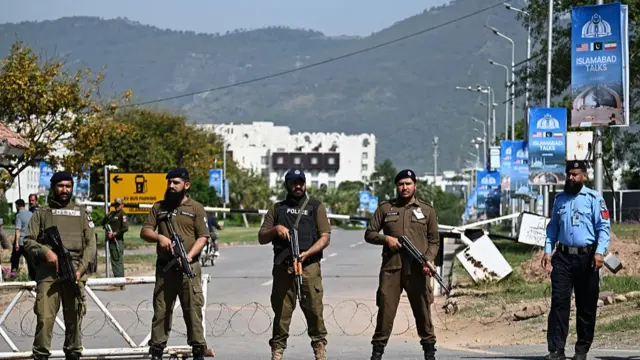
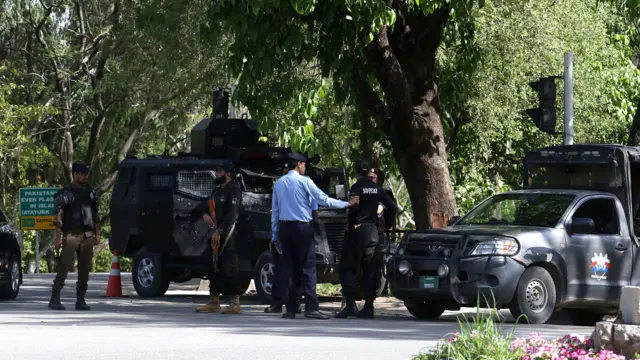
    There is heavy security in Islamabad, Pakistan, where talks are due to take place laterImage source, Getty Images
    Image caption,

    There is heavy security in Islamabad, Pakistan, where talks are due to take place later

    Iran has not yet decided whether it will attend a second round of negotiations with the US, a spokesman for Iran's foreign ministry says.

    "As of now... we have no plans for the next round of negotiation, and no decision has been made in this regard," spokesman Esmail Baghaei says, in a translation from the AFP news agency.

    President Trump has said he is sending a delegation to Pakistan led by Vice-President JD Vance for talks planned for Monday evening. Trump's Middle East Envoy Steve Witkoff and son-in-law Jared Kushner were also due to attend.

    On Sunday Iranian state media reported officials had no plans to attend due to the "continuation of the so-called naval blockade, violation of the ceasefire and threatening US rhetoric".

  8. Israel warns south Lebanon residents, and says it has hit Hezbollah targetpublished at 08:26 BST

    A Lebanese family returning to their home after the ceasefire beganImage source, EPA
    Image caption,

    A Lebanese family travelling near the city of Tyre on 19 April

    We've been focusing so far on the US-Iran war - and the prospects of their two-week ceasefire being extended this week.

    Another ceasefire, between Israel and Lebanon, was announced on 16 April. As part of the deal, Lebanon must take "meaningful steps" to prevent Hezbollah and all other "rogue non-state armed groups" from carrying out attacks against Israeli targets.

    The Israeli military has now called on residents in southern Lebanon not to move south of a specified line of villages or approach areas near the Litani River.

    The IDF says it remains deployed in south Lebanon due to "ongoing terrorist activities by the Hezbollah organisation".

    It posted a specific list of villages that people should not return to, or travel south of - adding that it struck a Hezbollah rocket launcher overnight in the Kfarkela area of south Lebanon.

    Israel says it creating a "buffer zone" in south Lebanon to protect residents of Israel from Hezbollah rocket fire.

  9. Islamabad gears up for peace talks - but will Iran attend?published at 07:47 BST

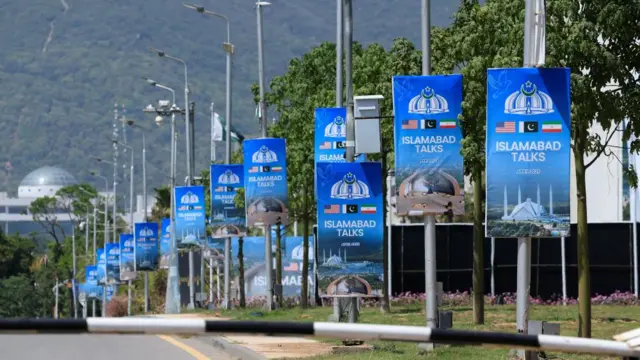
    Blurred out security personnel are pictured in front of posters advertising talks between the US and Iran in Islamabad, with the posters being in focus.Image source, Getty Images
    Image caption,

    Security personnel at a checkpoint near the Serena Hotel on Monday

    Talks between the US and Iran are due to begin in Pakistan's capital, Islamabad, later today.

    Guests at the city's Serena Hotel, where failed peace talks were held on 11 April, have been told to leave in preparation of today's meeting - while police announced the closure of key roads due to the arrival of foreign delegations.

    Donald Trump has said his "representatives" would arrive in Islamabad on Monday evening, with Vice-President JD Vance leading the delegation alongside Steve Witkoff and Jared Kushner.

    But Iran is yet to formally confirm whether it will attend the talks. The country's state media reports that officials will not participate while the US blockade of Iranian ports remains.

    The two-week ceasefire between the US and Iran is due to end on Wednesday - with Trump repeating threats of destroying Iranian infrastructure if a deal is not reached.

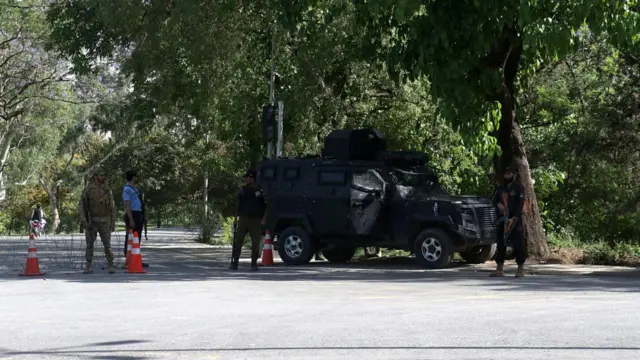
    Security personnel are seen standing beside vehicles on an empty road. Trees line the pavement on either side of the road and orange traffic cones can be seen.Image source, Getty Images
    Image caption,

    An Islamabad road temporarily closed on Monday ahead of the talks

  10. Iran attacks US ships with drones, says Iranian media, with no reports of damagepublished at 07:15 BST

    Iran has launched drone strikes on US military vessels in the Gulf of Oman, the Iranian semi-official news agency Tasnim reports, after the US navy seized an Iranian-flagged container ship in the Gulf of Oman.

    There has been no reports of damages from the apparent drone attacks.

    Earlier, Iran's Khatam al-Anbiya Central Headquarters - the country's highest operational command unit coordinating the armed forces - described the US naval operation as a violation of the ceasefire and said it would "retaliate for this act of armed piracy by the US Navy."

    ALT TEXT: Map showing where the Strait of Hormuz is in the Gulf of Oman, a key route for global oil transport. The strait lies between Iran and the peninsula of the United Arab Emirates and Oman. The map also shows countries in the wider Middle East region including Saudi Arabia, Iraq, Jordan and Israel
  11. US marines boarded Iranian-flagged ship after six hours of warnings, says Centcompublished at 06:44 BST

    A grainy image og a helicopter through a black and white night vision lens.Image source, US Central Command
    Image caption,

    The helicopter used by the US marines to board the Touska

    We now have more on the interception of the Iranian-flagged cargo ship, Touska, by US forces.

    US Central Command (Centcom) says in a post on X that US marines departed the USS Tripoli assault ship by helicopter and rappelled (descended by rope) onto Touska on Sunday.

    The update, which includes a video of the marines onboard the helicopter, says the USS Spruance "disabled Touska's propulsion" after the ship "failed to comply with repeated warnings" from US forces over a six-hour period.

    Earlier, President Trump described the same incident as: "Our Navy ship stopped them right in their tracks by blowing a hole in the engineroom."

    Iran's top military headquarters, Khatam al-Anbiya, has vowed that the country will respond to the interception, which was originally announced by Trump on his Truth Social platform.

  12. Oil prices rise after Trump says Iranian ship seizedpublished at 06:10 BST

    Global oil prices rose in Monday morning trade in Asia after President Donald Trump said the US has intercepted and seized an Iran-flagged cargo ship.

    It came after Iran said on Saturday that it was closing the Strait of Hormuz waterway again to commercial vessels and that any ship that approaches it would be targeted.

    Brent crude futures were up by 4.74% at $94.66 (£70.11) a barrel, while West Texas Intermediate was 5.6% higher at $88.55.

    Energy markets have seen wild swings since the US and Israel attacked Iran on 28 February and Tehran responded with threats to target shipping in the strait, through which about 20% of the world's oil and liquefied natural gas (LNG) passes.

    Read more here.

  13. BBC investigates insider trading rumours swirling around Trump's presidencypublished at 05:53 BST

    Nick Marsh

    The BBC has found a pattern of spikes in trades on financial markets ahead of public announcements by US President Donal Trump, including during the Iran war.

    It is a suspicion that has loomed over Trump's entire second term in office.

    The president makes an announcement on social media which moves the financial markets and hours, sometimes minutes before, traders pile millions of dollars into a stock or commodity, profiting heavily from the market reaction.

    By analysing market data, the BBC has identified two clear examples from the Iran war when the US president had declared a resolution to hostilities was imminent.

    On both occasions, the price of oil dropped significantly – and in each case, oil trades spiked minutes before the information was made public. Analysts say that millions of dollars would have been made predicting the dip.

    The White House has not responded to a request for comment – although it has strenuously denied allegations of insider trading in the past.

    Read more here.

  14. JD Vance heads to Pakistan for fresh talkspublished at 05:39 BST

    We are resuming our live coverage.

    Donald Trump has said that a delegation will travel to Pakistan for a new round of negotiations with Iran.

    In his post to social media, he said that his "representatives" would arrive in Islamabad on Monday evening.

    Shortly afterwards, the White House said US Vice-President JD Vance would lead the delegation.

    A White House official confirmed to the BBC the delegation would include Trump advisers Steve Witkoff and Jared Kushner, who were both also present at the previous talks.

    Tehran has not yet confirmed its attendance. Iranian state media has reported that officials will not participate while the US blockade remains in place.

    The last talks went for about 21 hours and failed to reach a peace deal with Washington and Tehran remaining far apart on key issues including Iran's nuclear programme.

  15. US negotiators to head to Pakistan and Iranian cargo ship seized - a recappublished at 00:37 BST 20 April

    Around eight cargo ships pictured in the seaImage source, Reuters
    Image caption,

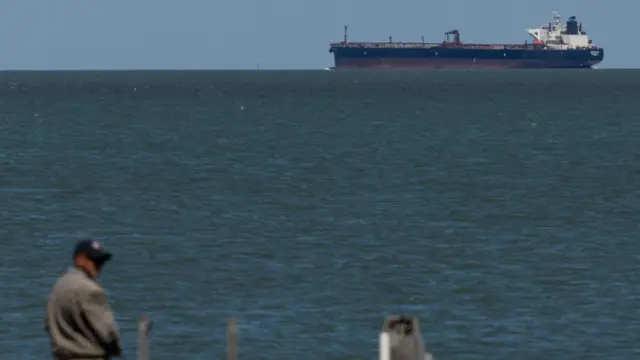
    Tankers in the Strait of Hormuz on Saturday

    Here's a recap of the latest developments.

    US negotiators will head to Pakistan on Monday with the intention of holding further talks on ending the war, Trump says - but Iranian state media cites unnamed officials as saying Tehran has "no plans for now to participate".

    The prospect of further high-level negotiations - a White House official says Vice-President JD Vance will attend - comes amid reports of fresh attacks on commercial vessels.

    Trump says the navy intercepted and took "custody" of an Iranian tanker attempting to pass through the US blockade, "blowing a hole" in the ship's engine room in the process.

    Earlier, in the same post announcing his representatives would travel for more talks, Trump renewed his threat to destroy Iranian energy sites and bridges if no deal is reached.

    Reports in Iranian media over the weekend suggest Iran is continuing to work on plans to potentially apply a toll to ships passing through the strait - although it's unclear if such a move will be implemented.

    Iranian state TV cites unnamed officials as saying that "continuation of the so-called naval blockade, violation of the ceasefire and threatening US rhetoric" are slowing progress in reaching an agreement.

    Trump also accused Iran of violating the ceasefire, saying more commercial ships have been attacked by Iran in the Strait of Hormuz.

    A UK maritime agency reported two commercial ships came under fire in the strait on Saturday.

    Iran's foreign minister had said on Friday that the strait would be opened - which was shortly followed by Trump saying the US naval blockade of Iranian ports would remain in place until a deal is reached. Iran has since said the strait is closed again.

  16. Watch the moment the US navy warns Iranian-flagged cargo ship before firingpublished at 23:57 BST 19 April

    Media caption,

    Moment US navy warns Iranian-flagged cargo ship before firing

  17. Iran vows retaliation, calls attack on its ship 'violation of ceasefire'published at 23:29 BST 19 April

    Ghoncheh Habibiazad
    Senior reporter, BBC Persian

    Iran's top military headquarters, Khatam al-Anbiya, has vowed that Iran will respond to the US seizing an Iranian-flagged cargo ship and has called it a "violation of the ceasefire".

    According to a statement carried on state media outlets, a spokesperson has said that the US in "violation of the ceasefire opened fire on one of Iran's commercial vessels in the waters of the Sea of Oman, disabled its navigation system, and boarded it" by "deploying" marines.

    "Armed Forces of the Islamic Republic of Iran will soon respond to and retaliate for this act of armed piracy by the US Navy," reads the statement.

  18. Tehran will never cede control of Strait, senior Iranian politician tells BBCpublished at 23:01 BST 19 April

    Lyse Doucet
    Chief international correspondent, in Iran

    A man with a grey beard and hair looks into the camera. He is wearing a black shirt and behind him is the Iranian flag.

    "Never." That's when a senior Iranian lawmaker says they'll be ready to give up their control of the Strait of Hormuz.

    "It's our inalienable right," Ebrahim Azizi, a former commander in Iran's Islamic Revolutionary Guards Corps (IRGC), tells the BBC in Tehran. "Iran will decide the right of passage, including permissions for vessels to pass through the Strait."

    And he says that's about to become enshrined in law.

    "We are introducing a bill in parliament, based on article 110 of the constitution, which includes the environment, maritime safety and national security - and the armed forces will implement the law," says this member of parliament who heads the Committee for National Security and Foreign Policy.

  19. Analysis

    Trump ramps up rhetoric after striking optimistic tone in previous dayspublished at 22:33 BST 19 April

    Simi Jolaoso
    Washington DC correspondent

    US President Donald TrumpImage source, EPA

    President Trump has publicly struck an optimistic tone this past week, suggesting a deal with Iran is within reach.

    But today, he has dialled up his rhetoric, again threatening to "knock out" Iran's power plants and bridges.

    It appears his administration's strategy is to continue applying economic pressure on Iran - through the naval blockade and additional sanctions - to get a deal Trump's satisfied with.

    His latest threat raises the stakes and risks creating a more volatile atmosphere, when both the negotiations and ceasefire appear fragile.

    It’s still not confirmed whether Iran will join the talks - the coming days could be critical in deciding if diplomacy can hold.

    The White House has framed this next round of talks as a potential final diplomatic off-ramp, before a return to a full-scale regional war.

  20. 'Trump is threatening massive war crimes,' says former Human Rights Watch chiefpublished at 22:17 BST 19 April

    Kenneth Roth

    As we've reported earlier, US President Donald Trump has again threatened to strike electricity plants and bridges in Iran if a deal is not reached.

    Former Human Rights Watch chief Kenneth Roth says this would amount to a war crime.

    "Trump is threatening massive war crimes, it's as simple as that," Roth tells the BBC News channel.

    "He may say he doesn't follow international humanitarian law, but the US government and the rest of the world does purport to, and humanitarian law prohibits targeting civilian objects like power plants or bridges," Roth says.

    Roth says Trump may argue that bridges and power plants are "so-called dual-use objects" because they are also used by soldiers, but "that's not the end of the story".

    "Humanitarian law also requires that even a military target not be fired upon if the harm to civilians would be disproportionate."

    US ambassador to the UN Mike Waltz has said it is a "false, fake and ridiculous notion" to suggest this could be a war crime, and the infrastructures are "legitimate military targets".