Summary

  1. Analysis

    An unambiguous warning from Rubio, but little detail on US vision for Venezuelapublished at 18:48 GMT
    Gary O'Donoghue
    Chief North America correspondent

    We’ve now had more of a fleshing out of the vision Secretary of State Marco Rubio says the United States has for Venezuela.

    He made it clear that, in the administration’s view, the removal of the entire regime could have triggered huge instability – including fighting, looting, and the mass movement of refugees that would put pressure on neighbouring countries.

    The better option, he suggested, is to deal pragmatically with the people currently in power.

    At the same time, it’s also clear that the US intends to prioritise American business interests in Venezuela. How that fits with the country’s sovereignty is the big question.

    Rubio’s remarks also contained an unambiguous warning: if the US doesn’t think things are moving in the direction it expects, there could be further violence.

    He added that he wanted to see figures in the opposition – which he described as fragmented – back in Venezuela to rebuild and take part in civil society.

    But there was no timescale or detail on when or how elections might happen.

    And with that, we're bringing our live coverage to an end.

  2. Key takeaways from Rubio's grilling on Venezuelapublished at 18:27 GMT

    Adam Goldsmith
    Live reporter

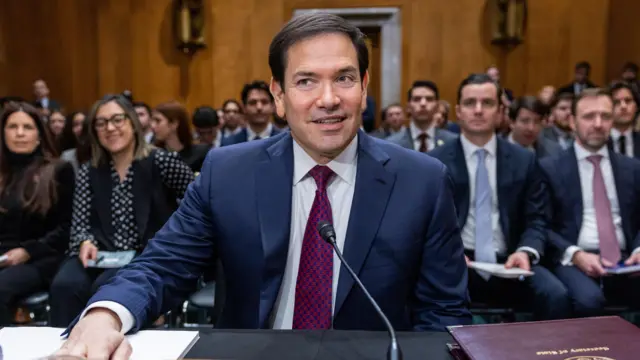
    Marco RubioImage source, EPA/Shutterstock

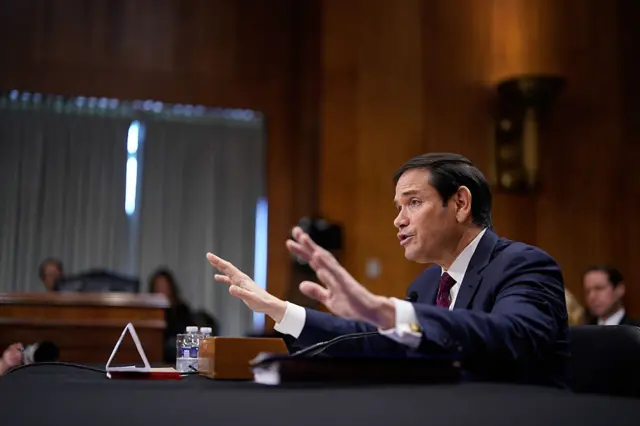
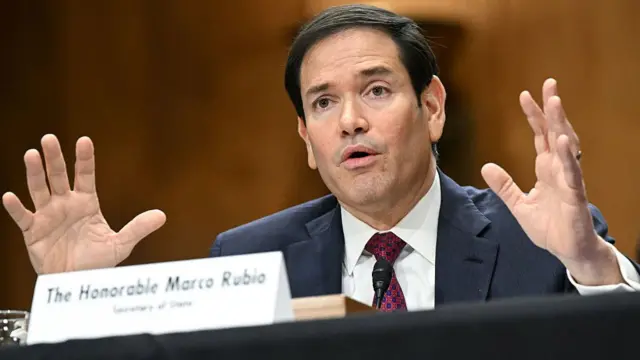
    In a session that ran just shy of three hours, US Secretary of State Marco Rubio was grilled by senators for the first time on US operations in Venezuela.

    Here's what we heard:

    We'll shortly be ending our live coverage. In our next post we'll bring you some analysis from our chief North America correspondent on how Rubio's grilling in the Senate played out.

  3. How are Venezuelans feeling now?published at 18:13 GMT

    The Global Story podcast

    When US Special Forces captured Venezuela’s former president Nicolás Maduro several weeks ago, many wondered whether his ouster would bring about further changes to the country.

    So, what has changed in Venezuela?

    The BBC's Global Story podcast has spoken with BBC Mundo correspondent Norberto Paredes, reporting from inside Venezuela, to ask how Venezuelans feel about the country since Maduro's departure.

    Listen to the Global Story here, on the BBC Sounds app or wherever you get your podcasts.

  4. Analysis

    Rubio clear on his threats if the US doesn't get its way on Venezuelapublished at 17:59 GMT

    Gary O'Donoghue
    Chief North America correspondent

    While Marco Rubio stressed his hopes for a stable and prosperous future for Venezuela, he was unambiguous in his threats if the US didn't get what it wanted.

    "Make no mistake", he said, "we are prepared to use force to ensure maximum cooperation if other methods fail."

    He told the committee that democratic elections should happen, but laid out no timetable for them to take place.

    He indicated that the decapitated Maduro regime was being "respectful" and "productive", but insisted the US was being clear-eyed about the nature of those still in charge.

    Washington would, he said, quite quickly establish a diplomatic presence in the country but again reiterated there would be no American troops on the ground.

  5. Rubio's questioning endspublished at 17:53 GMT

    With that, the senators have finished asking their questions about the US operations in Venezuela.

    Democratic ranking member Jeanee Shaheen thanks Rubio for this time and asks the secretary of state to come back soon to provide information on the war in Ukraine.

    Rubio agrees, and says he can give a small update now.

    The situation is fluid, he says, but that territorial questions and security guarantees are the main issue still to be sorted

    Republican Chairman Senator James Risch also thanks Rubio and adjourns the hearing.

    We'll shortly bring you a recap of the key lines and some analysis on what we heard from Rubio.

  6. Rubio hits back against claim Trump's operation in Venezuela was 'all about oil'published at 17:43 GMT

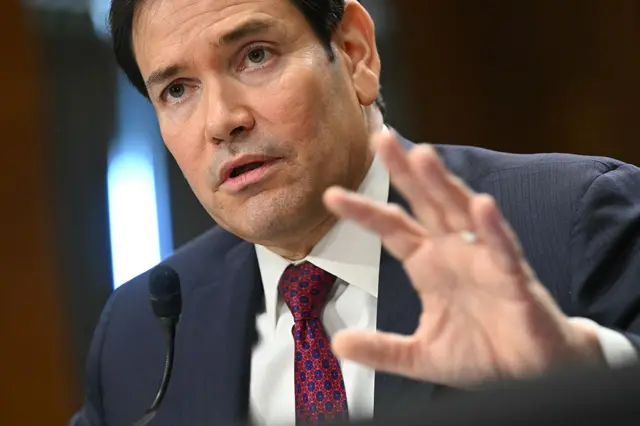
    Marco Rubio.Image source, Getty Images

    We're now hearing from Democratic Senator Chris Van Hollen.

    He claims the president told us what this was all about in his press conference shortly after Maduro was seized: "oil, oil, oil".

    Van Hollen says Trump used the word 19 times, but never mentioned democracy, freedom or human rights.

    He also claims that Trump publicly admitted to having conversations with people from the oil industry about going into Venezuela "before anyone here in Congress was notified".

    He asks Rubio to answer with a yes or no: "Were you with President Trump during any of those conversations?"

    Rubio says the notion that the president authorised the operation at the urging of oil executives is "absurd".

    Oil executives learned about the operation "at the same time everyone else did", he says.

    Van Hollen claims Trump himself has said the opposite, but Rubio denies this.

  7. Analysis

    Does Rubio's experience give him an advantage in the Senate?published at 17:34 GMT

    Will Grant
    Central America and Cuba Correspondent

    As a former-Florida Senator with years of experience on the Foreign Affairs Committee, Marco Rubio has something of an advantage over many of the committee members.

    If there is one region he can be quizzed on endlessly as secretary of state and still come back with answers, it is Latin America.

    He knows the history, geography and politics of the hemisphere, and it shows — regardless of whether either the committee members or the viewing public agree with him on the best strategy towards Venezuela and Cuba.

  8. Threat of transnational criminal organisations requires forceful confrontation, Rubio sayspublished at 17:33 GMT

    Senator Mike Lee says he is pleased that President Trump has been "refocussing" on the western hemisphere and asks what this looks like going forward.

    Rubio says the fact that US troops were permanently deployed somewhere in the western hemisphere "was a shock to everyone, because we haven't done it".

    He says the US is facing multiple "transnational criminal terrorist organisations" possessing a large amount of weaponry in the region which are threatening the "stability of the region".

    He does not provide more detail but claims this threat requires forceful confrontation.

  9. Analysis

    Rubio's outlook on roadmap to success in Venezuela is simple, but Democrats criticalpublished at 17:27 GMT

    Will Grant
    Central America and Cuba Correspondent

    "The glue that held the regime together was corruption and graft", said Secretary Rubio of the Maduro Government.

    "His removal has created the conditions to begin to move away from that", he argued.

    The point troubling several Democratic Party senators is that working with Delcy Rodríguez, as Nicolás Maduro's vice president, means engaging with a leader who was a fully-signed up member of the same "corrupt" administration that Mr Rubio was denouncing.

    There have been numerous questions about the road to what Washington might consider "success" in Venezuela and how the Trump Administration is proposing to get there.

    His essential take on, as it were, a roadmap to success was broadly simple: "we are not even four weeks into this thing", he retorted. "Four, five or six months from now cannot look like now" he said.

    Matters would become easier, the Secretary of State insisted, once a proper US ambassador took up her place in Caracas rather than just him talking to Rodríguez "three times a week", he added.

  10. 'Are we at war with Venezuela?' Rubio's heated exchange with Democrat Duckworthpublished at 17:19 GMT

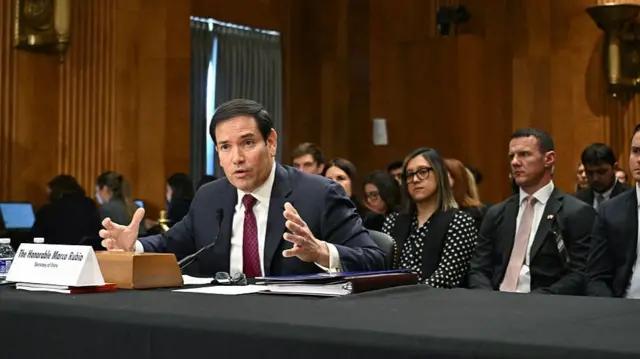
    Marco Rubio in Senate.Image source, SAUL LOEB / AFP via Getty Images

    We've just heard a fiery exchange between Rubio and Democrat Senator Tammy Duckworth.

    She repeats Rubio's claim that the US is "not at war with Venezuela". She asks: "If this is the case, will you advise the president to rescind his invocation of the wartime alien enemies act?"

    She repeats: "Are we currently at war with Venezuela?"

    Rubio says that gangs and narco-trafficking groups have "waged war on the United States".

    "We have arrested people that are members of gangs, and we have deported them. We don't want gang members in our country," he says.

    The debate between the two becomes heated. Pushed again on whether he will push Trump to rescind the act, Rubio says: "Of course not".

    "When it comes to narco-trafficking gangs and criminal gangs, there's no doubt about the fact that we're confronting them in a war-like setting," he says.

  11. Rubio pushed on Russian 'shadow fleet' and US seizures of oil tankerspublished at 17:15 GMT

    A little earlier, we heard a question from Senator John Cornyn on Russian "shadow fleets", after US seizures of tankers linked to Venezuelan oil exports.

    Rubio is asked how far Venezuela has been assisting its allies Iran and Russia in circumventing sanctions in order to fund "nefarious activities" in the Middle East and Ukraine.

    Rubio says Maduro's regime was held together by "corruption and graft" and describes how the "ghost fleet" exists because of US sanctions on oil.

    "You have to turn to these pirates," he explains, saying these vessels are either falsely flagged or stateless as they ship oil around the world.

    "Our goal is to rope all of this illegal oil into a channel that goes into this account that ultimately goes to the benefit of the Venezuelan people," he says.

    And, Rubio suggests that no illegal ship has headed to Venezuela since Maduro was removed, while interim authorities are helping the US identify shadow fleet ships that they want to be seized.

  12. Analysis

    Rubio less than forthcoming on the nitty-gritty of US planspublished at 17:10 GMT

    Vanessa Buschschlüter
    Latin America editor

    Senators have been quizzing Marco Rubio on the plans the Trump administration has for Venezuela for over two hours - something Venezuelans in particular are keen to hear more about.

    But while Rubio's similes are colourful - he says Venezuela is like a "critically ill patient" whose life-threatening injuries have to be treated first - he is giving little detail about how the administration intends to proceed.

    He would not be drawn on how long the transition to democracy would take and keeps stressing that "it has been less than four weeks" since Maduro was removed.

    Rubio is, however, adamant that "for the first time in a decade and a half there's a prospect for transformation".

    This echoes what opposition leader María Corina Machado said in the aftermath of the US raid. She insisted that Maduro's removal was the start of an "irreversible process".

    Rubio has told senators that he will be meeting Machado after the hearing.

    With Rubio less than forthcoming on the nitty-gritty of how the US intends to proceed, Venezuelans will be hoping for more information to surface after that meeting.

  13. Democrat claims US is 'complicit' in human rights violations over Venezuela operationpublished at 17:00 GMT

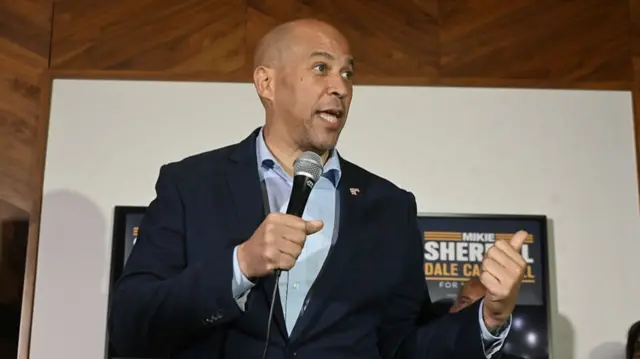
    Cory Booker.Image source, Getty Images
    Image caption,

    Democratic Senator Cory Booker

    Democratic Senator Cory Booker points to travel advisories that state the risk of unlawful detention is high and says the "constant oppression" of Venezuelan people is continuing.

    Rubio defends travel advisories, saying it was due to concerns people would "flood over" after Maduro had been seized.

    Booker comes back, saying it is "hypocritical" for the US government to be issuing "human rights cautions" for Americans who might want to travel to Venezuela, at the same time as lifting temporary protected status for Venezuelans and threatening to deport them.

    He says the US is "complicit" in human rights violations.

    Rubio claims temporary protected status was granted to "vast" numbers "without proper vetting", and said some of them could be Venezuelan gang members.

  14. Rubio calls Venezuela a 'critically ill patient'published at 16:57 GMT

    Republican Senator John Curtis is now questioning Rubio, he asks how Latin Americans should view the US operation in Venezuela.

    "There is the opportunity that something will change" following America's intervention, Rubio stresses: "We have changed that dynamic."

    He says this will require smart action on the part of the US, but ultimately will need "decisions made by Venezuelans".

    At the moment, Venezuela is a "critically ill patient," he says. "You've got to deal with the life threatening first before you can deal with a broken leg."

    He finishes by stressing that Venezuela will need those who have left the country during Maduro's rule to return, and adds that "many of them are eager to do so".

  15. 'Rubio knows better,' Democratic Senator tells reporters outside hearing roompublished at 16:52 GMT

    Alex Lederman
    Reporting from the US Senate

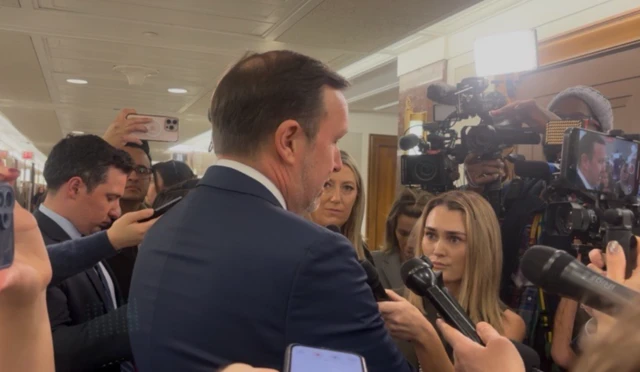
    Democratic Senator Chris Murphy outside Senate hearing room, people holding microphones up to him.
    Image caption,

    Democratic Senator Chris Murphy outside Senate hearing room.

    Democratic Senators haven’t minced their words to reporters outside the hearing room.

    "There’s no sign that this has been a success," Senator Chris Murphy tells us.

    "A month later, the Maduro people are still in charge, a month later there’s no transition to democracy, a month later the opposition leader is still in exile," he continued.

    "The only thing the Venezuelan government is complying with is our request for them to give us the oil," he added.

    His colleague Chris Coons attacked what he saw as a change in position from Rubio, a former Senator.

    "Secretary Rubio knows better," Coons tells us.

    "He served with me here for 14 years, and when he was a Senator, he was a big fan of Congressional consultation. Now as National Security Advisor and Secretary, he needs to follow through."

  16. Rubio doubles down on commitment not to use US taxpayer dollars to prop up Venezuelapublished at 16:47 GMT

    Marco Rubio in Senate with hand raised, image shows his profile.Image source, Al Drago/Bloomberg via Getty Images

    We're now hearing from Democratic Senator Jeff Merkley, who tells Rubio on Venezuela: "We had a dictator we didn't like; we've replaced it with a dictator we think we can manipulate."

    But he then adds that he did like Rubio's remark about "no US taxpayer dollars" being used to prop up the state of Venezuela. "Can you restate commitment to that?" he asks.

    Rubio says the US is "not spending money in Venezuela now", other than costs like embassy operations.

    Merkley then says Rubio has a "way too rosy sense of the oil economy" in Venezuela, before running through a series of risks faced by oil companies considering investing there.

    Rubio disagrees, saying: "It's not a rosy projection". He also adds that there's "no world" in which the US will subsidise investment in Venezuelan oil.

  17. US operation in Venezuela was not an act of war, Rubio insistspublished at 16:32 GMT

    Republican Senator Rand Paul says that a declaration of war is constitutionally a power of Congress.

    He hints at the Trump administration's argument that their seizure of Maduro was not an act of war.

    But he asks Rubio if a foreign country bombed the US air defence system, "captured and removed" its president and "blockaded" the country, would that be considered an act of war?

    Rubio rejects that the US military's mission in Venezuela "comes anywhere close" to the constitutional definition of an act of war, since it only took a few hours hours, and was, he claims, a "law enforcement operation" and because the US does not recognise Maduro as a head of state.

  18. 'US does not intend to take military action in Venezuela,' Rubio says after quickfire questionspublished at 16:20 GMT

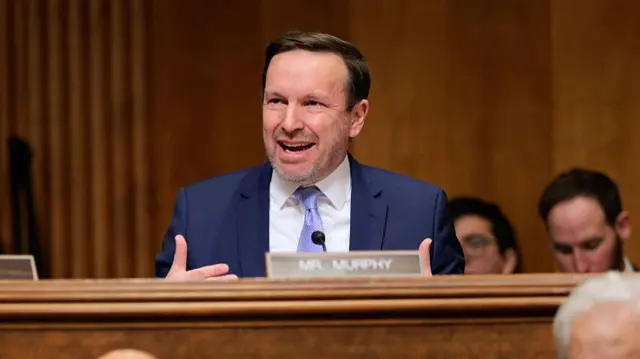
    Democrat Senator Chris MurphyImage source, Getty Images
    Image caption,

    Democrat Senator Chris Murphy

    Democrat Senator Chris Murphy is next, and he's critical of the operation, describing the attempts to stabilise Venezuela through managing its oil funds as "destined for failure".

    He then sets out three questions for Rubio.

    First, he asks Rubio to commit that companies who bid to sell Venezuelan oil will be chosen through a "fair, open selection process".

    Second, if current interim leader Delcy Rodríguez is still in power six months from now, does that mean the US policy has been a success or failure? he asks.

    Thirdly, he asks Rubio about comments that the US reserves the right to use force again in the future. What would cause this, and do you accept that you might need congressional approval?

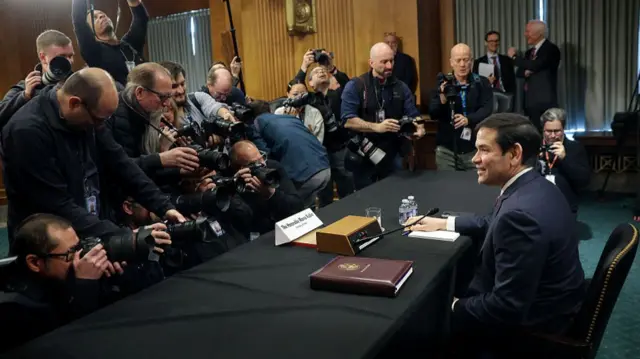
    Marco Rubio facing cameras and press sat behind a table in the Senate.Image source, Getty Images

    In answering, Rubio says first that Venezuela was experiencing oil storage issues. This is why two companies were selected in the short term very quickly, he says.

    On the second question Rubio says he can't give a timeline, but says "we have to be much further along" in six months' time.

    Finally, on the third question, the secretary of state says Trump never rules out his options, but clarifies the administration does "not intend or expect to have to take any military action in Venezuela at any time".

  19. What has the US got planned for Venezuela's opposition leader?published at 16:17 GMT

    Vanessa Buschschlüter
    Latin America editor

    María Corina Machado.Image source, Samuel Corum/Getty Images

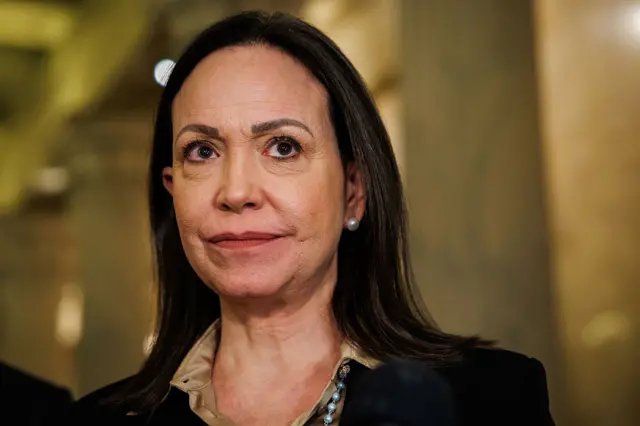
    When US forces seized Maduro, many in Venezuela - and abroad - assumed that the Trump administration would work with opposition leader María Corina Machado to restore democracy in the South American country.

    Marco Rubio has had a good relationship with Machado, who was awarded the Nobel Peace Prize for her fight for democracy in her homeland.

    But Trump said shortly after the US raid that she lacked the "support" and "doesn't have the respect" of the Venezuelan people.

    His administration has instead been working with Interim President Delcy Rodríguez, who is a Maduro loyalist and who has repeatedly called for his release.

    Marco Rubio has just said that the Trump administration is going to judge Rodríguez's government "based on actions not their words".

    Opposition supporters in Venezuela are frustrated by this.

    They have repeatedly pointed out that Rodríguez - while she may be doing the US bidding on some issues - is "one of the main architects of the Maduro regime".

    They will be listening out for any indication as to what - if any - role the US envisions for María Corina Machado.

    Machado managed to unite the opposition behind her before the 2024 election and voting tallies the opposition collected suggest that Edmundo González - the candidate she backed when she was barred from running for president - won the election by a landslide.

  20. Co-operating with the US is in Venezuela's interest, Rubio sayspublished at 16:07 GMT

    Marco Rubio speaking in Senate with hands raised.Image source, Getty Images

    Senator Dave McCormick now asks Rubio what is being put in place to prevent "malign actors" from having influence in Venezuela.

    Rubio says co-operation with the US is in line with Venezuela's interests. The US will be a "far better partner" for a future Venezuelan government - and even for the current authorities - than some of the partners they are signed up with now, he adds.

    It is not in Venezuela's interest to have an "Iranian presence" or the "sale of Iranian weaponry into their country", Rubio says.

    He describes some of the "criminal elements" they have "allowed in the past" as a "deal with the devil". In the long term, it has created "real destabilisation", Rubio says.