Summary

  1. Strikes start again in Tehranpublished at 15:37 GMT
    Breaking

    Ghoncheh Habibiazad
    Senior reporter, BBC Persian

    A source in east Tehran tells me strikes have started again on the Iranian capital.

    We'll bring you further updates on this when we get it.
  2. Initial reports suggest no casualties in Israel after latest wave of Iranian strikes, IDF sayspublished at 15:29 GMT

    The Israeli military says people can now stop sheltering following the latest round of Iranian strikes.

    A little earlier, the Israeli Defense Forces urged people to take shelter after it detected new attacks.

    Search and Rescue forces are now working in several locations in central Israel after reports of "fallen projectiles", it says.

    "According to initial reports, there are no casualties," a spokesperson from the Fire and Rescue Services says. "Teams are continuing searches at all locations. No trapped individuals have been reported," they add.

  3. Ships attacked near the Strait of Hormuz - a reminderpublished at 15:14 GMT

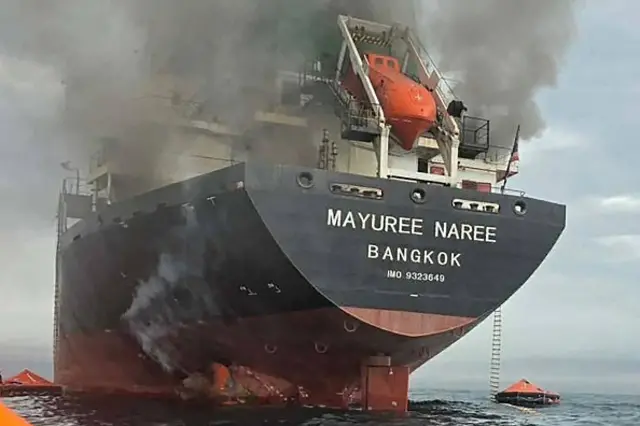
    Smoke rises from a cargo ship with the words "Mayuree Naree Bangkok" written on it.Image source, Royal Thai Navy

    In its latest update on 12 March, the UK Maritime Trade Operations (UKMTO) said, since 28 February, it had received 20 reports of incidents affecting vessels operating in and around the Arabian Gulf, Strait of Hormuz, and Gulf of Oman.

    Sixteen of those ships have been attacked, it adds, and four cases of suspicious activity recorded in the area.

    The Thai-flagged Mayuree Naree, was hit while transiting through the Strait of Hormuz on Wednesday morning, the ship's owner told BBC Verify.

    Iran's new supreme leader Mojtaba Khamenei vowed to keep blocking the Strait of Hormuz in his first public statement on Thursday.

    Verified footage showed two tankers on fire in Iraqi waters at the north of the Gulf late on Wednesday and UKMTO reported the ships had been "struck by an unknown projectile".

    Safesea Vishnu, a US-owned vessel heading to India, is one of the most recent boats to have been attacked.

    It was hit by an "unmanned speed boat carrying explosives" which "rammed into it, resulting in a major fire onboard", Indian authorities said.

    • The Strait of Hormuz has become a sticking point in the US-Israel war with Iran. US President Trump vowed a short while ago to get the Strait "open and safe", "one way or the other". He called on the UK and other nations to join the US in sending ships to help secure the shipping lane
  4. Israeli military says more strikes launched from Iranpublished at 14:55 GMT

    More missiles have been launched towards Israel from Iran, the Israeli Defense Forces say.

    In a recent update, the IDF adds that defence systems are working to intercept the threat and the public has been asked to enter shelters.

    It follows a series of strikes in rapid succession launched from Iran towards Israel a short while ago.

    Sirens sounded in Jerusalem, Israel, and injuries have been reported in Eilat in southern Israel.

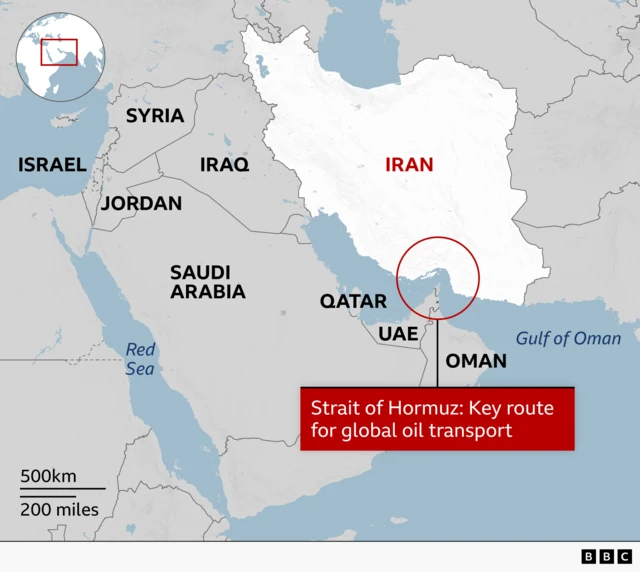
  5. Strait of Hormuz: What is it and why is it important?published at 14:40 GMT

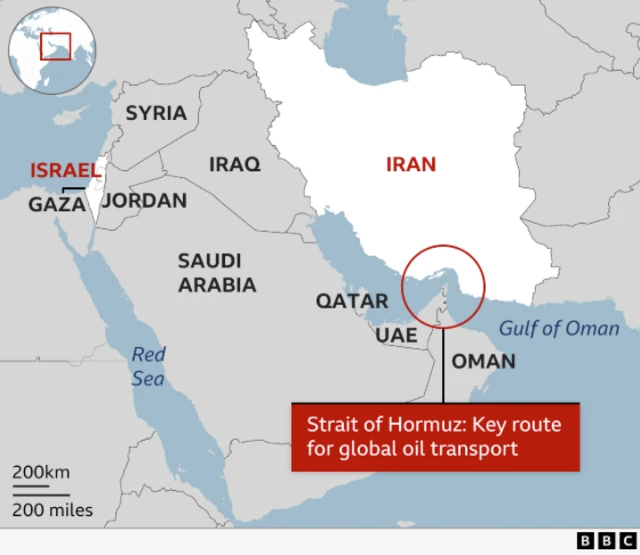
    Map showing where the Strait of Hormuz is in the Gulf of Oman, a key route for global oil transport. The strait lies between Iran and the peninsula of the United Arab Emirates and Oman. The map also shows countries in the wider Middle East region including Saudi Arabia, Iraq, Jordan and Israel

    As we've just reported, US President Donald Trump says "one way or the other" the US will get the Strait of Hormuz "open and safe".

    The Strait of Hormuz is a key trade artery through which around 20% of the world's oil passes.

    Since the beginning of the conflict, numerous ships have been reported to have come under attack in the area and Iran's new supreme leader on Thursday said that Iran should keep using the "lever of blocking" the Strait.

    About 3,000 or so ships usually sail through the corridor each month. In 2025, about 20 million barrels of oil passed through the Strait per day.

    It is deep enough for the world's biggest crude oil tankers, and is used by the major oil and gas producers in the Middle East – and their customers.

  6. Trump says US will open Strait of Hormuz 'one way or the other'published at 14:22 GMT
    Breaking

    US President Donald Trump says that "one way or the other, we will soon get the Hormuz Strait OPEN, SAFE, and FREE!"

    In a post on his platform Truth Social, he writes that he hopes China, France, Japan, South Korea and the UK will send war ships to the key shipping channel so it can "no longer be a threat" by Iran.

    He adds that many countries will be sending war ships to keep the key shipping channel "open and safe".

    In the meantime, he says, the US will be "bombing the hell out of the shoreline and continually shooting Iranian boats and ships out of the water".

    He claims the US has "destroyed 100% of Iran's military capability" but says it's still "easy" for them use drones, mines and close-range missiles.

    Iran's representative in Geneva, Ali Bahrani, said Trump's claims about eliminating Tehran's capabilities are "based on fabricated lies".

    In our next post, we'll bring you a reminder of what you need to know about the Strait of Hormuz.

  7. More than 200 students and teachers killed in Iran since start of warpublished at 14:11 GMT

    Ghoncheh Habibiazad
    Senior reporter, BBC Persian

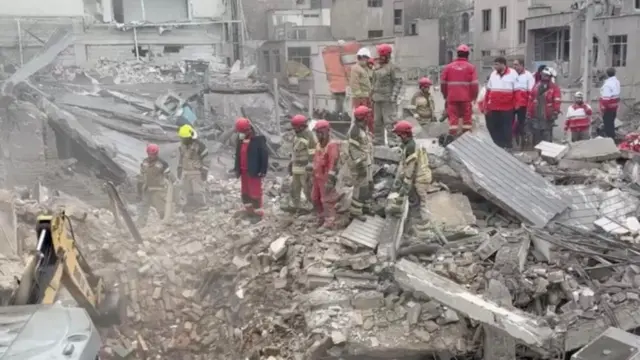
    Iranian Red Crescent aid workers and firefighters work at a residential site damaged by strikes, in Javadiyeh district, Tehran, Iran.Image source, Iranian Red Crescent Society/Reuters
    Image caption,

    Iranian Red Crescent aid workers at a residential site damaged by strikes in Javadiyeh district, Tehran, as 10,000 properties have been damaged in the city

    Fatemeh Mohajerani, spokesperson for the Iranian government, says more than 200 students and teachers have been killed since the start of the war.

    She adds that 120 schools have been "severely damaged".

    Tehran’s landmark Azadi Tower has sustained damage, she says on state TV.

    Iran’s minister of education said on 11 March that 206 students and teachers had been killed and 161 injured in the attacks so far, according to a report by official IRNA news agency.

    Iran’s Red Crescent Society says that, so far, 42,914 civilian properties have been damaged. Of these, 6,179 are commercial properties and 36,489 are residential, including 10,000 in Tehran.

    "Since the start of the war, 160 medical, health, and emergency centres across the country have been seriously damaged by enemy attacks," it adds.

  8. Trump says reports that five US planes were destroyed are wrongpublished at 13:57 GMT

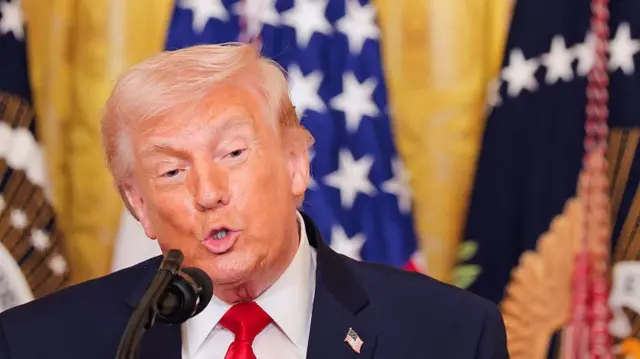
    Donald Trump mid-speech in the Oval Office. He's in a dark blue suit, white shirt and red tie, as US flag pin on the top of his left suit lapelImage source, Getty Images

    US President Donald Trump denies reports that five US tanker planes were heavily damaged at the Prince Sultan Air Base in Saudi Arabia.

    Multiple media sites reported overnight that the planes were damaged in an Iranian missile strike, but in a post on his platform Truth Social, Trump says that while the base was hit a few days ago, the planes were not "struck or destroyed".

    "Four of the five had virtually no damage, and are already back in service. One had slightly more damage, but will be in the air shortly," he adds.

  9. Injuries reported in Eilat, Israel following strikespublished at 13:49 GMT

    An earlier attack aimed at Eilat, in southern Israel, appears to have hit a building.

    Magen David Adom (MDA), Israel's ambulance service, says paramedics are providing treatment to a 12-yer-old boy and a 39-year-old man with shrapnel injuries.

    The boy is "in serious condition, conscious with injuries to his body", while the man is "in moderate condition with head and limb injuries", a spokesperson for MDA says.

    Rotem Basodo, from the service, says he saw "destruction, broken glass, and smoke at the scene".

  10. Sirens triggered in Jerusalem as missiles fly overheadpublished at 13:43 GMT

    There have been reports of explosions above Jerusalem, Israel, after its military said Iran had launched further attacks at the country.

    One barrage was fired towards Tel Aviv, with another triggering sirens around Jerusalem.

    We are working to bring you more details on any potential impact from the strikes.

  11. Nine ballistic missiles and 33 drones intercepted by UAE todaypublished at 13:39 GMT

    The UAE's Ministry of Defence says it has intercepted nine ballistic missiles and 33 drones so far today.

    It brings the total to 294 ballistic missiles, 1,600 drones and 15 cruise missiles since the start of the conflict.

    There have been six deaths and 141 "minor to moderate" injuries over this period.

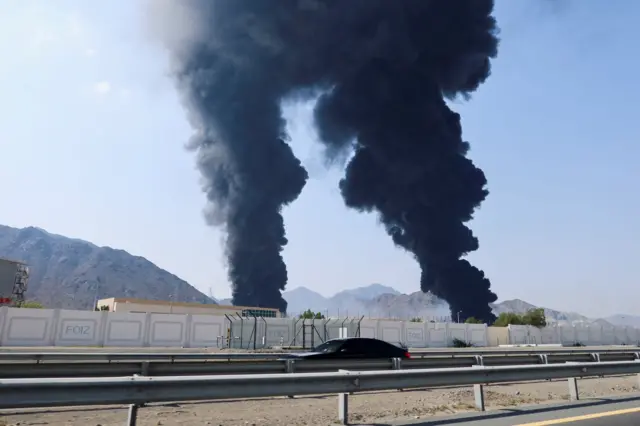
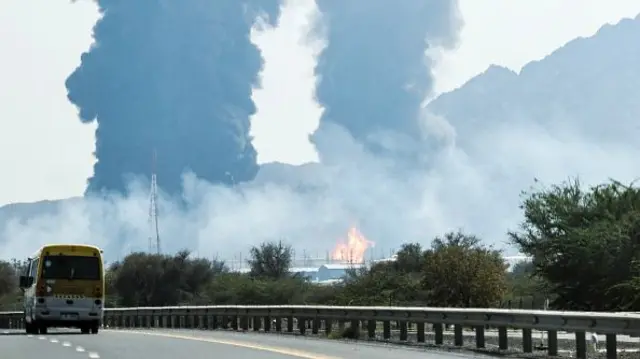
    Earlier, we reported that thick plumes of smoke were seen rising above the UAE's port of Fujairah, one of the largest oil storage facilities in the region, after it was targeted by a drone strike.

    The Iranian military has also told UAE residents to evacuate areas close to US targets.

  12. UAE port targeted by drone strike sits just off Strait of Hormuzpublished at 13:34 GMT

    Two parallel clouds of black smoke billow into the sky from an area near the port of FujairahImage source, Reuters

    Earlier we reported the port of Fujairah in the United Arab Emirates was targeted by a drone strike.

    A fire also broke out at the port after a drone was intercepted by air defences on 3 March, the Fuijairah Media Office reported.

    The port sits in a significant location on the Gulf of Oman around 70 miles from the Strait of Hormuz.

    The site is one of the biggest maritime service hubs in the world, according to its website, and provides "world class facilities" and equipment to service containers, cargo ships, livestock and cruise ships.

    Close to 12,500 vessels arrived at its anchorage in 2022 while more than 4,700 vessels were hosted at the port.

    Saudi Arabia and the UAE are among the few Gulf producers with pipelines designed to partially bypass the Strait of Hormuz. The UAE’s Abu Dhabi Crude Oil Pipeline can transport about 1.8 million barrels a day to the port of Fujairah.

  13. What is the Strait of Hormuz and why is it important?published at 13:25 GMT

    The Strait of Hormuz is a key trade artery through which around 20% of the world's oil passes.

    Since the beginning of the conflict, numerous ships have been reported to have come under attack in the area and Iran's new supreme leader on Thursday said that Iran should keep using the "lever of blocking" the Strait.

    About 3,000 or so ships usually sail through the corridor each month. In 2025, about 20 million barrels of oil passed through the strait per day.

    It is deep enough for the world's biggest crude oil tankers, and is used by the major oil and gas producers in the Middle East – and their customers.

    Map of the Middle East with Iran and Israel highlighted in white. A red circle connected to a red text box indicates the area known as the Strait of Hormuz, located between the Persian and Oman Gulfs
  14. Two Indian tankers safely cross Strait of Hormuzpublished at 13:16 GMT

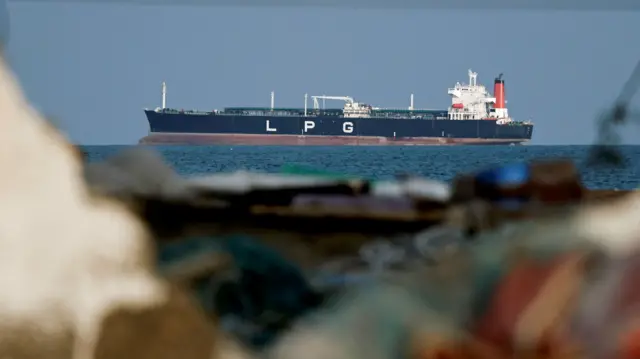
    An LPG gas tanker at anchor as traffic is down in the Strait of HormuzImage source, Reuters
    Image caption,

    An LPG gas tanker is seen at anchor as traffic comes to a virtual standstill in the Strait of Hormuz

    India says two of its tankers "safely" crossed the Strait of Hormuz this morning and are heading to India.

    The news was confirmed in a press briefing by Rajesh Kumar Sinha, special secretary of the Ministry of Ports, Shipping and Waterways.

    The two Indian-flagged tankers are carrying liquefied petroleum gas (LPG).

    It comes after Iran's ambassador to India, Mohammad Fathali, described the two countries as "friends" with "common interests" and a "common fate" on Friday, according to Reuters, citing comments made to the media.

    Iran has previously threatened to open fire on any vessels crossing the waterway - a key artery for global energy markets. Traffic has dropped dramatically as a result, causing oil prices to rise dramatically.

  15. Iran launches two strikes on Israel in rapid successionpublished at 13:04 GMT
    Breaking

    The Israel Defense Forces (IDF) has issued two updates in the last half hour saying a volley of missiles launched from Iran towards Israel have been detected.

    Iran's state broadcaster IRIB has also said on Telegram a new wave of missiles has been launched from Iran towards Israel.

    The Iranian Tasnim News Agency, which is linked to the Islamic Revolution Guards Corps, also reports that a huge explosion was heard in Tel Aviv as Iran's retaliatory strikes hit the Israeli city.

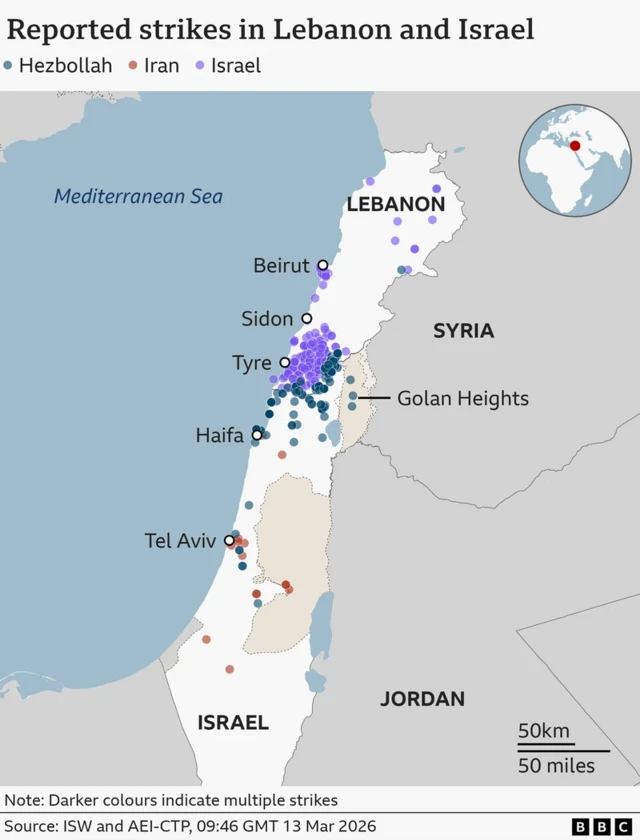
  16. Strikes in Lebanon and Israel - mappedpublished at 12:47 GMT

    Hezbollah launched missiles towards Israel following the killing of the Iranian Supreme Leader Ayatollah Ali Khamenei.

    This week Israel said it carried out around 70 strikes in Beirut against what it called "terrorist infrastructure" in the city.

    The Lebanese health ministry said on Friday that 773 people have been killed since Israel began its offensive on 2 March.

    A graphic showing sites of strikes in Lebanon and Israel - a large concentration in central Lebanon and Beirut, as well as Tel Aviv in Israel.
  17. Macron offers to host ceasefire talks between Israel and Lebanon in Parispublished at 12:34 GMT

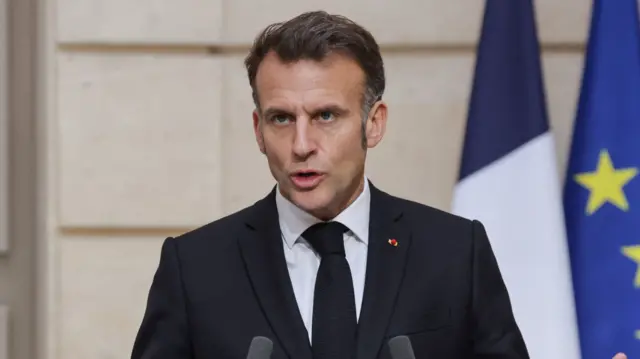
    French President Emmanuel Macron mid-speech as he delivers remarks outdoors. He's in a black suit, white shirt and black tie, a French and EU flag behind him to his leftImage source, Reuters

    French President Emmanuel Macron has urged Israel to hold direct talks with Lebanon and has offered to host ceasefire talks in Paris.

    In a post on X, he says he has spoken with Lebanese President Joseph Aoun, Prime Minister Nawaf Salam and Speaker of Parliament Nabih Berri, adding that "everything must be done to prevent Lebanon from descending into chaos".

    He calls on the Iranian-backed militant group Hezbollah to not escalate and for Israel to refrain from its "intensive bombing campaign" and "large-scale offensive" which has caused hundreds of thousands of people to flee the bombardments.

    "The Lebanese executive branch has expressed its readiness to enter into direct talks with Israel," he says, insisting that Israel should try to reach a ceasefire.

    He adds that France is prepared to hold the talks in Paris.

  18. UN base in Lebanon hit by 'machine gun fire', spokesperson tells BBCpublished at 12:23 GMT

    Samantha Granville
    BBC News, Middle East

    A spokesperson for the United Nations Interim Force in Lebanon (Unifil) tells the BBC one of their positions has been hit, "likely by heavy machine gun fire".

    They say a fire started following the attack on their base near Meiss el-Jabal, which is situated around 70 miles (114 kilometres) away from the Lebanese capital, Beirut.

    "One peacekeeper on his way to the shelter was lightly injured. We have launched an investigation. We remind all actors of their obligations to ensure the safety and security of peacekeepers at all times," the spokesperson adds.

  19. Strikes near key oil infrastructure in Iran and UAE raise stakes of war for both sidespublished at 12:10 GMT

    Jacob Phillips
    Live reporter

    Two columns of thick, black smoke are seen from the side of the road. Bright, tall flames can be seen in front of one of the plumes of smoke. Several foothills can be seen in the backgroundImage source, Getty Images
    Image caption,

    Smoke and flames rise from an energy installation in the Gulf emirate of Fujairah

    The US has gone for Iran's economic jugular vein as the conflict in the Middle East enters its third week, writes our security correspondent.

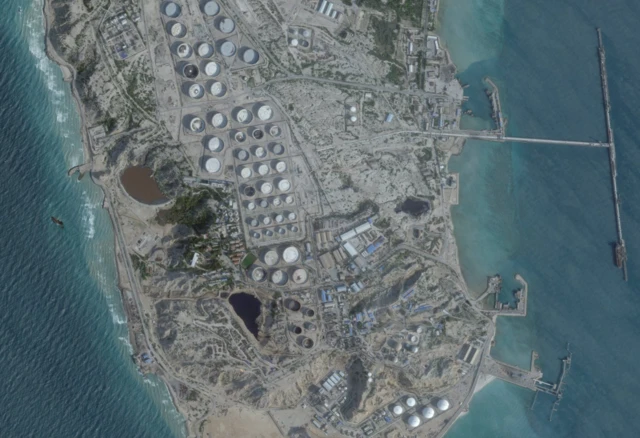
    The US says more than 90 military targets on Iran's Kharg Island have been destroyed in overnight strikes. The vital island in the northern Gulf is the terminal for close to 90% of the Iran's oil exports.

    Tehran, however, says there has been no damage to its oil infrastructure and no fatalities.

    Israel says the attack delivered a "severe blow" to the regime as its defence minister warns the conflict with Iran is now entering a "decisive phase".

    Meanwhile, thick plumes of black smoke have been rising from one of the largest oil facilities in the Middle East at the port of Fujairah in the United Arab Emirates.

    The port is a key location for fuelling ships as it sits just past the Strait of Hormuz - meaning vessels do not need to navigate through it as it remains practically cut off.

    Earlier, the US embassy in Baghdad, the capital of Iraq, was attacked while Israel continues to trade strikes with Iran and militant group Hezbollah in Lebanon.

    Media caption,

    Plumes of smoke seen rising over UAE port city

  20. US hit more than 90 Iranian military targets on key oil islandpublished at 11:53 GMT

    Aerial footage of Kharg IslandImage source, Reuters
    Image caption,

    Aerial footage of the oil terminal at Kharg Island taken five days before the US attack

    US Central Command (Centcom) has just shared further details on last night's strike on the Iranian oil island of Kharg.

    US forces hit "more than 90 Iranian military targets" on the island, while "preserving the oil infrastructure", it says.

    The strike destroyed naval mine storage facilities, missile storage bunkers, and multiple other military sites, it adds.

    This aligns with earlier comments from Iran, which said oil facilities "remain intact" with exports "fully under way".