Our live updates have endedpublished at 17:30 GMT
Our live coverage has now concluded for the day.
You can read more about today's proceedings here.
Two of the three survivors of the Nottingham attacks of 13 June 2023 - Sharon Miller and Wayne Birkett - have given evidence to a public inquiry, being held in London, on Thursday
The trio, which also included Marcin Gawronski, were struck by a van being driven by Valdo Calocane after he had killed Barnaby Webber, Grace O'Malley-Kumar and Ian Coates in the city
Wayne and his partner Tracey Hodgson said they were not told of Calocane's history with police - nor his violent past
Sharon later gave evidence and was told in a letter that NHS staff may have inappropriately accessed her medical records
Police officers have also given evidence, saying that giving the wrong cause of Ian's death to his partner was a "terrible error", adding they were "wholeheartedly sorry" for the delay in informing his family of his death
It has also emerged police were contacted to say King Charles III wanted to write to the victims' families
Our live coverage has now concluded for the day.
You can read more about today's proceedings here.
The Nottingham Inquiry has heard evidence today from two of the three survivors, Wayne Birkett and Sharon Miller, as well as their partners Tracey Hodgson and Martin Reed respectively.
The inquiry also heard evidence from family liaison advisor Det Ch Insp Claire Gould, and family liaison officer Det Insp Raj Johal, from Nottinghamshire Police.
Here are some of the key takeaways:
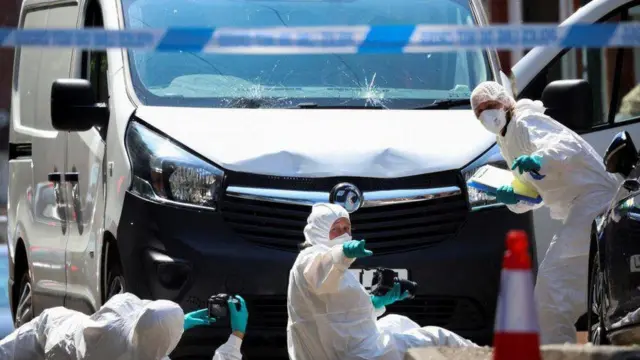 Image source, Reuters
As set out to chairwoman, senior retired judge Deborah Taylor KC, the inquiry will examine what happened, the events and actions that led to them, and triple killer Valdo Calocane's care and monitoring.
It will look at a broad range of areas in connection with the attacks, including:
The statutory inquiry will undertake a "thorough, independent assessment" of the events that culminated in the attacks and provide recommendations to prevent similar incidents.
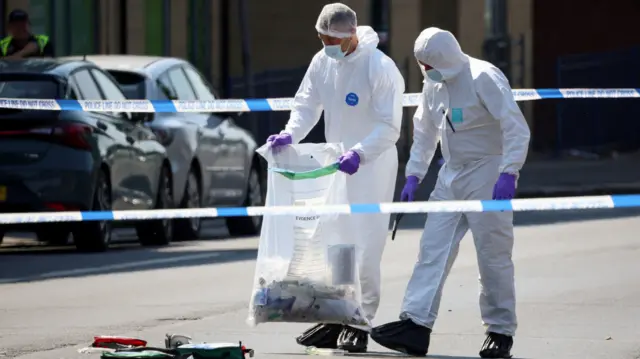 Image source, PA Media
Retired Det Con Raj Johal's evidence has now finished, and with that proceedings at Mary Ward House in London have concluded for the day.
Johal said while she stayed in touch with the families of the survivors, she believed she should have been present at meetings about the investigation.
"I continually kept in contact with the families," Johal said. "But I wasn't aware of the decision-making in relation to what was happening with [Calocane].
"I think it would have been advantageous of me to be present during those meetings, and for me to have a better understanding of how those decisions were made, so I could relay them in lay terms to the families that I was serving."
The inquiry has heard Det Con Raj Johal family liaison notes on her work laptop were deleted when she handed her device back to the force at the point of her retirement.
She said: "I wasn't aware at the time that I handed my laptop in before retirement that it would be not on the server.
"So my assumption was all documentations, emails... would be safely on the server for six years at least."
She said she knew she had to retain all her documents and notes in relation to the attacks, but was not aware they would be deleted.
The notes were made on a programme called OneNote, which, according to the force policy, should not have have been used for evidential notes.
Johal said she was only aware she should not have used OneNote at the point of the inquiry.
Continuing her evidence, Johal said Gould had told her to update the survivors that King Charles III would be sending letters to them.
The inquiry heard earlier today Gould was contacted to say the King wanted to write to the "three families" of the Nottingham attacks victims.
Gould said she replied to the royal correspondent to ask if the King would also consider writing to the three survivors "because there are actually six victims of the Nottingham attacks".
Johal said in her last communication with the survivors, she was told they had not received the letters.
When asked if she ever received information that the letters were on their way, Johal said: "No."
Earlier today Tracey Hodgson, the partner of survivor Wayne Birkett, told the inquiry she was informed by Johal that Valdo Calocane had no prior contact with police before the attacks.
Johal said her recollection of that conversation was different.
"I wasn't aware of any police contact with [Calocane] until this inquiry," she said.
Johal added: "I recall that conversation with Tracey Hodgson. She asked whether VC was known to the police, because she was confused as to how somebody could do this.
"I said to her 'I don't know', and the reason I said I don't know, is because I didn't know. I had no idea of his previous contact with the police at that time."
She said on reflection, she should have gone back to the family liaison advisor, Det Ch Insp Claire Gould, and asked the question and asked how to address it with the survivors.
Asked if she ever enquired about Calocane's history with the police, she added: "I didn't, and I should've done, and I should have clarified that with Tracey."
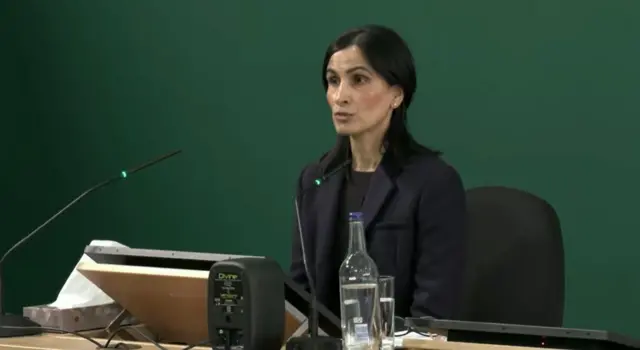 Image source, The Nottingham Inquiry
Johal told the inquiry "on reflection", it would have been better for all three of the survivors to have their own dedicated family liaison officer.
She said she did not "hold back information", but added it was "difficult" to update all three survivors at the same time.
Johal recalled there was an occasion when she was updating the survivors with new information, and by the time she was informing the third survivor, a media release had been published.
Johal told the inquiry she did not feel able to fully update the families she was supporting.
She said: "I felt that I wasn't involved in the bigger discussions so I wasn't able to fully update the families.
"I am aware that right at the beginning of the investigating, I was invited to a FLO meeting by the [senior investigating officer].
"I wasn't able to make that meeting because I had work commitments, but from there on I wasn't invited to any further meetings."
She said she did not query that or ask to be involved and that if she was to update the victims it would "often be at short notice".
Johal told the inquiry she started her career with Nottinghamshire Police in 1993, and retired in June 2025.
The inquiry heard she was asked to come to work early on the day of the Nottingham attacks.
However, she was told she was not required as a liaison officer as officers had been allocated for the families.
The hearing was told she was taken "aback" by this, as she was initially told to watch the CCTV of the incident in Ilkeston Road, where Barnaby Webber and Grace O'Malley-Kumar were killed, which she told the inquiry would stay with her "for the rest of my life".
She added there was "no need for me" to have to watch that footage.
Retired Det Con Raj Johal, the family liaison officer assigned to the survivors, is now giving her evidence.
Cartwright then questioned Gould about the information that was provided to the families about the outstanding warrant for Calocane's arrest.
She said she instructed family liaison officers to inform them about the warrant, which had been outstanding at the time of the attacks and issued nine months earlier.
Cartwright asked if she had caveated the wording to be given to the families with "only if the families asked".
Gould said: "Absolutely not."
Asked if and why she had underplayed the details of the warrant, and Calocane's assault on PC Barnaby Pritchard in September 2021, Gould said: "I didn't believe that I'd underplayed the information.
"I did what was in my role, and that was to pass on the information that was given to me by the [senior investigating officer] to the families."
In her questioning of Gould, Sophie Cartwright KC - representing the survivors - suggested they had had a "secondary level" of family liaison officer support.
However, Gould disagreed and said she never perceived they were treated as "secondary" or less of a priority.
"These were victims of a really serious incident," Gould added.
The inquiry has heard the survivors of the attacks were described as "walking wounded" in documents.
Questioned about that language, Gould said she appreciated the "victims feel that is insensitive language", but that it was often used by police and in the military in "medical terms".
She said now retired Det Supt Leigh Sanders, the senior investigating officer in the case, used the phrase and so she continued doing so.
Emma Webber, the mother of attacks victim Barnaby Webber, has formally complained to Nottinghamshire Police after the inquiry heard bodyworn camera footage was unnecessarily accessed by staff.
On Tuesday, she said there should be a full investigation and for the breach to be "considered as a criminal matter".
"It is only in the past few days of the statutory inquiry that the full seriousness of the misconduct has been revealed," she said.
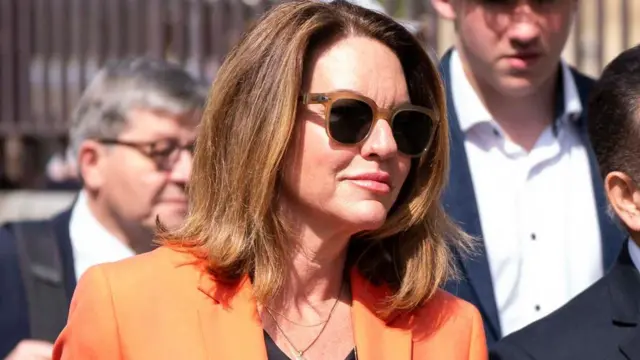 Image source, PA Media
Gould told the inquiry that more information should have been provided to families regarding Calocane's previous contact with police and his history of mental health.
The hearing heard that the Webber family had asked for important information to be put in writing.
Gould agreed and said: "Yes, that should have been done."
The inquiry heard Gould was contacted to say King Charles III wanted to write to the "three families" of the Nottingham attacks victims.
Gould said she replied to the royal correspondent to ask if the King would also consider writing to the three survivors "because there are actually six victims of the Nottingham attacks".
She said she was told that should not be a problem, and that the letters would be sent from the Palace to the families.
"I thanked her, and from then on it's never been raised to me that any letters have not been received or that there have been any issues with that," Gould told the inquiry.
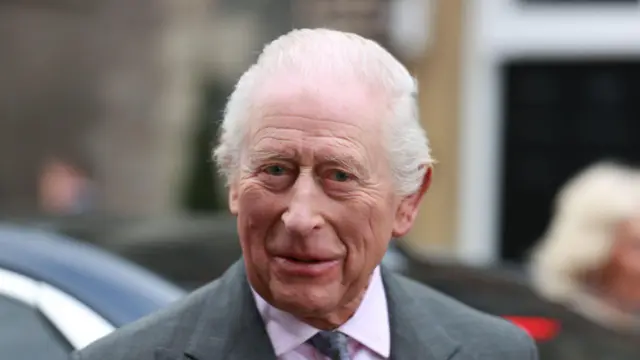 Image source, PA Media
The inquiry heard there was a "lack of understanding" within the police about identifying interested persons in police misconduct investigations.
Gould said it needed to be "front and central" that misconduct investigations were matters that impacted families.
She added they were not just matters affecting officers who might face potential sanctions.
The inquiry heard that telling the families about the police misconduct investigations was delayed even further after it was decided in December 2023 that it was "too late".
Gould said she shared that perspective and asked if it could wait until the new year.
She added: "I was very concerned at this time.
"The families were facing the acceptance of pleas, and we knew how distressing they were finding that.
"It was coming up to the first Christmas and knowing how close the families were, I felt it would be a very difficult time."
Gould maintained her belief that the families should have been told three months earlier.
However, she added: "I felt that it would be in the best interests in the families to delay until the new year."
Gould said when that information was eventually provided to the families, she did not think it was sufficient.
