Summary

  • Our live coverage is now closed - read our news story here

  • Defence Secretary John Healey says three Russian submarines carried out a "covert" operation above cables and pipelines in the Atlantic, north of the UK, lasting longer than a month

  • In a Downing Street news conference, Healey says he deployed a warship and aircraft in response, and the Russian vessels were "monitored 24/7"

  • He says there is "no evidence" of any damage to UK infrastructure in the Atlantic

  • And in a message to Vladimir Putin, he says: "We see your activity over our cables and our pipelines, and you should know that any attempt to damage them will not be tolerated and will have serious consequences"

  • This is not the first time the UK has accused Russia of spying close to critical undersea cables, writes Jonathan Beale, but this appears to be a more sophisticated and clandestine Russian operation

  • Earlier this year, the BBC looked at the Russian threat to British cables - read the InDepth piece here. You can also see our map of crucial cables and pipelines around the UK here

Media caption,

'We see you', Healey warns Putin

  1. Russia's month-long covert submarine operation failed, defence secretary sayspublished at 13:56 BST

    Joe Coughlan
    Live Reporter

    A Russian submarine operation was detected in and around British waters by the UK and its allies during a month-long operation, UK Defence Secretary John Healey told a Downing Street press conference today.

    He said the Akula attack submarine and two Gugi spy submarines have since left UK waters and headed back north after the spy vessels spent time over "critical infrastructure relevant to us and our allies".

    Healey added there "no evidence that there has been any damage" to UK cables and pipelines, but that any attempt to damage the infrastructure would not be tolerated and will have "serious consequences".

    This appears to be a more sophisticated and clandestine Russian operation, writes the BBC's defence correspondent, while our security correspondent explains why the UK's dependence on the cables and pipelines comes with vulnerability.

    The defence secretary also said the UK is "stepping up" its defence efforts by spending an extra £100m on submarine hunting aircraft and launching the Atlantic Bastion programme to create a "British built hybrid naval force".

    In a message to Russian President Vladimir Putin, Healey says: "We see you." Watch the full clip below.

    We're now ending our live coverage but you can read more on this in our news story.

  2. Analysis

    UK's dependency on undersea cables comes with vulnerabilitypublished at 13:32 BST

    Frank Gardner
    Security correspondent

    As an island nation, the UK is especially dependent on its undersea cables and pipelines for its data and for its energy.

    More than 90% of our day-to-day internet traffic travels not via satellite, but by these undersea cables.

    With that dependency comes a unique vulnerability. There are 'clusters' where these cables come ashore from the Atlantic and the North Sea.

    These can be monitored, although some would argue not nearly as much as they should be. But it is impossible to monitor every metre of undersea cable that lies at the bottom of the ocean.

    The Russian Defence Ministry’s Gugi unit, euphemistically designated as ‘deep sea research’, has developed uncrewed minisubs specially designed to dive to depths of thousands of metres below the surface.

    These vessels can be equipped with what are, in effect, giant scissors, capable of cutting cables on the seabed. They can also place monitoring devices that can stay hidden for years.

    Charlotte Wilson, Head of Enterprise at Check Point Cybersecurity says what makes this Russian operation more concerning is the level of sophistication involved.

    "These aren’t standard submarines, they’re specialist vessels designed for deep sea operations. So this isn’t random movement, it suggests a deliberate effort to understand where critical infrastructure sits and how it behaves. Not only mapping locations but also assessing how resilient those systems are".

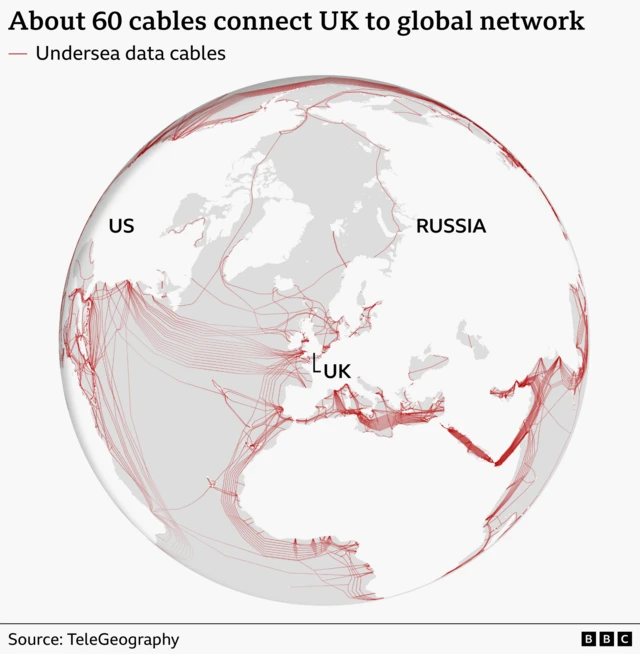
    Globe-style map titled “About 60 cables connect UK to global network” showing the UK highlighted at the centre, with dozens of red lines representing undersea data cables spreading across the Atlantic to the United States, across Europe, and onward toward Russia, Asia and the Middle East. The cables form dense clusters around the UK and western Europe, illustrating the UK’s role as a major hub in the global internet infrastructure; Source: TeleGeography
    Image caption,

    The UK is especially dependant on about 60 undersea cables which connect it to the international network

  3. Attacks on cables and pipelines in recent yearspublished at 13:29 BST

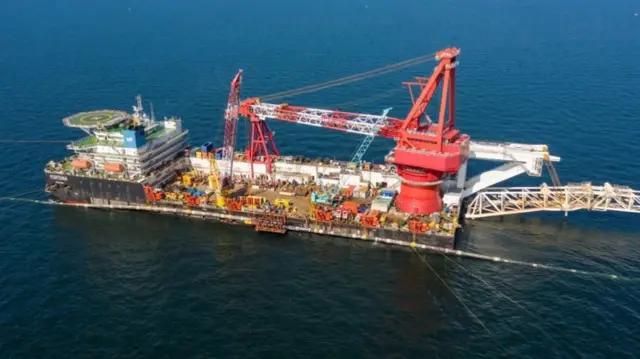
    A floating vessel in the sea with people working, a large crane and helicopter pad.Image source, Reuters
    Image caption,

    Nord Stream 1 supplied Germany with the majority of its gas from Russia before an attack in 2022

    There are two key bits of infrastructure that could be vulnerable to an undersea attack: our data cables and pipelines - here's why they're important.

    A 2025 inquiry into how vulnerable the UK is to an attack on cables found three key threats: Russia, China, and non-state actors.

    There have been some attacks on cables and pipelines, mainly concentrated in the Baltic, in recent years. A suspected attack in 2024 caused disruptions in data transmission services for Latvia's state broadcaster, LVRTC.

    And UK has previously sent ships to the Baltic to protect its own infrastructure, after an attack on the Nord Stream 1 and Nord Stream 2 gas pipelines in 2022.

    But the UK's committee on national security strategy said it wasn't confident the UK could prevent such attacks or recover within an acceptable time period, in its September 2025 report, external.

  4. Russian threat in North Atlantic is growing, Royal Navy chief tells BBCpublished at 13:23 BST

    Jonathan Beale
    Defence correspondent

    The head of the Royal Navy, General Sir Gwynn Jenkins has told the BBC the Russian threat in the North Atlantic "isn’t diminishing, it’s growing".

    Earlier this year I accompanied the First Sea Lord on a visit to northern Norway - where the UK is doubling its military presence from 1,000 to 2,000 Marines.

    General Jenkins told me Russia has continued to invest in their submarine capabilities in the High North, despite its focus on the war in Ukraine.

    He said Russia had "restarted their deployments of their subsurface sabotage capability - their so called Gugi".

    Jenkins also told the BBC the UK was "holding on in the Atlantic in terms of our ability to track them with allies, but only just".

  5. What is a Gugi submarine?published at 13:16 BST

    Vitaly Shevchenko
    Chief analyst, BBC Monitoring

    Two specialist submarines from the Russian defence ministry's deep sea research programme, known as Gugi, were part of the "increased Russian activity" in the Atlantic north of the UK, Healey said.

    The Main Directorate for Deep-Sea Research (Gugi) is unofficially known as the "underwater spetsnaz", or special operations force.

    It is Russia’s long-running military programme to develop capabilities to be deployed from specialist surface vessels and submarines.

    Set up in the 1960s, it now operates a fleet of nuclear-powered submarines which can spy on underwater cables. Some of such submarines are equipped with manipulative arms and can cut undersea cables.

    They are intended to survey underwater infrastructure during peacetime but damage or destroy infrastructure during a conflict.

    One of the Gugi submarines, the Losharik, is named after a character from a Soviet cartoon - a puppet made up of strings of balls. This design reportedly allows the sub to dive below 2.5km.

    The submarines depend on motherships for longer transits, which Rusi says are likely to be detectable by Nato.

    Gugi has been accused of spying on undersea cables numerous times in the past. In November 2024, Gugi's surveillance ship, the Yantar, was spotted "loitering over UK critical undersea infrastructure", according to Healey.

  6. The importance of undersea cables - explainedpublished at 13:01 BST

    Around 600 undersea cables carry electricity and information across international oceans and seas, stretching 870,000 miles (1.4m km).

    Most of them are data cables, which support almost all of our internet traffic.

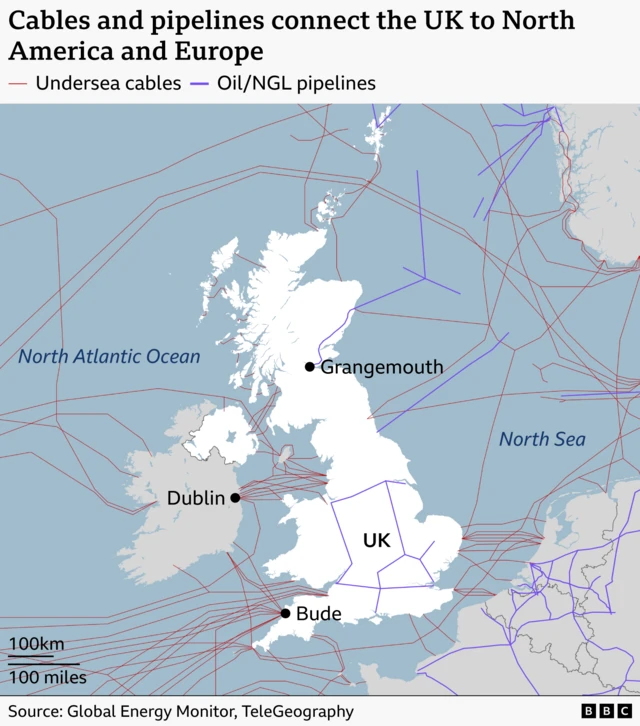
    The UK has around 60 undersea cables which come ashore at several parts along its coastline, particularly around East Anglia and South West England.

    Meanwhile, pipelines are used to transport oil and natural gas.

    Keir Giles, Russia expert at Chatham House and author of Who Will Defend Europe?, previously told the BBC that potential sabotage to cables should be seen "as not just an isolated phenomenon".

    He added that the damage should be seen as part of "Russia's much more holistic programme of targeting communications infrastructure and critical infrastructure overall".

    Map titled “Cables and pipelines connect the UK to North America and Europe” showing the UK at the centre, with dense networks of undersea data cables (red) and oil and NGL pipelines (purple) crossing the North Atlantic Ocean and North Sea. Key landing points are marked at Bude (south‑west England), Dublin (Ireland) and Grangemouth (Scotland), with routes linking the UK to continental Europe and across the Atlantic to North America; a distance scale is shown. Source: Global Energy Monitor, TeleGeography.
  7. Analysis

    This appears to be a more sophisticated and clandestine Russian operationpublished at 12:47 BST

    Jonathan Beale
    Defence correspondent

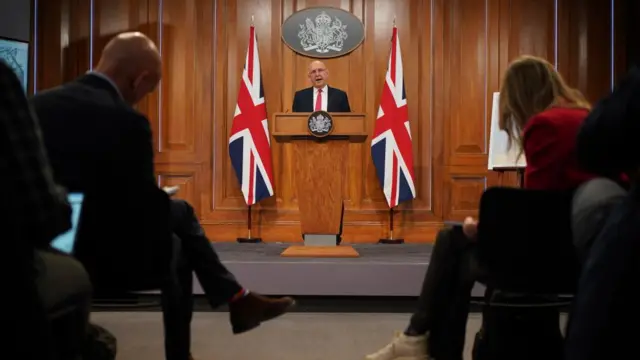
    Healey delivering his speech in front of reporters in Downing StreetImage source, PA

    This is not the first time the UK has accused Russia of spying and carrying out surveillance close to critical undersea cables near British waters.

    But this appears to be a more sophisticated and clandestine Russian operation.

    John Healey said that Russia had sent an Akula class submarine as a diversionary tactic - while two of its Gugi spy submarines carried out the surveillance of undersea cables - somewhere in the North Atlantic.

    The clandestine Russian activity went on for almost a month, but was observed by RAF maritime surveillance aircraft and a Royal Navy Frigate HMS St Albans. Other nations were involved in tracking the Russian activity - though Healey only mentioned Norway by name.

    The defence secretary said he believed that President Putin had also hoped the war in Iran - taking place at the same time - would divert attention away from the activities of the Russian spy submarines. But clearly it did not.

    Despite the international focus on the Middle East, Healey stressed that Russia remained the primary threat to the UK and Nato allies.

  8. More funding to defend UK waters as Russian vessel threats increasepublished at 12:19 BST

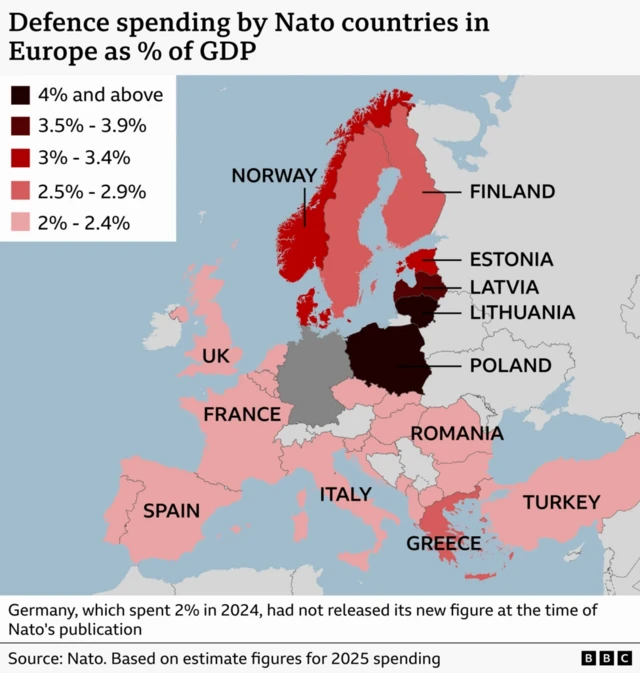
    Healey's update includes some key figures that, he says, highlight the government's increase in defence spending:

    • The defence secretary says UK has seen a 30% increase in Russian vessels threatening UK waters
    • He announced an additional £100m is being invested in supporting RAF P8 submarine hunting aircraft, to protect critical underwater infrastructure
    • That's part of what Healey says is the government's biggest uplift in defence spending since the Cold War, with a £270bn investment in defence across this Parliament - reaching 2.6% of GDP from 2027

    But earlier this year, Head of the Armed Forces Sir Richard Knighton said the UK is "not as ready as we need to be for the kind of full-scale conflict we might face". At the time, he avoided questions about the reported shortfall in government spending on defence.

    In January, reports suggested the Ministry of Defence (MOD) needed an extra £28bn to meet existing costs over the next four years.

    And, at the end of last year our security correspondent Frank Gardner took a closer look at whether the UK could fight a war for more than just a few weeks.

    A map of Europe showing defence spending as percentage of GDP. Poland, Lithuania and Latvia highest, UK, France, Italy, Spain and Turkey lower.
  9. Defence ministry shares image of UK vessel used in operationpublished at 12:02 BST

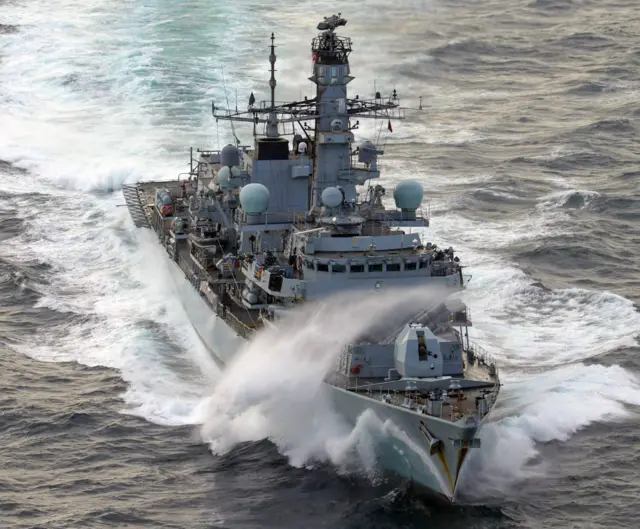
    Defence Minister John Healey said in his news conference that the Royal Navy deployed a Type 23 frigate HMS St Albans, RFA Tidespring and Merlin helicopters to track the Russian attack submarine as it operated near British territorial waters.

    In its press release, shared a few minutes ago, the defence ministry provided this file photo of the Type 23 frigate HMS St Albans:

    File photo shows a Type 23 frigate HMS St Albans from 2016 sailing through the ocean with spray around itImage source, Ministry of Defence
  10. Starmer: 'We will not shy away from taking action' on Russiapublished at 11:58 BST

    Keir Starmer (L) with Emirati government official Khaldoon Al Mubarak (R) during a visit to Abu Dhabi, United Arab Emirates 09 April 2026Image source, Handout
    Image caption,

    UK Prime Minister Keir Starmer is meeting UAE government official Khaldoon Al Mubarak during a visit to Abu Dhabi today

    We've just seen a press release that goes alongside Healey's comments, which includes remarks from Prime Minister Keir Starmer.

    Starmer arrived in the UAE this morning as part of a visit to Gulf allies this week.

    Here are Starmer's comments in full:

    "I am determined to protect the British people from paying the price for Putin’s aggression in their household bills.

    "That is why we will not shy away from taking action and exposing Russia’s destabilising activity that seeks to test our resolve.

    "Our Armed Forces are among the best in the world, and the British public should be in no doubt that this government will do whatever it takes to defend our national and economic security, wherever in the world that is needed."

  11. UK reveals Russian submarine operation in and around British waterspublished at 11:51 BST

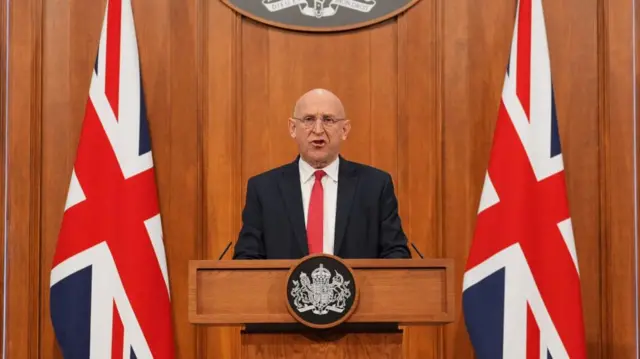
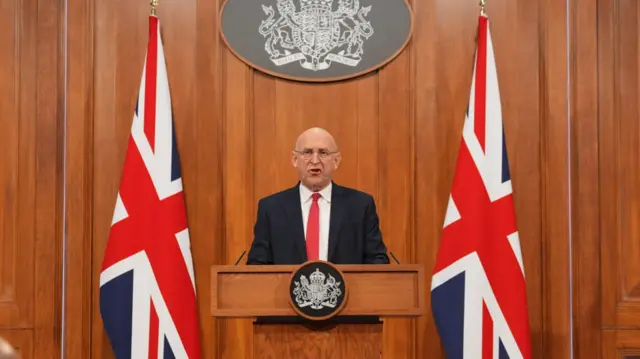
    John Healey delivering his statement in front of two British flagsImage source, Reuters

    UK Defence Secretary John Healey has just wrapped up his remarks at Downing Street, revealing a Russian submarine operation in and around British waters. Here's a recap of what he said:

    • The UK and its allies spent more than a month tracking a Russian Akula attack submarine and two Gugi spy submarines in the North Atlantic before they retreated
    • These submarines were monitored 24/7 by a warship and aircraft and "have now left UK waters and headed back north", Healey says
    • Healey says the Akula submarine was "a likely decoy to distract" from the two Gugi submarines as they spent time over "critical infrastructure relevant to us and our allies"
    • The defence secretary says there is "no evidence that there has been any damage" to UK cables and pipelines
    • Addressing Russian President Vladimir Putin, Healey says: "We see your activity over our cables and our pipelines, and you should know that any attempt to damage them will not be tolerated and will have serious consequences"
    • Healey says Moscow still "poses a threat", but he is confident that the UK can track and monitor future activity and continue to expose "any covert operations that Putin wants to mount that may threaten our vital interests"
  12. Healey shares image of Russian Gugi vesselspublished at 11:44 BST

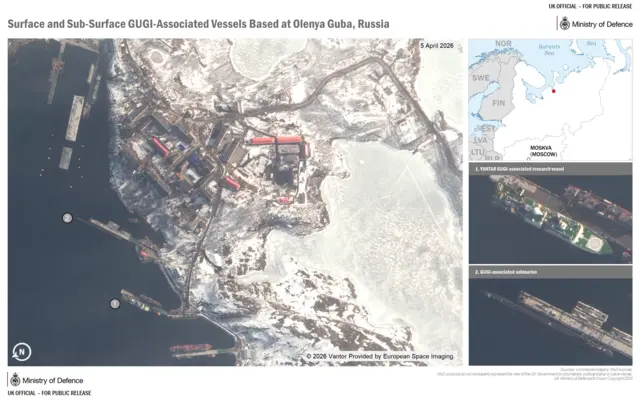
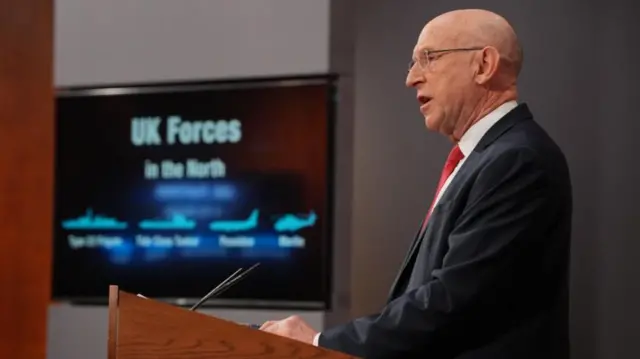
    Healey is continuing to take questions in Downing Street. He earlier showed reporters an image of surface and sub-surface Gugi vessels in Russia - specialist submarines from Russia's ministry of defence deep sea research programme.

    You can see the graphic he shared below:

    Handout composite image issued by the Ministry of Defence showing of surface and sub-surface GUGI-associated vessels based at Olenya Guba in Russia.Image source, Ministry of Defence
  13. Healey confident no damage done to UK cablespublished at 11:36 BST

    Healey is asked by ITV's political correspondent Shehab Khan about what the consequences would be to Russia if damage was found to UK cables.

    The defence secretary says the UK has "watched, monitored and tracked" the Russian movements and the country has the ability to "step up" its responses to the incursions.

    He says: "These were our wider waters in and out and around our exclusive economic zone, to be clear, not our close-by shore territorial waters."

    He adds that the UK has one of the most resilient undersea networks of any nation, with in-built contingencies, and he remains confident no damage has been done.

  14. Healey tells BBC he condemns Lebanon escalationpublished at 11:32 BST

    Media caption,

    'We welcome the ceasefire, we want it to hold'

    The BBC's Defence Correspondent Jonathan Beale is the first to ask a question. He asks for more clarity on what the Russian submarines were doing in the North Atlantic, and also whether the ceasefire in the Middle East can hold.

    On the Middle East, Healey says he welcomes the ceasefire and wants it to hold, but "condemns" the escalation in Lebanon.

    Speaking about the submarines, he says that the UK spent more than a month tracking every mile of them. Recognising the Russian Akula-class nuclear-powered attack submarine as a likely decoy to the two specialist submarines from Russia's ministry of defence deep sea research programme, Gugi (Main Directorate of Deep-Sea Research).

    He says they watched the Gugi submarines spend time over "critical infrastructure", but he is confident that there is no evidence of any damage. This is being verified with allies, he adds.

  15. Healey: Government acting to defend interests and allies in Middle Eastpublished at 11:27 BST

    Healey concludes by saying that as the government acts to defend its interests and allies in the Middle East, it also steps up to meet the "increasing threats" in the High North and to strengthen Nato and defend Ukraine.

    He says this will protect the UK to be "secure at home and strong abroad".

  16. Not in national interest to deploy all military assets to Middle East - Healeypublished at 11:24 BST

    Healey touches briefly on the Middle East conflict, saying that when a crisis erupts "dangerously and noisily", people question why all military assets are not deployed to deal with it.

    This is not in the national interest Healey says.

    He adds that the "greatest threats are often unseen and silent" and as demand rises for defence, we must deploy resources to best effect.

  17. Putin's covert operation failed, says defence secretarypublished at 11:22 BST

    Healey says Putin's covert operation failed "because this government completed our first duty", which he says is to protect.

    Consequently, this year the UK's carrier group will be deployed to the High North and lead the new Nato mission, Arctic Sentry. Healey says this is "where it is most needed".

    Nato's Arctic Sentry is a military activity focused on strengthening deterrence and defence in the region.

  18. UK stepping up defence efforts, says Healeypublished at 11:20 BST

    Healey says the UK is "stepping up" its defence efforts, making the biggest sustained increase in defence spending since the Cold War.

    He says an extra £100m is being spent on submarine hunting aircraft and the launch of the Atlantic Bastion programme to create a "British built hybrid naval force".

    HealeyImage source, PA Media
  19. Sea bed pipelines are a 'prime target'published at 11:18 BST

    Healey says this operation is a reminder as to why the sea bed matters to the UK.

    As an island nation, he says this connection is very important for our economy and security.

    Sea bed pipelines provide half of the gas that heats our homes and 99% of international telecoms and data traffic, as well as trillions of pounds of trade each day, he says.

    These reasons make the sea bed a "prime target" for adversaries, Healey adds.

  20. Attempts to damage cables will have 'serious consequences' - Healeypublished at 11:15 BST

    Healey addresses Russian President Vladimir Putin, saying: "We see you, we see your activity over our cables and our pipelines."

    The defence secretary adds that "any attempt" to damage UK cables or pipelines will not be tolerated and will have "serious consequences".

    John HealeyImage source, PA Media