Summary

  1. UKHSA confirms 13 cases recorded in Kent so farpublished at 19:59 GMT

    Echoing an update we received a little earlier from NHS Kent and Medway, the UK Health Security Agency UKHSA) says that anyone who visited the Canterbury nightclub Club Chemistry on March 5, 6 or 7 should "come forward for preventative antibiotic treatment as a precautionary measure".

    The number of confirmed cases remains at 13, according to the update.

    Trish Mannes, the UKHSA's regional deputy director for the south east, says that “investigations have identified that some cases visited Club Chemistry in Canterbury" on those three dates.

    "It is important that anyone who visited the club between 5th and 7th March now comes forward," she says.

    The UKHSA says it acted as soon as it was notified of a sudden rise in cases in the south east.

    "UKHSA was notified of a cluster of cases late on Saturday. We acted immediately and communication to those at risk took place on Saturday evening and Sunday," a spokesperson says.


  2. Family shares photo of A-level student who diedpublished at 19:26 GMT
    Breaking

    Nick Johnson
    Reporting from Kent

    The BBC has been given permission to share this picture of 18-year-old Juliette, a sixth form student who died after contracting meningitis.

    Her father tells the BBC that the family are "beyond devastated and they have no words to express their loss."

    Her family has requested her surname not be publicised.

    Earlier, we heard from Amelia McIlroy, the headteacher at her school, who said Juliette "embraced everything the school had to offer and was genuinely caring".

    A picture of JulietteImage source, Supplied
    Image caption,

    Juliette's family have given the BBC permission to share this picture of her

  3. 'I had infection at uni - more needs to be done'published at 19:01 GMT

    James Kelly
    UGC Hub

    Matt Woolford smiles upwards at the cameraImage source, Matt Woolford

    Matt Woolford, 25, from Reading, suffered a life-threatening meningococcaemia infection when he was at university.

    Following on from news of the Kent outbreak today, Woolford tells the BBC "more really needs to be done".

    "From the John Radcliffe Hospital in Oxford, I was sent back to my university halls prematurely, confused and still severely ill resulting in the UKHSA having to contact my flatmates," he explains.

    "I was told that these outbreaks happen regularly at universities.

    "I then asked about vaccines. Most people my age have their MenACWY vaccine. None have been given MenB [because of] cost effectiveness and so the NHS says they will only give this out to young children.

    "That is simply not good enough, and more people will die the longer awareness isn’t raised, and people aren’t vaccinated."

  4. Families join students queuing for antibiotics at universitypublished at 18:47 GMT

    A long line of people outside a university building.Image source, PA Media

    As we've been reporting, people have been queuing throughout the day at the University of Kent to collect antibiotics.

    A mix of ages and young families with buggies have been among those lining up for medicine there, the Press Association reports.

    Dan Turner brought his two children, aged one and two years old, and partner to get antibiotics after calling NHS advice line 111 on Monday afternoon.

    The 40-year-old says his stepdaughter's sister had been rushed to hospital with a suspected case of meningitis and the family were told to get checked out.

    "Better to be safe than sorry," he says.

    Some waiting in line were seen wearing masks, carrying shopping bags, while others could be seen sharing vapes elsewhere, PA reported.

  5. NHS offering antibiotics to people who were at Canterbury nightclub on 5, 6 and 7 Marchpublished at 18:32 GMT

    The exterior of Club Chemistry night club in CanterburyImage source, PA Media
    Image caption,

    Club Chemistry night club in Canterbury

    NHS Kent and Medway says it is giving free antibiotics to people who visited a Canterbury nightclub on three particular days in March.

    It says that more emergency antibiotics are available for "people who visited Club Chemistry on March 5, 6 and 7". This is the Canterbury nightclub that earlier said it was closing until it receives further advice from UKHSA.

    In comments made earlier to the Press Association, the nightclub's owner Louise Jones-Roberts said that they had been "told somebody was in our club at the weekend who has since been diagnosed with meningitis".

    As a precautionary measure, the antibiotic tablets are being offered to people who do not have symptoms and can be accessed at four temporary clinics, the NHS says.

    People who live on the University of Kent campus in Canterbury are also eligible, as well as close household contacts of cases who have been identified by UKHSA or who self-identify as having contact with a confirmed case.

    The NHS Kent and Medway website has more information on where the clinics are located, external and their opening times.

  6. 'My son was very anxious going in,' says mum at school with confirmed casepublished at 18:22 GMT

    James Kelly
    UGC Hub

    Emily Smith, 49, is the mother of a 13-year-old at Simon Langton Grammar School for Boys in Canterbury - it earlier confirmed that a student in Year 13 has been admitted to hospital with meningitis.

    "I'm concerned and feel awful for the families involved, it's terrible," she says.

    She says her son was "very anxious going in, because obviously it was on the grapevine but school weren't in the position to confirm it, I assume."

    "It is just a frightening time for everybody and I think it's the rapidity of it as well that's frightening."

    Your Voice
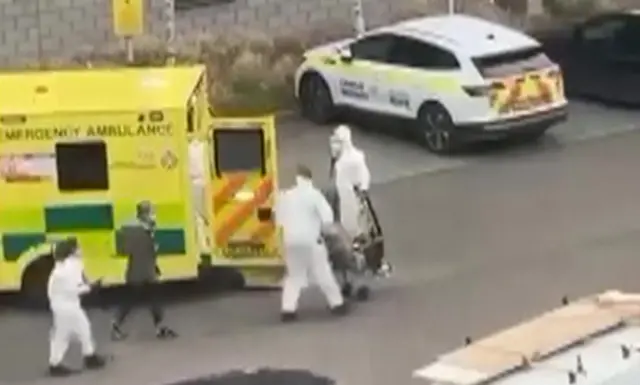
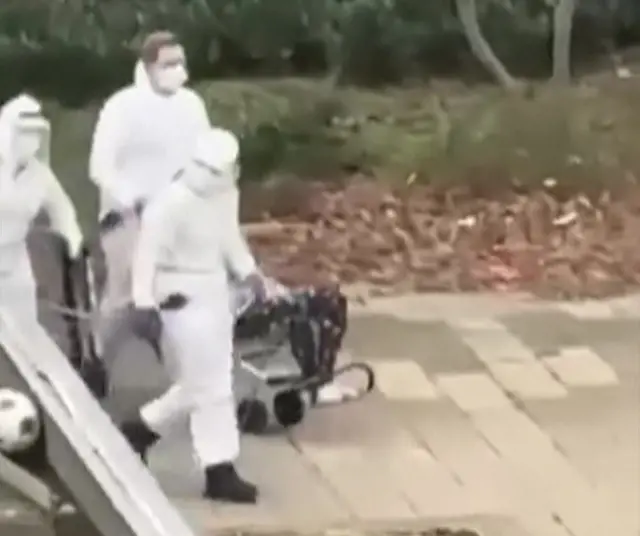
  7. Images show health professionals at University of Kentpublished at 18:13 GMT

    We can now bring you some more images from the University of Kent.

    These pictures, obtained by the BBC, show health professionals at the university in the immediate aftermath of the outbreak - transferring people to hospital and wearing protective clothing.

    A grab from video shows people in hazmat suits loading a patient into an ambulance with another emergency vehicle saying 'Kent campus security' in the background.
    A grab from video shows people in hazmat suits loading a patient into an ambulance with another emergency vehicle saying 'Kent campus security' in the background.
    A grab from video shows people in white hazmat suits wheeling a patient down a pavement
  8. Ashford school confirms Year 13 student has meningitispublished at 17:47 GMT
    Breaking

    Norton Knatchbull School in Ashford has confirmed that one of its Year 13 students has meningitis. This follows an earlier update from the school, in which it said a pupil had been admitted to hospital with a suspected case.

    "We have now been informed that the diagnosis has been confirmed, and the student is receiving appropriate hospital treatment," says a statement from the headteacher.

    "Our thoughts are with them and their family at this difficult time."

    The school adds that it is in close contact with the UK Health Security Agency (UKHSA), which has confirmed that "the wider school community does not require any additional measures beyond being vigilant for symptoms".

    "The school will continue to operate as normal unless UKHSA advises otherwise," it says.

  9. Analysis

    Why is the MenB vaccine not given to teenagers in the UK?published at 17:36 GMT

    Philippa Roxby
    Health reporter, BBC News

    It's down to how effective that vaccine is seen to be in that age group.

    Research suggests the MenB vaccine doesn't influence transmission of the infection from one person to another, it doesn't target against all the different B bacteria strains and doesn't protect for particularly long either.

    For all those reasons, and despite campaigns by charities to have it introduced, UK vaccine experts have concluded that the MenB vaccine isn't cost effective on the NHS for adolescents.

    Babies are offered the MenB vaccine and given three doses in the first year of life.

    That's because young babies are more likely to get invasive infections more often than other age groups, and their bodies are less likely to be able to fight them off, experts say.

    Teenagers are currently offered the MenACWY vaccine, which has reduced the number of young people getting ill from meningitis and spreading those bugs.

    But uptake of that vaccine is still not where it was before the pandemic - about 73% of 13-year-olds were vaccinated last year in England. Among 14 year olds, uptake was 75%.

  10. Third Kent school confirms meningitis casepublished at 17:21 GMT
    Breaking

    A grammar school for boys confirms one of its Year 13 students has been admitted to hospital with meningitis.

    "Our thoughts are with him and his family during this difficult time, and we hope for a speedy recovery," the headmaster of the Simon Langton Grammar School for Boys says in a letter seen by the BBC.

    He acknowledges the situation can be "worrying" but adds that the school will remain open tomorrow as the risk of contagion "is low".

    Simon Langton Grammar School for Boys is the second school to confirm a case of meningitis after Queen Elizabeth's Grammar Faversham, whose student - identified as Juliette - died.

    Earlier, Norton Knatchbull School in Ashford said one of its Year 13 pupils is currently in hospital with suspected meningitis. The University of Kent announced yesterday a 21-year-old student had died after becoming infected.

  11. 'Everyone is going home, I'd rather avoid making my family sick'published at 16:55 GMT

    Malu Cursino
    Live reporter

    Isabel Kenny, a fourth year student at the University of Kent, recalls hearing about the meningitis outbreak on the news before emails from the university started coming in.

    That's when her friends started texting in group chats, getting in touch with each other. "Everyone [was] getting quite nervous really," she tells the BBC.

    The 21-year-old was notified she'd been in contact with someone who has meningitis, but she doesn't know who.

    "It's a girl in my dance class, but we weren't told who it is, which I think is fair enough. It feels a bit weird not knowing who it is, it's a bit nerve-wracking, but I actually think it'd make me more nervous if I did know who it was. I'm wishing the best for her," Kenny explains.

    As she was walking up to campus this morning to get her dose of antibiotics, Kenny saw several of her peers packed up and heading home.

    "Everybody is going home ... I saw so many students with suitcases going towards the train station."

    Asked if that changes her plans, Kenny says she'd prefer to wait things out before making a decision. "I'd rather just wait a few more days to make sure I don't have meningitis before going home to my family, because I don't want to make them sick."

    Isabel Kenny is pictured wearing a grey top. She has brown hair.Image source, Isabel Kenny
    Image caption,

    Isabel Kenny will graduate this summer with a degree in media studies from the University of Kent

  12. 'I feel sick to my stomach,' says Faversham parentpublished at 16:42 GMT

    Oliver Whitfield-Miocic
    BBC South East

    People in Faversham, where one sixth-form pupil is confirmed dead from meningitis, say they feel concerned about the outbreak.

    "It is quite worrying," one woman tells the BBC. "It's a very serious disease."

    She adds that her heart goes out to the family of the Year 13 student at Queen Elizabeth’s Grammar who has died.

    "It is scary," another woman with her children tells the BBC. "[As a parent], I feel sick to my stomach."

    "Sadly, these things come down in cycles, and it's our turn," adds one man in the town.

    "I don't know that there's much we can do about it, except now that we're aware of it, we could be more vigilant and be more careful with our hygiene," he continues.

  13. Student union closes venues amid outbreakpublished at 16:30 GMT

    The University of Kent's student union says they are cancelling events and shutting venues following the death of a student from meningitis.

    "While public health guidance has not advised venues to close at this time, we feel it is the responsible and caring thing to do to help protect our student community and our guests," says a spokesperson.

    They add that Woody's - a bar and restaurant on campus - will remain open for the "time being".

    However, the spokesperson says a St Patrick's Day event will not go ahead, while other student events, including Vensday, ONDA and Give it a Go have also been cancelled.

    "We will continue to monitor the situation closely and further updates will be shared shortly," says the spokesperson. "Kent is a community of people who care for each other.

    "Please lean on that during this difficult time and make sure we are all looking after one another."

  14. Watch: Student says outbreak 'came out of nowhere'published at 16:18 GMT

    Media caption,

    Canterbury students queue for antibiotics after meningitis outbreak

  15. Meningitis survivor tells BBC of lifelong impact from illnesspublished at 16:07 GMT

    Gemma Williams contracted meningitis when she was six days old. Now aged 32, she tells the BBC that contracting the illness has had "a lifelong impact".

    "I've got an acquired brain injury as a result, which affects my memory - mainly short term," she says.

    Gemma also has cerebral palsy, meaning her left arm is shorter than her right: "I have to modify a lot of everyday tasks and the house is modified so i can reach items."

    "Terrifying is the word", says Gemma's mother, Karen.

    She explains how she sought medical advice as Gemma was sleeping all the time, but was told not to worry.

    "Gemma really survived because of my gut instinct", Karen says. "She didn't have a lot of the signs and symptoms, no rash, no reaction to light, no vomiting."

    After a visit from a GP, they rushed Gemma to hospital where she stayed for eight weeks. Gemma wasn't predicted to survive, until she was put on a drug trial.

    Your Voice
  16. Why is meningitis spreading now?published at 16:03 GMT

    The next question comes from a student at the University of Kent. He asks why the disease is spreading now.

    Dr Tom Nutt from Meningitis Now says there's a "tragic randomness" and unpredictability to meningitis outbreaks.

    "There's a necessary vigilance that's required all the time," he says. The expert notes that it's important for students to look out for one another.

    "Be careful, because meningitis is so fast-acting, it's really important that if anyone is feeling unwell to let your flatmates know, let your next-door neighbour know" so they can keep an eye on you, he says.

    Your voice text in white over red background.
  17. People can call their GP or try the NHS app to check their vaccination status - expertpublished at 15:57 GMT

    Turning back to Meningitis Now chief executive Dr Tom Nott, he explains it is "highly unlikely" any teenagers or adults will have had the specific vaccination against Meningitis B unless they had opted to do it privately.

    Parents can find out if children are up to date with vaccines through the NHS app or by phoning their GP - for young adults over the age of 18 they will need to do so themselves, he says.

    Nutt adds that the NHS immunisation schedule doesn't protect against all forms of meningitis - with Meningitis B being the "big gap" for the age group of those affected by this outbreak.

    He says as an organisation they would encourage people to make an "informed choice" about considering whether to get it privately, but adds it's "not cheap" . He says Meningitis Now would like the government to consider putting in a vaccination programme for this.

    The specific strain of meningitis in this outbreak has not yet been identified.

    A BBC graphic saying "your voice"
  18. How is meningitis transmitted?published at 15:55 GMT

    The BBC's health editor, Hugh Pym, explains that this infection can be spread through "close personal contact" in situations such as crowded environments or close living arrangements - and can be spread by people who are not presenting with symptoms.

    He adds that it is not as infectious as illnesses like flu or Covid - but that it can take a turn for the worse "really quickly".

    This is why, Pym continues, if you have any of the symptoms it's really important to seek medical advice as quickly as possible.

    A BBC graphic which says "your voice"
  19. Are only children born after 2015 vaccinated for Meningitis B?published at 15:48 GMT

    Although babies are now vaccinated against Meningitis B and C, Dr Ellie Cannon says that it's "very possible" that people who are teenagers, or young people at university "were not vaccinated for Meningitis B because that was not on the schedule when those young adults were babies".

    The exception would be if they were opted into the vaccine on private healthcare, she says.

    Many people won't realise that other vaccines routinely given to children - such as measles, mumps and rebella (MMR) or pneumococcal - also offer protection because those illnesses can cause meningitis too.

    Cannon adds that the MenACWY vaccine is routinely given in school, but "the concern right now" is about young adults not having had Meningitis B vaccines and that is what parents should be checking.

    The specific strain of meningitis in this outbreak has not yet been identified.

    Your Voice
  20. Around one in 10 cases of bacterial meningitis are fatal - expertpublished at 15:46 GMT

    Helping us understand how serious meningitis is, Dr Tom Nutt explains that it causes "devastation when it strikes".

    Of those infected by bacterial meningitis "around one in 10 will die", he says, adding it's not unusual for people to die within 24 hours or less.

    "It causes untold pain and devastation to families," he says, adding there is "something particularly nasty about this disease".

    A BBC graphic which says "your voice"