Summary

  1. Kent students to get vaccines during 'unprecedented' meningitis outbreakpublished at 19:24 GMT 17 March

    Freya Scott-Turner
    Live reporter

    The Health Secretary Wes Streeting has announced new measures to tackle what he calls the "unprecedented outbreak" of meningitis in Kent.

    Two young people have died, and 13 others have been put in hospital.

    Four of the meningitis cases have been confirmed as Meningitis B, or MenB - a serious bacterial form of the illness. Routine vaccination of babies for MenB was only rolled out in 2015, meaning teenagers and young adults are unlikely to have had a jab.

    A targeted vaccination programme will be rolled out for students in halls of residence at the University of Kent - where one of those who died was a student - Streeting told the House of Commons.

    The general eligibility of the vaccination for Meningitis B is also going to be reviewed.

    On the ground in Kent, four schools have confirmed cases, St Patrick's Day events have been cancelled, and demand for the jab has surged at pharmacies offering it privately.

    The mother of a restaurant worker, currently in hospital with meningitis, has thanked her daughter's flatmate for "literally saving her life" after she collapsed. While a nurse treating some of those affected says that you can "feel the anxiety off everyone" in the area.

    We're ending our live coverage now, but you can keep up-to-date with the developments on this story here.

  2. How meningitis is tested for, and how it's treatedpublished at 19:04 GMT 17 March

    If doctors suspect that someone has meningitis, they usually test them to see if it's been cause by a bacterial or viral infection.

    The NHS says some of these tests are:

    • A physical examination, to look for symptoms such as a rash
    • A blood test
    • Taking a sample of fluid from the spine, which is called a lumbar puncture
    • A CT scan, to look for any brain issues like swelling

    Treatment

    Four of the 15 confirmed cases of meningitis in Kent have been confirmed as Meningitis B, which is bacterial.

    Bacterial meningitis can be very serious, and it's recommended that all cases are treated in hospital so someone can be closely monitored. According to the NHS, hospital treatments include:

    • Antibiotics, given into the vein
    • Fluids, also given into a vein
    • If someone has breathing difficulties, oxygen is administered through a face mask
    • Steroid medication, if the person has any brain swelling
  3. Parent says they are concerned government response 'wasn't quick enough'published at 18:44 GMT 17 March

    James Kelly
    UGC Hub

    The parent of a pupil at Highworth Grammar School - which earlier said that one of its Year 13 students had been admitted to hospital with a suspected meningitis case - says that they have "concerns that there wasn't a quick enough response to the overall situation, despite what the government is saying".

    They say their 13-year-old daughter hasn't had a vaccine against Meningitis B: "We think we should be offered [one] free, rather than people local to the area having to pay out of pocket."

    They've kept their daughter at home today, while they "monitor the situation".

    "Obviously, this looks like it isn't a covid situation", they say, but nonetheless the family are experiencing "the same level of fear... especially with a potential case so close to home."

    "It's devastating that two teenagers have already lost their lives," they add.

    Health Secretary Wes Streeting earlier defended the government's response.

    A BBC graphic saying "your voice"
  4. ‘Getting meningitis was the worst thing to happen in my life’published at 18:12 GMT 17 March

    Pria Rai and Naomi de Souza
    BBC Newsbeat

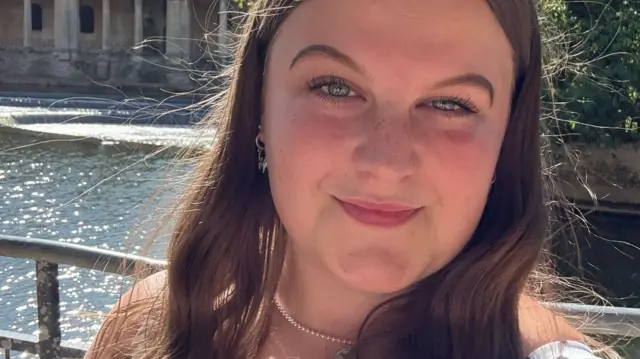
    Ella stands in front of a river. she has long brown hair and wears a white top with black dots.Image source, Supplied
    Image caption,

    Ella says she still grapples with after-effects from meningitis, like veritgo

    BBC Newsbeat has been speaking to Ella Moulsdale, a 22-year-old who contracted meningitis B during her first year of university back in 2021.

    Ella ended up staying in hospital for nine days to receive treatment – and says students shouldn’t fear asking for help if they are worried about meningitis.

    “I didn’t really know how ill I was,” Ella recalls.

    Describing her experience of Meningitis B, she says she was confused, was very sensitive to light and generally felt really unwell at the height of her illness.

    “I hadn’t even heard of meningitis, which I think is the biggest problem,” she says.

    “I know how it felt for me and it was the worst thing to happen in my life,” Ella says of her experience with MenB.

    “It took a lot of courage to be where I am today.”

    Ella says it took “a lot of willpower” to get back to university and finish her degree.

    She still grapples with vertigo, hearing and memory loss as after-effects of having meningitis.

    Ella now works at the charity Meningitis Now to raise awareness of the condition.

  5. Canterbury venues cancel St Patrick's Day celebrationspublished at 18:02 GMT 17 March

    Several events across Canterbury have been cancelled as a result of the meningitis outbreak in the area.

    The students' union for the University of Kent said on its website that it would not be running its St Patrick’s Day event, which was planned to take place at a bar on campus today, as well as several other previously scheduled events.

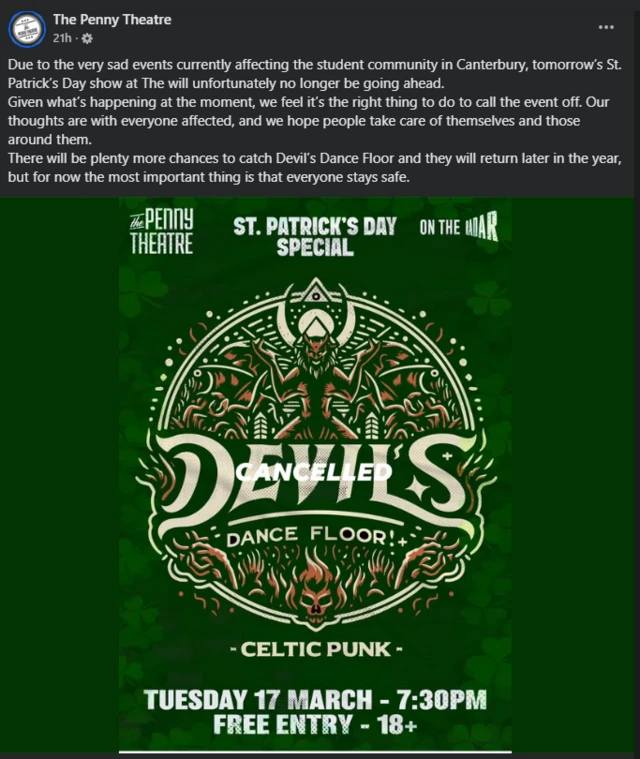
    The Penny Theatre said in a post on its public Facebook page yesterday that its St Patrick’s Day show would not be going ahead, adding that “it’s the right thing to do”.

    The Cuban nightclub also said on its public page yesterday that all student events at the venue had been cancelled until further notice.

    Moving further west, the Tap 'N' Tin club in Medway decided to close on Monday night, saying in a public post on its Facebook page that it would be following health reports “closely” to determine whether to open this weekend.

    Screenshot of a Facebook post from The Penny Theatre in Canterbury, informing users that its event scheduled for St Patrick's Day, on 17 March 2026, has been cancelled.Image source, Facebook
  6. Restaurant worker thought she had Covid before meningitis diagnosispublished at 17:52 GMT 17 March

    Nick Johnson
    Reporting from Kent

    Keeleigh Goodwin, a 21-year-old restaurant worker, went to Club Chemistry in Canterbury on Thursday night. Two days later, she complained she was feeling unwell. She and her mum thought it was a bad case of Covid.

    But on Saturday night, Keeleigh collapsed in her Canterbury flat. She was found by her flatmates and taken to hospital.

    Keeleigh was told she had meningitis, was given antibiotics and is starting to feel better. Speaking from her hospital bed, she told us her symptoms included a headache, hot and cold sweats, achey bones and vomiting.

    Her mum, Khali Goodwin, said she was "blown away" when she was told Keeleigh had meningitis and that it "hadn't even been on my radar".

    She also paid tribute to Keeleigh's flatmate for "literally saving her life", saying: "words can't express how grateful I am."

  7. 'It has felt worse than some Covid shifts' - nurse working in Kent hospitalpublished at 17:43 GMT 17 March

    A nurse at a hospital in Kent says working during the meningitis outbreak in Kent “has felt worse than some Covid shifts" and that you can "feel the anxiety off everyone".

    The nurse, who did not want to be named, says: "Meningitis isn’t like Covid when the advice was to ‘stay at home’... The urgency of time sensitive treatment for possible meningitis cases added with the sheer volume of patients coming in is really overwhelming."

    "You’ve got young people away from home, away from their support system and then parents of teenagers who are also just as scared," she adds.

  8. How many cases of meningitis are there per year in England?published at 17:33 GMT 17 March

    Meningitis is usually caused by a viral or bacterial infection - the latter is less common but much more serious.

    Between July 2024 and July 2025, there were 378 cases of invasive meningococcal disease (IMD) in England, according to the UK Health Security Agency. This is a serious bacterial infection and, of these, 31 people died.

    The previous year there were 340 cases.

    Four of the cases in Kent have been identified as coming from the MenB strain, which made up over 80% of IMD cases last year.

    IMD cases have been trending downwards from a peak of 2,595 cases in 1999-2000, initially driven by the introduction of the vaccine against the MenC group.

    During the pandemic, social distancing and lockdowns brought the spread of IMD to a low of 80 cases.

    This Flourish post cannot be displayed in your browser. Please enable Javascript or try a different browser.

  9. Students told to monitor email inboxespublished at 17:21 GMT 17 March

    University of Kent students are being advised to monitor their email addresses for further information on the outbreak.

    The university says in a post on X that those living in accommodation on campus are being asked to collect “precautionary” antibiotics.

    It adds that updates on the government’s MenB vaccination programme for students will be distributed once guidance from the UKHSA had been received.

  10. Government to ask independent advisory body to review availability of MenB vaccinepublished at 17:09 GMT 17 March

    Nick Triggle
    Health correspondent

    Addressing the Commons earlier, Health Secretary Wes Streeting said that he would ask the independent Joint Committee on Vaccination and Immunisation (JCVI) to "re-examine eligibility for meningitis vaccines".

    The Department of Health has given me some more information on what this actually means.

    We've been told that there will be a targeted Meningitis B vaccination programme for students livings in halls of residence at the University of Kent. It will then be up to the UK Health Security Agency whether this is then widened to more people in the Kent area.

    But separately to this, the health secretary is also going to ask the JCVI - that independent advisory committee - to do a review.

    It will then advise whether the MenB vaccine should be offered more widely moving forward, for example to young people who will not have had the jab as babies because it wasn't routinely offered then.

  11. Specialist schools to reopen after 'precautionary' closurespublished at 16:55 GMT 17 March

    Two specialist schools which were closed today "as a precaution" will reopen tomorrow after advice from the UKHSA.

    Nore Academy and Estuary Academy Island, both on the Isle of Sheppey, did not open on Tuesday because of "potential links between suggested cases and some students and staff".

    The schools say they have now been told by the UKHSA that contacts of cases do not need to isolate and can attend school as normal.

    It means both schools will reopen tomorrow.

    Kent County Council has confirmed all its mainstream schools are open as normal.

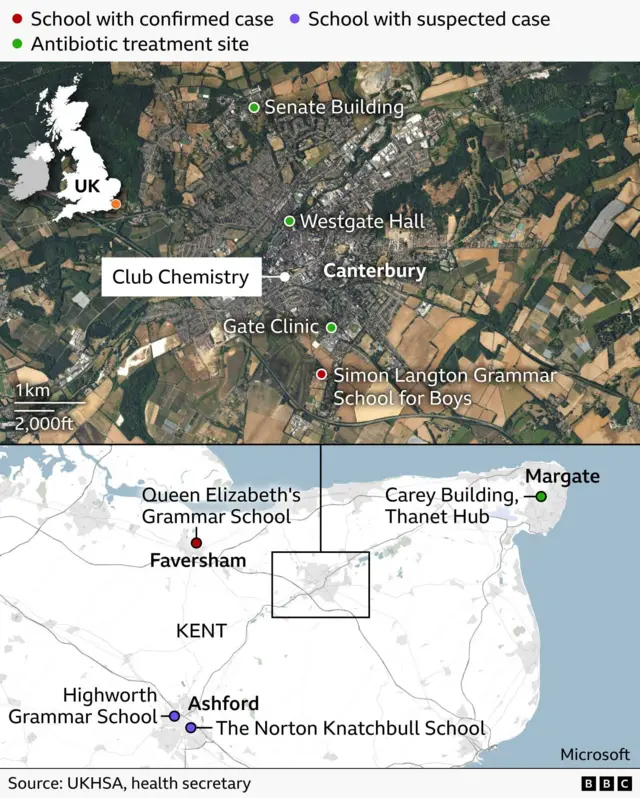
  12. In maps: Meningitis outbreak in Kentpublished at 16:38 GMT 17 March

    Four sites have been opened up in Kent for people affected by the meningitis outbreak to get antibiotic treatment.

    Senate Building, Westgate Hall, Gate Clinic and Carey Building Thanet Hub are all locations where people can get hold of the medicine.

    The map also shows Simon Langton Grammar School for Boys and Queen Elizabeth's Grammar School, where there were confirmed cases of meningitis.

    A two‑part map showing four schools with confirmed and suspected meningitis cases and four antibiotic treatment sites in Kent, UK. The top map focuses on Canterbury, marking schools, clinics, treatment locations, and Club Chemistry. The bottom map shows the wider Kent area, including Faversham, Ashford, Margate and additional schools. Coloured dots indicate confirmed cases (red), suspected cases (purple), and treatment sites (green).
  13. Meningitis outbreak in Kent is 'really, really troubling', says Kemi Badenochpublished at 16:24 GMT 17 March

    Helen Catt
    Political Editor, BBC South East

    Kemi BadenochImage source, PA Media

    Kemi Badenoch, the Conservative leader has described the outbreak of meningitis in Kent as “really, really troubling”.

    Speaking to BBC South East while on a visit to Godstone in Surrey, she says her “heart goes out” to the families of those people who have lost their lives.

    Badenoch says that a student died from meningitis when she was at university, which came as “a huge shock”, so she thinks the outbreak must be “deeply tragic and disturbing for so many of the people that are affected."

    She adds: “My plea is for people to check themselves as soon as they have the slightest symptoms and also for everyone to make sure they are up to date on their vaccinations.”

  14. Is it safe to visit the area of the outbreak?published at 16:18 GMT 17 March

    A 65-year-old who is planning to visit Canterbury has asked whether they are safe to visit the area.

    Dr Nighat advises people to take precautions such as using hand sanitisers and washing hands.

    Correction 18 March 2026: This post was updated to remove incorrect information on how long protection from MenB lasts after a booster vaccine. Protection does not last for life, but for several years, according to experts.

    It also removes reference to advice on face masks. A spokesperson for the UKHSA says: "The bacteria are not as contagious as other infections such as measles and Covid. Therefore face masks are not considered an effective measure in controlling meningococcal disease outbreaks."

    BBC graphic with 'your voice' in white text on a red background
  15. How can students not in Kent go about getting the vaccine?published at 16:12 GMT 17 March

    James Munroe in Glasgow is a mature student who asks how to go about getting the vaccine.

    Health correspondent Nick Triggle says chemists are experiencing high demand for the vaccines and he has heard of some having to hold back stocks of the jab to support the vaccination programme for University of Kent students.

    Many people are ringing pharmacies wanting to get it privately he says, at a cost of a couple of hundred pounds.

    Rachel paid privately for her daughter - born in 2014 - to be vaccinated against MenB. If the efficacy of the jabs drops over times, she asks whether she should pay for a booster now that she is 11.

    Dr Nighat says if she hasn't had her booster as a baby (initial jab recommended after eight weeks, and booster four weeks later) then it would be recommended.

    Correction 18 March 2026: This post was updated to remove incorrect information on the effectiveness of MenB vaccines. You can read more on the NHS website., external

    Your Voice red BBC brandingImage source, BBC Sport
  16. What can be done to raise awareness about MenB vaccines?published at 15:58 GMT 17 March

    Matt, 25, says he mistakenly believed he was vaccinated when he contracted Meningitis B at university. He asks what more can be done to raise awareness about it, why the vaccine isn't offered to more people.

    It's "really confusing" for people to understand which vaccines they've had, says Vinny Smith, chief executive of the Meningitis Research Foundation. He recommends checking with your GP what's on your vaccine record.

    While he understands the government has to "make decisions about investment in the NHS" based on evidence of the impact of the disease, Smith says he thinks "unfortunately for this cohort" of young people and teenagers, the framework right now "isn't helping them make a decision" to prevent meningitis.

    They're a "highly at risk group", he says.

    He says his organisation is "delighted" that the health secretary is asking for a review on the availability of vaccines because the incident this week is "in some ways its very predictable, it's just not predictable where, when or how many people".

    "That will continue until we have a national MenB vaccination programme," he says.

    Your Voice
  17. I have a weakened immune system, should I get vaccinated?published at 15:54 GMT 17 March

    A first-year undergraduate student has asked if he should seek a MenB vaccination due to his weakened immune system.

    The student added that he was born in 2006, meaning he is not included in the cohort entitled to NHS vaccinations against the bacteria.

    Vinny Smith says that the "best way" to be protected through the current infection is through vaccination, while also welcoming Wes Streeting's calls for the JCVI to look at the evidence for MenB vaccine uptake among the group that is at risk.

    Dr Nighat is also asked if children should receive booster vaccines after already being vaccinated years earlier, to which she responds by saying people are generally protected against infection if they received the vaccine and booster as a baby.

    She says: "Vaccines work really well if we're getting lots of other individuals vaccinated."

    your voice
  18. How does meningitis spread?published at 15:46 GMT 17 March

    Dr Nighat Arif is asked how meningitis spreads. She says it spreads "pretty ... similar" to Covid.

    So the ways to tackle this, she says, are washing your hands, wearing masks, ventilating the rooms by opening windows and doors.

    "All those lessons that we learnt back in Covid, I'm afraid they come back. If you're poorly then try to self isolate as much as possible." She says to watch people around to see if they are "behaving differently" and "just think, could this be meningitis?" Then, she says, seek help early.

    Update 16:45: The UKHSA has issued advice on the symptoms of meningitis, how it is spread and vaccines to help protect against it, which you can read here., external

    A spokesperson says: "Transmission of MenB requires close and prolonged contact to spread including living in the same household and intimate contact such as kissing.

    "The bacteria are not as contagious as other infections such as measles and Covid. Therefore face masks are not considered an effective measure in controlling meningococcal disease outbreaks.

    "If you or someone you know becomes unwell and are worried about meningitis or septicaemia, seek medical help urgently by going to the nearest Accident and Emergency department or calling 999. If a friend goes to bed unwell, check on them regularly. Early treatment can be lifesaving."

    You Voice red sign branding
  19. What is meningitis?published at 15:44 GMT 17 March

    A team of experts and correspondents are answering your questions on the meningitis outbreak in Kent. As a reminder, you can watch live at the top of this page.

    Meningitis can affect the whole body, says Dr Nighat Arif, who is a GP.

    You get infection around the meninges - protective membranes around the spinal cord and brain - and infected inflammation can then go out into the blood stream and cause something called septicaemia, she explains.

    This can cause "a range of symptoms" from fever, headache, stomach cramps, as well as "a change of behaviour" like sleepiness or confusion, she says.

    Symptoms are similar to flu, and can be "hard to distinguish until it becomes quite sinister", she says. At this point, people often get a rash that doesn't disappear when pressed with a glass tumbler. Arif adds that for people with brown or black skin, its best to check hands, the soles of the feet or inside their mouth as its harder to detect the rash.

    Vinny Smith, chief executive of the Meningitis Research Foundation, says that he will "always advise people to trust their instincts" when something doesn't feel right.

    "If this is going seriously badly wrong really quickly, that's a good indicator" of meningitis too, he adds.

    Your Voice
  20. If you must pay for a vaccine, here's what to knowpublished at 15:41 GMT 17 March

    Michelle Roberts
    Health editor, BBC News online

    Do I have to pay for the meningitis vaccine?

    Two vaccines protect against the main causes of meningitis and septicaemia.

    • The MenACWY vaccine offers protection against four types of bacteria that can cause meningitis - meningococcal groups A, C, W and Y - and is offered to teenagers aged 14 years old. People born on or after 1 July 2015 should have been offered it
    • The MenB vaccine helps protect against meningococcal group B bacteria and is recommended for babies aged eight weeks, followed by a second dose at 12 weeks and a booster at one year

    Contact your GP to find out which vaccines you've already received if you're not sure, or look at your red book which records the vaccines you've had.

    The MenACWY vaccine is free for anyone who missed out at school until your 25th birthday.

    There have been calls for the MenB vaccine to be offered more widely to protect teenagers and young people, but the NHS does not currently offer a catch up campaign for MenB.

    Some parents have paid private doctors to get the vaccine for teenagers. High street pharmacies offer a full course of two doses for around £220.

    Your Voice