Summary

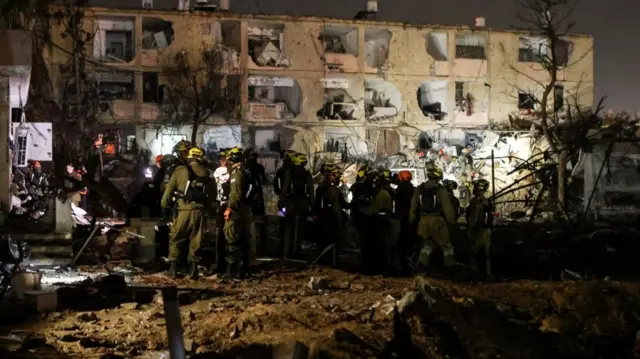
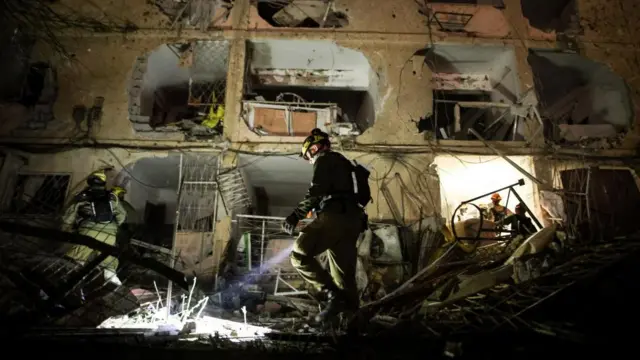
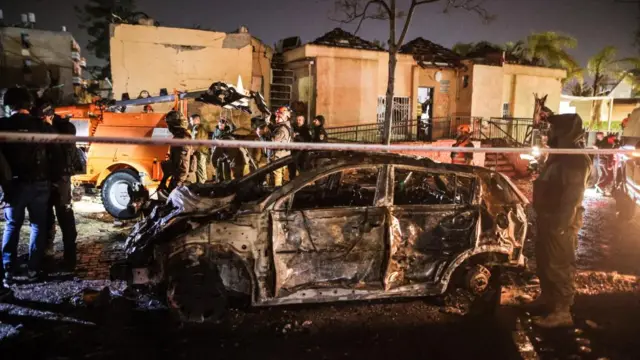
  1. Shelter order lifted after latest wave of Iranian missiles - IDFpublished at 06:42 GMT

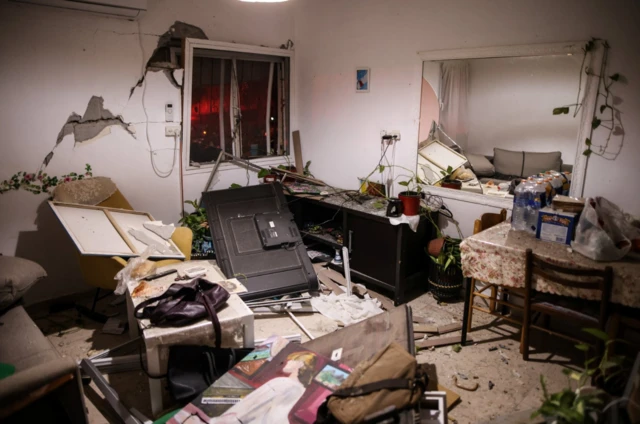
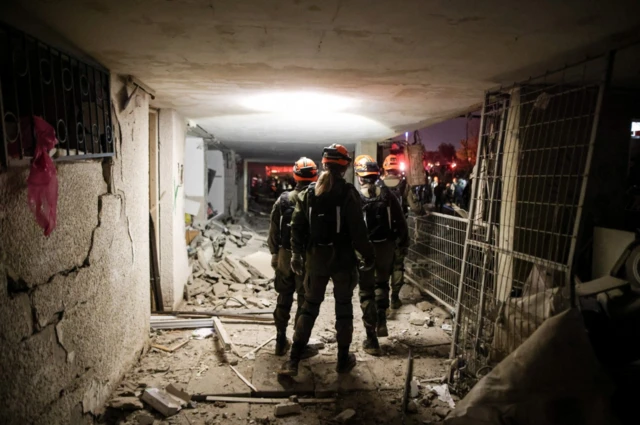
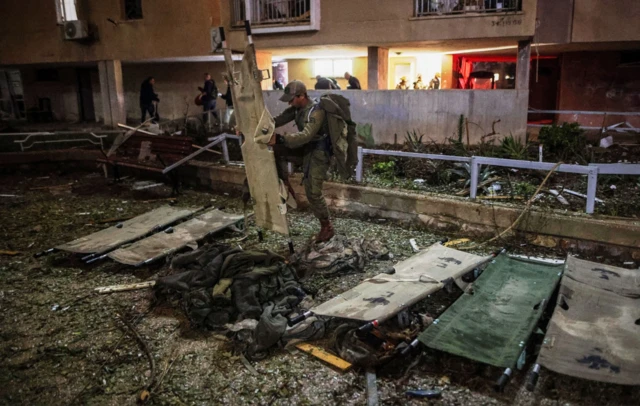
    A little earlier, the Israel Defense Forces (IDF) said it had detected another wave of Iranian missiles.

    It came around five and a half hours after the previous wave was reported.

    Around 15 minutes later, it issued another update saying people could leave shelters.

  2. Kuwaiti oil refinery hit in drone attackspublished at 06:16 GMT

    Azadeh Moshiri
    South Asia Correspondent, in Dubai

    A distant shot of the refinery, showing lots of chimneys, with some cars travelling on a road closer to the camera.Image source, AFP via Getty Images
    Image caption,

    The Mina Al-Ahmadi refinery, shown in 2021

    Despite calls on Iran to halt its attacks, Kuwait's state oil firm KPC has said its oil refinery has been hit by multiple drone strikes. So far, there are no reports of casualties.

    Emergency crews battled a fire at the Mina Al-Ahmadi refinery, and some units have been forced to shut down, according to the state news agency.

    This is the nightmare scenario that Gulf countries had hoped to avoid - their energy infrastructure becoming a repeated target in the war.

    After Israel's strikes on Iran's South Pars facility, Iran has retaliated, with Gulf countries' on the frontline of its fury.

    The war shows no sign of abating, even as countries across the Gulf mark Eid al-Fitr, the end of the holy month of Ramadan.

  3. More heavy explosions reported in Tehranpublished at 05:47 GMT

    Yolande Knell
    Middle East correspondent, in Jerusalem

    Israel has been hitting Iran's capital, Tehran, with air strikes as Iranians mark Nowruz - the Persian New Year.

    Overnight, Iran also launched rounds of missiles at Jerusalem. The loud thuds of interceptions were repeatedly heard overhead here through the night.

    Israel’s Prime Minister, Benjamin Netanyahu had earlier told journalists that Iran was now “decimated” and unable to enrich uranium or manufacture ballistic missiles.

    This week, as Iran retaliated for Israel’s attack on its vast South Pars gas field, global energy prices soared. They’ve now started to fall back with Israel’s pledge to refrain from similar strikes and US plans to boost oil output.

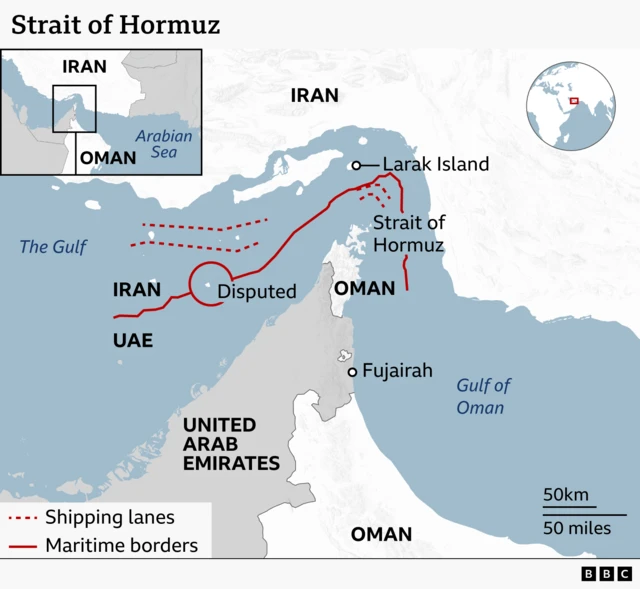
    There was also a joint statement on Thursday evening, in which the UK, France, Japan and others expressed what they said was their “readiness to contribute to appropriate efforts to ensure safe passage” through the Strait of Hormuz.

  4. Gulf nations responding to overnight attackspublished at 05:29 GMT

    The United Arab Emirates, Kuwait, Saudi Arabia and Bahrain have all reported missile and drone attacks in the past few hours.

    The UAE's Ministry of Defence says it is currently responding to incoming threats from Iran, and told residents they might hear booms from air defence systems that are intercepting attacks in the sky.

    Kuwait also warned of explosions as a result of its air defence system, and asked people to adhere to safety instructions from authorities.

    Saudi Arabia's Ministry of Defence reported the interception and destruction of several drones in the eastern region of the country.

    In Bahrain, sirens rang out and the interior ministry asked residents to go to their nearest safe place. Later, officials said it was a result of "Iranian aggression", and that falling shrapnel had caused a fire at a warehouse.

  5. Damage to world's largest LNG plant will cost Qatar billions - energy ministerpublished at 05:06 GMT

    Nick Marsh
    Asia Business Reporter, Singapore

    Map of the Gulf region showing Qatar, Iran, Saudi Arabia, and the UAE. The North Dome–South Pars gas field is highlighted in yellow, spanning offshore areas between Qatar and Iran. A label identifies Ras Laffan on Qatar’s northeast coast

    We knew Iran's attacks on Qatar's Ras Laffan facility were significant, but these are huge numbers being cited by the country's energy minister.

    He says Qatar's liquefied natural gas (LNG) export capacity will reduce by 17% over the next five years, causing the country to lose $20bn in annual revenue.

    LNG is created by cooling natural gas down to a very low temperature using a large industrial processing unit known as a train. The minister says the Iranian attacks on damaged two of the plant's 14 trains.

    Iran's attack on Ras Laffan was in response to an Israeli attack on Wednesday to its South Pars gas field, which is located just north in the Persian Gulf.

    A distant shot of the Ras Laffan facility, with lots of cranes and chimneysImage source, Reuters
    Image caption,

    Ras Laffan LNG production facility in Qatar

    "Five years isn't a repair," Ciaran Roe, chief commercial officer at HySights, a clean fuels market intelligence provider based in Singapore, tells the BBC. "It's a full rebuild".

    Countries in Asia are the most reliant on Qatari LNG, especially Japan, South Korea, India and China. In Europe, Italy and Belgium are already big customers - but the continent as a whole is becoming increasingly reliant on Middle Eastern gas, having turned away from Russian imports in the wake of the Ukraine war.

    Qatar is one of the leading, if not the leading player, in the global natural gas market.

    "Fear may be embedded in the market for several months, if not years," says Roe. "This will change governments' thinking towards LNG imports".

    LNG is a crucial energy source needed to heat people's homes, cook food and even power ships and factories. It's also needed to make fertiliser to grow food.

  6. Iranians prepare for Persian new year under shadow of warpublished at 05:05 GMT

    Ghoncheh Habibiazad
    Senior reporter, BBC Persian

    A woman carries plants in preparation for Nowruz.Image source, Getty Images

    The days before the Persian new year festival Nowruz usually see Iran buzzing with excitement, as people shop for new clothes, snacks and sweets, to usher one of the most significant celebrations in the country.

    Nowruz, which translates to "new day" marks the first day of spring, has been celebrated in Iran and among the Persian diaspora for more than 3,000 years.

    This year, it's different.

    Markets remain open, but some are fearful of going home to the capital Tehran, which has been most intensely bombarded by US and Israeli strikes.

    "I wish everything could be wiped from our memories like we just woke up from a bad dream," Mina tells me.

    Here's more on how Iranians are preparing for the event under the shadow of war.

  7. Netanyahu agrees to 'hold off' attacks on Iranian gas fields after Trump requestpublished at 05:05 GMT

    Israeli Prime Minister Benjamin Netanyahu speaks during a press conference in Jerusalem.Image source, EPA

    Our live coverage of conflict in the Middle East continues, as nations across the Gulf respond to attacks overnight.

    • Israeli Prime Minister Benjamin Netanyahu held a press conference last night, where he said Israel would "hold off" future attacks on Iranian gas fields after being asked to do so by President Trump
    • Netanyahu also rejected accusations that he'd dragged Trump into the war with Iran
    • Blasts were also heard in Jerusalem and Tehran, Iran's capital - Iran's foreign minister earlier warned that Tehran would act with "zero restraint" if there were further attacks on its infrastructure
    • The United Arab Emirates, Kuwait, Saudi Arabia and Bahrain have all reported missile and drone attacks in the last few hours, which the UAE and Bahrain have attributed to Iranian aggression
    • US-based Human Rights Activists News Agency (Hrana) has issued an update on the death toll in Iran, which it says has reached 3,186 people since war began on 28 February
    • The price of gas has risen sharply in the UK and Europe following the attack on Qatar's Ras Laffan energy complex, which Qatar's PM has called a "very dangerous escalation by the Iranians"

    Stay with us for more updates and analysis.