Summary

  1. Oil prices fall from peak - but remain higher than before warpublished at 11:29 GMT

    Oil prices have fluctuated substantially since the onset of the war - reaching a peak on Monday of almost $120 a barrel. It currently sits around $90 a barrel.

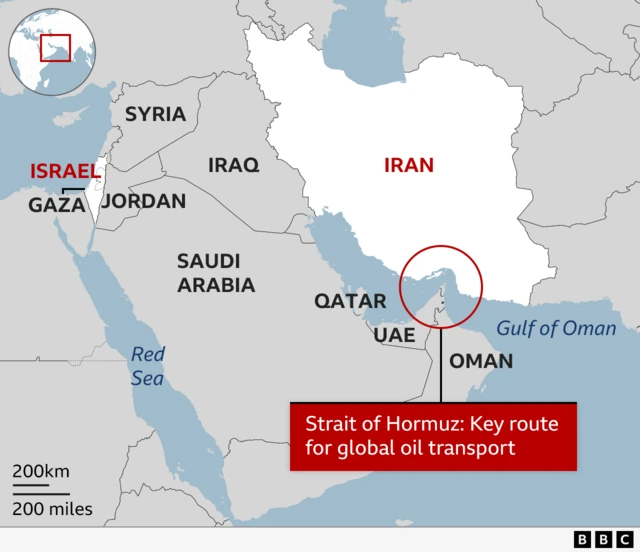
    Prices spiked over fears that the conflict could cause disruption to supplies from the Middle East through the Strait of Hormuz.

    Donald Trump has threatened that Iran would be hit "TWENTY TIMES HARDER" if the flow of oil through the Strait was stopped.

    Here's a look at how the price has changed over the last few days.
    This Flourish post cannot be displayed in your browser. Please enable Javascript or try a different browser.

  2. Explosions reported in Tehran after Israeli strike warningpublished at 11:24 GMT
    Breaking

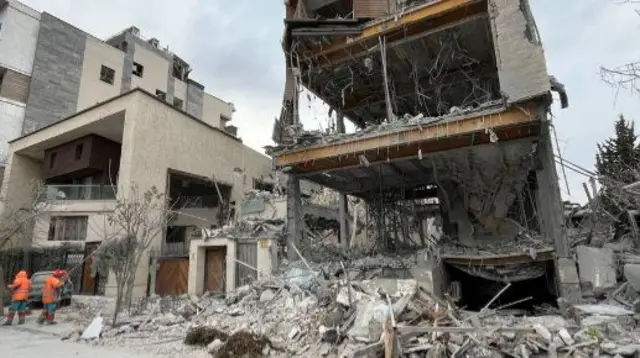
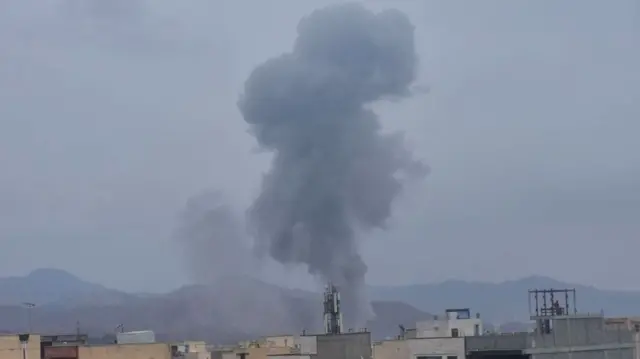
    Smoke rising after strike in Tehran

    There have been two explosions in Tehran, according to AFP journalists in the Iranian capital, shortly after the Israeli military warned it had begun a wave of strikes on the city.

    The image above, of a blast in the eastern part of the city, has been shared with the BBC.

  3. More than 1,300 people killed in Iran since start of war, says governmentpublished at 11:13 GMT

    The number of people killed in Iran since the start of the war has reached 1,332, according to Iranian government officials.

    Government spokesperson Fatemeh Mohajerani says among them are 206 women and children, and claims dozens of health centres have been targeted by strikes.

  4. 'We felt the shadow of death' - woman recounts intense strikes in Iranian citypublished at 11:00 GMT

    Soroush Pakzad
    BBC Persian

    I've just heard from a mother in Mehrshahr - an upmarket neighbourhood of Karaj, a city near the Iranian capital Tehran - following a night of what has been described by some people there as the most intense strikes of the campaign so far.

    The woman in her 50s claims she heard Iranian forces had moved into residential areas "and are even staying in places like hospitals and schools, which has put people in even greater danger".

    The US and Israel have accused Iranian forces of operating from civilian areas but the BBC hasn't been able to verify this.

    She says last night a target near her home was hit, "the closest place to us, and we truly felt the shadow of death over our heads".

    "My brother, who is a doctor in Tabriz, says that next to their hospital there are two schools that are now being used as stations or hiding places by Basij militants and armed forces after their base was hit by Israeli missiles," the woman says.

    She adds that her family is "standing firm until the end, to survive and to be free".

    A destroyed building in Mehrshahr, an area of KarajImage source, Supplied
    Image caption,

    A destroyed building in Mehrshahr, an area of Karaj

  5. UKMTO investigating incident involving cargo ship near Abu Dhabipublished at 10:50 GMT
    Breaking

    The UK Maritime Trade Operations (UKMTO) says it is investigating reports of an incident involving a cargo ship 36 miles north of Abu Dhabi.

    A loud bang was heard close to a bulk carrier at around 08:00 GMT on Monday, it reports. It doesn't specify who or what might have caused it.

    The UKMTO says it has received 13 reports of incidents affecting vessels operating in and around the Persian Gulf, Strait of Hormuz and Gulf of Oman since the war begin - including 10 reports of attacks.

  6. IDF begins new wave of strikes on Tehranpublished at 10:33 GMT
    Breaking

    The Israel Defense Forces (IDF) says it has begun a new waves of strikes on the Iranian capital Tehran.

  7. Russian media reacts to oil price rise - and its impact on Russia's economypublished at 10:30 GMT

    On Monday, US President Donald Trump had a phone call with Vladimir Putin, and later said the US could lift some oil sanctions, without specifying which countries might be affected - more on that here.

    The oil price has a major impact on Russia's economy - and the budget for its war in Ukraine. Our Russia editor, Steve Rosenberg, looks at how Russian media is reacting to the spike in oil prices caused by the US-Israel war with Iran.

  8. Countries take emergency measures over disruption through Strait of Hormuzpublished at 10:26 GMT

    Barbara Plett Usher
    Reporting from Doha

    President Trump and Iran's Islamic Revolutionary Guard Corps (IRGC) are trading threats over the Strait of Hormuz, as nations take emergency measures over disruptions in global oil and gas shipments.

    Pakistan’s navy has launched a maritime security operation to protect shipping lanes and energy supplies.

    Islamabad relies heavily on fuel imports from the Gulf, and its military says this operation – named Protector of the Seas – aims to ensure uninterrupted national energy supplies.

    President Trump has vowed to launch “fire and fury” against Iran if it seeks to block tanker traffic, and the IRGC responded that it would not allow one litre of oil through the crucial water passageway as long as Israel and the US continued their attacks.

    The head of Saudi Aramco, Saudi Arabia’s state-owned oil company and the largest exporter of oil in the world, warns that the war is the “biggest crisis” the region’s energy industry has ever faced.

    Amin Nasser says there would be “catastrophic consequences” for the world’s oil markets if the conflict continues to disrupt shipping in the Strait of Hormuz.

    Map showing where the Strait of Hormuz is in the Gulf of Oman, a key route for global oil transport. The strait lies between Iran and the peninsula of the United Arab Emirates and Oman. The map also shows countries in the wider Middle East region including Saudi Arabia, Iraq, Jordan and Israel
  9. BBC Verify

    Damage to historic palace following strikes in Isfahanpublished at 10:14 GMT

    By Shayan Sardarizadeh and Ghoncheh Habibiazad

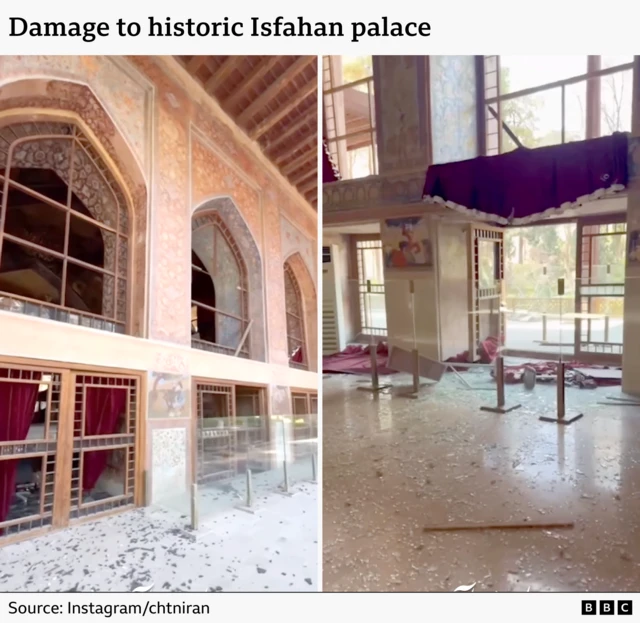
    BBC Verify and BBC Persian have examined images showing damage to Chehel Sotoun, a 17th Century palace and Persian gardens recognised as a Unesco World Heritage site in the city of Isfahan, central Iran.

    Verified footage shared yesterday by Iranian media shows the interior of the palace has been affected - with woodwork damaged and windows broken.

    Two screemgrabs from the palace, with many shattered windows, broken glass on the ground and damaged woodwork

    Iranian news outlets have reported the office of Isfahan’s provincial government, located about 110 metres (370 ft) from Chehel Sotoun in the city's historic centre, was targeted by a strike. Two other World Heritage sites are within a short distance of the office.

    Ruhollah Seyyed-Asgari, Isfahan province’s deputy for cultural heritage, said several other historical landmarks have been damaged - and accused the US of targeting them.

    It is not possible to say from the footage what the target of the reported attack was or who carried it out.

    Verified videos from last week show damage to two other landmarks after strikes in Iran’s capital - the Tehran Grand Bazaar and Golestan Palace, also a World Heritage site.

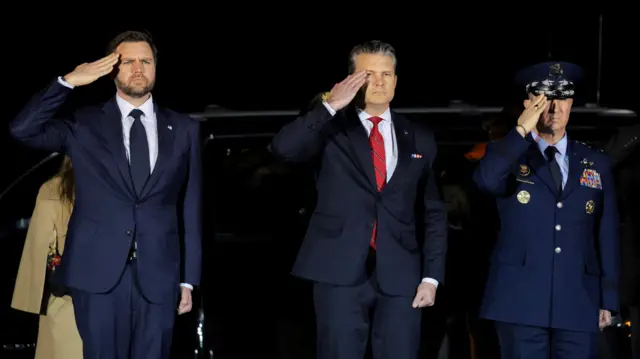
  10. Seventh US soldier killed in war returns to USpublished at 10:07 GMT

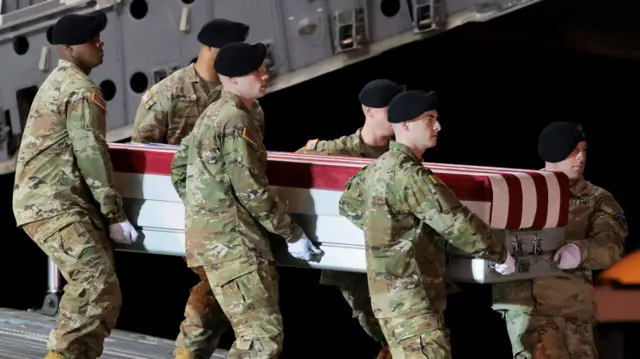
    A coffin carrying the seventh US soldier to be killed in the US-Israel war with Iran has been returned to the United States overnight.

    Sgt Benjamin N Pennington died following injuries sustained on a strike on Prince Sultan Air Base in Saudi Arabia last week.

    Vice President JD Vance and Secretary of Defense Peter Hegseth were in attendance at the ceremony as the coffin was unloaded.

    Members of the military carry the transfer case during a dignified transfer of the remains of U.S. Army Sgt. Benjamin Pennington, who died on March 8 from injuries sustained during a March 1 attack at Prince Sultan Air Base in Saudi Arabia, at Dover Air Force Base in Dover, Delaware, U.S., March 9Image source, Reuters
    U.S. Vice President JD Vance, Secretary of Defense Pete Hegseth and Chairman of the Joint Chiefs of Staff Dan Caine salute during a dignified transfer of the remains of U.S. Army Sgt. Benjamin Pennington, who died on March 8 from injuries sustained during a March 1 attack at Prince Sultan Air Base in Saudi Arabia, at Dover Air Force Base in Dover, Delaware, U.S., March 9Image source, Reuters
  11. Tehran left in 'total darkness' due to strikes overnight, Iranians tell BBCpublished at 10:00 GMT

    Iranians in Tehran have described how they were left "in total darkness" following heavy strikes overnight.

    A man in the Iranian capital tells BBC Persian: "The electricity went out and I had no idea what was happening."

    "I’m dying from a headache now. They hit hard last night. All you can see in our house are cracks in the walls. Sleeping has become the hardest thing for me.”

    Also in Tehran, a woman says "every few hours there are explosions" while a man describes how strikes were happening for "20 minutes in a row" at one point.

    Residents in nearby Karaj have similarly described how the electricity was fluctuating on Monday night. "There were some fluctuations, but I’ll tolerate this situation as long as the regime is gone," one man says.

    BBC Persian is the Persian language service of BBC News, used by 24 million people around the world - the majority in Iran - despite being blocked and routinely jammed by Iranian authorities.

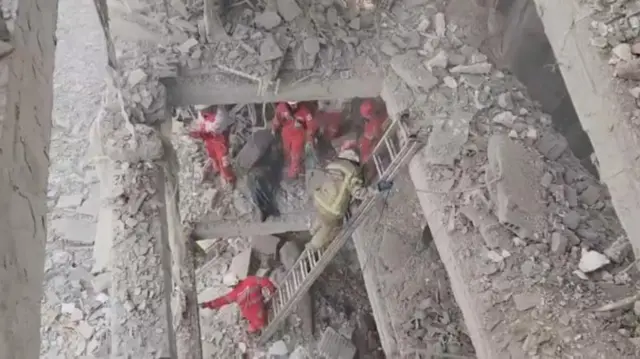
    Rescuers work in the rubble of residential buildings after air strikes in Tehran - this is a screengrab from a video released by the Iranian Red Crescent SocietyImage source, Red Crescent via Reuters
    Image caption,

    Rescuers work in the rubble of residential buildings after air strikes in Tehran - this is a screengrab from a video released on Monday by the Iranian Red Crescent Society

  12. Analysis

    Iranian state TV is celebrating the new supreme leader, but Khamenei himself is yet to appearpublished at 09:51 GMT

    Ghoncheh Habibiazad
    Senior reporter, BBC Persian

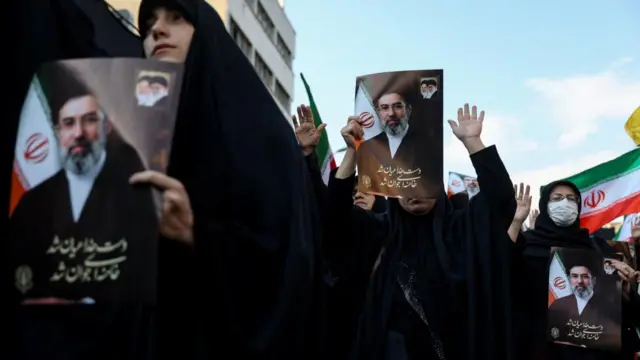
    People hold pictures of Supreme Leader Mojtaba Khamenei at a public gathering in Iran.Image source, reuters

    I have been monitoring Iranian state TV since the announcement late on Sunday of the appointment of Mojtaba Khamenei, the son of the late supreme leader, as the third head of the Islamic Republic.

    While the mood on state TV has been very much celebratory since his selection, Khamenei himself has not issued any statements or appeared in public.

    State TV news channel has referred to him as a “veteran of the Ramadan war”, without giving any further information as to whether he has been injured during the ongoing conflict.

    In addition to his father, Mojtaba Khamenei’s mother and wife were also killed in the US-Israeli strikes.

    US President Donald Trump said yesterday that he was “disappointed” about Khamenei’s selection as supreme leader. Before he was chosen, Israel had said it would “continue to pursue every successor”.

    Iranians inside the country who oppose the establishment tell me they expect him to continue his father’s hard-line policies.

    Mojtaba is the second son of Ali Khamenei and, although he had long been regarded as one of the front-runners to succeed him, has kept a low profile - being seen to exercise influence from behind the scenes.

    Both his father, Ali Khamenei, and his predecessor, the founder of the Islamic Republic, Ruhollah Khomeini, - no relation - had criticised hereditary succession in the context of the Pahlavi monarchy, which was overthrown in the 1979 Islamic Revolution.

  13. UK preparing ship for possible Mediterranean deploymentpublished at 09:36 GMT
    Breaking

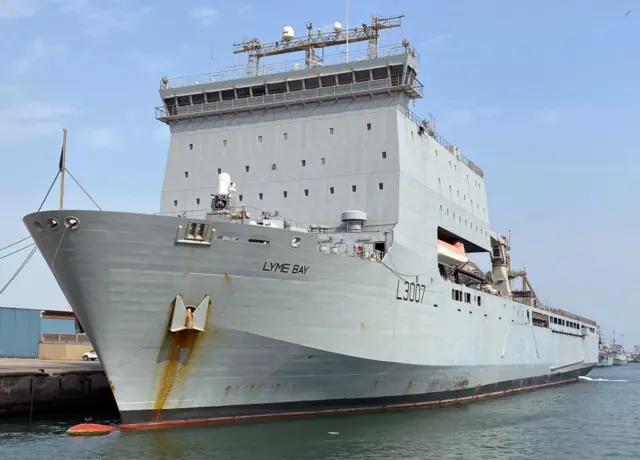
    The UK Ministry of Defence says RFA Lyme Bay is being prepared in case it is needed to help out in the Eastern Mediterranean.

    In a statement this morning an MOD spokesperson says: “As part of prudent planning, we have taken the decision to bring RFA Lyme Bay to heightened readiness as a precaution, should she be needed to assist in maritime tasks in the Eastern Mediterranean.”

    RFA Lyme Bay is a landing ship with medical facilities on board - at present it's in Gibraltar.

    The UK is also sending the warship HMS Dragon to the Mediterranean, with Defence Secretary John Healey saying yesterday that it would leave Portsmouth in the next couple of days.

    Royal Fleet Auxiliary ship Lyme Bay, pictured in 2021Image source, PA Media
    Image caption,

    Royal Fleet Auxiliary ship Lyme Bay, pictured in 2021

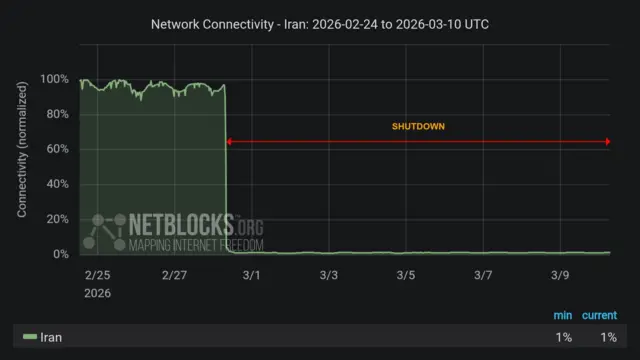
  14. Iran has spent a third of 2026 offline, reports internet monitoring grouppublished at 09:24 GMT

    A graphic shows a sudden drop in internet connectivity in Iran at the end of FebruaryImage source, NetBlocks

    Iran's internet blackout is now among the "most severe government-imposed nationwide internet shutdowns on record globally", according to independent internet monitoring group NetBlocks.

    It reports that it's been 240 hours since the internet shutdown in Iran began, and that the country has now spent a third of 2026 offline.

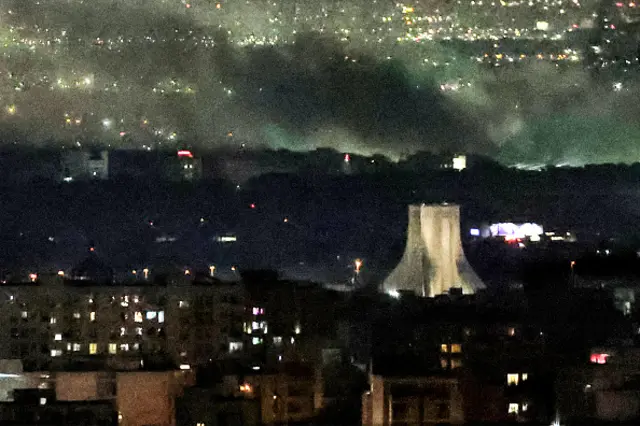
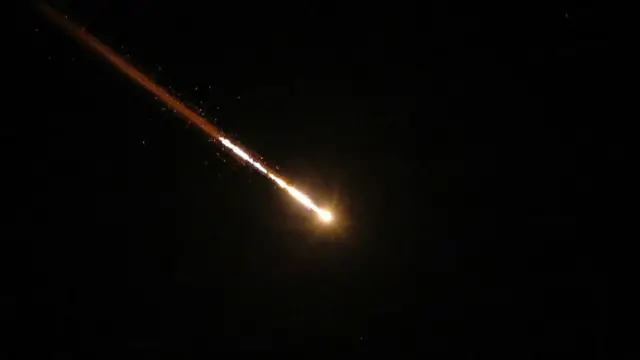
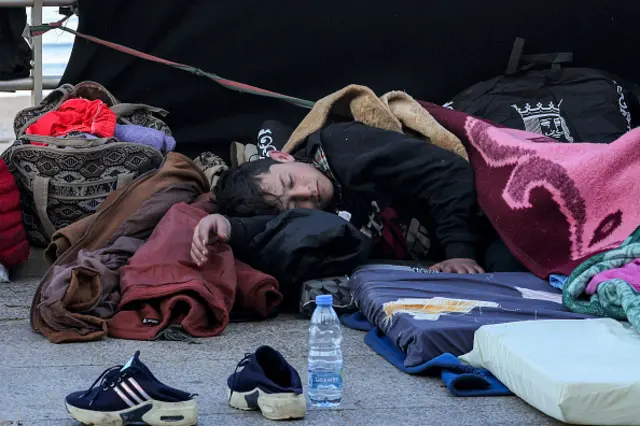
  15. Strikes continue as war enters 11th daypublished at 09:19 GMT

    A night-time image of a Tehran cityscape, with smoke rising beyond a lit up Azadi Tower in the right, middle-ground.Image source, Getty Images
    Image caption,

    Smoke rises from the site of airstrikes near Azadi Tower in western Tehran

    A glowing streak in the night sky showing a rocket being intercepted over northern IsraelImage source, EPA
    Image caption,

    Israel's air defence systems intercept a projectile over northern Israel late on Monday night

    A young boy sleeps on a mattress outdoors with his family's belongings close by.Image source, Getty Images
    Image caption,

    A child sleeps on the Beirut waterfront as thousands of people in Lebanon flee Israeli strikes

  16. Violations of Turkish airspace 'cannot be justified', Erdogan tells Iranpublished at 09:08 GMT

    Emily Wither
    Reporting from the Turkey-Iran border

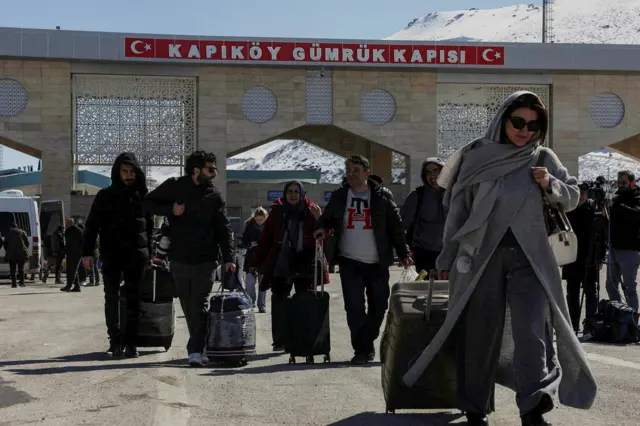
    Iranians crossing into Turkey at the Kapikoy border crossing on TuesdayImage source, REUTERS/Dilara Senkaya
    Image caption,

    Iranians crossing into Turkey at the Kapikoy border crossing on Tuesday

    Turkey’s President Recep Tayyip Erdogan has warned Iran that violations of Turkish airspace “cannot be justified” and says attacks on countries in the region help no one.

    In a phone call with Iran’s President Masoud Pezeshkian, he says Turkey is trying to open the door to diplomacy to help bring the war to an end.

    In a cabinet meeting last night Erdogan said: “Despite our sincere warnings, extremely wrong and provocative steps continue to be taken that will jeopardise Turkey's friendship.”

    The comments come after Nato air defences shot down a second Iranian ballistic missile that had entered Turkish airspace on Monday.

    Turkey has Nato's second-largest army and shares a long border with Iran that has been stable for 500 years.

    No other Nato country has the same depth of contact with what remains of the regime inside Iran. Erdogan is positioning himself, as he has done on Ukraine, Gaza and in several other theatres, as a mediator.

  17. Markets rally in Europe, following gains in US and Asiapublished at 09:04 GMT

    Nick Edser
    Business reporter

    We mentioned earlier that London’s FTSE 100 index had opened higher, and the relief rally has been seen right across Europe following gains in the US and Asia.

    The FTSE 100 is now up 1.7%, more than compensating for Monday’s fall. In Germany the Dax index is up 2.4% while France’s Cac 40 is 1.9% higher.

    Bank shares have seen some of the biggest gains - with Barclays, Societe Generale and Deutsche Bank all up more than 4%.

    When markets were sinking on Monday, shares in oil giants BP and Shell were among the few to rise. So you probably won’t be surprised to hear that today while most shares are up, the two oil giants are down - with both slipping about 2%.

  18. US and Israel don't have 'any realistic endgame' in mind, says Iran's foreign ministerpublished at 08:52 GMT

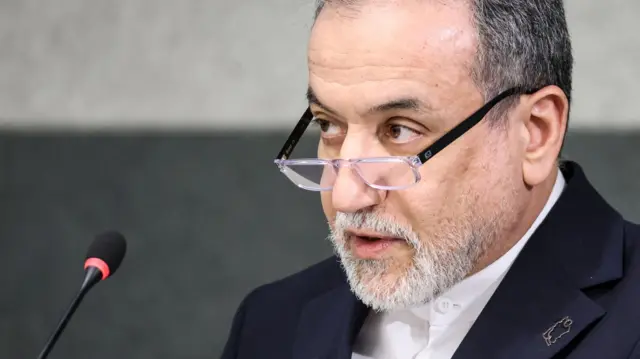
    Iran's Foreign Minister Abbas Araghchi addresses a special session of the Conference on Disarmament at the United Nations, aside of U.S.-Iran talks in Geneva, Switzerland, February 17Image source, Reuters

    Late on Monday night, Iranian Foreign Minister Abbas Araghchi gave a wide-ranging interview, external on the ongoing US-Israel war with Iran to US broadcaster PBS News - here are the key takeaways:

    • Mojtaba Khamenei’s appointment - Araghchi says the appointment of Ali Khamenei's son is a "continuation" of his father’s regime, and provides "some sort of stability" at the same time
    • Negotiations with the US – Asked if Iran had been in contact with US officials to talk about negotiations over the war, Araghchi says he doesn’t believe that will "be on the table" as Iran has “very bitter experience of talking with Americans”
    • US-Israeli objectives - “I don't think they have any realistic endgame in their mind,” says Araghchi, who adds that he believes they have failed to achieve all of their goals so far
    • Oil prices - Araghchi says a rise in oil prices "is not our fault", blaming "the attacks and aggression made by Israelis and Americans against us". He adds that Iran “has not closed” the Strait of Hormuz and "we are not preventing them to navigate in that strait"
    • Civilian casualties - Iran’s foreign minister says there has been “some collateral damage” from Iranian strikes, but says it has “never targeted any civilian location, any civilian purpose, any civilian place”
  19. IDF issues new Lebanon evacuation order ahead of strikes on coastal citiespublished at 08:41 GMT

    The Israel Defense Forces (IDF) has issued a new evacuation order for residents of the coastal cities of Tyre and Sidon in Lebanon ahead of air strikes.

    In a post on X, the IDF's Arabic spokesman Avichay Adraee says Israeli forces would be targeting Hezbollah infrastructure in specific areas of the cities in the near future.

    The alert follows an earlier evacuation order for people in southern Lebanon, urging residents to move north of the Litani River ahead of strikes.

  20. Israel 'ahead of schedule' on war objectives, says ambassadorpublished at 08:35 GMT

    Israel's ambassador to France, Joshua Zarka, says Israeli forces are "ahead of schedule on the war objectives".

    Speaking to French broadcaster BFMTV, Zarka says their prediction that the war would last "a few weeks...hasn't changed".

    "How many weeks exactly I can't tell you", he says.

    On the selection of Mojtaba Khamenei to succeed his father as Iran's new supreme leader, the ambassador says he's not "who the Iranians wanted to choose".

    "They’ve [the Assembly of Experts] chosen someone but we don’t know what his goals are or what his relationship with the Revolutionary Guards is," Zarka says. "If he continues to follow the same path of his father, he will also be added to the list of those who must be eliminated."