Summary

  • The benchmark oil price has dipped after US President Donald Trump said the war with Iran will end "very soon"

  • Oil surged past $100 a barrel on Monday - before Trump said the war was "very far ahead of schedule" and "very complete, pretty much" - while adding "we haven't won enough"

  • His comments led to a fall in the oil price, which is now closer to $90 a barrel - but still well above pre-war levels

  • But Trump lacked clarity, even when pushed for detail, says our correspondent Anthony Zurcher - and the president later threatened to hit Iran "twenty times harder" if they blocked the Strait of Hormuz

  • Iran has reportedly said it will not allow "one litre of oil" to be exported from the region if US-Israeli attacks continue

  • Also on Monday, President Trump spoke to Russia's Vladimir Putin - and later said some oil sanctions could be lifted, without specifying on which countries

  1. Analysis

    Iranian state TV is celebrating the new supreme leader, but Khamenei himself is yet to appearpublished at 09:51 GMT

    Ghoncheh Habibiazad
    Senior reporter, BBC Persian
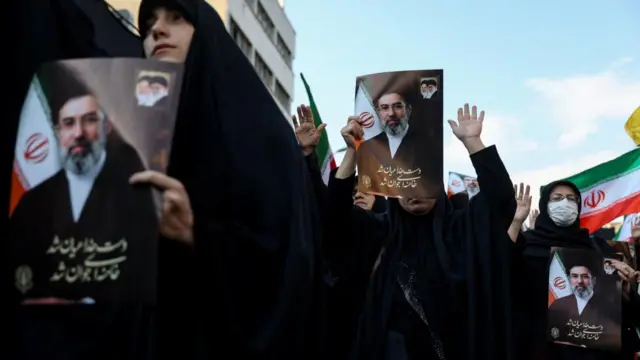
    People hold pictures of Supreme Leader Mojtaba Khamenei at a public gathering in Iran.Image source, reuters

    I have been monitoring Iranian state TV since the announcement late on Sunday of the appointment of Mojtaba Khamenei, the son of the late supreme leader, as the third head of the Islamic Republic.

    While the mood on state TV has been very much celebratory since his selection, Khamenei himself has not issued any statements or appeared in public.

    State TV news channel has referred to him as a “veteran of the Ramadan war”, without giving any further information as to whether he has been injured during the ongoing conflict.

    In addition to his father, Mojtaba Khamenei’s mother and wife were also killed in the US-Israeli strikes.

    US President Donald Trump said yesterday that he was “disappointed” about Khamenei’s selection as supreme leader. Before he was chosen, Israel had said it would “continue to pursue every successor”.

    Iranians inside the country who oppose the establishment tell me they expect him to continue his father’s hard-line policies.

    Mojtaba is the second son of Ali Khamenei and, although he had long been regarded as one of the front-runners to succeed him, has kept a low profile - being seen to exercise influence from behind the scenes.

    Both his father, Ali Khamenei, and his predecessor, the founder of the Islamic Republic, Ruhollah Khomeini, - no relation - had criticised hereditary succession in the context of the Pahlavi monarchy, which was overthrown in the 1979 Islamic Revolution.
  2. UK preparing ship for possible Mediterranean deploymentpublished at 09:36 GMT
    Breaking

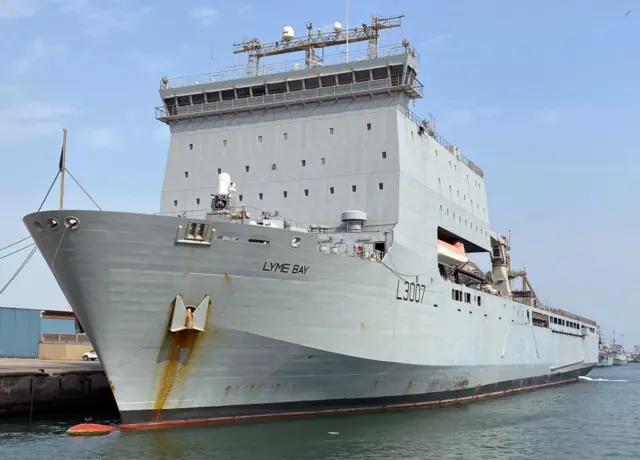
    The UK Ministry of Defence says RFA Lyme Bay is being prepared in case it is needed to help out in the Eastern Mediterranean.

    In a statement this morning an MOD spokesperson says: “As part of prudent planning, we have taken the decision to bring RFA Lyme Bay to heightened readiness as a precaution, should she be needed to assist in maritime tasks in the Eastern Mediterranean.”

    RFA Lyme Bay is a landing ship with medical facilities on board - at present it's in Gibraltar.

    The UK is also sending the warship HMS Dragon to the Mediterranean, with Defence Secretary John Healey saying yesterday that it would leave Portsmouth in the next couple of days.

    Royal Fleet Auxiliary ship Lyme Bay, pictured in 2021Image source, PA Media
    Image caption,

    Royal Fleet Auxiliary ship Lyme Bay, pictured in 2021

  3. Iran has spent a third of 2026 offline, reports internet monitoring grouppublished at 09:24 GMT

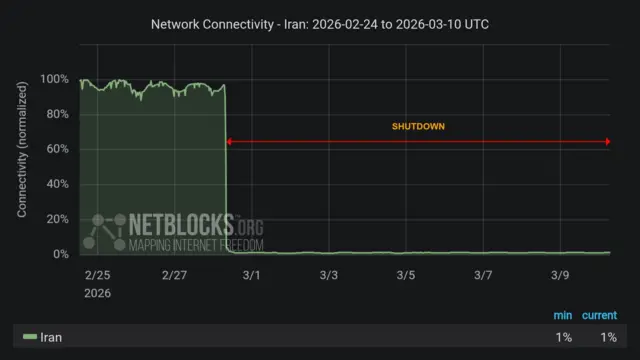
    A graphic shows a sudden drop in internet connectivity in Iran at the end of FebruaryImage source, NetBlocks

    Iran's internet blackout is now among the "most severe government-imposed nationwide internet shutdowns on record globally", according to independent internet monitoring group NetBlocks.

    It reports that it's been 240 hours since the internet shutdown in Iran began, and that the country has now spent a third of 2026 offline.

  4. Strikes continue as war enters 11th daypublished at 09:19 GMT

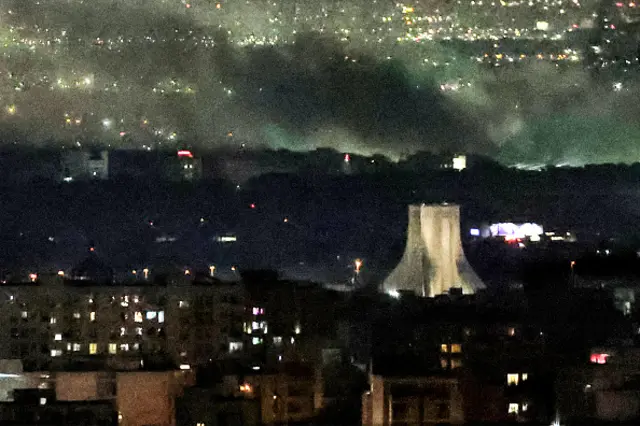
    A night-time image of a Tehran cityscape, with smoke rising beyond a lit up Azadi Tower in the right, middle-ground.Image source, Getty Images
    Image caption,

    Smoke rises from the site of airstrikes near Azadi Tower in western Tehran

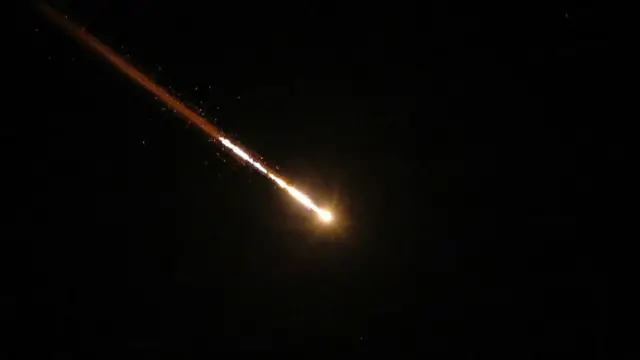
    A glowing streak in the night sky showing a rocket being intercepted over northern IsraelImage source, EPA
    Image caption,

    Israel's air defence systems intercept a projectile over northern Israel late on Monday night

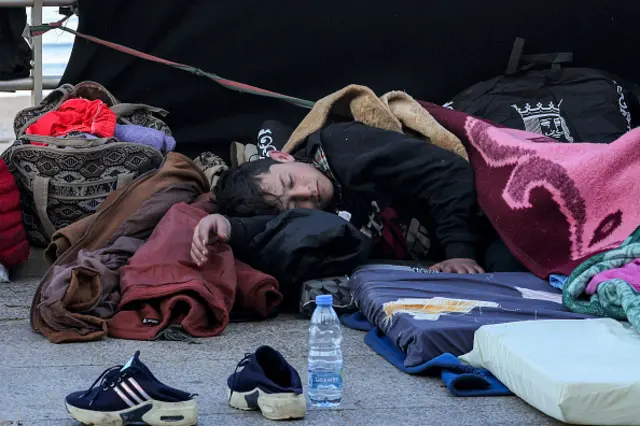
    A young boy sleeps on a mattress outdoors with his family's belongings close by.Image source, Getty Images
    Image caption,

    A child sleeps on the Beirut waterfront as thousands of people in Lebanon flee Israeli strikes

  5. Violations of Turkish airspace 'cannot be justified', Erdogan tells Iranpublished at 09:08 GMT

    Emily Wither
    Reporting from the Turkey-Iran border

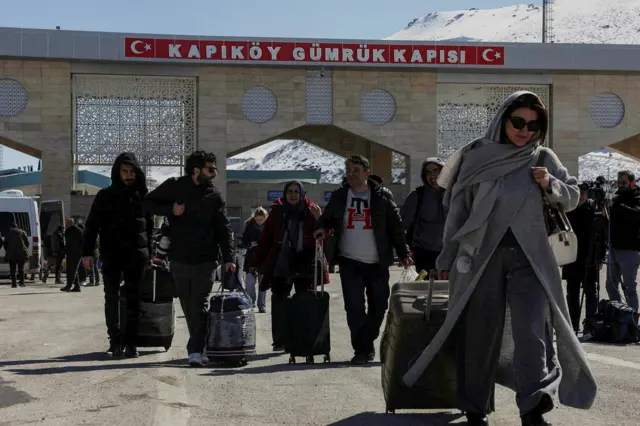
    Iranians crossing into Turkey at the Kapikoy border crossing on TuesdayImage source, REUTERS/Dilara Senkaya
    Image caption,

    Iranians crossing into Turkey at the Kapikoy border crossing on Tuesday

    Turkey’s President Recep Tayyip Erdogan has warned Iran that violations of Turkish airspace “cannot be justified” and says attacks on countries in the region help no one.

    In a phone call with Iran’s President Masoud Pezeshkian, he says Turkey is trying to open the door to diplomacy to help bring the war to an end.

    In a cabinet meeting last night Erdogan said: “Despite our sincere warnings, extremely wrong and provocative steps continue to be taken that will jeopardise Turkey's friendship.”

    The comments come after Nato air defences shot down a second Iranian ballistic missile that had entered Turkish airspace on Monday.

    Turkey has Nato's second-largest army and shares a long border with Iran that has been stable for 500 years.

    No other Nato country has the same depth of contact with what remains of the regime inside Iran. Erdogan is positioning himself, as he has done on Ukraine, Gaza and in several other theatres, as a mediator.

  6. Markets rally in Europe, following gains in US and Asiapublished at 09:04 GMT

    Nick Edser
    Business reporter

    We mentioned earlier that London’s FTSE 100 index had opened higher, and the relief rally has been seen right across Europe following gains in the US and Asia.

    The FTSE 100 is now up 1.7%, more than compensating for Monday’s fall. In Germany the Dax index is up 2.4% while France’s Cac 40 is 1.9% higher.

    Bank shares have seen some of the biggest gains - with Barclays, Societe Generale and Deutsche Bank all up more than 4%.

    When markets were sinking on Monday, shares in oil giants BP and Shell were among the few to rise. So you probably won’t be surprised to hear that today while most shares are up, the two oil giants are down - with both slipping about 2%.

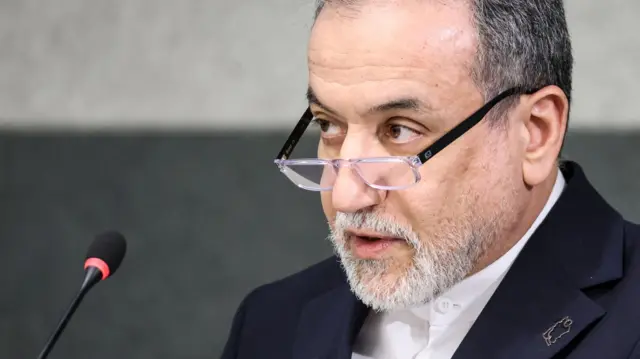
  7. US and Israel don't have 'any realistic endgame' in mind, says Iran's foreign ministerpublished at 08:52 GMT

    Iran's Foreign Minister Abbas Araghchi addresses a special session of the Conference on Disarmament at the United Nations, aside of U.S.-Iran talks in Geneva, Switzerland, February 17Image source, Reuters

    Late on Monday night, Iranian Foreign Minister Abbas Araghchi gave a wide-ranging interview, external on the ongoing US-Israel war with Iran to US broadcaster PBS News - here are the key takeaways:

    • Mojtaba Khamenei’s appointment - Araghchi says the appointment of Ali Khamenei's son is a "continuation" of his father’s regime, and provides "some sort of stability" at the same time
    • Negotiations with the US – Asked if Iran had been in contact with US officials to talk about negotiations over the war, Araghchi says he doesn’t believe that will "be on the table" as Iran has “very bitter experience of talking with Americans”
    • US-Israeli objectives - “I don't think they have any realistic endgame in their mind,” says Araghchi, who adds that he believes they have failed to achieve all of their goals so far
    • Oil prices - Araghchi says a rise in oil prices "is not our fault", blaming "the attacks and aggression made by Israelis and Americans against us". He adds that Iran “has not closed” the Strait of Hormuz and "we are not preventing them to navigate in that strait"
    • Civilian casualties - Iran’s foreign minister says there has been “some collateral damage” from Iranian strikes, but says it has “never targeted any civilian location, any civilian purpose, any civilian place”
  8. IDF issues new Lebanon evacuation order ahead of strikes on coastal citiespublished at 08:41 GMT

    The Israel Defense Forces (IDF) has issued a new evacuation order for residents of the coastal cities of Tyre and Sidon in Lebanon ahead of air strikes.

    In a post on X, the IDF's Arabic spokesman Avichay Adraee says Israeli forces would be targeting Hezbollah infrastructure in specific areas of the cities in the near future.

    The alert follows an earlier evacuation order for people in southern Lebanon, urging residents to move north of the Litani River ahead of strikes.

  9. Israel 'ahead of schedule' on war objectives, says ambassadorpublished at 08:35 GMT

    Israel's ambassador to France, Joshua Zarka, says Israeli forces are "ahead of schedule on the war objectives".

    Speaking to French broadcaster BFMTV, Zarka says their prediction that the war would last "a few weeks...hasn't changed".

    "How many weeks exactly I can't tell you", he says.

    On the selection of Mojtaba Khamenei to succeed his father as Iran's new supreme leader, the ambassador says he's not "who the Iranians wanted to choose".

    "They’ve [the Assembly of Experts] chosen someone but we don’t know what his goals are or what his relationship with the Revolutionary Guards is," Zarka says. "If he continues to follow the same path of his father, he will also be added to the list of those who must be eliminated."

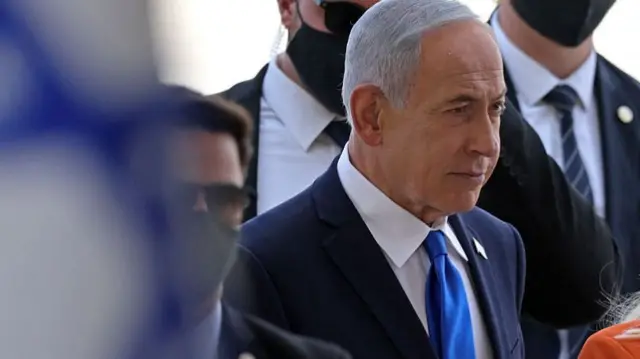
  10. Israel 'breaking the bones' of Iranian regime, and we are still active - Netanyahupublished at 08:24 GMT
    Breaking

    Israel's Prime Minister Benjamin Netanyahu arrives to receive his Indian counterpart Narendra Modi at the Ben Gurion airport near Tel Aviv on February 25, 2026.Image source, Getty Images

    Israeli Prime Minister Benjamin Netanyahu has spoken about the war with Iran, saying Israel's military action is "breaking their bones".

    He says Israel's goal is to free the Iranian people of the "tyranny" of the current regime, but says "ultimately it is up to them".

    "There is no doubt that through the actions taken so far, we are breaking their bones and we are still active," he says, via the Israeli prime minister's office X account., external

  11. Attacks over Tehran and Karaj worse than night before, say Iranianspublished at 08:11 GMT

    Ghoncheh Habibiazad
    Senior reporter, BBC Persian

    Overnight, US-Israeli attacks overnight seemed to occur mostly on parts of Tehran and nearby Karaj.

    They were worse than the previous night, residents tell us, with some saying they heard repeated attacks over a long period of time.

    One Tehran woman in her 20s told me "it seemed different from the nights before".

    "There was a strange white light in the sky last night," she said, adding, "when they hit, there were some fluctuations".

  12. London's FTSE 100 index opens up after dip in oil pricepublished at 08:03 GMT
    Breaking

    Nick Edser
    Business reporter

    Trading has just started on the London Stock Exchange and the FTSE 100 index has opened up 1.3%

    Stock markets had begun to recover last night after Donald Trump’s comments raised hopes the US-Israeli war with Iran would not be a drawn-out conflict

    In Asia, Japan's Nikkei share index closed up 2.9%, recovering some of Monday's heavy losses, while South Korea's Kospi gained 5.4%.

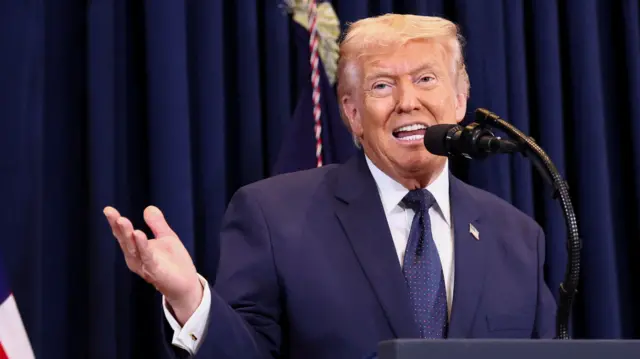
  13. Trump spoke to Putin - then said sanctions on some countries could be liftedpublished at 07:57 GMT

    U.S. President Donald Trump speaks during a press conference at Trump National Doral Miami in Miami, Florida, U.S., MarchImage source, Reuters

    On Monday - in his flurry of interviews and news conferences about the war - Donald Trump said the US was considering easing some oil sanctions to combat rising prices.

    Trump told reporters on Monday: "We have sanctions on some countries. We're going to take those sanctions off till this straightens out."

    "Then, who knows? Maybe we won’t have to put them on – there’ll be so much peace," he added.

    Trump told reporters in the same news conference that he had had a "very good" call with Russian President Vladimir Putin, who Trump said he believes "wants to be helpful".

    But Trump did not detail exactly which sanctions, or on which countries, he would look to lift - although the US has alreadytemporarily eased sanctions to allow India to buy Russian oil stranded at sea.

  14. Gas prices also down after oil dippublished at 07:48 GMT

    Nick Edser
    Business reporter

    Following the sharp drop in oil prices overnight, the cost of gas has also seen a significant drop this morning.

    As soon as trading got under way, UK wholesale gas prices fell more than 10% to about 123p a therm, which is well below the high of 171p it reached at one point on Monday.

    Despite the recent price spikes, gas prices remain well below the 640p-a-therm peak reached in 2022 following Russia's invasion of Ukraine.

  15. Gulf nations report more attacks overnightpublished at 07:42 GMT

    Smoke and flames rise following a drone attack on the UAE consulate in ErbilImage source, Reuters
    Image caption,

    Smoke and flames rise following a drone attack on the UAE consulate in Erbil

    As the US and Israel continue air strikes on Iran, with Israel also hitting Lebanon, apparent retaliatory strikes from Iran continue to be intercepted by Gulf states:

    Saudi Arabia says it intercepted a ballistic missile and five attack drones overnight.

    The Kuwaiti military says it successfully intercepted and downed six drones.

    Following the death of a 29-year-old woman in an attack on Bahrain's capital Manama late on Monday, Bahrain has sounded its warning sirens, while urging residents to shelter.

    The United Arab Emirates (UAE) defence ministry announced early on Tuesday that it was continuing to intercept "missile and drone threats" from Iran and has deployed air defence systems and fighter jets.

    The UAE also said its consulate in Erbil, northern Iraq, was targeted with a drone, causing damage but no injuries.

  16. Power cuts for some Iranians following overnight explosionspublished at 07:33 GMT

    Ghoncheh Habibiazad
    Senior reporter, BBC Persian

    Iran's national energy company Tavanir has acknowledged that, following explosions overnight in Tehran and nearby Alborz provinces, there were "damage to parts of the power network facilities".

    In a statement reported by local media, it said a "number of customers in these regions experienced a temporary power outage" but that "electricity was restored in less than two hours".

    Earlier some of those living in these two provinces told the BBC about electricity outage.

  17. Oil prices go up, down, up - but are still much higher than before the warpublished at 07:22 GMT

    Dearbail Jordan
    Business reporter

    To say oil prices have been rising and falling in the 11 days since the US-Israel war with Iran began would be a vast understatement.

    On Monday, Brent crude came within a whisker of $120 a barrel - the highest since Russia’s full-scale invasion of Ukraine four years ago.

    Prices then slid back to $83 as Donald Trump announced that the war is "very complete" yesterday evening. They have since ticked back up to $93 a barrel on Tuesday as the US president said: "We have won in many ways but not enough."

    Where do oil prices go now? Who on earth knows.

    But at the current rate, Brent crude is still $20 higher than it was before the conflict began on 28 February when it was trading at $73.

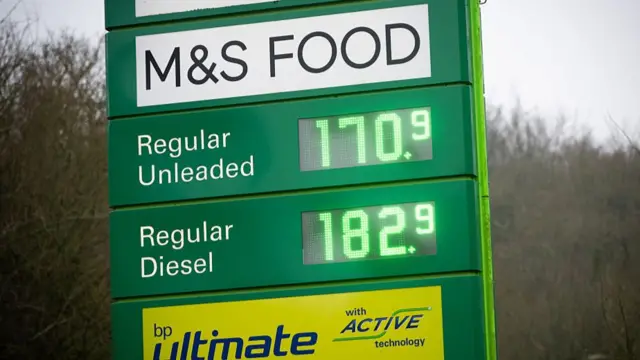
    And drivers and businesses in the UK are already feeling that via higher petrol and diesel prices.

    Petrol prices at Winchester Services on the M3 on MondayImage source, Getty Images
    Image caption,

    Petrol prices at Winchester Services on the M3 on Monday

  18. US embassy in Beirut urges citizens to leave country or 'shelter in place'published at 07:01 GMT

    The US embassy in Beirut is urging its citizens to "shelter in place" if they are not leaving Lebanon.

    In a security alert issued this morning, the embassy says US citizens "should strongly consider" leaving the country on Middle East Airlines flights departing Beirut Rafic Hariri airport, if they believe it is safe to do so.

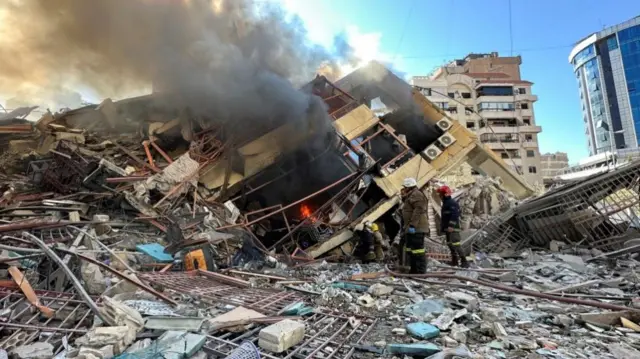
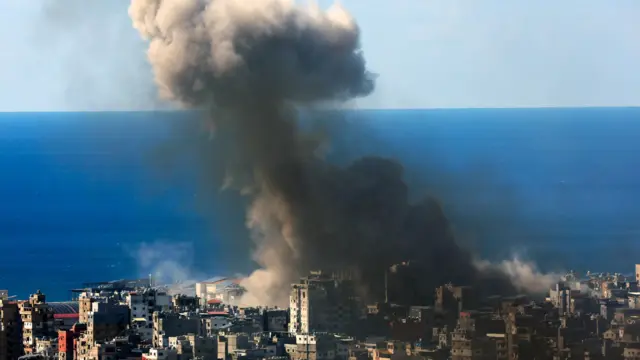
    Beirut and parts of southern Lebanon have been under consistent bombardment from Israel over the past week, which says it is targeting the Iran-backed militant group Hezbollah.

    Members of the Lebanese Civil Defence inspect a damaged building after an Israeli strike on Beirut's southern suburbs on MondayImage source, Reuters
    Image caption,

    Members of the Lebanese Civil Defence inspect a damaged building after an Israeli strike on Beirut's southern suburbs on Monday

  19. Israel again orders evacuation of southern Lebanon as it continues air strikespublished at 06:52 GMT

    An Israeli airstrike targets the Dahiyeh neighborhood of southern Beirut, Lebanon, 09 March 2026Image source, EPA
    Image caption,

    Israel carried out a number of strikes against Lebanon on Monday

    Israel has ordered the urgent evacuation of southern Lebanon as it continues to hit the area with air strikes.

    Israel Defense Forces (IDF) spokesman Avichay Adraee says Israel is acting "forcefully" against Hezbollah south of the Litani River due to the group's activities in the region.

    "We reiterate our urgent appeal for you to evacuate your homes immediately and head immediately north of the Litani River," he writes on X.

    On Monday, the IDF said it carried out a series of strikes in Lebanon against Al-Qard Al-Hassan Association (AQAH) targets, a financial association linked with Hezbollah.

    The Lebanese health ministry said yesterday that 486 people had been killed since Israel began its offensive earlier this month.

  20. Analysis

    After a tumultuous day in the markets, Trump's comments seemed to have the desired effectpublished at 06:35 GMT

    Anthony Zurcher
    North America correspondent

    President Donald Trump and his administration have so far offered mixed messages and contradictory explanations on the joint US-Israeli military campaign against Iran.

    And Monday - the 10th day of an operation that has rattled allies and shaken markets - typified this confusion around the war's timeline and ultimate goals.

    After a tumultuous morning during which US stock market indexes dropped and oil prices surged, the American president began speed-dialing reporters in an apparent effort to soothe nerves.

    His comments, however, were lacking in clarity even when he was pushed for more detail.

    "I have a plan for everything, okay?" he told a reporter from the New York Post when asked about spiking oil prices. "I have a plan for everything. You'll be very happy."

    To CBS News, he said the war "is very complete, pretty much". "We're very far ahead of schedule," he added. You can see a summary of his comments in our previous post.

    His telephone spree, at least in an economic sense, had the desired effect. Stock markets rallied, and the price of a barrel of oil – which had reached $120 earlier in the day - dropped below $90.

    Just days ago, Trump said that he would not stop the war until Iran's "unconditional surrender".

    But after his comments on Monday, it appeared as though an end to a military operation that has roiled the Middle East and led to the near complete shutdown of shipping traffic through the Straits of Hormuz could be in sight.