Summary

Media caption,

Watch: Canada's PM Carney meets China's Xi Jinping

  1. Key takeaways from Carney's visit to Beijingpublished at 10:51 GMT 16 January

    Canadian Prime Minister Mark Carney's visit to Beijing – which observers have described as "pivotal" and "historic" – has concluded, and we're wrapping up our live coverage.

    Here are the key takeaways from today:

    • Carney and his Chinese counterpart Xi Jinping announced a "new strategic partnership". The two leaders have agreed that Beijing will lower tariffs on Canadian canola seed, peas and some seafood; while Ottawa will allow 49,000 Chinese EVs into its market
    • Xi hailed a "turnaround" of ties between both countries, while Carney says the partnership will deliver "stability, security and propsperity"
    • Carney's visit comes after almost a decade of strained ties between Ottawa and Beijing. He is the latest in a string of leaders to visit Beijing in the hope of resetting ties with China
    • Speaking to reporters at the end of his visit, Carney spoke positively on various issues of collaboration, including in clean energy, agriculture and security. He agreed that China is a "more predictable partner" – when asked for a comparison with the US
    • China's record on human rights came up a few times in the press conference, which lasted nearly an hour. "We're very clear about where we cooperate, where we differ," Carney said.

    You can read more in our news story here.

    With that we'll close this page. It was edited by Tessa Wong, Yvette Tan and Joel Guinto; with reporting and analysis from Suranjana Tewari, Laura Bicker, Jessica Murphy, Osmond Chia, Stephen McDonell, Nadine Yousif, Koh Ewe and Kelly Ng. Thank you for staying with us.


  2. Flurry of leaders' visits to China in face of US tariffspublished at 10:49 GMT 16 January

    Suranjana Tewari
    Asia Business Correspondent

    Mark Carney is the latest in a string of leaders to visit Beijing looking to mend fences and boost trade with China.

    South Korea's Lee Jae Myung was the first earlier this month. He managed to secure improved relations with Beijing after becoming the first South Korean president to visit China since 2019.

    Carney has talked about advancing trade and environmental co-operation with China, and resolving Beijing's heavy tariffs on Canadian pork, canola and seafood.

    Later in the month, Keir Starmer is expected to travel to China, with a business delegation - the first visit by a British Prime Minister since 2018.

    Germany's chancellor Friedrich Merz is also set to visit China next month.

    Although tensions between the US and China have somewhat eased, Donald Trump's trade war is still looming large for many countries around the world.

    They're all looking for new markets and new trading partners, and the world's second largest economy could offer irresistable opportunities.

  3. Analysis

    What does this trip mean for Canada's relationship with the US?published at 10:43 GMT 16 January

    Jessica Murphy
    BBC News, Toronto

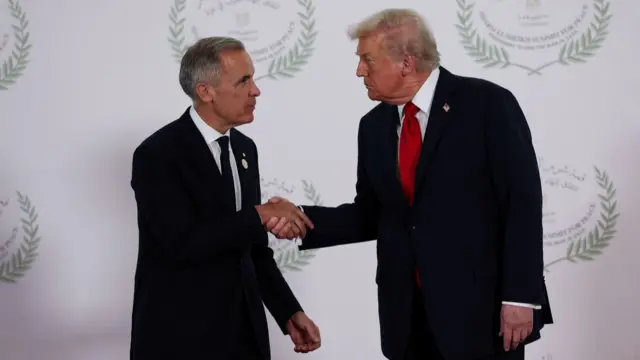
    Carney shaking hands with Donald TrumpImage source, Getty Images

    Carney is performing a delicate balancing act in China.

    He wants to reset the relationship with Beijing but knows it’ll be a sensitive issue with the US, Canada’s closest neighbour - a security ally that currently buys roughly 75% of its exports.

    Canada, the US and Mexico are also about to review their longstanding trilateral free trade deal, an economic framework the US is openly considering severing.

    “I do think the Chinese look at us as the closest ally of the United States, and anything they can do to put a wedge in there serves their interests,” says Colin Robertson, a former Canadian diplomat and vice-president at the Canadian Global Affairs Institute.

    Meanwhile, the Americans “are watching this very closely, and they will tend to look at it negatively, but my presumption is that we are keeping them well informed of what we're doing,” he said.

    “At the end of the day, there's Canadian interests that we're pursuing.”

    Canadian officials say they are mindful of the impact closer ties with China would have on the relationship with Washington.

    But speaking with reporters this week, some of them pointed to the significant trade relationship the US itself has with China.

    They say Ottawa is focused on pursuing its own national interests through trade diversification.

  4. When was the last time a Canadian leader went to China?published at 10:30 GMT 16 January

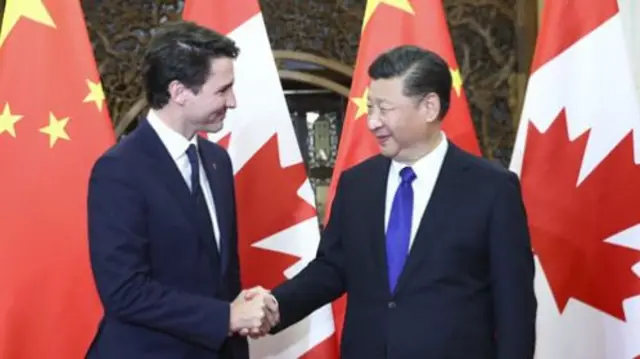
    Justin Trudeau shaking hands with Xi JinpingImage source, Xinhua News Agency

    The last time a Canadian Prime Minister visited China was in 2017, when Justin Trudeau met Xi Jinping in Beijing. That was his second official visit to China.

    Trade was the main focus of the trip, as officials from both sides discussed a potential comprehensive trade agreement and the export of Canadian beef and pork, according to the Canadian PM's office.

    Trudeau also attended a business forum in the southern Chinese city of Guangzhou, where he met Chinese business leaders.

    That trip happened before a diplomatic spat - involving the detentions of Huawei executive Meng Wanzhou and the "Two Michaels" - derailed the two countries’ trade talks.

  5. Analysis

    Canola is a strategic and political export for Canadapublished at 10:17 GMT 16 January

    Suranjana Tewari
    Asia Business Correspondent

    Under the deal, tariffs on canola seed will drop from roughly 85% to around 15% by 1 March allowing Canadian farmers to plan ahead of the planting season.

    Carney said the deals will unlock nearly $3bn (£1.6bn) in orders for Canadian farmers, fish harvesters, and processors as they realise the full potential of the Chinese market.

    Significantly, it signals a broader return of Canada as a key agricultural partner for China.

    Carney said the deal reflects “the spirit of what is a new partnership, a new era" which could one day extend to other products including grains, pulses, lobster, beef, pork, and pet food.

    Canadian exporters will be relieved after almost a year of tariff chaos.

    The return of such a major trading market and a strengthening of trade ties with China will likely offer support to the farming, processing, and related industries in Canada, and in the future help create jobs and boost growth.

  6. Months of defrosting ties before this Carney-Xi meetingpublished at 10:04 GMT 16 January

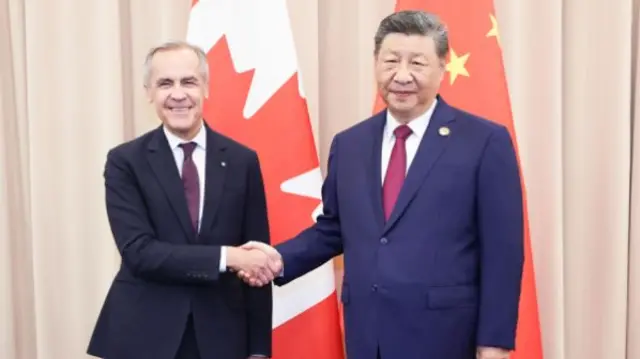
    Mark Carney and Xi Jinping shaking handsImage source, Chinese Ministry of Foreign Affairs
    Image caption,

    Carney and Xi last met each other on the sidelines of the Apec summit in South Korea

    Before Carney and Xi’s big meeting this week, there have been signs of thawing bilateral ties in recent months.

    In August, the two countries revived meetings of the Canada-China Joint Economic and Trade Commission, an annual consultation mechanism which had been on hiatus for years.

    Last September, Carney met Chinese premier Li Qiang in New York; the following month he met Xi in South Korea, on the sidelines of the Apec summit.

  7. Analysis

    Carney flags a shift in the global trading systempublished at 09:54 GMT 16 January

    Suranjana Tewari
    Asia Business Correspondent

    Canadian Prime Minister Mark Carney called the preliminary trade deal with China “enormous progress” in resetting economic ties.

    But he also noted a broader shift in how global trade will work in the future, saying institutions like the World Trade Organisation and International Monetary Fund would become less relevant.

    This is something a lot of state leaders and experts have been discussing, especially in the wake of US tariffs and trade disputes upending global supply chains.

    Carney added that future trading rules would be shaped by “bilateral deals, plurilateral arrangements and coalitions” formed around specific sectors.

    They could include digital trade, agriculture, clean energy, climate finance and financial services, as well as the evolution of cross-border payments and the global financial system.

    He said groups of countries are likely to work together, rather than through global institutions, creating more certainty and opportunity for businesses and ordinary Canadians who depend on trade.

  8. Canada's taken 'decisive steps' to bolster Arctic security - Carneypublished at 09:44 GMT 16 January

    The final question Carney addressed was on Greenland and security in the Arctic.

    He first stated that the future of Greenland, a self-governing Danish territory, is a decision for Greenland and Denmark.

    Canada is in discussions with Denmark and partners of the North Atlantic Treaty Organization (Nato) on safeguarding Arctic security, he said.

    "We've taken decisive steps in terms of Arctic security over the course of this [past] year," he said, noting that Canada is increasing its presence in that region from four months in a year to year-round.

    Carney had earlier pledged to boost Canada’s military and security presence in the Arctic. It will officiallly open a consulate in Nuuk, Greenland, next month, and is planning for another in Anchorage, Alaska.

  9. Analysis

    Trump tariffs have sent Canada on direct path to Chinapublished at 09:32 GMT 16 January

    Laura Bicker
    China correspondent

    Mark Carney said that the "world has changed dramatically” and how Canada positions itself in the world now “will shape our future for decades to come.”

    This aligns with the message from President Xi Jinping’s in the last year who talks of “great changes unseen in a century."

    In short, Canada's new relationship with China appears to be a direct result of the Trump effect. His tariffs seem to have sent one of his key trading partners on a direct path to the other superpower.

    And China is taking full advantage of this opportunity.

    Canada was once seen by Beijing has a follower of Washington when it comes to its China policy. Now Mr Carney says he’s “designing new tracks”.

    Mr Carney told reporters that Canada’s relationship with China had been more “predictable” in recent months and he announced that he has found talks with Beijing “realistic and respectful”.

    The Canadian Prime Minister describes this agreement as “pragmatic” and he is made it clear Ottawa does not agree with Beijing on everything.

    He also made it clear Ottawa will engage on more difficult issues including human rights and the need for “guardrails” on this new relationship.

    But for now, this deal is a huge turnaround for a relationship that was in the deep freeze, and it could set an example for others across the world who are also feeling the pain of Washington’s trade policies.

  10. On human rights, Canada 'very clear' about where it differs from China - Carneypublished at 09:18 GMT 16 January

    China's record on human rights came up a few times during Carney's press conference.

    The prime minister affirmed that Canada stands up for human rights and democracy, but he said "we take the world as it is, not as we wish it to be".

    With countries that do not share these same values, Ottawa will engage on a "narrower, more specific" manner, he said. "We're very clear about where we cooperate, where we differ," he said.

    Carney said issues concerning Taiwan and Hong Kong's pro-democracy figure Jimmy Lai came up in "broad discussions over the last few days".

    Canada and China has "different systems", he said, which limits the breadth of their cooperation. "But to have an effective relationship, we have direct conversations. We don't grab a megaphone and have the conversations that way."

  11. Analysis

    A significant trade thaw after years of strained tiespublished at 09:13 GMT 16 January

    Suranjana Tewari
    Asia Business Correspondent

    Allowing up to 49,000 Chinese electric vehicles (EVs) into Canada at a low tariff of 6.1% signals something of a reset between China and Canada.

    Before the visit, all of China's EVs were subject to a 100% tariff - imposed in 2024 amidst criticisms that government subsidies gave Chinese companies an unfair advantage in the global market.

    More affordable EVs in Canada could lower consumer prices and accelerate the country's energy transition.

    There is still a cap though which may allay fears in Canada of too many cheap Chinese EVs flooding in.

    In return, China’s planned cut to canola tariffs to about 15% is important for Canada, offering immediate relief to farmers.

    Politically, the deal shows Canada is looking for more reliable trading partners. In the press conference, Mark Carney said himself that the relationship with China is more predictable than the US.

    This will be closely watched in Washington - especially with the sale of agricultural products being a major sticking point between the US and China in trade negotiations.

    North America's auto supply chains are deeply intertwined between Canada, the US and Mexico. But Trump's tariff and trade war has rattled businesses, and the entry of more affordable foreign vehicles could alter the market in a number of ways.

  12. Carney clarifies 'new world order' remarkpublished at 09:06 GMT 16 January

    Earlier, a reporter asked Carney on his remark yesterday - which as we reported has stirred some debate online - that the Canada-China partnership sets the two countries up for a "new world order".

    "The world is still determining what that order is going to be," he said.

    "The multilateral system that has been developing...has been eroded, to use a polite term, or undercut," he said.

    "Like-minded countries" may start to form coalitions to collaborate on various aspects, such as clean energy, digital trade, and so on, he said.

    "The expectation is that, rather than being developed through multilateral organisations like the International Monetary Fund or World Trade Organisation, it's going to be coalitions for sub-sectors of the world," Carney said.

  13. Carney ends press conferencepublished at 09:00 GMT 16 January

    Carney's press conference has just ended - but we will continue to bring you more lines on what he said. Stick with us.

  14. Canada discussed 'red lines' against foreign interference with Beijing - Carneypublished at 08:58 GMT 16 January

    Asked about concerns of China's foreign interference in Canada, Carney maintained that Ottawa does not tolerate foreign interference and that in his discussions with Xi he made clear Canada's "red lines".

    "As prime minister, I have always taken this extremely seriously," he said.

    Canada's new partnership with China includes greater cooperation to tackle cross-border crime, Carney said. "That's the kind of progress we need to address issues such as narcotics and interference," he said.

  15. Canada's relationship with China 'more predictable' than with USpublished at 08:51 GMT 16 January

    Another reporter had asked if Carney considers China "a more predictable and maybe reliable partner" compared to the United States today.

    The prime minister acknowledged that Ottawa and Beijing had "differences in opinions and views" but have been able to engage in "candid and consistent, frank dialogue", which leads to a "more predictable and effective" relationship.

    China is Canada's second-largest export market after the US, though by a far stretch.

    "Our relationship with US is much more multifaceted and broader than our relationship is, with China.

    "But yes, in terms of [how] our relationship has progressed withn China, it is more predictable and you see results coming from that," Carney said.

  16. Carney affirms One China policypublished at 08:48 GMT 16 January

    When asked about reports that two Canadian MPs were asked by the Canadian government to shorten their visit to Taiwan this week, ahead of Carney's visit to Beijing, the prime minister reaffirmed the One China policy - the diplomatic acknowledgement of China's position that there is only one Chinese government.

    "It's consistent. We have relations with the government here, the People's Republic of China, and we have people-to-people relations with Taiwan," he said.

    Another reporter noted how Carney had described China as the biggest security threat to Canada last year.

    "The security landscape continues to change in a world that's more dangerous and divided," Carney replied.

    "My responsibilities as prime minister is to manage those threats by building resilience, building security... through alliances," he said.

  17. No 'discrimination tariffs' on Canadian peas, lobsters, crabs from 1 Marchpublished at 08:38 GMT 16 January

    Earlier, Carney also announced that Canadian peas, lobsters and crabs would not be subject to "discrimination tariffs" from 1 March until "at least the end of this year".

    This is expected to bring in nearly $3bn of export orders for Canadian farmers, fish harvesters and processors, he said.

  18. Ottawa to allow 49,000 Chinese EVs into Canadian marketpublished at 08:33 GMT 16 January

    Ottawa and Beijing also discussed developing clean energy in several areas.

    For instance, Canada has agreed to allow 49,000 Chinese electric vehicles into the Canadian market, with the most-favoured-nation tariff rate of 6.1%, Carney said.

    As Canada intends to double its energy grid capacity and move towards clean power, the prime minister also welcomed China to invest in his country in these areas.

  19. Canada expects China to lower canola tariffs to 15% by 1 Marchpublished at 08:27 GMT 16 January
    Breaking

    Canada expects China to lower tariffs on Canadian canola seed to a combined rate of about 15% by 1 March, Carney said.

    "With this agreement, we expect to see a resolution to many long term obstacles," he said.

  20. Carney elaborates on five key areas in 'new strategic partnership'published at 08:23 GMT 16 January

    Carney then lays out the five key areas of the two countries' "new strategic partnership":

    • Clean energy and climate competitiveness
    • Expanding trade in agriculture and food
    • Commitment to multilateralism and strengthening global governance
    • Deepening public security and safety
    • Strengthening people-to-people ties and culture