Summary

Media caption,

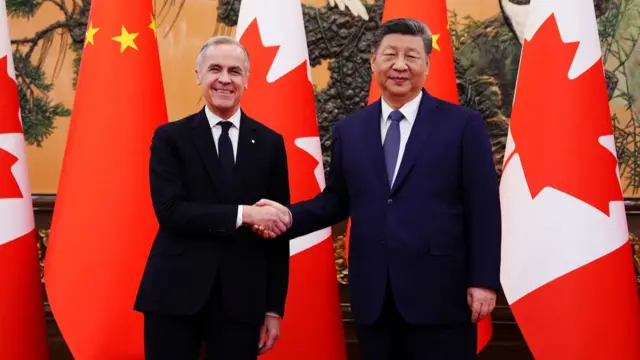
Watch: Canada's PM Carney meets China's Xi Jinping

  1. The arrest that froze China-Canada tiespublished at 08:04 GMT

    Osmond Chia
    Business reporter

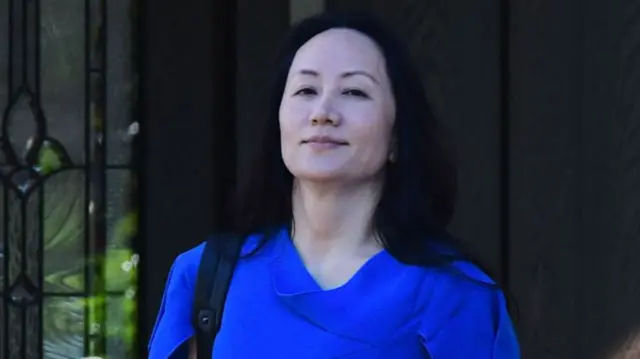
    Huawei CFO Meng Wanzhou is pictured dressed in an electric blue top and a bag carried on her shoulder as she leaves her Vancouver homeImage source, Getty Images
    Image caption,

    Meng Wanzhou in 2021

    Diplomatic relations between Beijing and Ottawa were heavily strained in 2018 when Canada arrested a top executive from Chinese technology giant Huawei at the request of the US.

    Meng Wanzhou, the daughter of the telecommunications group’s founder and the firm's chief financial officer, was accused by of fraud by Washington and placed under house arrest in Canada for three years.

    For Huawei, the situation was a blow to their hopes of expanding globally, putting the tech company under intense scrutiny. The UK, Japan, Australia and the US placed restrictions on its services.

    Meng's arrest also spurred Washington's concerns about Huawei as national security risk. Within months, the US placed the firm on a list of sanctioned entities, restricting its access to American technology.

    China has argued that Meng's detainment is a political attack.

    In a move widely interpreted as a form of retaliation, Beijing detained two Canadian citizens, who were accused of being spies. They were held under harsh conditions, deepening tensions between the countries.

    Each side released their detainees in 2021, bringing an end to the diplomatic row.

  2. Analysis

    From central banker to trade negotiatorpublished at 07:53 GMT

    Suranjana Tewari
    Asia Business Correspondent

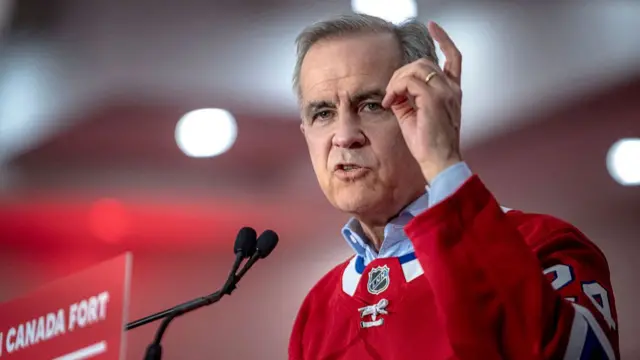
    Carney speaks into microphones while wearing a red hockey shirtImage source, Getty Images

    In many ways, Mark Carney is well placed to reshape Canada's trade relationships.An economist by training, he has spent much of his career at the intersection of markets and public policy.

    As former governor of both the Bank of Canada and the Bank of England, Carney built his reputation by steering economies through periods of crisis.

    That was his pitch to voters in the Canadian leadership race that made him Prime Minster, as the country faced slowing productivity, US tariffs and a deterioration in relations with its closest ally - the US.

    Carney’s visit to Beijing - the first by a Canadian prime minister in nearly a decade - is also central to that strategy.

    China remains one of the few markets large enough to absorb more Canadian energy, minerals and agricultural exports.

    With roughly three-quarters of Canada’s exports still going to the US, Carney will want to reduce that reliance and open new routes to other global markets.

  3. Carney's 'new world order' remark rattles some observerspublished at 07:42 GMT

    Koh Ewe
    Live page reporter

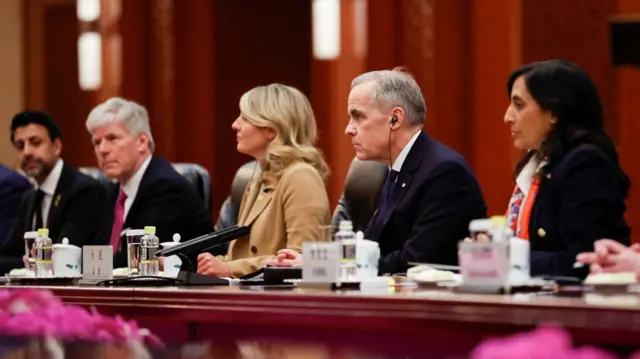
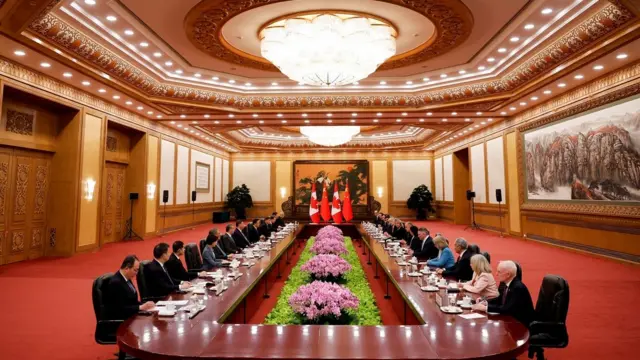
    Carney sitting with his team at a long tableImage source, Reuters

    Ahead of his meeting with Xi today, Carney's visit to Beijing stirred up some debate on social media over three words: "new world order".

    On Thursday, during a meeting with Chinese Premier Li Qiang, Carney noted that this was the first visit by a Canadian PM in nearly a decade.

    "The world has changed much since that last visit. I believe the progress that we have made in the partnership sets us up well for the new world order," said Carney, pausing between each of the last three words.

    Those words have rattled observers who disapprove of Carney's overture to China.

    "What on earth is he talking about?" Blaine Calkins, Canadian MP from the Conservative Party, wrote on X.

    The comments come at a time when global trade has been tossed into uncertainty by tariffs from the US - Canada's closest ally.

    Carney is on a mission to diversify Canada's economic partnerships, reducing its reliance on the US.

    Other Western leaders appear to be doing the same: also set to visit China in the coming weeks are Germany's Chancellor Friedrich Merz and British Prime Minister Sir Starmer.

    "If I'm China, I'm liking this new world order," wrote political scientist Ian Bremmer.

  4. Analysis

    Trump's actions have been a gift to Xipublished at 07:29 GMT

    Stephen McDonell
    China correspondent

    In their comments so far this trip, both Xi and Carney have emphasised defending multilateralism as a key point of unity between Canada and China.

    The unspoken secondary message here: this is a point of differentiation with the Trump administration which has been characterised by the Chinese government as an enemy of multilateralism.

    When they referred to backing the authority of the United Nations to safeguard world peace, they are not only finding mutual ground but also, in a way, mutually criticising those who undermine institutions like the UN or the WHO.

    President Trump has been a gift to China’s leader, pushing traditional American allies towards Beijing, as they seek stable partners on trade and much more, like working to combat climate change.

    Among Xi Jinping’s four proposals for cooperation, he listed education, culture, tourism, sports and people-to-people exchanges as fundamental.

    It is a quite a shift. When you consider how bad China’s reputation was in Canada after its highly criticised imprisonment of Canadians Michael Kovrig and Michael Spavor, this has been a remarkable turnaround for Ottawa and Beijing thanks, in no small way, to the contributions of Donald J Trump.

  5. What is at stake at Xi-Carney meeting?published at 07:14 GMT

    Osmond Chia
    Business reporter

    This is a meeting with huge economic stakes, especially for Canada as it seeks a path to grow its exports outside of the US.

    But the relationship between Canada and China has been strained with a slew of trade barriers and geopolitical tensions in recent years.

    One of Canada's key goals during this trip is to ease Chinese tariffs on its goods, especially canola oil, one of its largest industries.

    China will also hope to ease a 100% tariff on electric vehicles.

    Ottawa has in place a 25% tariff on Chinese steel and aluminium – both vital industries in Canada.

    Carney will also have to be mindful about the US - Canada’s largest customer - as US President Donald Trump has raised national security concerns over Chinese ties among its neighbours.

  6. What to know about Xi and Carney's meetingpublished at 07:04 GMT

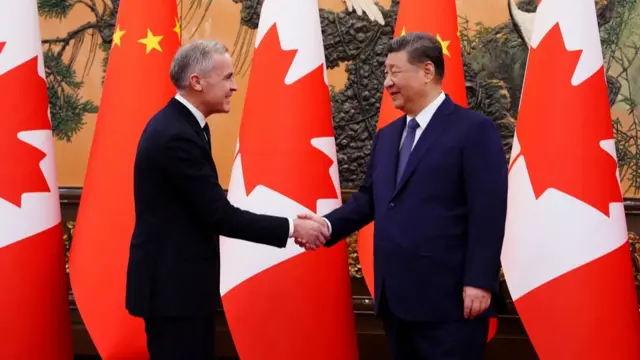
    Carney shakes hands with XiImage source, Reuters

    Good morning to our readers in the UK and Europe. If you're just joining us, here's what you need to know about Canadian Prime Minister Mark Carney's visit to Beijing:

    • Carney met China's leader Xi Jinping on Friday where both leaders spoke positively about progress in bilateral ties
    • Xi hailed a "turnaround in ties" since they met in South Korea last year, while Carney spoke of building a "new" relationship and urged both sides to focus on agriculture, energy and finance
    • Xi also laid out "four proposals" to Carney on how their two countries could be better partners, emphasising respect, trust, "common development" and "mutual coordination"
    • This meeting comes after almost a decade of strained ties between Ottawa and Beijing, following the arrest of a top Huawei official in Vancouver on a US warrant
    • Carney, who also met Chinese Premier Li Qiang on Thursday, is the latest in a string of leaders to visit China in the hope of resetting ties with Beijing

    Xi and Carney have had a working lunch, which was closed to the media. We're now waiting for a press conference which will take place in an hour's time, where Carney will be addressing reporters. Stick with us for more.

  7. Chinese negotiators are 'extremely adroit', says analyst and ex-detaineepublished at 06:54 GMT

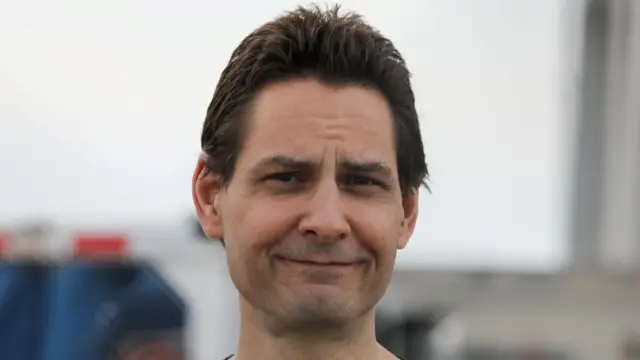
    Michael Kovrig smiling at the cameraImage source, Reuters

    Michael Kovrig, an adviser at Crisis Group and a former Canadian diplomat, says that Carney's visit should not just be about warming ties but also "managing leverage".

    He's one of the "Two Michaels" who were detained by China from 2018 to 2021, in what was widely seen as a retaliatory move for Canada's arrest of Huawei CFO Meng Wanzhou - an allegation that China denies.

    The arrests sent China-Canada ties plunging, until all three were released in 2021.

    Kovrig described Chinese negotiators as "extremely adroit, calculating, and always looking for leverage".

    "They understand the constraints Ottawa faces with Washington and will look for pressure points both inside and outside the negotiating room," he wrote on X, hours ahead of Carney's meeting with Xi.

    "That’s why engagement has to be handled with discipline. Falling into a transactional, deal-by-deal pattern risks harming broader national interests," he said, adding that Carney should also advocate for Canadians imprisoned in China.

    There are about 100 Canadians detained in China, according to Canadian media.

  8. Who is on the trip with Carney?published at 06:34 GMT

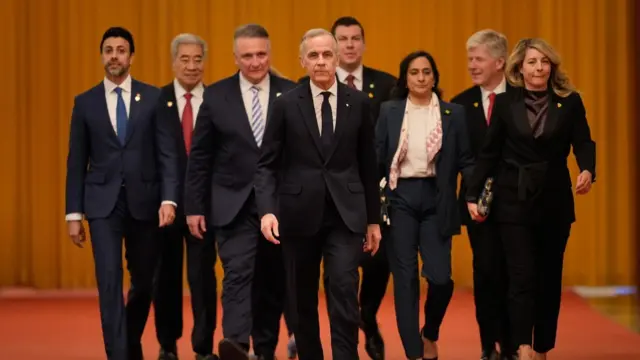
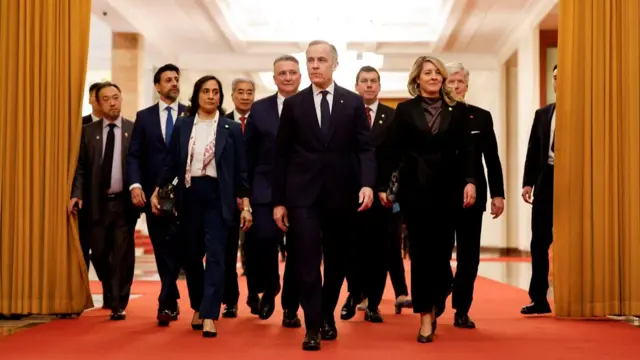
    Carney walking on a red carpet with his delegationImage source, EPA/Shutterstock

    Mark Carney is accompanied on his Beijing trip by several members of his administration.

    They include:

    • Foreign Minister Anita Anand
    • Natural Resources Minister Tim Hodgson
    • Industry Minister Mélanie Joly
    • Agriculture Minister Heath MacDonald
    • Liberal member of parliament Michael Ma
  9. Xi makes 'four proposals' to Canadapublished at 06:20 GMT

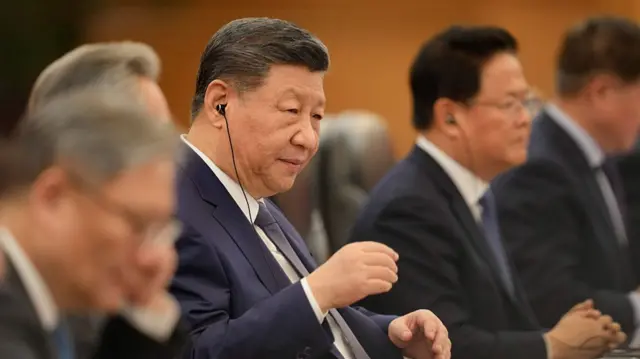
    Xi Jinping listening to something with a earpieceImage source, Getty Images

    We've just seen a readout from their meeting carried on Chinese state news agency Xinhua. The readout quotes Xi Jinping as offering "four proposals" to Carney on China-Canada relations:

    • Be partners who respect each other: Xi says both countries should respect each other's sovereignty, territorial integrity and political systems;
    • Be partners in common development: Describing the "essence" of bilateral trade ties as "mutual benefit and win-win cooperation", Xi says both sides should cooperate and strengthen shared interests;
    • Be partners who trust each other: Xi says both countries should also encourage "people-to-people exchanges", the "most fundamental" form of connection
    • Be partners in mutual coordination: China is willing to work with Canada through international frameworks like the UN, G20 and Apec to "jointly address global challenges", Xi says.

    The readout also states that Canada reaffirmed its adherence to the One China policy and is willing to work with China to "jointly safeguard world peace and stability".

    We will hear more from the Canadian side in about two hours' time, when Carney addresses reporters directly.

  10. Analysis

    A ‘realistic’ reset in China-Canada tiespublished at 06:01 GMT

    Jessica Murphy
    BBC News, Toronto

    Senior Canadian officials are saying this meeting between Carney and Xi is a chance to reinvigorate a relationship that has been tense in recent years, to look for ways to collaborate on areas of mutual interest and place guardrails on areas where there are disagreements or concerns, like around critical minerals and defence.

    Colin Robertson, a former Canadian diplomat and vice-president at the Canadian Global Affairs Institute, external, says it will likely be “a reset of a relationship that will be perhaps more modest in ambition than we had in the past, but much more realistic about what we can reasonably obtain”.

    Carney has in the past called China Canada’s biggest national security threat. But Robertson suggests those comments aren’t at odds with his ambitions to seek closer economic ties.

    You can “go in, eyes wide open, but you can do business”, he said. He added that it’s a “healthier relationship if both sides understand where they're coming from and what the red lines are”.

    Carney has been open about some of those lines, telling the Canadian Broadcasting Corporation in December that around "artificial intelligence, critical minerals, defence, where clearly the security threats are such that we would not have a deep relationship with China in those areas".

  11. Huawei arrest and 'Two Michaels': The low points in China-Canada relationspublished at 05:44 GMT

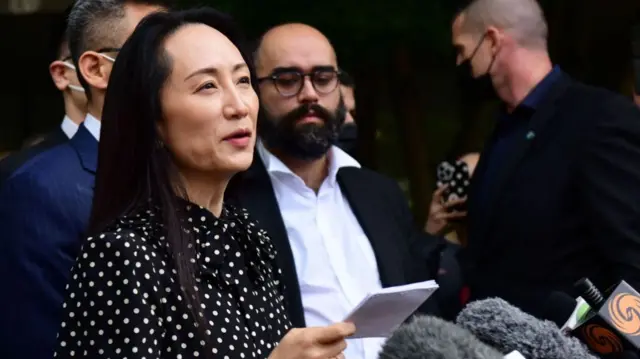
    Meng Wanzhou in a black polka dot blouseImage source, Getty Images

    Carney’s visit to China signals a warming in bilateral ties, which have in recent years seen more lows than highs.

    In December 2018, Canada detained Huawei chief financial officer Meng Wanzhou on fraud charges at the request of the US, accussing her of breaking Iranian sanctions.

    Days later, China detained Canadian citizens Michael Kovrig and Michael Spavor on espionage charges. Critics accused China of using the “Two Michaels” as bargaining chips in the extradition battle over Meng - which China denied.

    In 2021, the US dropped its extradition request for Meng and she flew back to China. That same month, the "Two Michaels" were released from Chinese detention.

    Trade relations between the two countries have come under serious strain since 2024, as Ottawa and Beijing imposed tit-for-tat tariffs on each other, from Chinese electric vehicles to Canadian canola.

    In the months ahead of Carney’s visit, however, officials in both countries have expressed willingness to deepen cooperation in trade the diplomacy.

  12. What to expect for the rest of the daypublished at 05:32 GMT

    Carney is set to speak to reporters at 16:00 local time (08:00 GMT), according to the schedule published by his office. We'll be covering that press conference, so stick with us for the next few hours.

    Then at 19:00 (11:00 GMT), he will deliver opening remarks at a gala dinner hosted by the Canada China Business Council.

  13. What are the trade sticking points?published at 05:14 GMT

    Suranjana Tewari
    Asia Business Correspondent

    In 2024, Canada imposed 100% tariffs on Chinese electric vehicles, following similar US curbs.

    At the time, former Prime Minister Justin Trudeau had said government subsidies had given Chinese companies an unfair advantage in the global marketplace, impacting Canada's auto industry.

    Last year, China retaliated with tariffs on more than $2bn (£1.5bn) of Canadian farm and food products like canola seed, oil and meal. As a result Chinese imports of Canadian goods fell by 10% in 2025.

    Canada's industry minister has said talks about auto tariffs are ongoing and will continue on Friday when asked by reporters if electric vehicle tariffs might reduce to 50%.

  14. Healthy China-Canada ties 'conducive to world peace' - China's foreign ministrypublished at 05:00 GMT

    Xi and Carney’s meeting in South Korea last October "charted the course" for the resumption of cooperation between the two countries, China's foreign ministry said on Monday.

    China-Canada ties have "gradually improved and developed", a ministry spokesperson said.

    "The healthy and stable development of China-Canada relations is in the common interest of both countries and their people, and is also conducive to world peace, stability, development, and prosperity."

    Earlier today Xi reiterated the same lines in his meeting with Carney.

  15. Analysis

    Sore spots: Jimmy Lai, foreign interference and human rightspublished at 04:46 GMT

    Jessica Murphy
    BBC News, Toronto

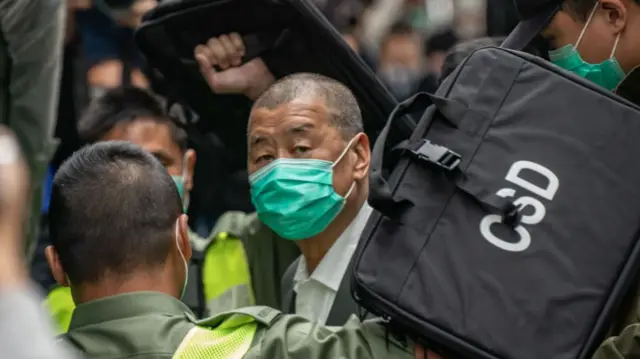
    Jimmy Lai wearing a green mask looking to the sideImage source, Getty Images

    The Canadian delegation is under domestic pressure to bring up the case of Jimmy Lai, a British citizen and Hong Kong media mogul who also has family ties to Canada.

    A pro-democracy advocate, Lai is incarcerated in China having been found guilty on national security charges.

    Canada has joined other G7 nations in calling on Hong Kong to release him.

    Carney will also be expected to raise concerns about alleged Chinese interference in Canadian elections - a claim that China denies.

    Canadian intelligence agencies say China has been the most active state conducting such activities in the country, including acts of transnational repression of Chinese Canadian communities.

    And Carney is being pushed to more widely address concerns around human rights.

    “Prime Minister Carney should recognise that the Chinese government’s deepening repression threatens not just the rights of people in China but, increasingly, Canada’s core interests and values,” said Maya Wang, the deputy Asia director at Human Rights Watch in a statement last week.

    Navigating those issues while trying to maintain a relationship with Beijing has long been a challenge for Canadian leaders, who have in the past tried various tactics, from addressing the concerns behind closed doors to more public criticism.

  16. Canadian provincial premier pushes for ‘off ramp’ on agriculture tariffspublished at 04:28 GMT

    Jessica Murphy and Nadine Yousif

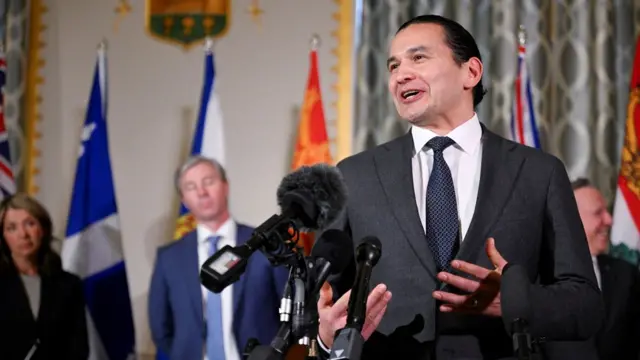
    Wab Kinew, Premier of Manitoba, speaks during a press conferenceImage source, Reuters

    Carney is under significant pressure on this trip to get some relief from tariffs imposed by China on Canada’s agricultural sector, notably canola, as well as pork and seafood.

    “We have a lot of canola exporters and farmers, and we have a lot of pork producers and pork manufacturing facilities, and having the Chinese tariffs on our pork products has been a real financial hit to those manufacturers and those producers this year, and the canola impact has created a ton of uncertainty,” Wab Kinew, the premier of Manitoba, told the BBC this week.

    Kinew, who leads a prairie province with a significant agriculture sector, said it’s been painful to have some Canadian products effectively shut out of a major market.

    “We really, really encourage the prime minister to get a deal done here so that we can see an off ramp,” he said.

    He added that with the uncertainty caused by tarifs from the US, it would be beneficial to have more stability from China.

    ”This trade relationship would be great for Canada,” he said.

  17. Analysis

    Where could Canada and China work together?published at 04:08 GMT

    Suranjana Tewari
    Asia Business Correspondent

    Canada and China already trade in agricultural products, and on Thursday, both sides signed an economic roadmap in which they agreed to "maintaining open channels of communication" to resolve issues.

    Canada also welcomed Chinese investments in energy, agriculture and consumer products.

    Beijing said it looked forward to Canada's investment in sectors including services, aerospace and advanced manufacturing.

    Both sides plan to explore oil and gas development, and cooperate in natural uranium trade.

    Canadian Minister Tim Hodgson said he had heard "loud and clear" that China was looking for reliable trading partners, and would like more Canadian energy products.

    Since arriving in Beijing Carney has met senior executives from prominent Chinese businesses, including an electric vehicle battery maker and an energy giant.

  18. Xi and Carney head for lunchpublished at 03:53 GMT

    The two leaders and their delegations are now heading into a luncheon hosted by Xi, according to the schedule posted by Carney's office.

    The event is closed to the media.

    Carney is due to speak to reporters in few hours, at 16:00 local time (08:00 GMT).

    We'll continue to bring you the latest updates and analysis from this meeting. Stick with us.

  19. Xi hails 'turnaround of ties' since Apec meetingpublished at 03:46 GMT

    There's been a "turnaround of ties" between China and Canada, says Xi Jinping, since he met Carney at the annual Asia-Pacific Economic Cooperation summit in South Korea late last year.

    On Thursday, Chinese Premier Li Qiang also hailed a “turnaround” in bilateral ties, and called it a "new starting point" for the two countries.

  20. In photos: Carney and Xi meet in Beijingpublished at 03:39 GMT

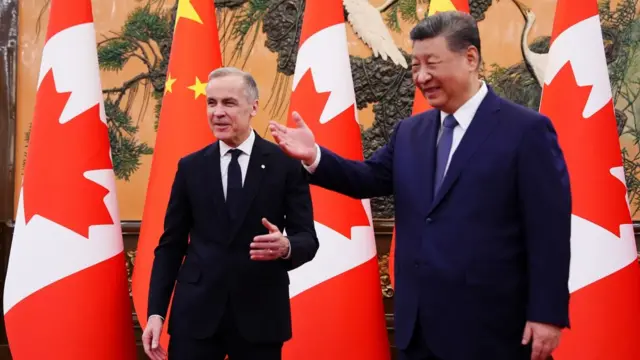
    We can now bring you the latest photos from Carney and Xi's meeting, where the two leaders exchanged opening remarks, shook hands and posed for photos.

    Carney walks in with his teamImage source, Reuters
    Carney and Xi smile and gestureImage source, Reuters
    Carney and Xi shake handsImage source, Reuters
    Conference hallImage source, Reuters