Summary

  • Donald Trump says he could "take the oil in Iran" and possibly seize its major fuel hub of Kharg Island in an interview with the Financial Times

  • The price of oil rises to more than $115 as markets open in Asia

  • Iran has threatened to expand retaliatory strikes against universities and the homes of US and Israeli officials

  • Tehran says a university in the central city of Isfahan has been targeted by strikes for the second time this weekend

  • Power has been restored to most parts of Tehran after the Iranian government said its energy infrastructure had been damaged in strikes, while Israel says a fire at an industrial site in the south of the country caused by an Iranian attack has been brought under control

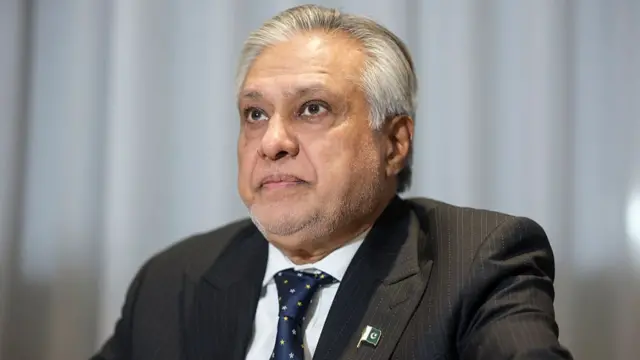
  • Pakistan's foreign minister says country is preparing to host peace talks "in the coming days" - but it is not clear if Iran or the US have said they will take part

  • Earlier, Iran's parliament speaker said forces are "waiting" for American ground troops so they can "rain fire upon them", following the US announcement that 3,500 soldiers are in the region with the USS Tripoli warship

  1. Why is the US reportedly considering seizing Iran's Kharg Island?published at 03:28 BST

    Media caption,

    Watch: Why Kharg Island is a lifeline for Iran

    As we just reported, Trump has told the Financial Times that the US could attempt to seize Kharg Island, a small island off the coast of Iran.

    The US has its sights on the island because it is home to a major oil terminal - Iran's economic lifeline.

    Seizing it would not only choke off Iran's oil exports but could also provide a platform from which to carry out attacks against the mainland.

    Taking the island would effectively cut off a chief source of revenue for Iran's Islamic Revolutionary Guard Corps (IRGC), affecting its ability to conduct war, security analyst Mikey Kay, from the BBC's Security Brief, says.

    Any US operation to seize the island would be relatively small in size, but challenging, Aaron Maclean, host of the School of War podcast and a CBS national security analyst told the BBC.

    Read more about Kharg Island's significance here.
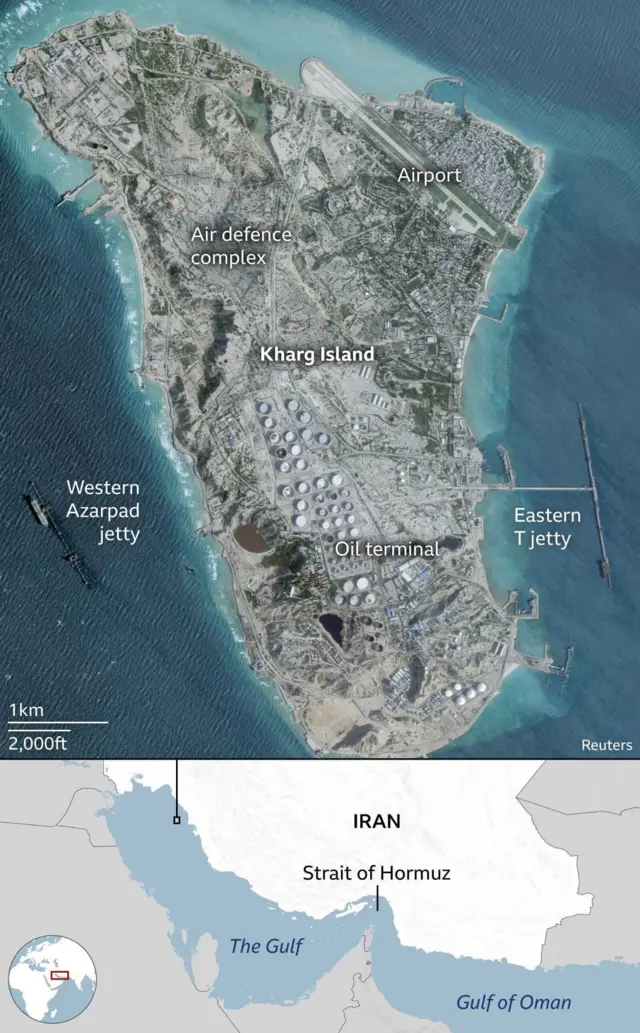
    A graphic showing the location of Kharg Island in the northwest of The Gulf about 15 nautical miles (24km) off the coast of Iran. An underwater pipeline connects it to the mainland and 90% of Iran’s oil is exported via the island. A satellite image shows the whole island which is roughly eight kilometres long and four kilometres wide. Shadows indicate that the island has many rocky outcrops but the island has been heavily industrialised. There is an airport in the northeast that extends slightly into the sea and around it appears to be the main accommodation on the island. The oil terminal takes up most of the southern half of the island where more than fifty large, white circular structures are clearly visible. These are the oil containers and they are surrounded by other smaller industrial buildings. The south of the island is flanked by two jetties for oil tankers to dock when loading. In the middle of the island an area is labelled as being an air defence complex. Image credit: Reuters, Google.
  2. Stock markets in Asia slidepublished at 03:08 BST

    Osmond Chia
    Business reporter

    Asian stocks slid in early Monday trade as oil prices are headed for a record monthly surge.

    Japan's Nikkei 225 index was down by more than 4.5% while the Kospi exchange in South Korea fell by 4.3%. Both stock exchanges have been hit hard by rising oil prices as their countries are highly reliant on energy from the Middle East.

    Australia's ASX 200 index also fell by 1.4%.

    Oil prices have risen since the Iran war intensified over the weekend, with the Iran-backed Houthis militant group from Yemen joining in the fighting and more US troops arriving in the Middle East.

    The price of Brent crude has risen by 3%, passing $115 a barrel in early trade in Asia.

    US-traded oil also jumped close to 3% at $102.50.

    Read more here.

  3. Trump says 'we've had regime change' in Iranpublished at 02:47 BST

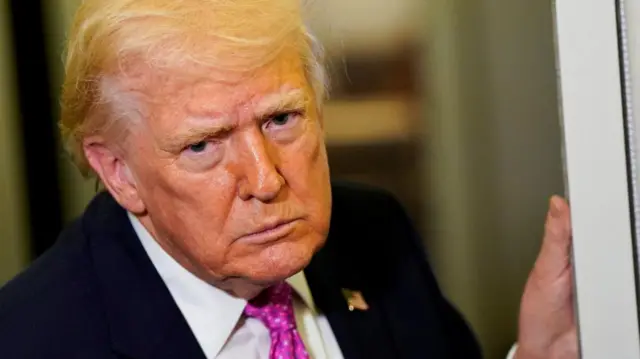
    Donald Trump hand a hand on a door on Air Force OneImage source, Reuters

    Donald Trump has been speaking recently on Air Force One, where he says the US believes it has achieved regime change in Iran, echoing comments made last week on Fox news, where he said, "You could really say we have regime change because they have been killed."

    Speaking to reporters on board the plane, he says: "But we've had regime change if you look already because the one regime was decimated, destroyed, they're all dead. The next regime is mostly dead, and the third regime we're dealing with different people than anybody's dealt with before, it's a whole different group of people, so I would consider that regime change, and frankly they've been very reasonable.

    "So I think we've had regime change, I mean you can't do much better than that.

    "The regime that was really bad, really evil ... the second was appointed, and they're all gone, they're all dead, other than one who may have a little life in him," Trump says, citing the number of Iranian leaders killed in the month-long war.

    He also says he believes Iran is likely to make a deal with the US.

    "I think we'll make a deal with them, pretty sure, but it's possible we won't," he says.

    "You never know with Iran, because we negotiate with them and then we have to blow them up," he adds.

  4. Saudi Arabia says it intercepted multiple missilespublished at 02:18 BST

    Saudi Arabia's ministry of defence says it detected and intercepted five ballistic missiles heading towards its eastern region.

    No further details were provided on whether there was damage or casualties.

    It comes after an Iranian attack on Prince Sultan air base on Friday. Pictures verified by the BBC show a US command and control aircraft were destroyed in that attack.

  5. 'Hands full of blood': Pope Leo seemingly criticises those involved in warpublished at 02:05 BST

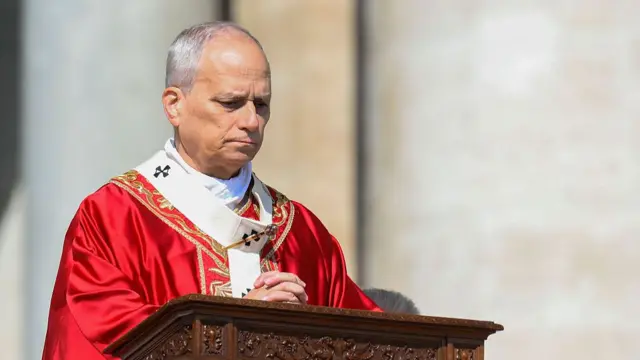
    Pope Leo XIV presides over Palm Sunday Mass at St. Peter's SquareImage source, Vatican Media via Vatican Pool/Getty Images

    As conflict in the Middle East continues, Pope Leo XIV has been addressing people at the Vatican who are celebrating Palm Sunday today.

    The Pope says God rejects the prayers of leaders who start wars and have "hands full of blood", in what has been interpreted as a criticism of those involved in the US-Israeli war with Iran.

    "This is our God: Jesus, king of peace, who rejects war, whom no one can use to justify war,” says the Pope.

    “He does not listen to the prayers of those who wage war, but rejects them.”

    Quoting a passage from the Bible, he says: “‘Even though you make many prayers, I will not listen: your hands are full of blood'."

  6. Trump says US could 'take oil in Iran' and seize Kharg Islandpublished at 01:47 BST
    Breaking

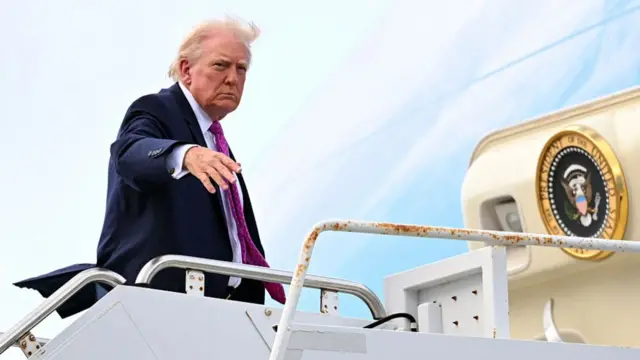
    Donald Trump boards Air Force OneImage source, Getty Images

    Donald Trump has told the Financial Times he could "take the oil in Iran" and possibly seize the country's major fuel hub of Kharg Island.

    "To be honest with you, my favourite thing is to take the oil in Iran but some stupid people back in the US say: ‘Why are you doing that?’ But they’re stupid people,” he said.

    Trump suggested the move could mean taking Kharg Island. “Maybe we take Kharg Island, maybe we don’t. We have a lot of options,” Trump told the FT. “It would also mean we had to be there [in Kharg Island] for a while.”

    When asked about Iranian defence on the island he said: "I don’t think they have any defence. We could take it very easily."

    The president's comments come as a further 3,500 US troops arrived in the Middle East as fears grow that further escalation could expose American forces to Iranian attacks.

    Trump added that indirect talks between US and Iran via Pakistan "emissaries" were progressing well, but declined to comment on whether a ceasefire deal could be reached soon.

    “A deal could be made fairly quickly,” he said.

  7. Netanyahu instructs military to expand 'security zone' in Lebanonpublished at 01:34 BST

    Sebastian Usher
    Middle East analyst

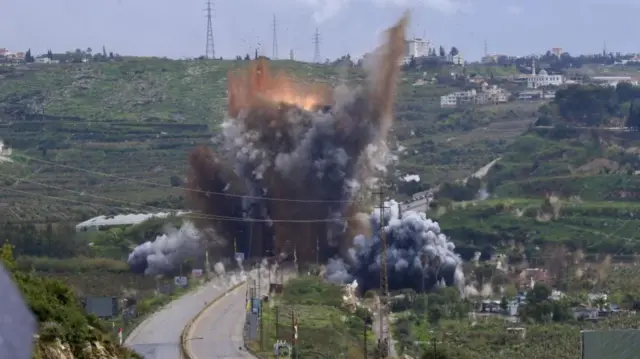
    An explosion is seen on a road running through what appears to be farmlandImage source, EPA
    Image caption,

    Israel blew up five bridges on the Litani River in southern Lebanon earlier this week

    As we reported earlier, the Israeli Prime Minister Benjamin Netanyahu has said he's ordered what he called the "existing security zone" in southern Lebanon to be expanded further.

    During a visit to the headquarters of the Northern Command of the Israel Defense Forces (IDF), Netanyahu said the aim was to "definitively thwart the invasion threat" from Hezbollah and push anti-tank missile fire away from the border.

    He did not give any detail as to whether this extension goes beyond the zone that last week the Israeli Defence Minister Israel Katz said would now stretch up to the Litani river, with no Lebanese residents allowed to stay in their homes until the threat from Hezbollah to northern Israel had been entirely removed.

    Mr Katz' words were the strongest statement so far of the Israeli government's intentions in Lebanon with a move that puts a tenth of the country under Israeli control.

    The extent of the zone and the description of it as a "buffer" are reminders of the Israeli occupation of southern Lebanese territory from 1985 to 2000.

    Clashes are continuing in the area between Israeli forces and Hezbollah fighters, with the IDF saying several members of the group have been killed in recent operations, while another Israeli solder was earlier confirmed to have died - the fifth since Israel launched its latest incursion into Lebanon.

  8. Indian worker killed in Iranian attack on Kuwaitpublished at 01:15 BST

    In Kuwait, a worker from India has been killed in an Iranian attack on a power and desalination plant, Kuwait’s Ministry of Electricity and Water says in a statement on X.

    The attack caused "significant damage" to the facility, the statement says, and technical teams are working "to ensure the continuity of vital services".

  9. Iran and US 'expressed confidence' in Pakistan talkspublished at 00:54 BST 30 March

    Pakistan’s foreign minister looks up as he attends a ceremony. He is wearing a suit and tieImage source, Getty Images

    Pakistan’s foreign minister says both Iran and the US have "expressed confidence in Pakistan to facilitate" talks.

    He says Pakistan "will be honoured to host and facilitate meaningful talks between the two sides in the coming days".

    However, there was no mention about whether Iran or the US had confirmed they would take part in peace talks.

    Foreign minister Ishaq Dar made these comments following the first day of meetings in Islamabad between foreign ministers from Pakistan, Saudi Arabia, Turkey and Egypt.

    According to Dar, the group discussed possible ways to bring an early and permanent end to the war in the region. He expressed his profound gratitude to all three for their support to Pakistan’s efforts for peace in the region.

    Dar also says he had spoken to the Chinese Foreign Minister Wang Yi and the Secretary General of the United Nations, both of whom expressed support for the peace initiative.

    After a meeting earlier today between Pakistan’s prime minister and Saudi Arabia’s foreign minister, Pakistan released a separate statement saying Pakistan would "always stand shoulder to shoulder" with Saudi Arabia and that Pakistan appreciated the "remarkable restraint" exercised by the country.

  10. Shipping had only recently returned to Red Sea route before Houthi threatspublished at 00:29 BST 30 March

    Jonathan Josephs
    BBC business reporter

    The route through the Red Sea and Suez Canal that is being threatened by Yemen-based Houthis isn’t as important as it once was to global shipping.

    It significantly reduces the cost and time for moving goods between where they are made in Asia and where they are sold in Europe.

    Before December 2023 it carried approximately 12% of global trade, but then the major shipping companies stopped using it because of Houthi attacks linked to the Hamas-Israel conflict.

    They had just started experimenting with using it again when the Iran war broke out, and swiftly abandoned it again.

    It means the likes of Maersk and Hapag-Lloyd are sticking to the longer, safer route around the southern tip of Africa.

    Those extra costs are ultimately being passed on to consumers, and the longer this conflict carries on, the more that bill will come to.

    Whilst some ships, particularly those of smaller companies, may continue to try and navigate the Red Sea route, as Maersk’s CEO Vincent Clerc told me recently: “It's very hard for us to put our colleagues and our ships in harm's way and risk having an attack be successful and create damage or loss of life in the process”.

  11. Iran threatens to target homes of US and Israeli officials in the regionpublished at 00:29 BST 30 March

    Ghoncheh Habibiazad
    Senior reporter, BBC Persian

    Ebrahim Zolfaghari, the spokesperson for Iran's Khatam al-Anbiya Central Headquarters - the country's highest operational command unit coordinating the armed forces - has threatened that the armed forces will target the houses of US and Israeli “commanders and political officials in the region".

    He says it is a “retaliatory measure” after accusing the US and Israel of “targeting residential homes of Iranian civilians in various cities”.

    Several Iranian military commanders and officials have been killed during the war, including Iran's late Supreme Leader Ayatollah Ali Khamenei who was killed on the first day of the war on 28 February.

  12. Oil prices rise as strikes continue in Middle Eastpublished at 00:29 BST 30 March

    Oil prices rose to over $115 when markets open in Asia on Monday, just over a month into the war.

    The price of Brent crude is $115.84, a 2.9% increase. Oil was trading at around $72 a barrel before 28 February, when the US and Israeli strikes on Iran began.

    Last week it peaked at $118 a barrel on 19 March and as of Friday afternoon was sitting at just below $112 - significantly up from its pre-war price.

    Here is what else has happened recently as our live coverage continues:

    • Ebrahim Zolfaghari, the spokesperson for Iran's Khatam al-Anbiya Central Headquarters - the country's highest operational command unit coordinating the armed forces - has threatened that the armed forces will target the houses of US and Israeli “commanders and political officials in the region"
    • Iranian Parliament Speaker Mohammad Bagher Ghalibaf earlier said that Tehran was "waiting for American soldiers to enter on the ground so they can rain fire upon them"
    • The Israel Defense Forces (IDF) says it is striking targets across Iran's capital, Tehran, not long after heavy explosions were reported in the city
    • Iran’s Ministry of Energy says attacks on the country's "electricity infrastructure" caused power cuts in parts of the Tehran and Albroz provinces, but power seems to have been restored in most areas
    • In southern Israel, firefighters have now contained a large blaze in the Neot Hovav industrial zone, where a "hazardous materials incident" was declared earlier. The IDF say it may have been caused by missile shrapnel
    • Despite the steady attacks exchanged, Iran and US have "expressed confidence" in peace talks, says Pakistan's foreign minister
    • Meanwhile in Lebanon, a Beirut-based American university is operating virtually after Iran's Islamic Revolutionary Guard Corps (IRGC) threatened to target US and Israeli universities. It comes after two Iranian universities were struck in US-Israeli strikes on Saturday - the one in Isfahan was struck again on Sunday
    • Lebanon has also seen the funerals of three Lebanese journalists killed in a targeted Israeli air strike - hundreds have gathered to mourn their deaths
    • Attacks have been reported across the Gulf - including Kuwait, where 10 army personnel were injured as a result. In Saudi Arabia, photos appear to show a heavily damaged US military jet at an American air base