Summary

Are you affected?

  1. Why Indian pilgrims were travelling through flood-hit Nepalpublished at 06:01 BST

    Nikita Yadav
    BBC News, Delhi
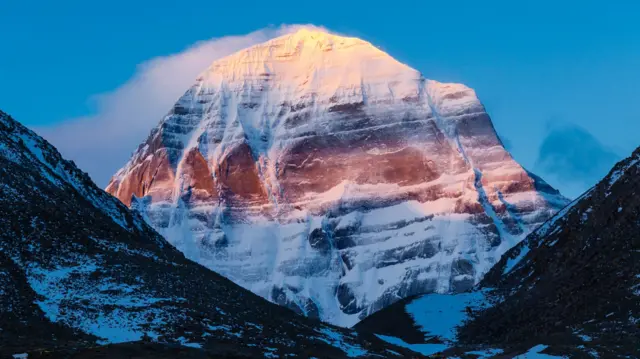
    ibet. Mount Kailash. North faceImage source, Getty Images

    At least 133 Indians are among those reported missing after deadly flash floods in Nepal.

    Many of them were travelling to or from Mount Kailash - a peak in the Himalayas near the border between Nepal and Tibet - which is considered the spiritual home of the Hindu god Shiva.

    The journey to the mountain is part of the Kailash Mansarovar Yatra, a sacred pilgrimage for Hindus. Some people travel through an official programme run by India’s foreign ministry, while others make the journey through Nepal with private tour operators.

    The pilgrimage had only recently resumed after being disrupted first by the pandemic and then by tensions between India and China.
  2. Rescue efforts complicated by rain and geography, Chinese authorities saypublished at 05:42 BST

    Rescue operations have grown increasingly difficult on the Tibet side because of uncertain weather conditions and the remote geography of the area, Chinese authorities say.

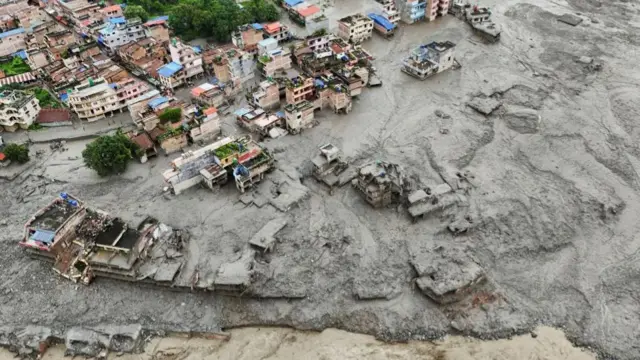
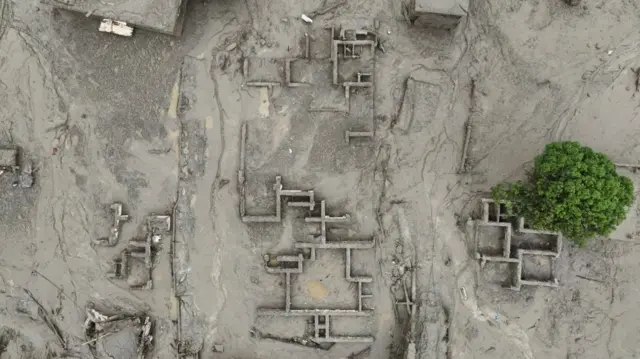
    The mudslide that struck Tibet's Gyirong county is nearly 1.5m in depth, and the edge of it stretches 2.5km from the border crossing, which "significantly hinders subsequent rescue efforts", state broadcaster CCTV report authorities saying.

    "The area is characterised by high mountains and deep valleys with concentrated water catchment areas, so [ongoing] rainfall would bring considerable uncertainty," the report said.

    Meteorological authorities expect rain to continue over the next three days along the route between Gyirong Port and Dingri Airport which would complicate rescue efforts.

    It has also been challenging to deploy large vehicles and heavy equipment through narrow mountain roads, authorities say.

  3. USGS says 'glacial collapse' caused 'catastrophic impacts downstream'published at 05:27 BST

    The US Geological Survey has confirmed that what it had initially reported as an earthquake "was instead a glacial collapse and debris flow" that "caused subsequent catastrophic impacts downstream".

    It had first reported the event as a magnitude 4.4 earthquake on Wednesday.

    "Additional analysis of nearby seismic stations, long period seismic waves, and satellite imagery led to the determination that the seismic event was instead a glacial collapse and debris flow, and that no earthquake had occurred," the USGS said on Thursday morning.

    Earlier Nepali authorities had also told the BBC that a massive chunk of ice may have collapsed from a mountain, pulling down rocks and other sediments with it.

    Meanwhile, scientists are still working through the exact sequence of events that could have unleashed such a disaster.

  4. Debris in river could cause further flash flooding, report sayspublished at 05:06 BST

    The International Centre for Integrated Mountain Development (ICIMOD) has released a detailed assessment of what happened on Wednesday, when a major flash food caused devastation in Nepal and Tibet.

    In it, experts warn of a secondary potential flooding event, as a result of the debris that washed into the river systems.

    The experts cited in the report say they are in the process of assessing whether the Trishuli River has been temporarily blocked in narrow sections. If it has been blocked, it is at risk of forming a landslide dam - and a second flooding event.

    Authorities and scientists are continuing to evaluate the size, location and stability of any potential blockages.

  5. Nepali army deploys 2,000 troops for search and rescuepublished at 04:41 BST

    Phanindra Dahal
    BBC Nepali, Kathmandu

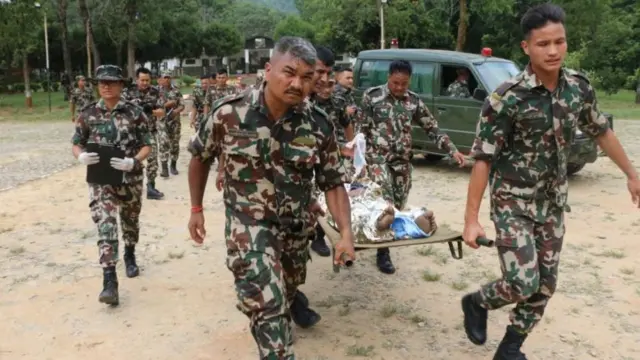
    The Nepali army has deployed 2,000 military personnel for land and aerial search and rescue operations in flood affected areas.

    The troops are concentrated in the worst-hit areas, including the Rasuwa and Nuwakot districts, army spokesman Brigadier General Rajaram Basnet told the BBC.

    The military has thus far managed to rescue 97 people trapped in floods, he said, noting that three of them were workers stranded in the tunnel of Trishuli A hydropower project.

    Nepal's police and the armed police force have also deployed officials to help with search operations.

  6. In pictures: Aerial pictures show scale of destructionpublished at 04:22 BST

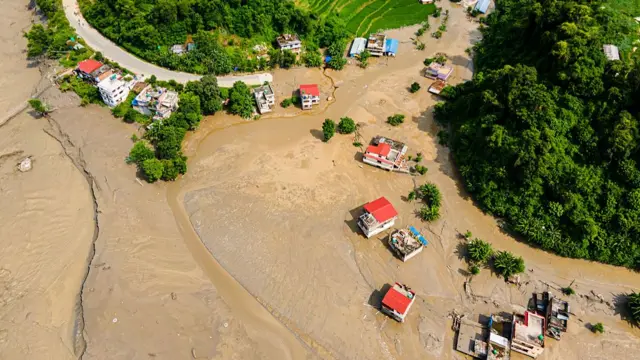
    New photographs have emerged showing the scale of destruction of yesterday's massive floods and landslides.

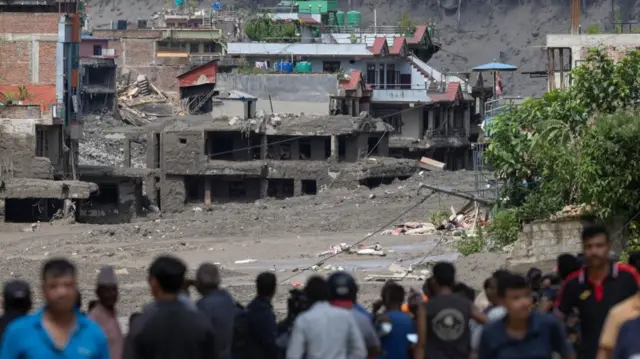
    Mud covering properties following a flash flood in Trishuli, NuwakotImage source, Reuters
    Image caption,

    Mud covering properties following a flash flood in Trishuli

    A drone view shows mud covering buildings following a flash flood in TrishuliImage source, Reuters
    Image caption,

    An aerial view of buildings in Trishuli partially submerged by mud

    Nepali army officers conducting a helicopter rescue of survivorsImage source, EPA
    Image caption,

    Nepali army officers rescuing flood survivors

    In Tibet, China has ordered "all-out" rescue and relief effortsImage source, Xinhua
    Image caption,

    In Tibet, China has ordered "all-out" rescue and relief efforts

  7. Number missing on Tibetan side of shared border rises to 558published at 03:49 BST

    The number of people missing in the mudslide disaster in Tibet's Gyirong county has risen to 558, China's state broadcaster CCTV said this morning.

    Among these are 260 foreign nationals, CCTV said, adding that the death toll remained at three.

    The border at Gyirong is the main crossing point for tourists and traffic between China and Nepal.

    On Wednesday, state media had reported "major casualties" shortly after the mudslide broke out on the shared border.

    Nepal had earlier said that some 579 tourists were missing, with 466 foreigners among them. It is not immediately clear if any of the numbers have been counted twice.

  8. One tour group counts 47 missingpublished at 03:31 BST

    Simon Atkinson
    Australia reporter

    I have been in touch via WhatsApp with one of the tour companies whose guests and staff have been impacted by the flash floods in Nepal.

    Sanket Pandey, Managing Director for Himalayan Glacier US tells me: “We have a group of 47 total, including our guides that are missing and out of contact since the event.”

    He says they include 15 Australians, 10 Canadians, nine people from Nepal, eight from the US, two from Singapore, two from the UK and one a dual US-Russian citizen. Seven of the missing Nepalese people are guides, and two are clients.

    Australian media are reporting two of the Australian nationals were boys aged 14 and 11 – though the BBC has not yet confirmed this.

    Pandey says the group were Kailash Yatries – people making a sacred pilgrimage to Mount Kailash and the nearby Lake Manasarovar located in the remote high-altitude region of Tibet, China.

    The company says the group was due to cross into Tibet on Wednesday. Most of the group were staying at Hotel Kailash around 1.5km south on the Nepali side of the Rasuwa Gadhi border crossing, though nine were on the road from Syaburbensi – around 15km south - when contact was lost.

  9. Death toll rises to 162published at 03:14 BST
    Breaking

    The death toll has risen to 162, according to Nepali police. Among those killed, 64 were found in downstream areas in the Chitwan district while another 26 were found in Nawalparasi East, police said in a statement this morning.

    Twenty-eight police officers are among the hundreds still unaccounted for, it added.

    Chitwan, a tourism hotspot known for its jungle safaris, is one of several municipalities that have been placed on high alert as floodwaters rise.

  10. US pledges $500,000 in aid for Nepalpublished at 02:55 BST

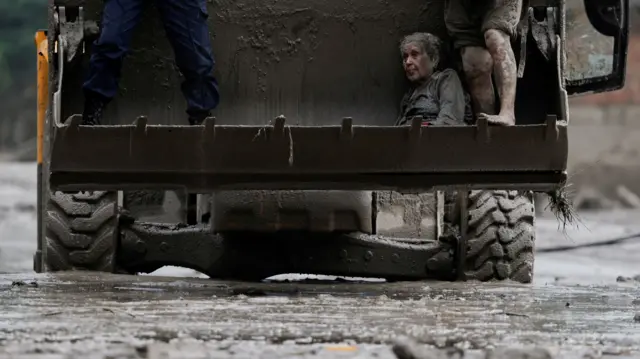
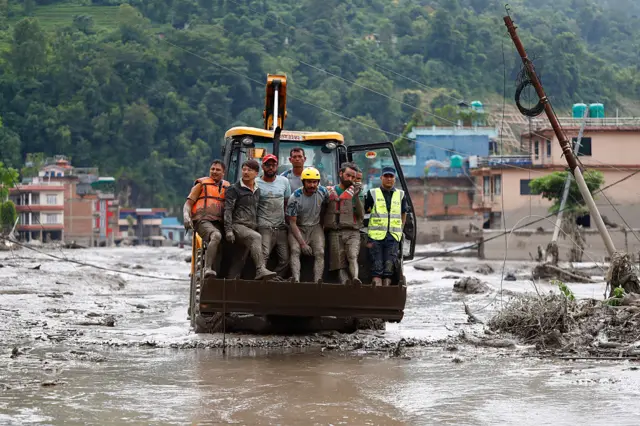
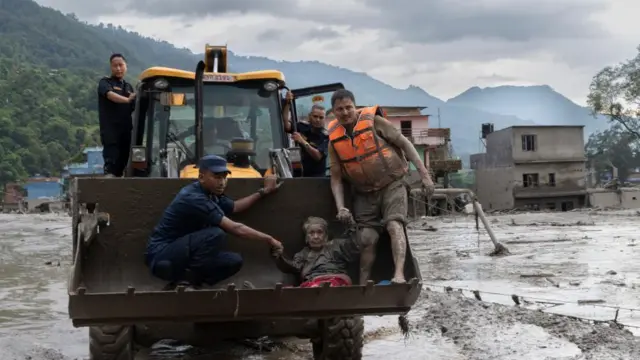
    Elderly woman covered in mud, evacuated from the site of massive mudslide in Nepal on board an excavatorImage source, Reuters

    The US has promised $500,000 in aid which will be used to cover emergency shelter, water, sanitation and other relief items for communities affected by the floods.

    "The United States extends its deepest condolences to the families and loved ones of those who lost their lives in the devastating flash floods in the Rasuwa district of Nepal," the State Department says in a statement.

    "Our thoughts are with all those affected by this disaster," it adds.

    At least 54 Americans, most of them tourists, have been reported to be among the hundreds of people missing following the catastrophic floods and mudslides.

  11. Here's the latest on the deadly Nepal floodspublished at 02:27 BST

    People watch as floodwaters sweep through Trishuli Bazar following a flash flood, in Nuwakot district, NepalImage source, EPA

    It's been nearly 24 hours since massive flash floods and landslides wiped away entire villages in Nepal near its border with Tibet. At least 157 people have been killed and hundreds more are missing, many of them foreign tourists, authorities say.

    Here's the latest on the disaster:

    • The eventual death toll is expected to be much higher as search and rescue efforts are underway. At least 403 people are thought to be missing, including 341 foreign nationals, many from India
    • Aerial images show widespread damage to homes, roads and bridges in the Bhotekoshi River in Nepal's Rasuwa region
    • The entire nation is "shocked and deeply distressed", says Nepal's Prime Minister Balendra Shah. Some survivors have recalled witnessing their family being swept away
    • Approximately eight tonnes of relief supplies have been dispatched to areas affected by the flash floods. The US, China, the EU and India are among the countries that have pledged assistance or dispatched supplies
    • Authorities initially believed an earthquake triggered the flash flooding, the United States Geological Survey's latest analysis suggests there was no quake and that "glacial collapse and debris flow" was what caused the seismic activity
    • Experts are now trying to piece together the order of events. Climate change is known to be driving faster glacier melt in parts of the Himalayas, but scientists say it is too soon to pinpoint its role in this event

  12. 'My wife is still somewhere beneath the mud'published at 02:05 BST

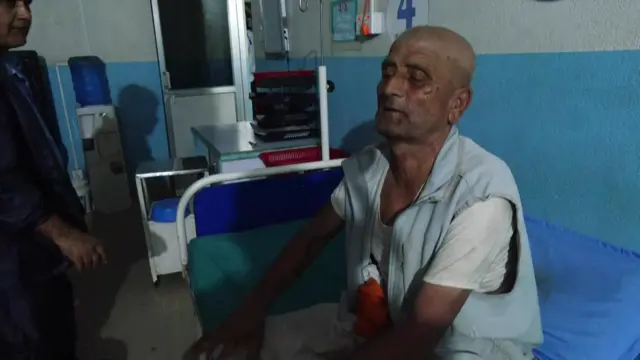
    Keshav Prasad Baral sits on a blue hospital bed. His eyes are closed and his head is shaved.Image source, Reuters

    Keshav Prasad Baral says the flood at the Nepal-Tibet border looked like a "huge gush of mud coming straight towards us".

    Speaking to Reuters news agency while being treated at a small hospital, the 68-year-old says the water rose "higher and higher" before it entered his home.

    He adds that he tried to grab his wife's hand but she was "swept away", adding that the mud reached the top floor of his home before subsiding about an hour later.

    "Four or five hours later, a helicopter came to rescue me. My wife is still somewhere beneath the mud. She's gone," he says.

  13. PM Anthony Albanese confirms 34 Australians among the missingpublished at 01:28 BST

    Simon Atkinson
    Australia reporter

    We’re getting more updates from governments in the Asia Pacific region on the situation in Nepal.

    Australian Prime Minister Anthony Albanese has confirmed that 34 Australian citizens are among the missing. The country’s foreign minister Penny Wong is due to give a press conference a little later.

    Meanwhile New Zealand’s Ministry of Foreign Affairs and Trade has said that it is aware of “a small number“ of Kiwis who are in the region and that it is in touch with their families.

    But it stresses it has no “official or verified information” on who had been affected at this stage.

    “New Zealand’s High Commission in India is also urgently seeking information from Nepalese authorities,” it added.

  14. Emergency supplies sent to disaster sitepublished at 01:15 BST

    Approximately eight tonnes of relief materials have been dispatched to areas affected by the flash flooding in the Bhotekoshi River in Nepal's Rasuwa region, Prime Minister Balendra Shah's office has said.

    The secretariat says the materials were sent via eight Nepal army trucks on Wednesday evening, which among other items include 500 mosquito nets, 500 blankets, 500 solar lights, 500 solar panels and 220 sleeping bags.

  15. What caused the flash flooding?published at 01:04 BST

    Men covered in mud ride an excavator throught the site of a massive landslide on the Tibet-Nepal borderImage source, Getty Images

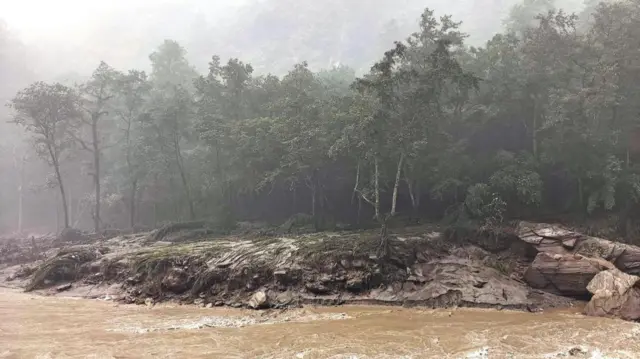
    Nepalese authorities initially believed that an earthquake had caused the flash flooding on the Nepal-Tibet border, but authorities have since confirmed that it was actually triggered by a landslide.

    "Additional analysis of long period seismic waves indicate that the seismic energy was instead generated by a landslide," says the US Geological Survey.

    Officials with Nepal's department of meteorology and hydrology have told the BBC that a massive chunk of ice may have collapsed from a mountain, pulling down rocks and other sediments with it.

    While climate change is known to be contributing to glacial melt in the region, scientists say it's still too early to know if it played a role in this specific event.

    Other factors being considered include whether any glacial lakes suddenly drained or whether the river became blocked - as well as data on recent rainfall.

  16. Aerial images show flood-damaged areas in Nepalpublished at 00:40 BST 27 August

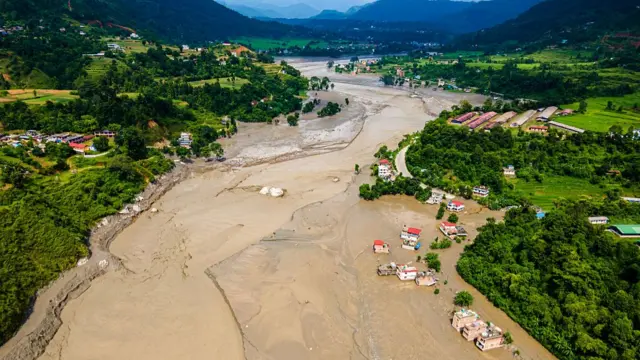
    These pictures show the extent of flood-damage in the Nuwakot area of Nepal, after a flash flood swept through the Bhotekoshi River.

    There is widespread damage to infrastructure in the area, including to homes, roads and bridges.

    It's currently 05:00 in Nepal, so we can expect new images in the next few hours.

    Aerial view shows flood-damaged areas after a flash flood swept through the Bhotekoshi River in Nuwakot, Nepal.Image source, Getty Images
    Aerial view shows flood-damaged areas after a flash flood swept through the Bhotekoshi River in Nuwakot, NepalImage source, Getty Images
  17. UN mobilising support in response to floodingpublished at 00:13 BST 27 August

    Guterres speaking into a microphone at an event.Image source, AFP via Getty Images

    UN Secretary General António Guterres says he is "saddened by the severe flooding" that has "claimed many lives, left people missing, and caused widespread destruction" in Nepal and China.

    He offers his condolences to the victims' families and sends his well wishes to those who were injured.

    "My solidarity is with all those affected," he says, adding that UN teams and partners are mobilising supplies and personnel in Nepal to support the government-led response.

  18. Watch: BBC visits hospital in Kathmandu as families wait for newspublished at 23:32 BST 26 August

    The disaster continues to unfold as the loved ones of those who remain missing search for them.

    The BBC Nepali's Shreejana Shrestha visited a hospital in Kathmandu, where some survivors were being flown in by helicopter for treatment.

    Families were gathered outside the hospital with the hope of finding their loved ones.

    Ram Kumari Shrestha said she is searching for her husband, who was off to Rasuwa as part of his driving job. She said she has not heard from him since a night earlier.

    The missing include more than 100 from India, 54 from the US, and 33 from the UK, as well as more than 100 from Nepal itself, according to Nepal's tourist board.

    Media caption,

    BBC visits hospital in Kathmandu as families wait for news

  19. Fifty-three Ukrainians among those missing, Ukrainian foreign ministry reportspublished at 23:04 BST 26 August

    Ukraine's foreign ministry has told BBC News Ukraine that 53 Ukrainian citizens are currently missing as a result of the flash floods at the Nepal-Tibet border, citing information from Nepalese authorities.

    The ministry adds that there is no information indicating the Ukrainian citizens are among the dead or injured, and it has been receiving messages from relatives of the missing.

  20. Recap: More than 150 dead and hundreds missing after flash floods hit Nepal-Tibet borderpublished at 22:39 BST 26 August

    Katie Williams
    Live reporter

    Rescuers transport an elderly woman in Trishuli Bazar, Nuwakot district, NepalImage source, EPA
    Image caption,

    Rescuers transport an elderly woman in Trishuli Bazar, in the Nuwakot district of Nepal

    More than 150 people are dead after a flash flood hit the Nepal-Tibet border earlier on Wednesday, affecting an area popular with pilgrims and trekkers. Here's the latest:

    Over 500 tourists are missing in Nepal, including more than 100 from India, 54 from the US, 33 from the UK, and more than 100 from Nepal itself.

    In Tibet, at least three people have been killed and 265 are missing, according to Chinese state media.

    Authorities initially thought an earthquake caused the flooding, but it is now believed that a landslide triggered the seismic activity.

    The entire nation is "shocked and deeply distressed", says Nepal's Prime Minister Balendra Shah. One trekking guide in Nepal's Rasuwa region tells the BBC he is praying his missing sister will be found alive.

    Dramatic video footage shows thick brown water surging through the landscape, splitting bridges in two and leaving destruction in its wake.

    At the Gyirong border crossing, CCTV footage shows people running for their lives before a wall of water slams into the building.

    The number of casualties could continue to climb over the coming days, as the true scale of the disaster emerges.