Strikes in Beirut leave major destructionpublished at 21:24 BST
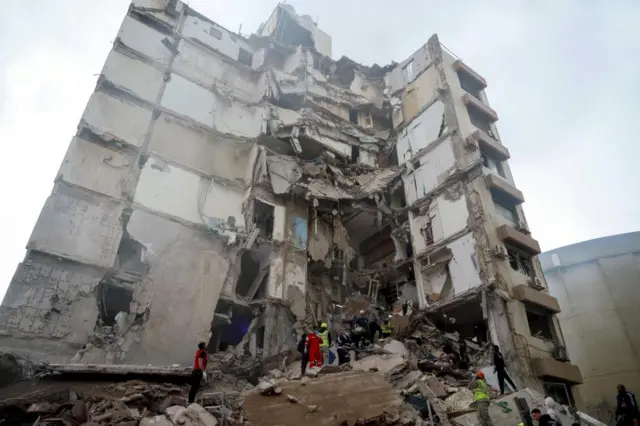 Image source, Reuters
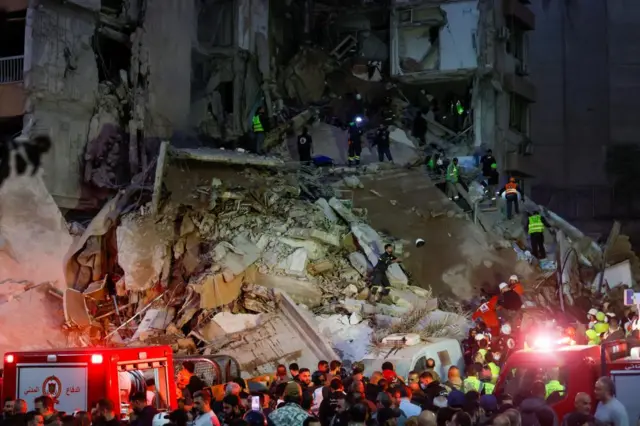 Image source, EPA
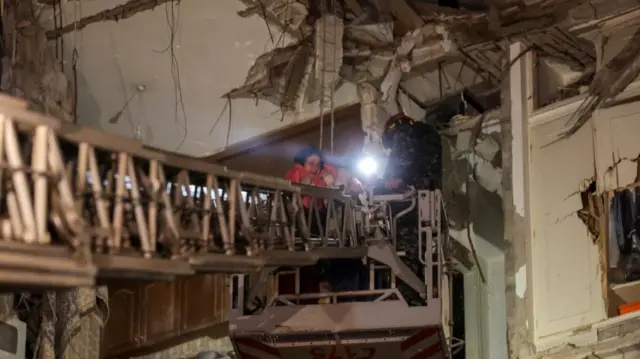 Image source, Reuters
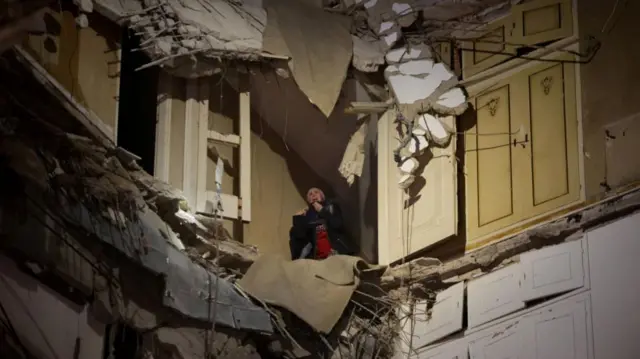 Image source, Reuters
The Iranian Revolutionary Guard Corps (IRGC) says it will deliver a "regret-inducing response" if Israeli strikes on Lebanon don't stop immediately, state media reports
Israel and the US say Lebanon is not included in a two-week ceasefire deal with Iran. PM Benjamin Netanyahu says today Israel delivered "the greatest blow" to Hezbollah since the start of its ground operation in Lebanon
White House Press Secretary Karoline Leavitt says Vice-President JD Vance will lead a US negotiating team at peace talks in Pakistan on Saturday - here's what we know about the truce
Iran warns ships passing through the Strait of Hormuz without permission will be "targeted and destroyed", adding the route "remains closed" - Leavitt says Trump wants the strait to reopen "without any limitations"
Since the ceasefire was announced there have been reports of attacks continuing in the UAE, Kuwait, and at an oil refinery in southern Iran
Mohammad Bagher Ghalibaf, the speaker of the Iranian Parliament, says that three ceasefire clauses have already been "openly and clearly violated"
Image source, ReutersImage source, EPAImage source, ReutersImage source, ReutersEarlier, Iranian Parliament Speaker Mohammad Bagher Ghalibaf said on his X account that three clauses of Iran’s 10-point proposal have been "openly and clearly violated" - including a proposed ceasefire in Lebanon.
Vance says he's seen the post and takes it as a positive. If there are only three points of contention, that signals broad agreement, the vice-president says.
But he does write off some of Ghalibaf's points.
"I actually wonder how good he is at understanding English," he says. "Because there are things that he said that frankly didn't make sense in the context of the negotiations that we've had."
He went on to call the Lebanon question a "reasonable misunderstanding".
"Ceasefires are always messy," he says, adding that they never go off without some "choppiness".
The US never promised to include Lebanon in the ceasefire, Vance says, even though the Iranians may have been under that impression.
If Iranians want negotiations to fall apart over Lebanon, "it's their choice", he says, adding that the thinks it would be "dumb".
Vance also takes a question on the Strait of Hormuz, saying there are signs that it is starting to reopen.
Iranian officials have contradicted that, saying the strait remains closed.
Earlier, the country warned ships passing through Strait of Hormuz without permission will be "targeted and destroyed".
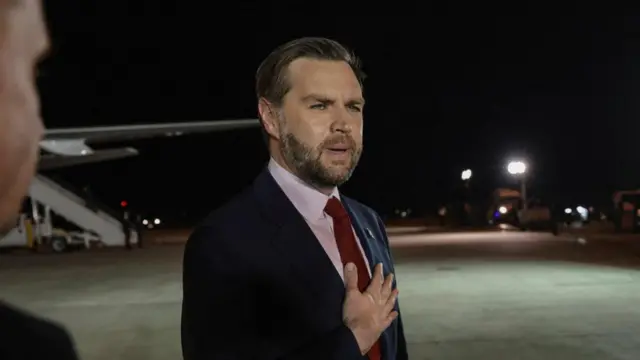 Image source, Reuters
We're now hearing from US Vice President JD Vance, who is speaking to reporters in Hungary before boarding Air Force Two.
"What's happening on the ground in Iran is that you have, clearly, the position of the government to negotiate with the United States of America," he says.
He also says Trump wants to send his negotiating team to Pakistan for talks, too, for "good faith negotiations".
Vance then says: "You have some crazy people at the fringes who are leaking anonymously, either for propaganda purposes, or because they're embarrassed, or because they don't like what happened."
He also claims that the US achieved military objectives in Iran.
 Joel Gunter
Reporting from Jerusalem
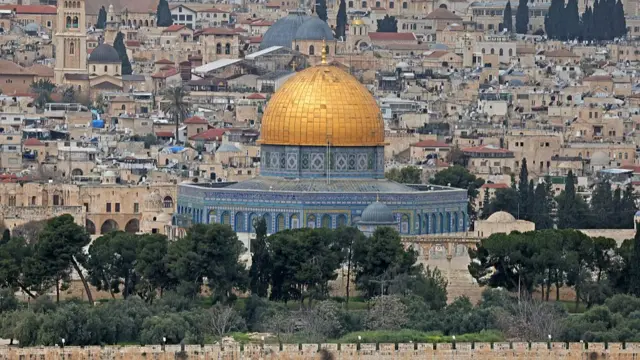 Image source, Getty Images
Israeli police have just announced that Jerusalem's holy sites will reopen to visitors and worshippers following the temporary ceasefire arrangement reached in the Middle East conflict.
The sites, including the Al-Aqsa mosque compound, Western Wall, and Church of the Holy Sepulchre, all with the Old City, are among the holiest in the world in Islam, Judaism and Christianity.
Because of the war on Iran launched by the US and Israel six weeks ago, the sites have been closed through key religious holidays, including over Easter and parts of Passover, with only very limited numbers of clergy admitted.
The Old City, whose alleys are typically bustling with activity from residents, market-goers, tourists and worshippers, has been extremely quiet, with many shop and stall owners not opening at all.
The police said that the holy sites would reopen from Thursday morning, with hundreds of additional officers deployed to ensure safety, and the public is encouraged to be patient if there is congestion.
Iranian Parliament Speaker Mohammad Bagher Ghalibaf has said on his account on X that three clauses of Iran’s 10-point proposal have been "openly and clearly violated" and in such situation a "bilateral ceasefire or negotiations" is "unreasonable".
Ghalibaf has mentioned that Lebanon ceasefire was included in the proposal, something that White House has rejected today.
He also mentions a drone entering Iran’s southern Fars province. The IDF (Israel Defense Forces) had told the BBC that they were "not aware" of such an incident.
On the third one, he has said that Iran's right to enrichment was included in the proposal, something that was included in the Persian statement of Iran's Supreme National Security Council (SNSC), read aloud last night by the presenter on state TV.
The US and Israel's war in Iran started on 28 February, two days after the latest round of negotiations over Iran’s nuclear programme.
Some unconfirmed reports had suggested that Trump administration was considering Ghalibaf as a potential partner and possibly even a future leader of Iran.
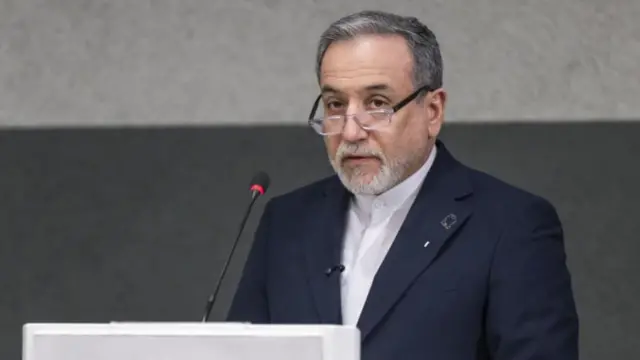 Image source, MARTIAL TREZZINI/EPA/Shutterstock
The US must choose between a ceasefire or a continued war "via Israel", says Iran's foreign minister following today's series of strikes across Lebanon.
In an X post, Seyed Abbas Araghchi says the terms outlined in the two-week ceasefire between the US and Iran are "clear and explicit".
The Iranian foreign minister attaches the announcement of the ceasefire by Pakistani Prime Minister Shehbaz Sharif, highlighting how Sharif said the agreement would include Lebanon.
"The U.S. must choose—ceasefire or continued war via Israel. It cannot have both," says Araghchi, adding that "the world sees the massacres in Lebanon".
He adds: "The ball is in the US court, and the world is watching whether it will act on its commitments."
 Hugo Bachega
Middle East correspondent reporting from Lebanon
One of the remaining questions is: will the war between Israel and Hezbollah derail the ceasefire?
Israel says its war in Lebanon is not over yet and Hezbollah, which has not fired against Israel since the ceasefire was announced, is now saying it has the right to respond.
Today saw the heaviest bombardment of Lebanon by Israel in this conflict. From the south, to the east and Beirut, for 10 minutes, the country was under heavy attack. The health ministry says at least 112 people have been killed and more than 800 wounded.
At the site of the largest air strike on Beirut, hours later, emergency workers were still searching the damaged buildings. Found amid the rubble, glimpses of interrupted lives: pictures of smiling families, pieces of clothing, school homework that was left unfinished. It was still difficult to believe the scale of the destruction in an area so close to the centre of capital.
Abdelkader Mahfouz came to visit his brother who had been injured in the attack. “There was a lot of body parts here. Only people are getting harmed. What should the people do. We can’t do anything. I wish I was a bomb so that I can blow up whoever is responsible for this. The enemy doesn’t have mercy.”
Many in Lebanon are angry with Hezbollah, saying it has dragged the country into an unwanted war. But they also blame Israel for bringing so much destruction to this country.
 Bernd Debusmann Jr
reporting from the White House
As of now, there is little expectation that we will see Donald Trump on-camera today. All his events are currently marked as "closed press", meaning that reporters have no access.
Among those events is a meeting at 15:30 (2030BST) this afternoon with Mark Rutte, the secretary-general of Nato.
The meeting between the two men - their eighth - comes at a difficult time in relations between the alliance and its largest member.
Trump has repeatedly criticised the alliance, referring to it as a "paper tiger" that has failed to come to America's aid during the conflict with Iran.
"They haven't been our friends when we needed them," Trump recently told Reuters.
Those tensions, however, stretch back to before Operation Epic Fury began, and were intensified by disagreements over the fate of Greenland, a Danish territory that Trump has set his sights upon despite vocal protests from European allies.
Rutte, whom Trump is known to be personally fond of, will be hoping that today's meeting can help smooth over those tensions, at least temporarily.
Joel Gunter
Reporting from Jerusalem
Israeli Prime Minister Benjamin Netanyahu has just given a public address from Jerusalem in which he denied reports that Israel had been sidelined in the ceasefire arrangement between the US and Iran.
In the message, Netanyahu says that he and President Trump “talk every day” and that Trump had recently told him “you are great."
The Israeli prime minister has been careful not to deviate publicly from President Trump, and in the hours after the ceasefire announcement this morning he published a — somewhat muted — message supporting the US president on the temporary deal.
But it is likely that this is a deal Netanyahu did not want. He is in an election year, and there is a sense here that he is not able to articulate a coherent success story around this war.
His stated aims — of regime change, and of removing Iran’s ability to fire ballistic missiles and drones into Israel — have clearly not been achieved.
In a notable shift in language, during his address, Netanyahu said that Israel had “set back” the Iranian regime “by many years”, when just days ago he was claiming to have “pulverised” Iran and “removed” the perceived existential threat to Israel for good.
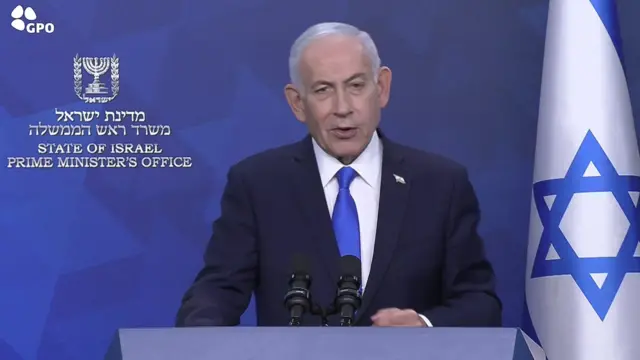 Image source, Israel Prime Minister's Office
A few minutes ago we heard from Israeli Prime Minister Benjamin Netanyahu, who made a statement in Hebrew.
Here's a summary of what we heard:
Bernd Debusmann Jr
Reporting from the White House
We are hearing very different things from the White House and from the Iranian side about the latest developments.
For one, Leavitt just made clear that from Trump's perspective, Lebanon is not included in the ceasefire - a fact she said has been "conveyed to all sides" of the conflict.
That stands in stark contrast to what we heard from the Iranian Revolutionary Guard Corps earlier when they promised a "regret-inducing response" if strikes in Lebanon continue.
Notably, that IRGC warning was delivered both to the "oath-breaking" US and to Israel.
Similarly, the current status of Iran's security posture in the Strait of Hormuz remains unclear. Leavitt herself said that "what they're saying publicly is different privately."
The most significant unanswerered question is how Iran's highly-enriched uranium - which Leavitt referred to as Trump's "red line" - will be handled, even though she said that Iran has signalled a willingness to hand the material over.
Leavitt is asked if Trump is considering withdrawing the US from the Nato alliance.
"Its something the president has discussed, and I think its something the president will be discussing in a couple of hours with Secretary General Rutte," she says.
"And perhaps you'll hear directly from the president following that meeting later this afternoon."
Asked whether "regime change" will lead to greater freedom for the Iranian people, Leavitt says it's a "little too early" to answer that question.
"We hope that's the case but it's something that is yet to be seen," she says.
Next is a question about whether it is acceptable for Iran to charge a toll for ships to pass through the Strait of Hormuz.
Leavitt refers to Trump's comment overnight in which he called for the immediate reopening of the strait, which she clarified meant "without limitation, including tolls".
Trump's threat that "a whole civilisation will die" unless a deal was agreed has repeatedly come up during this news conference.
Leavitt says Trump's message was a "strong threat" but "not an empty threat" against Iran - and ultimately it led Iranian leaders to agree to a deal.
She is then asked about Nato's role in the conflict.
"Nato was tested and they failed," Leavitt says, directly quoting President Trump.
She adds that it's "sad that Nato has turned their backs on the American people, when it's the American people who've been funding their defence".
She says that Trump and Nato Secretary General Rutte are holding a meeting at the White House later today, and Trump will have "a frank and candid conversation with him in regards to this".
Leavitt is asked about reports Iran's air defences have been activated and if bombing has continued.
She says she has not seen the reports and needs to check, calling it "a fragile" situation.
The White House secretary says communications are "difficult" in Iran right now, and asks for some patience in looking into these reports.
Leavitt says that Trump is considering an outcome under which the US earns revenue from ships passing through the Strait of Hormuz.
"It's something the president has floated," she says, adding that it is something negotiators will discuss in Islamabad.
She says Trump's immediate priority is to open the strait without limitations.
That, and Trump's demand that Iran turn over its enriched uranium, are "on the top of the priority list" for negotiators.
Leavitt is asked about Vice President JD Vance and China's role in the ceasefire between the US and Iran.
Vance's role is "very significant", Leavitt says, adding that he has been involved in all discussions and will be going to Islamabad for negotiations.
China has also been in touch with the US government, and Trump has great respect for Chinese President Xi Jinping, she says.
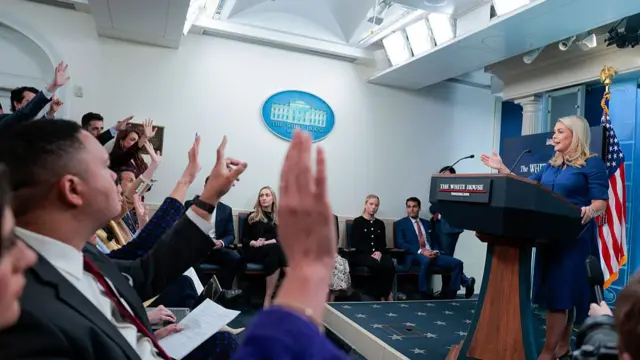 Image source, Getty Images
Leavitt is asked about how Trump can claim the moral highground after threatening to destroy the Iranian "civilisation" on social media before the ceasefire was agreed.
Leavitt replies that Iran has been a "rogue regime" that has been chanting "death to America" for decades.
"The president absolutely has the moral high ground," she says, adding that to suggest otherwise is "insulting".
Trump said hours before the ceasefire was agreed that "a whole civilisation will die tonight" unless Iran agreed to a deal.
The president is sending his negotiating team to Islamabad, Pakistan, says Leavitt.
The team will consist of Vice-President JD Vance, Trump adviser Steve Witkoff, and Trump's son-in-law Jared Kushner.
The talks will begin on Saturday morning local time, she says, adding: "We look forward to those in-person meetings."
