Summary

  1. ICRC warns against threats of 'indiscriminate warfare'published at 05:38 BST

    Imogen Foulkes
    Reporting from Geneva

    The International Committee of the Red Cross, the guardian of the Geneva Conventions, has warned against "deliberate threats, whether in rhetoric or in action", describing wars fought without limits as "indefensible, inhumane and devastating."

    The statement comes in the wake of repeated threats from President Trump to attack Iran’s power stations and even its desalination plants.

    Deliberate attacks on infrastructure that is essential to life, such as water and power services, are prohibited under the Geneva Conventions.

  2. More from what Trump said at the White Housepublished at 05:28 BST

    Here's a recap of what Trump has said at the White House press briefing on Monday, in which he threatened to take out Iran "in one night":

    • Trump said there needs to be a deal that's "acceptable" to him before his Tuesday deadline, and that part of the deal would involve "free traffic of oil"
    • Once the deadline passes, Trump added, Iran would be sent back to the "Stone Ages". "They're going to have no bridges," he said. "They're going to have no power plants"
    • "The entire country can be taken out in one night – and that night might be tomorrow night," he said
    • He expressed optimism that "reasonable" leaders in Iran were negotiating in "good faith", but the outcome remained uncertain
    • When asked about the impact of US targeting civilian infrastructure in Iran, Trumps said Iranians would be "willing to suffer to have their freedom"
    • He said he was very disappointed in Nato countries, especially with the UK, after US allies refused his request to join his Iran mission
    • Speaking on the mission to rescue two US fighter pilots, after their aircraft was downed in Iran last Friday, Trump said not everyone in the military was convinced about the wide-scale efforts - but he "felt it was worth it"
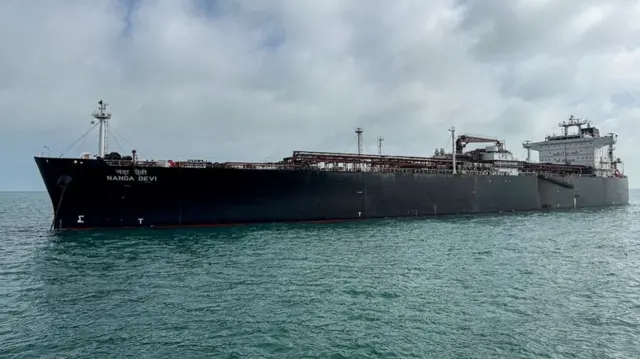
  3. Trump's deadline looms... but some countries have already secured passage through Strait of Hormuzpublished at 05:13 BST

    US President Donald Trump has threatened to hit Iran hard if it failed to make a deal to reopen the critical Strait of Hormuz shipping route by 20:00EDT (00:00GMT) on Tuesday.

    But even before Trump's latest threat, some countries - particularly in Asia - had secured deals with Tehran for their vessels to safely cross the channel.

    In recent weeks - several Asian countries including Pakistan,India and the Philippines - have made agreements with Tehran to letsome ships pass through the strait safely.

    China has also acknowledged that their vessels have also used the channel.

    Read more here.

    An Indian oil tanker pictured at seaImage source, Getty Images
    Image caption,

    An Indian tanker that passed through the Strait of Hormuz

  4. Trump threatens to take out Iran if it doesn't open Strait of Hormuz before his deadlinepublished at 05:11 BST

    Welcome back to our live coverage.

    US President Donald Trump has threatened to take out Iran "in one night" if it fails to make a deal before the deadline he set for Tehran to reopen the Strait of Hormuz.

    Here's what else to know:

    • Trump's deadline for an "acceptable" deal - one that includes the free flow of energy through the Gulf - is set for 20:00, Washington DC time on Tuesday (00:00 GMT Wednesday)
    • "The entire country can be taken out in one night – and that night might be tomorrow night," Trump said on Monday at a press briefing
    • Iran has rejected proposals for a temporary ceasefire, calling instead for a permanent end to the conflict and the lifting of sanctions
    • Pakistan, Turkey and Egypt have all been involved in efforts to mediate
    • The Strait of Hormuz is a key waterway, through which much of the world's oil passes. Since Iran effectively blocked the strait after US-Israeli attacks, countries around the world have been affected by a fuel crisis

    Thanks for joining us as we restart our live coverage of this story. More updates to come - stick with us.

  5. Analysis

    Trump takes triumphant tone, but still searching for meaningful solutions in Iranpublished at 23:59 BST 6 April

    Tom Bateman
    US State Department correspondent

    Donald Trump's news conference with his top military and political officials Monday afternoon felt triumphalist, especially given it was about a rescue operation, but it was perhaps an unsurprising response from the president.

    Trump repeatedly praised himself and his senior leaders for going through with the rescue even though he said some military officials warned it could lead to many casualties. He was prepared to take the risk.

    This was presented as a determination to leave no service member behind, which is indeed the US military ethos, but in reality it will also have been a highly political decision - to throw everything at the operation in order to deny the Iranians the chance to take an American service member prisoner. That would have greatly added to Tehran's leverage over Trump as he grapples with finding meaningful solutions to deal with Iran's control of the Strait of Hormuz - beyond threatening annihilation to civilian infrastructure.

    That's likely a big part of the apparent relief felt at the White House and why Trump and Defence Secretary Pete Hegseth are presenting the rescue as an embarrassing humiliation for Iran - which on Friday created the thorny dilemma for Trump by shooting down the F-15, damaging many other aircraft and leaving a number of Americans wounded.

    Hegseth at one point drew a parallel between the airman's Easter Sunday rescue to the resurrection of Christ, referring to "a pilot reborn." This war has frequently seen the administration fuse political and military strategy with religious language.

    Even as Trump's rhetoric appeared triumphant, Winston Churchill - an object of the president's admiration - warned after Britain’s Dunkirk evacuation in World War Two: "We must be very careful not to assign to this deliverance the attributes of a victory. Wars are not won by evacuations."

    We are pausing our live coverage of this story for now, but you can stay up-to-date on the latest developments here: Trump threatens to take out Iran in 'one night' if no deal before deadline

  6. UN humanitarian group warns of worsening situation in Iranpublished at 23:06 BST 6 April

    The United Nations Office for the Coordination of Humanitarian Affairs (OCHA) says in its latest update that the humanitarian situation in Iran is worsening as hostilities spread throughout the country.

    Between 17 March and 3 April, civilian casualties rose sharply with reported strikes on airports, hospitals, residential areas, markets, schools, industrial sites, and cultural heritage locations, the group says.

    OCHA says that from the start of the war through 30 March in Iran:

    • Over 2,100 civilians have been killed
    • Over 27,900 people have been injured
    • Over 3.8 million people have been "impacted"

    And, from the start of the war through 1 April, more than 115,000 civilian units have been damaged, it adds.

    OCHA also says, "Strikes on critical infrastructure and industrial sites have disrupted basic services including electricity, water and telecommunications, also leading to increasing immediate and longer term environmental and health risks."

  7. Americans injured in overnight strike in Kuwaitpublished at 22:51 BST 6 April

    Fifteen Americans were injured in an Iranian drone strike on Kuwait's Ali Al Salem Air Base overnight, US officials tell the BBC's US partner CBS News.

    The majority of them have already gone back to work, one of the officials tells the outlet.

    In total, 373 US military personnel have been injured since the war in Iran began - including 330 who have returned to duty and five who remain seriously wounded, a spokesperson for US Central Command tells CBS.

  8. Analysis

    Who is at the helm in Iran's negotiations?published at 22:43 BST 6 April

    Ghoncheh Habibiazad
    Senior reporter, BBC Persian

    Before 28 February, when Iran’s Supreme Leader Ali Khamenei was killed, he made constant remarks about Iran’s nuclear talks with the US. The latest round was held two days before the war started.

    Iran's nuclear programme has long been a point of contention, leading to extensive international sanctions. The current war began on 28 February, two days after a third round of indirect US-Iran nuclear talks in Geneva.

    Khamenei never travelled with Iran's negotiating team to engage in nuclear talks with the US held in third countries, but the team had often said that they were following his guidelines for negotiating with Washington.

    But his son, Iran’s third Supreme Leader Mojtaba Khamenei, is yet to be seen publicly since his succession early last month, although from his messages it seems he’s following the same hardline, anti-West path of his father.

    Iran has not officially announced the names of those within the establishment who are, according to them, "communicating messages via friendly countries" with the US.

    But some officials have been more visible than Iran's Supreme Leader, including Foreign Minister Abbas Araghchi, who was himself involved in several rounds of nuclear talks.

    Another official who has been active is Parliament Speaker Mohammad Bagher Ghalibaf. Ghalibaf’s account on X has been posting occasional memes recently as well, while he himself was last spotted on state TV on 17 March.

    When it comes to other officials, Iran has a highly complex system of governance. While the president heads the government, there is also a parallel government in the form of the IRGC, an institution whose influence extends far beyond a conventional military role, particularly in wartime.

    Several high-ranking IRGC commanders have been killed during this war and in last summer's conflict. However, officials have repeatedly said that for every commander lost, a replacement is ready to take their place.

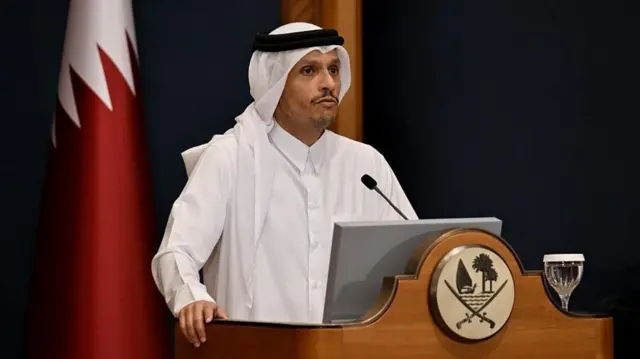
  9. Qatari PM says he condemns targeting infrastructure by 'any party' in call with Iranian officialpublished at 22:01 BST 6 April

    Al-Thani, wearing all white, stands and speaks at a podiumImage source, Getty Images
    Image caption,

    Qatari Prime Minister Sheikh Mohammed bin Abdulrahman bin Jassim Al-Thani

    Qatari Prime Minister Sheikh Mohammed bin Abdulrahman bin Jassim Al-Thani said he condemns the targeting of civilian infrastructure by any party during a call with Iranian Foreign Affairs Minister Abbas Araghchi.

    Qatar's Foreign Ministry wrote on social media that the two leaders spent the call discussing the ongoing escalation and its impacts on the region.

    During the call, Al-Thani reportedly expressed his displeasure at the continued Iranian strikes on Qatar and other neighbouring countries "that have distanced themselves from the war".

    "His Excellency also stressed that targeting civilian infrastructure and the resources of peoples is unacceptable and condemned behavior from any party and under any circumstances," the Foreign Ministry went on to say.

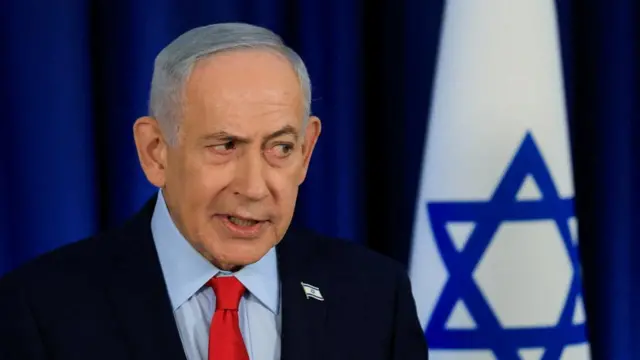
  10. Netanyahu claims Israel has destroyed Iran's largest petrochemical plantpublished at 21:10 BST 6 April

    Israeli Prime Minister Benjamin Netanyahu speaks during a press conference in MarchImage source, Reuters

    Israel's Prime Minister Benjamin Netanyahu has claimed that Israel has destroyed the largest petrochemical plant in Iran.

    "We are systematically dismantling the IRGC's (Islamic Revolutionary Guard Corps) money machine," a post on the Prime Minister of Israel's X account says.

    In a separate statement, the Israel Defense Forces (IDF) says it struck Iran's two largest petrochemical complexes, rendering more than 85% of its petrochemical exports inoperable.

    The IDF claims a site at Asaluyeh was used as a hub for making "essential components for the Iranian regime's missile industry".

    Also, during his briefing earlier, President Donald Trump said he spoke to Netanyahu on Sunday.

  11. Iran supreme leader issues written message over death of IRGC intelligence chiefpublished at 20:48 BST 6 April

    Ghoncheh Habibiazad
    Senior reporter, BBC Persian

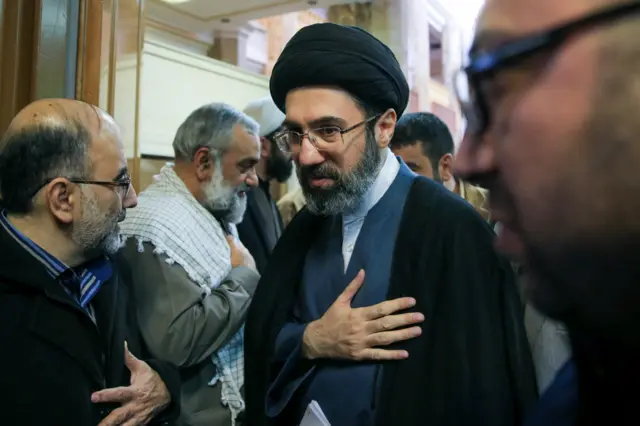
    Mojtaba Khamenei wearing a black turban, black cloak and grey suit as he walks among other men with his right hand over his heartImage source, Reuters
    Image caption,

    Mojtaba Khamenei, pictured here in 2016, hasn't been seen in public since he was elected as Iran's new supreme leader.

    We've been bringing you lines from Trump at the White House, now let's take a look at the situation on the ground in Iran.

    A written message attributed to the third Supreme Leader, Mojtaba Khamenei, has been issued following the killing of Islamic Revolutionary Guard Corps (IRGC) intelligence chief Majid Khademi.

    In the message, the killing was condemned and blamed it on the US and Israel. Israel has confirmed that it targeted Khademi.

    Khamenei repeated the rhetoric of Iranian officials, stating that the deaths of commanders would not cause any “disruption” to the ideology of Iranian forces because the “ranks are vast”. Several IRGC commanders have been killed since the war began on 28 February.

    There have also been several written messages attributed to Mojtaba Khamenei recently, but since succeeding his father around a month ago, he has not appeared in public or in any recent photos or videos on Iranian state TV.

    Donald Trump has said Mojtaba was “either dead or in very bad shape, because no one has heard from him”.

    Iran’s ambassador to the UN in Geneva said Khamenei’s absence was due to “security considerations”, while Foreign Minister Abbas Araghchi has insisted he is “in good health and fully managing affairs”. No audio or video evidence has yet emerged to support these claims yet.

  12. What did Trump say at the White House?published at 20:31 BST 6 April

    Kwasi Gyamfi Asiedu
    Live reporter

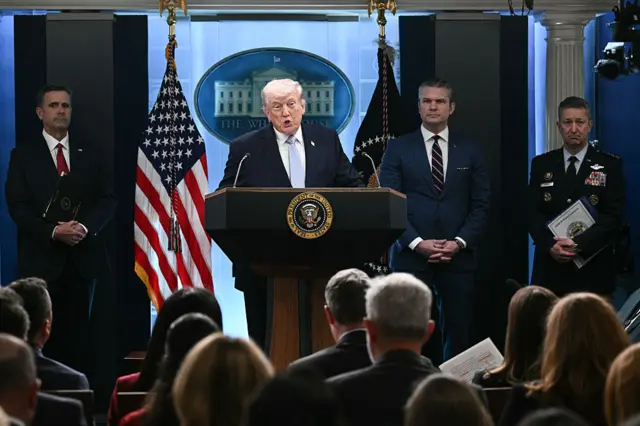
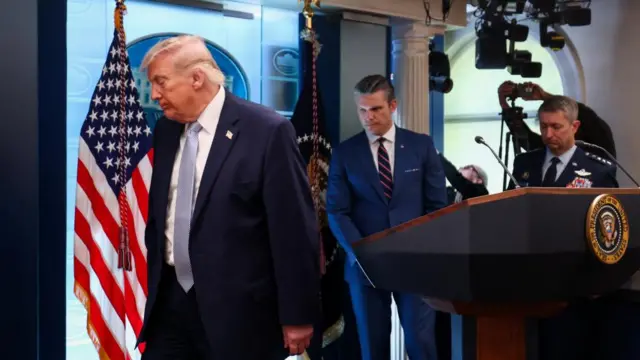
    US President Donald Trump (centre at the podium), alongside CIA Director John Ratcliffe (behind him on the left), US Secretary of Defense Pete Hegseth (second right) and Chairman of the Joint Chiefs of Staff General Dan Caine (right)Image source, AFP via Getty Images

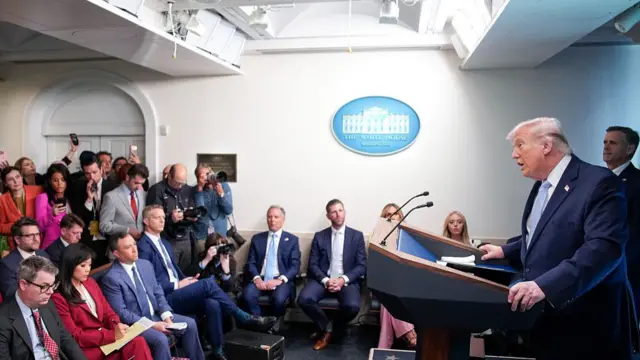
    We have heard from President Donald Trump, US Defence Secretary Pete Hegseth, CIA Director John Ratcliffe and Chairman of the Joint Chiefs of Staff Dan Caine at the White House.

    They gave more detail on the mission to rescue two US fighter pilots after their aircraft was downed in Iran last Friday.

    Here are some main lines from the news conference:

  13. Analysis

    Trump briefing includes detailed threat to Iran's infrastructurepublished at 20:12 BST 6 April

    Daniel Bush
    Washington correspondent

    After weeks of making general threats against Iran, Donald Trump issued a new warning on Monday that was far more specific: the US will bomb “every bridge” in the country if Iran doesn’t reach a deal to end the war “that’s acceptable to me."

    It was perhaps the most detailed, concrete threat Trump has made since launching the war in late February.

    Trump also said the US would attack Iran’s power plants and the strikes against the country's infrastructure would start at 20:00 Eastern Time, taking four hours, ending at midnight.

    It’s unclear if the US military is capable of destroying all of that infrastructure on that timeline.

    It’s also unclear if Trump will actually follow through. He has walked back on previous threats to Iran since the start of the war. But this time Trump has left himself very little, if any, wiggle room to deliver on his promise.

  14. Trump says 'every bridge in Iran will be decimated' without a deal to end warpublished at 19:50 BST 6 April

    A reporter asks about Trump's expletive-laden Truth Social post in which he called the Iranians "crazy bastards".

    The president says "I don't care" about critics who question his mental health over that post, and he says the US was being ripped off for many years before he came to office.

    He doubles down on his promises to target civilian infrastructure in Iran tomorrow evening, saying he will take out the country's bridges by midnight. He didn't clarify a timezone for the midnight deadline, but in an earlier post on Truth Social, the president said the strikes on bridges and power plants will start at 20:00 EDT Tuesday (0100 BST Wednesday).

    "Every bridge in Iran will be decimated by 12 o'clock tomorrow night," he says.

    The only way Iran will be able to rebuild their country after the war is with the help of the US, he says.

    "We may even get involved with helping them rebuild their nation," he says, saying in that case the US would prefer if important infrastructure weren't damaged.

    Trump once again criticises Nato for not getting involved, also naming other countries like Australia and Japan. Some countries in the Middle East have helped, though, he says.

    After an hour and a half, the news conference then comes to an end.

    Donald Trump leaves White House briefing roomImage source, Reuters
  15. Trump says passage of oil through Hormuz must be part of any dealpublished at 19:31 BST 6 April

    Trump is now asked whether he would consider ending the conflict in Iran with Tehran charging tolls for passage through the Strait of Hormuz.

    The US president says he would prefer for the US to charge tolls to vessels, saying "we're the winner"

    "We won," he says. "They are militarily defeated... we have a concept where we'll charge tolls."

    Trump says that in order to meet his 48-hour deadline - set to end at 20:00 Tuesday (0100 Wednesday) - there needs to be a deal with Iran "that's acceptable to me", adding that "part of that deal is going to be we want free traffic of oil".

  16. Trump says British ships 'barely work'published at 19:28 BST 6 April

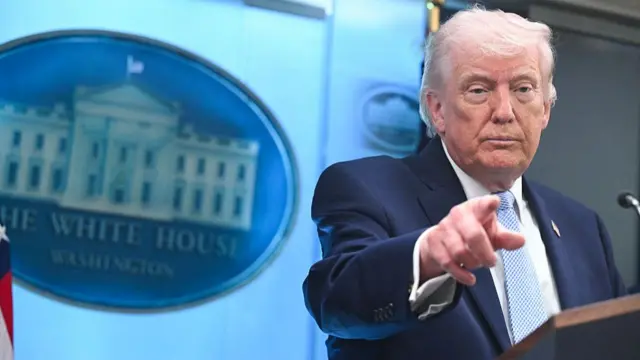
    Donald Trump answers questions in the White House briefing roomImage source, Getty Images

    Trump is still at the podium answering questions.

    He says the biggest problem the US currently has in negotiations is that Iranian officials can't communicate.

    Trump adds that he is very disappointed in Nato countries after allies refused his request to join the Iranian mission. He says he was most disappointed with the UK.

    "They have two old broken aircraft carriers" he says, adding that the British ships "barely work".

  17. Trump confirms threat to send Iran 'back to the Stone Ages'published at 19:23 BST 6 April

    When asked about the role of Kurdish forces in the war with Iran, Trumps says he would rather the Kurds stay away.

    He then adds that although his 10-day deadline for Iran to make a deal was supposed to be up today, he decided to extend it to tomorrow to "be a nice person" the day after Easter.

    But after tomorrow's deadline passes, "they're going to have no bridges", he says. "They're going to have no power plants. Stone Ages, yeah," he says, referring to a previous threat to send Iran "back to the Stone Ages".

  18. I felt this 'dangerous' mission was 'worth it' - Trumppublished at 19:09 BST 6 April

    Donald TrumpImage source, Getty Images

    Not everyone in the military was on board with conducting the rescue mission on Saturday, Trump says, responding to another reporter's question.

    "There were military people that said you just don't do this," he says, adding that hundreds of people could have been killed.

    "I decided to do it," Trump says.

    Another journalist asks if there was any point when he thought about aborting the mission. He doesn't directly answer.

    "I was told this is a very dangerous mission," he answers. "I just felt it was worth it."

  19. Iranians 'willing to suffer to have their freedom' - Trumppublished at 19:04 BST 6 April

    Trump is now answering questions from reporters at the White House. He's asked how he would react should the Iranian people "rise up against the regime".

    The president says "they should do it", saying the consequences would be "great".

    Trump also pushes back against criticism of his plan, saying "everything has been thought out by us".

    He's then asked about the impact of the US targeting civilian infrastructure in Iran, to which Trump says Iranians would be "willing to suffer to have their freedom".

    Trump adds that the US has had "numerous intercepts" suggesting Iranian people are calling for further strikes against the regime.

  20. US 'will recover our war fighters, anywhere in the world, under any conditions' - Cainepublished at 18:57 BST 6 April

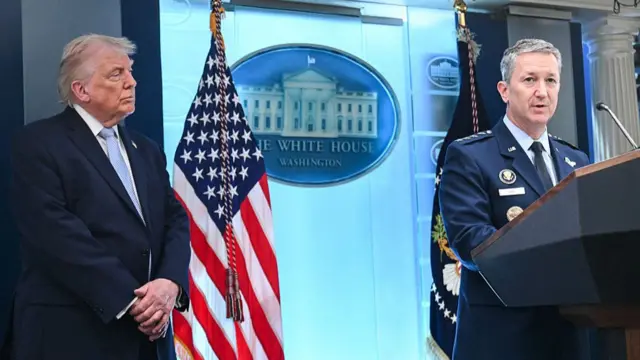
    Dan Caine and Donald TrumpImage source, Getty Images

    Dan Caine, chairman of the Joint Chiefs of Staff, is up next at the podium. He begins by again reiterating that the rescue mission was a dangerous undertaking for the US military.

    Detailing the early hours of the rescue, he says a US A-10 plane was involved in trying to find the first downed pilot, but it came under fire from gunmen in Iran, forcing it to fly to a nearby friendly country where the pilot safely ejected from the A-10.

    Caine explains that after the first pilot was recovered, the search for the second crew member continued even as Iranian forces also embarked on their own mission to capture the stranded US service member.

    He says the rescue mission was protected overhead by air armada, and that both crew members are now safely back with the US military.

    "The United States of America will recover our war fighters, anywhere in the world, under any conditions when we want to," he says.