Summary

  1. Israel strikes Beirut and southern Lebanonpublished at 17:43 GMT

    The Israel Defense Forces (IDF) says it has begun a "broad wave of attacks" against infrastructure belonging to the Iran-backed group Hezbollah in southern Lebanon.

    It says the strikes are being carried out "in parallel" with attacks in Beirut, Lebanon's capital.

    The statement comes after the IDF issued a warning to residents in Beirut, specifically those in the Bachura neighbourhood, to evacuate immediately.
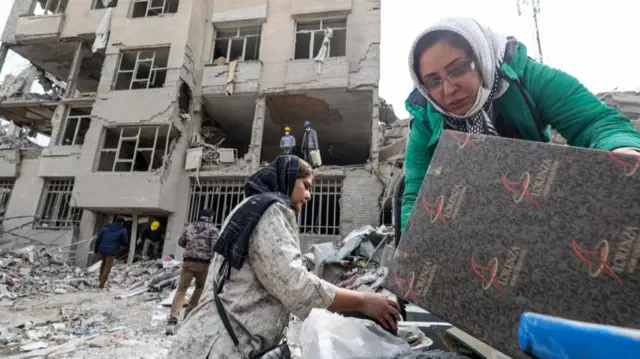
  2. Families and rescue workers search through rubble in Tehranpublished at 17:30 GMT

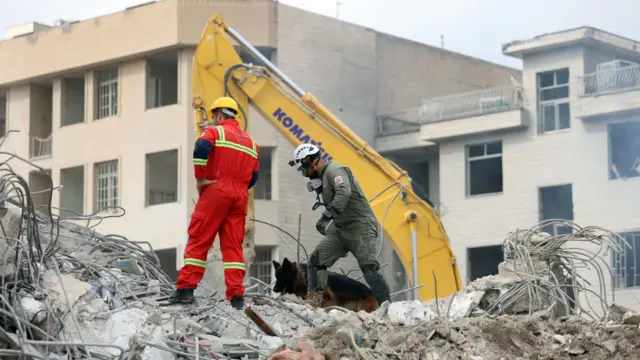
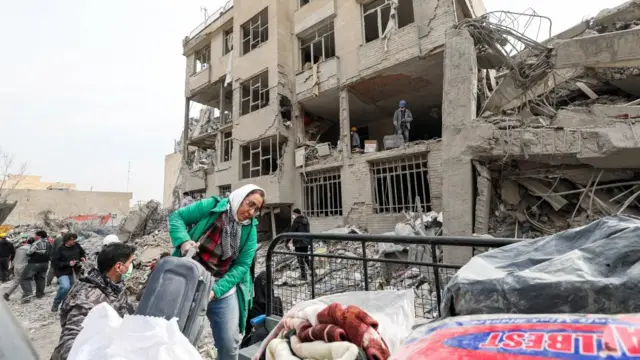
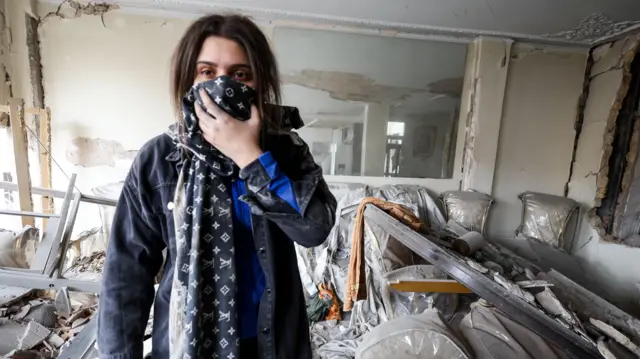
    We're seeing new pictures from Tehran, where air strikes by Israel and the US have reduced some buildings to rubble.

    People can be seen inspecting their homes and gathering what remains of their belongings.

    Rescue crews with sniffer dogs are also pictured searching through the wreckage.

    "I don’t have anything called a routine anymore," one Tehran resident told BBC Persian earlier. "I can’t go cycling or running outside."

    A woman inspects the damage inside her apartment after it was hit by an airstrike in TehranImage source, Reuters
    Image caption,

    A woman inspects the damage inside her apartment

    A family gathers the remaining furniture from an apartment damaged by an airstrike in TehranImage source, Reuters
    Image caption,

    A family gathers their remaining furniture

    Iranian rescue workers work among the rubble of damaged residential buildings in central TehranImage source, EPA
    Image caption,

    Rescue workers work among the rubble

  3. Iranians describe taking anxiety medication as US-Israeli strikes continuepublished at 17:15 GMT

    BBC Persian

    More now from BBC Persian, which has heard from an Iranian woman in Karaj.

    Today, on the 13th day of the war, "the situation is still the same" as it has been since the start, she says.

    But there are more checkpoints now, and though Persian New Year is close, most shops are closed and the city "feels strangely quiet".

    Larger shops are open, and although there are no shortages, "prices have risen drastically", she says.

    She and many of her friends are taking medication for the stress. "The worst part is that you never know where they might have moved the forces or equipment that are being targeted," she says.

    "It could suddenly end up somewhere close to your home, maybe even the street behind you, and without you knowing anything, everything could explode suddenly.

    "My cat gets very scared. I made a small place for her inside a closet so she can hide."

    She hears from friends in areas where there more strikes - one who lives in the same city has described a strike hitting near their home, shaking the house and shattering the windows, with the electricity cut off for hours.

    "The biggest fear is that after enduring all of this suffering, the clerics will still remain in power and the Islamic Republic will still be ruling," she says.

  4. Iran not laying mines in Strait of Hormuz, says deputy foreign ministerpublished at 17:00 GMT

    Majid Takht-Ravanchi, Iran's deputy foreign minister

    Deputy foreign minister Majid Takht-Ravanchi has denied Iran is laying mines in the Strait of Hormuz, days after the US said it had struck vessels equipped to do so operating close to the shipping channel.

    "Some countries have already talked to us about passing the Strait and we have cooperated with them," Takht-Ravanchi tells AFP news agency.

    But countries which "joined the aggression" against Iran "should not benefit from safe passage", he adds, saying the regime wants to ensure war can't be "imposed" on it again.

    He continues: "When the war started last June, after 12 days there was so called cessation of hostilities... but after eight or nine months, they regrouped and they did it again."

  5. Eight seafarers killed and thousands left stranded by Iranian shipping attackspublished at 16:52 GMT

    Jonathan Josephs
    Business reporter

    As Iran vows to continue target shipping in the Strait of Hormuz, around 20,000 seafarers remain stuck on vessels in the Persian Gulf.

    BBC News understands that eight seafarers have now been killed since this conflict began and three more remain unaccounted for as a result of the attack on a Thai-flagged bulk carrier, the Mayuree Naree.

    The welfare of the men and women who move goods around the world by sea will be at the top of the agenda when the UN’s International Maritime Organization (IMO) meets next week.

    The emergency meeting in London was called by Egypt, France, Qatar, Morocco, the United Arab Emirates and the UK.

    However, aside from diplomatic pressure and a statement condemning what’s happening it’s hard to see what action the IMO can take.

    It’s regulations require ships to be “sufficiently and efficiently manned”.

    So whilst the IMO is trying to coordinate efforts to look after those who are stuck on board with supplies and internet access, they remain sitting targets for further Iranian attacks.

  6. 'The atmosphere in Iran is extremely suffocating' - Tehran residentpublished at 16:43 GMT

    BBC Persian

    A family gathers the remaining furniture from an apartment damaged by an airstrike, amid the U.S.-Israeli conflict with Iran, in Tehran, IranImage source, Reuters

    BBC Persian has heard from an Iranian woman in Karaj - a city just west of Tehran - who has only just been able to access the internet since the first the war began.

    "The atmosphere in Iran is extremely suffocating. It has always been oppressive but now fear and terror have been added to it," she says.

    "On the first day, when the war started, most of us woke up to the sound of explosions. About an hour later the internet was cut off, and we kept following the news through satellite TV," she says.

    Lines for petrol started that same day, she says, and paramilitaries linked to the regime quickly appeared on the streets.

    Late that night, it was announced the then Supreme Leader, Ayatollah Ali Khamenei, had been killed, and "all the neighbours were celebrating from their balconies or windows", she says, before paramilitaries returned and people fell silent.

    "Every day we receive many SMS messages - warnings, threats, or false news. And every night supporters of the government organise mourning or celebration processions. The whole situation feels like nothing in this country belongs to us, as if we are strangers in our own city," she says.

    BBC Persian is the Persian language service of BBC News, used by 24 million people around the world - the majority in Iran - despite being blocked and routinely jammed by Iranian authorities.

  7. Analysis

    Millions displaced inside Iran as people flee citiespublished at 16:35 GMT

    Paul Adams
    Diplomatic correspondent

    The latest estimates from the United Nations Refugee Agency point to an alarming rise in the price paid by civilians over the course of just two weeks of war.

    It says as many as 3.2 million people have been displaced inside Iran since Israel and the US launched their attacks on 28 February.

    Large numbers are fleeing the capital Tehran and other major cities, looking for safety in rural areas. They include many Afghan refugees, some of whom have been living in Iran for decades and often in already difficult conditions.

    The US and Israel say they are attacking military and security targets, but these are often inside densely populated areas.

    Such is the intensity of Operation Epic Fury that civilians, including many who are deeply hostile to their own government, have been forced to flee an increasingly precarious situation.

    Donald Trump and Benjamin Netanyahu have repeatedly urged Iranians to turn on the regime. At the moment people are too busy simply trying to survive.

  8. Do high oil prices really mean the US is getting richer?published at 16:28 GMT

    Theo Leggett
    International Business Correspondent

    Earlier Donald Trump said that as the world’s largest oil producer, the US makes “a lot of money” when prices rise.

    The US is indeed the world’s largest oil producer, extracting more than 13 million barrels per day in 2024.

    It also produces large quantities of natural gas. While much of this is used domestically, a significant proportion is exported.

    Those exports will sell for a higher price, benefiting US producers. However, the US also imports significant quantities of oil and refined products, notably from Canada but also from Mexico, Brazil and the Middle East.

    These will cost more – and that will limit the overall benefits to the economy. Where extra profits are coming in, oil companies and their shareholders will benefit.

    However, higher fuel prices will hurt motorists, while businesses will face increasing costs for making or transporting goods.

  9. Death toll in Lebanon rises to 687, health ministry sayspublished at 16:24 GMT
    Breaking

    The death toll in Lebanon has risen to 687 since 2 March, the Ministry of Public Health says.

    That figure is up from 634 yesterday and includes 98 children and 62 women.

    Officials say 1,774 people have been injured in the same period, including 304 children and 328 women.

    Israel has launched a military offensive against Hezbollah, an Iran-backed armed group which operates from Lebanon, and has launched daily air strikes, as well as pushing troops further into southern Lebanon.

  10. Oil prices breach the $100 mark againpublished at 16:19 GMT

    Dearbail Jordan
    Senior business and economics reporter

    The oil price has risen further this afternoon, ticking up to $101 a barrel, an increase of 10% today.

    Iran’s new Supreme Leader Mojtaba Khamenei said earlier that the "lever of blocking the Strait of Hormuz" should still be used, in remarks attributed to him and read out on state TV.

    On Wednesday, the Islamic Revolutionary Guard Corps said that any vessel linked to the US, Israel or their allies would be targeted.

    "You will not be able to artificially lower the price of oil. Expect oil at $200 per barrel," a spokesperson said.

    Asked if this was possible, US Energy Secretary Chris Wright told CNN on Thursday: "I would say unlikely, but we are focused on the military operation and solving a problem.”

  11. Late supreme leader's wife still alive, claims Iran media outletpublished at 16:13 GMT

    Ghoncheh Habibiazad
    Senior reporter, BBC Persian

    Iran's Fars News Agency has reported that Mansoureh Khojasteh Bagherzadeh, wife of Iran's late Supreme Leader Ayatollah Ali Khamenei, is alive.

    The agency, which is affiliated with the Islamic Revolutionary Guard Corps, says that earlier reports about her death are false.

    Iran state TV channel Two had reported on 2 March that Bagherzadeh was killed “at home”, while other Iranian outlets said she was in a coma.

    Previously, Iranian media said that Khamenei’s daughter, grandchild and son-in-law were killed.

    Khamenei and his wife had six children - four sons and two daughters.

  12. Iranian drones pose 'no threat' to US mainland - White House press secretarypublished at 16:04 GMT

    White House Press Secretary Karoline LeavittImage source, Reuters

    White House Press Secretary Karoline Leavitt says Iranian drones pose "no threat" to the US mainland.

    It comes after ABC News published a story saying the FBI had warned police departments in California that Iran could "retaliate" for US attacks by "launching drones" from a vessel off the west coast of the US.

    "They wrote this based on one email that was sent to local law enforcement in California about a single, unverified tip," Leavitt writes on X.

    "TO BE CLEAR: No such threat from Iran to our homeland exists, and it never did," she adds.

    Yesterday, California Governor Gavin Newsom said he was "not aware of any imminent threats" to the state at this time, but was in "constant coordination" with security and intelligence officials.

  13. British troops based in Iraq came under attack from Iranian dronespublished at 15:49 GMT

    Jack Fenwick
    Political correspondent

    British troops at a base in Iraq have come under attack from Iranian drones, BBC News understands.

    There were no British casualties in the attack, but some US troops were injured.

    The Western base in Erbil, northern Iraq, is controlled by the US but often houses other coalition forces, including British troops.

    A British presence has been deployed to the region in recent weeks to take down Iranian drones.

    It’s understood that two Iranian drones headed for the base were destroyed with surface-to-air missiles overnight on Wednesday.

    An unknown number of projectiles did hit the base, resulting in injuries to US troops, but they are not thought to be serious.

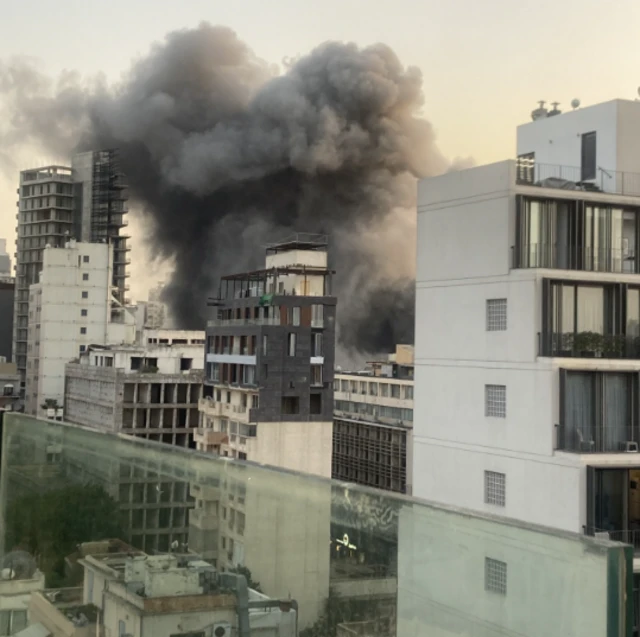
  14. Strikes hit close to BBC team in Beirutpublished at 15:41 GMT

    Alice Cuddy
    Reporting from central Beirut

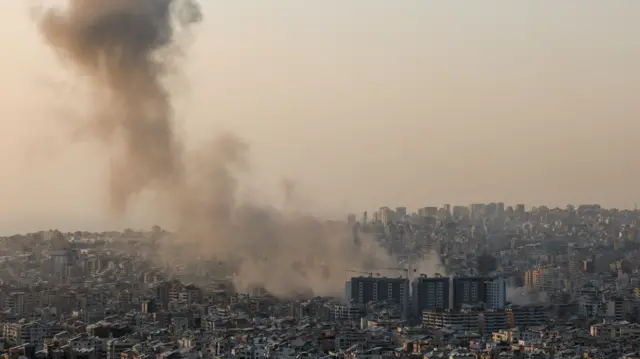
    Smoke rising over Beirut

    Israeli strikes just hit a building less than 500m away from our location in central Beirut.

    It followed an Israeli military warning that it would be targeting a building, which it described as being "a facility belonging to the terrorist group Hezbollah".

    A warning hit came before the building was struck, sending a plume of grey smoke over the city.

    More strikes followed, shaking the windows of the building where we're reporting from.

  15. IDF orders evacuations of building in Beirut, claims it is 'affiliated with Hezbollah'published at 15:37 GMT

    The IDF issued a warning to residents in Beirut, telling them to evacuate immediately. It specifically warns those in the Bachura neighbourhood.
    IDF spokesperson Avichay Adraee posted a map on X with a building near to University Saint Joseph highlighted. He said to those in the building: "You are located near a facility affiliated with the terrorist Hezbollah, which the Israel Defense Forces will act against."

    "To ensure your safety and the safety of your family members, you must immediately evacuate the specified building and those adjacent to it, and stay away from them by a distance of at least 300 meters," he added.

  16. Israel begins fresh wave of strikes on Beirutpublished at 15:27 GMT

    Smoke rises after Israeli strikes on BeirutImage source, Reuters

    In a post shared on Telegram a couple of minutes ago, Israel Defense Forces (IDF) says it has carried out a wave of strikes on Beirut.

    We're also seeing new images of smoke rising over the city.

  17. Trump says Iran can compete in World Cup, but he does not think it's appropriate for their own safetypublished at 15:24 GMT

    Infantino stands left of Donald Trump at World Cup drawImage source, Reuters

    US President Donald Trump says Iran's football team is "welcome" to attend this year's World Cup, but adds he doesn't "believe it is appropriate" for them to compete.

    In a social media post, Trump says this is "for their own life and safety".

    Iran are scheduled to play three group matches in the tournament, which is being held in the United States, Canada and Mexico and gets under way on 11 June.

    The team is due to face New Zealand and Belgium in Los Angeles on 15 and 21 June respectively, and Egypt in Seattle on 26 June.

    The county's minister of sports and youth Ahmad Donyamali cast the team's participation into doubt when he said on Tuesday: "Given that this corrupt government has assassinated our leader, under no circumstances do we have the appropriate conditions to participate in the World Cup.

    "Our boys are not safe, and conditions for participation do not exist."

    But, Fifa President Gianni Infantino - a close friend of Trump - said on Wednesday that he had spoken with the president who he said told him Iran was "welcome" to take part in the tournament.

  18. British forces shot down drones in Iraq, says UK defence secretary, claiming Iran is using Russian tacticspublished at 15:05 GMT

    Jonathan Beale
    Defence correspondent

    More now from Defence Secretary John Healey, who says British forces stationed in Erbil, Iraq shot down two drones overnight, though some did impact and there has been reports of a number of US casualties.

    Healey is speaking during a visit to the UK’s military headquarters in Northwood, north-west London, where he has received a briefing on the latest situation on the Middle East.

    He was told there is a “definitive link” between Iran and Russia in the way attack drones are being used.

    Healey later tells reporters that Iranian drone attacks have the hallmark of the way Russia is attacking Ukraine, adding: “No one will be surprised to believe that Putin’s hidden hand is behind some of the Iranian tactics."

    The defence secretary says Putin was the “one world leader” benefiting from the war because of higher oil prices, which he says help the Russian president with a fresh supply of funds for his brutal war in Ukraine.

  19. Fastest way to re-open Strait of Hormuz is through de-escalation - Healeypublished at 15:00 GMT

    Jonathan Beale
    Defence correspondent

    UK Defence Secretary John Healey said he’s been discussing the situation in the Strait of Hormuz with military planners and allies.

    He said reports had become clearer that Iran “may have been mining” the Strait.

    Healey added the UK still had some “autonomous de-mining assets” in the region.

    However, the only Royal Navy mine-hunting ship that was stationed in Bahrain, HMS Middleton, recently returned to Portsmouth for planned maintenance.

    Healey said that de-mining any waters was “extremely difficult”. He explained the fastest way of re-opening the Strait of Hormuz was through “de-escalation” in the conflict.

    Asked whether Royal Navy warships could be involved in escorting tankers in the region, Healey replied that any potential action in the future would have to be done in close co-ordination with allies because it was a shared international concern.

    The Royal Navy Destroyer, HMS Dragon, is currently sailing towards Cyprus with the specific mission of defending the island and the UK base there.

  20. BBC Verify

    Verified videos show oil tanks on fire at Bahrain airportpublished at 14:43 GMT

    Media caption,

    Plumes of smoke seen at Bahrain airport

    By Peter Mwai

    We’ve verified video showing a dark plume of smoke rising from the main airport in Bahrain following a reported Iranian drone strike overnight.

    The drone is reported to have hit fuel storage tanks at the airport, causing a huge fire.

    We matched the buildings seen in the footage with satellite imagery to confirm it was filmed from the north of the airport, and the smoke lines up with the location of the fuel tanks.

    Bahrain’s ministry of interior says the fire in the Muharraq governorate - an area that includes the airport - has now been contained.

    Residents were told last night to remain at home “as a precaution” but have been told they no longer need to.