Summary

  1. From technical issues to 'go for launch' - what just happened?published at 00:11 BST

    Pallab Ghosh
    Science correspondent, reporting from the launch
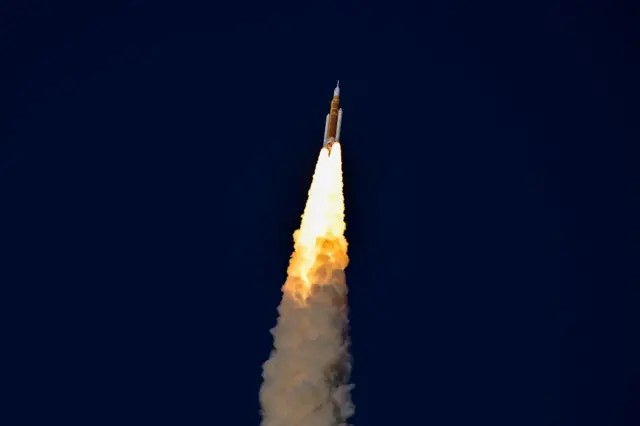
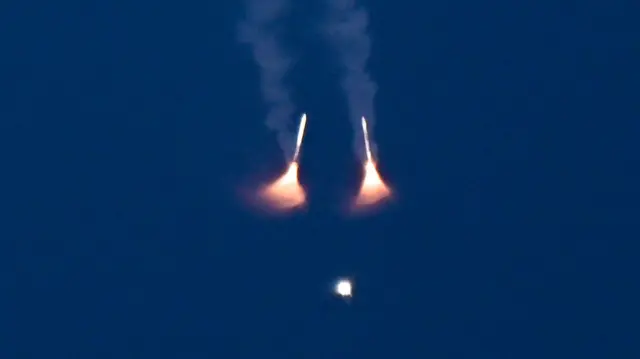
    Spacecraft seen against dark skies, shooting up into the airImage source, Reuters

    In the hour before take-off there were issues which threatened launch concerning the Launch Abort System.

    This is the system that enables Nasa engineers to eject the astronauts and blow up the rocket if there is a malfunction.

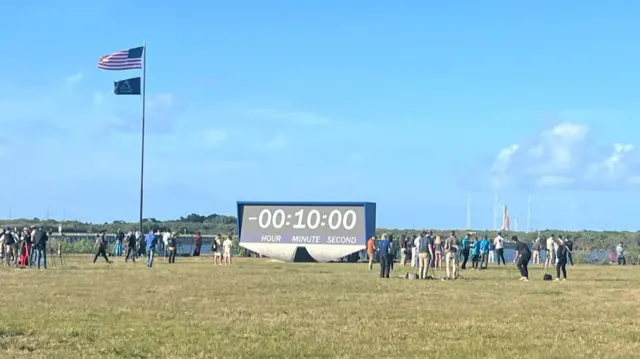
    The countdown clock was held at 10 minutes while engineers resolved the problem – which they speedily did.

    Then came the staccato rhythm of the calls by each engineer responsible for the rocket’s critical systems.

    One by one the voices came back: “Booster, go”, “GNC, go”, “Range, go” – each reply, a tiny release of tension and a build-up of expectation.

    “Artemis II, this is Launch Director – you are go for launch,” the crew was told. “We go for all humanity, Commander Reid Wiseman responded.

    The four RS‑25 engines and twin solid rocket boosters lit with a sheet of flame that seemed to engulf the rocket, driving more than 8.8m lbs of thrust into the Florida evening sky.

  2. My first rocket launch didn't disappointpublished at 00:05 BST

    Leyla Khodabakhshi
    Reporting from the Kennedy Space Center

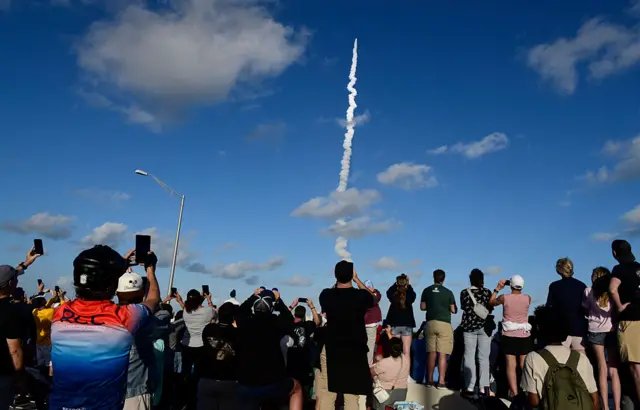
    Crowd points phones to the sky as they take pictures of rocket take offImage source, Getty Images

    This was my first rocket launch, and it was spectacular.

    From the moment I arrived here, people kept telling me you don’t just see a launch - you feel it. And they were right.

    As the rocket lifted off, you could feel it through your body.

    Now, the smoke is still lingering in the sky, hanging there - almost giving you a moment to take it in.

    If you can ever fully take it in.

  3. 'Great view', says astronaut Reid Wisemanpublished at 23:57 BST

    Esme Stallard
    Science reporter

    A few minutes into the launch as the astronauts began to enter the Earth's upper atmosphere, the spacecraft commander Reid Wiseman takes to the comms.

    "Great view" he declares. "We have got a great Moonrise".

    The astronauts will see views on this trip only a handful of humans in history have seen.

  4. Giddy euphoria among Nasa employeespublished at 23:56 BST

    Pallab Ghosh
    Science correspondent, reporting from the launch

    There was giddy euphoria at the Kennedy Space Center. Staff are laughing and clapping - this is the moment that they have spent years working for.

    There is still work to do - but for a moment they are bathing in the moment of triumph.

  5. You can feel the force of the rocket passing through your bodypublished at 23:50 BST

    Rebecca Morelle
    Science editor, reporting from the launch

    Wow - that is just spectacular…

    It’s not just what you can see and hear as the rocket lifts off. You can actually feel the force of it passing through your body.

    This is the most powerful rocket that Nasa has ever built - and it needs to be, because it’s sending these four astronauts 250,000 miles (400,000 km) away to the Moon.

    Rocket takes off into the sky with huge trail behind itImage source, BBC/Kevin Church
  6. Astronauts now in orbit around the Earthpublished at 23:48 BST

    Esme Stallard
    Science reporter

    Reid, Wiseman, Koch and Hansen have passed the Kármán line - the boundary between Earth's atmosphere and space. They are now in orbit around the Earth.

    All initial stages appear to have gone to plan.

    There is still ten days to go with this mission but so far, so good.

  7. Boosters have separatedpublished at 23:47 BST

    Esme Stallard
    Science reporter

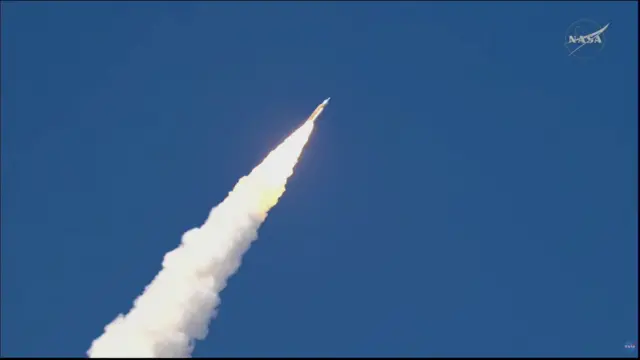
    The Space Launch System (SLS) rocket carrying NASA's Artemis II Orion crew capsule ascends after liftoff, with its solid rocket boosters already detached, from the Kennedy Space Center in Cape Canaveral, Florida, U.S., April 1, 2026.Image source, Reuters

    The pair of solid rocket boosters, which provide 80% of thrust, have done their job getting the system to more than 10,000 mph.

    They have now separated from the rocket.

    Within the next couple of minutes they are expected to splashdown in the Atlantic Ocean.

  8. Key moments to look out forpublished at 23:46 BST

    Pallab Ghosh
    Science correspondent, reporting from the launch

    It's now been ten minutes since launch - here's some of the key moments to look out for for the rest of the flight:

    After about eight minutes the core runs dry and drops back towards Earth, while the upper stage of the rocket - the interim cryogenic propulsion stage (ICPS) - takes over, lighting its engine to nudge the crew the rest of the way into orbit.

    With two engine burns, the ICPS places Orion into a high, stretched out orbit around Earth.

    At its furthest, the spacecraft will be about 46,000 miles away; at its nearest, roughly 115 miles up.

    That loop takes about a day. During this first day, Orion separates from the ICPS and carries out a docking practice manoeuvre, flying towards and around the spent stage as if it were a future Moon lander or small space station.

    All of this is rehearsal for what comes much later in Nasa’s grand plans for a long term presence on the lunar surface, when Orion will have to hook up in space with lunar landers and an orbiting outpost near the Moon.

    Artemis II is the crew’s chance to see how the capsule’s autopilot and thrusters behave when they really lean on them.

  9. Flames and cheers as rocket lifts offpublished at 23:39 BST

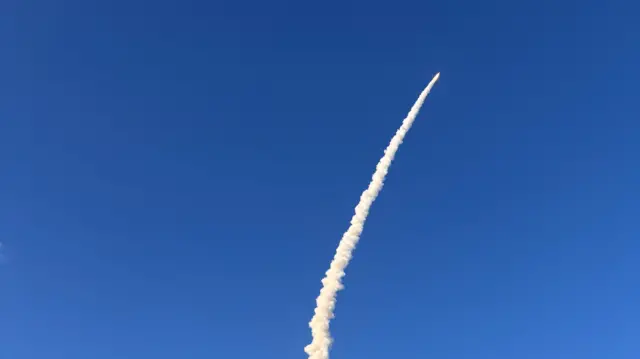
    rocket flying through skyImage source, NASA

    You can see the flames under the spacecraft, and hear an almighty roar as the rocket lifts off into the blue sky. A trail of smoke is left in its wake.

    You can hear the crowds at the launch cheer as the spacecraft shoots into the sky.

    As a reminder, you can watch live at the top of the page.

  10. Lift off!published at 23:35 BST
    Breaking

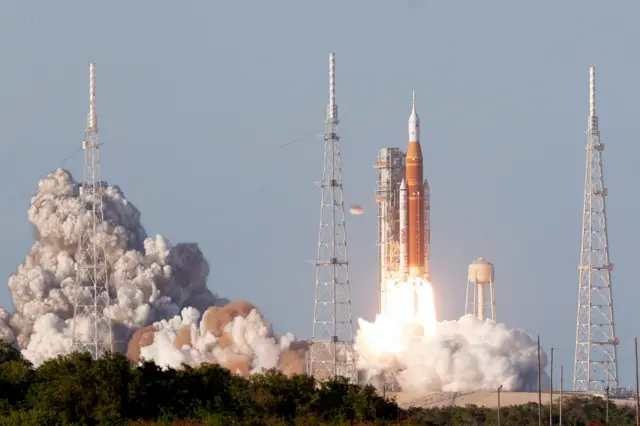
    Nasa’s Artemis II mission takes off heading for first Moon visit in 50 yearsImage source, Reuters

    We have lift off!

    The Artemis crew are officially on their way in a historic 10-day mission around the Moon, which could take them further from Earth than anyone has ever been before.

  11. Calm returns at Kennedy Space Center as launch nearspublished at 23:34 BST

    Leyla Khodabakhshi
    Reporting from the Kennedy Space Center

    There was a brief buzz and loud cheers as the countdown clock started again, but things have quickly gone quiet.

    The countdown clock has resumed here at the Kennedy Space Center after the hold at T-10 minutes.

    People are watching the clock, waiting.

    It feels like the calm before the storm as launch gets closer.

  12. For our families, teammates and all humanity - Artemis crew share pre-launch messagepublished at 23:31 BST

    Three of the astronauts shared a pre-launch message moments before the countdown began:

    "We are going for our families," said pilot Victor Glover.

    "We are going for our teammates," said mission specialist Christina Koch.

    "We are going for all humanity," said mission specialist Jeremy Hansen.

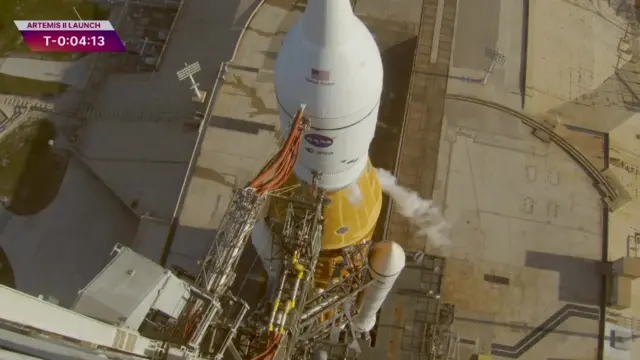
    With less than five minutes left on the countdown, the crew access arm has been retracted, meaning the Launch Abort System - where there was reportedly a battery issue earlier - will now be armed.

    Rocket on launchpadImage source, NASA
  13. Crowd cheers as countdown resumespublished at 23:28 BST

    Rebecca Morelle
    Science editor, reporting from the launch

    Cheers here as the countdown resumes - the crowd at the Kennedy Space Center is ready!

  14. Ten minutes to launchpublished at 23:26 BST
    Breaking

    "T minus 10 minutes and counting."

    The launch window is now open and the final countdown begins - ten minutes to launch.

  15. Countdown on hold for planned pause as final checks carried outpublished at 23:18 BST

    Leyla Khodabakhshi
    Reporting from the Kennedy Space Center

    The countdown for the Artemis launch is now on hold at T-10 minutes

    The countdown for the Artemis launch is now on hold at T-10 minutes.

    In spaceflight terms, “T” refers to the moment of launch, so this means there are 10 minutes to go before liftoff.

    This is a planned pause, giving engineers and mission control time to carry out final checks on the rocket, spacecraft and weather conditions.

    If everything is confirmed as “go”, the countdown will resume when the director says for the final minutes before launch.

  16. Battery issue 'will not affect launch', says Nasapublished at 23:04 BST
    Breaking

    Esme Stallard
    Science reporter

    Nasa says the battery issue it has identified will not stop proceedings today.

    It says engineers found a "higher temperature than would be expected" on a Launch Abort System battery, but "it is believed to be an instrumentation issue and will not affect today’s launch."

    Just in time.

  17. Issue is with one of the Launch Abort System batteriespublished at 22:50 BST

    Rebecca Morelle
    Science editor, reporting from the launch

    Nasa says the new issue is with one of the two batteries on the Launch Abort System. It is currently out of range, they say, which they are currently investigating.

    The Launch Abort System sits right at the top of the rocket.

    Were something to go wrong, either on the pad, or within the first three minutes of the launch, it would activate pulling the crew capsule away from danger.

    It can go from 0 to 500mph (805km/h) in two seconds - and would only be used in the event of a real problem. But it's essential its working perfectly for the launch to go ahead.

  18. Analysis

    Glitches aren't unusual, but it's still a bit nerve-janglypublished at 22:43 BST

    Rebecca Morelle
    Science editor, reporting from the launch

    After such a smooth countdown, the last hour has been a bit of a roller-coaster ride.

    But glitches aren't unusual for launches - in fact there are normally loads more.

    It's just a bit nerve-jangly that the problems are cropping up so close to the launch window opening.

    People gather to watch the launch of Artemis II from the A. Max Brewer Bridge in Titusville, FloridaImage source, Getty Images
    Image caption,

    Crowds gather as the countdown continues

  19. Nasa reports new technical issue, as launch window closes inpublished at 22:41 BST
    Breaking

    Esme Stallard
    Science reporter

    After years of planning, designing and testing we are into the final hour before the launch of the Artemis II mission.

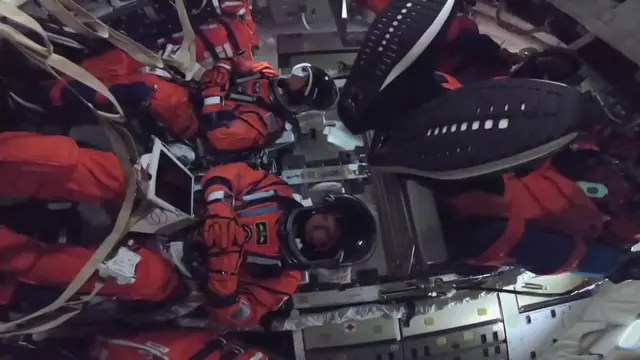
    The final hatch is now closed on the launch abort system that will evacuate the astronauts in the event of an emergency.

    We can see that the "close out" crew are about to leave the launchpad.

    But they are still testing all the systems, and Nasa have just said it is now investigating a battery temperature issue.

    It really is nail-biting stuff right into the closing minutes.

    Artemis astronauts sealed in spacecraftImage source, NASA
  20. Calm before launch as crowds gather at Kennedy Space Centerpublished at 22:32 BST

    Leyla Khodabakhshi
    Reporting from the launch

    There is a sense of calm here at Kennedy Space Center - at least for now.

    People are still gathering around the countdown clock, watching the time tick down and waiting for what comes next.

    In the press area, journalists are taking their positions, checking equipment and preparing for the moment the launch begins.

    For now, it is quiet anticipation.