Summary

  • Donald Trump says US military action in Iran could end in "two to three weeks"

  • He says the US will "leave whether we have a deal or not" once he's certain the regime cannot build a nuclear weapon "for years" - here's what else he said

  • Iranian President Masoud Pezeshkian says Tehran has the "necessary will" to end the war provided its enemies guarantee it will not flare up again

  • Meanwhile, China and Pakistan draw up a five-point plan to end the war, which includes an immediate ceasefire and the reopening of the Strait of Hormuz - why is China getting involved?

  • Strikes between Israel and Iran continue - and Iran is also attacking its Gulf neighbours: a drone strike sparks a fire at Kuwait's international airport; a tanker is hit off the coast of Qatar; and Saudi Arabia and Bahrain also report attacks

  • Thousands of people have been killed in the war, the vast majority in Iran and Lebanon

  1. Number of injured rises to 14 following strike outside Tel Avivpublished at 08:01 BST

    A MDA yellow ambulance parked in between cars on a street in Israel struck in a wave of Iranian attacksImage source, Magen David Adom

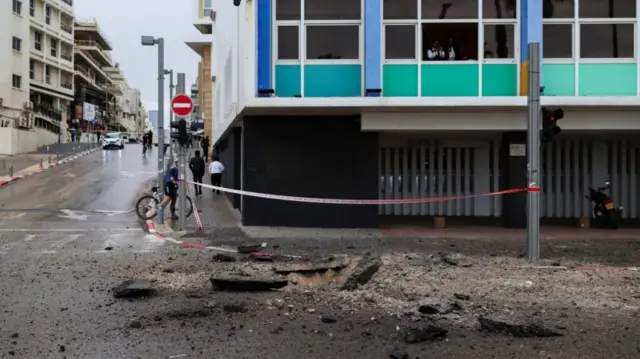
    Fourteen people, including an 11-year-old girl and 13-year-old boy, have been injured in the earlier Iranian strike on the outskirts of Tel Aviv.

    In an update on the injuries suffered in the strike, Magen David Adom, Israel's emergency services, says the girl suffered shrapnel injuries and has been evacuated to a local hospital.

    In a separate update, the service says no further injuries have been reported following another barrage of strikes from Iran.
  2. Man killed by falling debris in the UAEpublished at 07:36 BST

    A man has died after debris from an intercepted drone fell at a farm in Al Rifa, in the Emirate of Fujairah in the UEA, local authorities say.

    The man was a Bangladeshi national, the Fujairah Media Office says in a statement shared on social media.

    The UAE has intercepted 1977 drones and 433 ballistic missiles since the start of the war, the country's ministry of defence said yesterday.

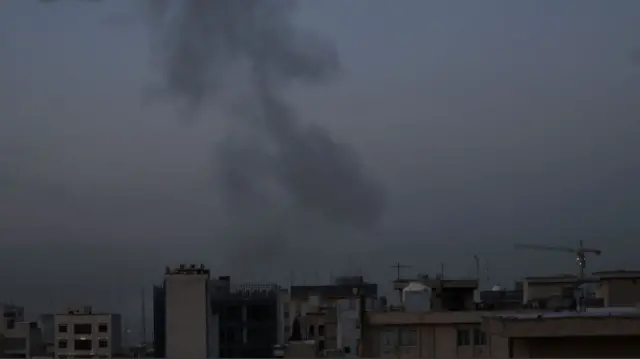
  3. Israel carries out new strikes over Tehran as Iran launches multiple missiles in returnpublished at 07:24 BST

    A cloud of black smoke emerges over a cluster of residential buildings in Tehran in the early hours of the morningImage source, EPA
    Image caption,

    Smoke rises over buildings in Tehran, where Israel carried out strikes overnight

    A little earlier, the Israel Defense Forces (IDF) said it had carried out a wide-scale wave of overnight strikes on Iran's capital, Tehran.

    The IDF says it has been targeting infrastructure site linked to the Iranian regime.

    In the last hour and a half, Tehran has responded with three separate missile launches on Israel.

  4. One of two projectiles that hit tanker off Qatar 'remains unexploded in vessel's engine room'published at 07:07 BST

    The UK Maritime Trade Operations (UKMTO) Centre has provided an update on the tanker struck off the coast of Qatar earlier.

    UKMTO says the vessel was struck by "two projectiles". One caused a fire which has now been extinguished while the other "remains unexploded within the vessel's engine room".

    The centre says it is currently unable to confirm the origin of the projectiles and an investigation is underway.

  5. Three injured in latest Iranian strikes on Israelpublished at 06:48 BST

    Debris on the streets of Tel Aviv outside a residential building, another street with people walking away on the leftImage source, Reuters
    Image caption,

    Strikes have been reported in Tel Aviv and surrounding areas

    Israel emergency services, Magen David Adom, says its teams have been deployed to multiple areas after reports of fresh Iranian missiles strikes.

    The Israel Defense Forces (IDF) said a little before 06:00 BST (08:00 local time) it had detected a new wave of projectiles fired from Iran.

    MDA says it has provided treatment to an 11-year-old girl in a "serious condition" and two others in Bnei Brak, east of Tel Aviv.

  6. UK chancellor says energy bill support would be based on household incomepublished at 06:31 BST

    Peter Ruddick and Shanaz Musafer
    Business reporters

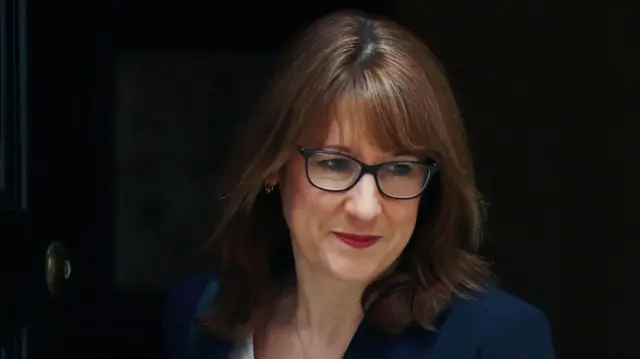
    Chancellor Rachel Reeves, a woman with medium-length brown hair and glasses in a dark suit.Image source, EPA

    Staying in the UK, Chancellor Rachel Reeves has told the BBC any support the government offers to help people with high energy bills pushed up by the Iran war would be based on household income.

    Wholesale oil and gas prices have soared over the past month, with supply from the Middle East severely disrupted. While household energy bills are set to fall in April under Ofgem's price cap, there is likely to be a big jump over the summer.

    Rachel Reeves said it was "too early" to say exactly who would get help but hinted any support would not arrive until the autumn.

    In a new interview with BBC Breakfast, she said: "I want to learn the lessons of the past because when Russia invaded Ukraine, the richest, the best-off third of households got more than a third of the support. That makes no sense at all."

    When asked if support could go beyond people who receive benefits, Reeves said: "We're looking at ways in which we can support people based on their household income."

    Read the full story here

  7. Keir Starmer to give update this morning on latest situation in Middle Eastpublished at 06:23 BST

    UK Prime Minister Keir Starmer, a man with short, grey hair, glasses and a dark suit.Image source, Reuters

    We're expecting to hear from Prime Minister Keir Starmer later this morning. He'll be providing an update on the latest situation in the Middle East and how the government is planning to support families amid the cost of living.

    The ongoing war in Iran has fuelled concerns that energy bills may rise further and Starmer has previously pledged to "protect the British people at home and abroad".

    The update follows the announcement that extra British troops and UK defence systems will be deployed to the Middle East for defensive action against Iranian attacks.

    The prime minister said earlier this week that the UK is "not going to get dragged into this war" but would continue to defend its interests and allies in the region.

  8. Where did we see strikes overnight?published at 05:56 BST

    Katy Watson
    Reporting from Doha

    Overnight, US Central Command released a video showing its forces dropping what it called precision munitions on underground military targets deep inside Iran.

    Israel says it attacked a factory which it says was involved in the production of chemical weapons. Iran says it was making medicines.

    The Gulf continues to be targeted too – fuel depots at Kuwait’s International Airport were hit by drones - causing a huge fire.

    Saudi Arabia said it had intercepted two drones, Bahrain was also attacked and a tanker off the coast of Qatar was hit by a missile.

    Gulf leaders aren’t saying much right now – their main focus is on defending their territory – but countries in the region have made it clear they want an end to the war and an end to the uncertainty that comes with this conflict.

  9. 'The Strait of Hormuz will certainly reopen but not for you' - Iran MP to Trumppublished at 05:44 BST

    Ghoncheh Habibiazad
    Senior reporter, BBC Persian

    The head of Iranian Parliament's National Security Committee, Ebrahim Azizi, has used his X account to send a message to Donald Trump, telling him: "The Strait of Hormuz will certainly reopen, but not for you; it will be open for those who comply with the new laws of Iran."

    Azizi has said the "47 years of hospitality are over forever", referring to the period since Iran’s 1979 Revolution.

    Azizi added: "Trump has finally achieved his dream of 'regime change'—but in the region's maritime regime!"

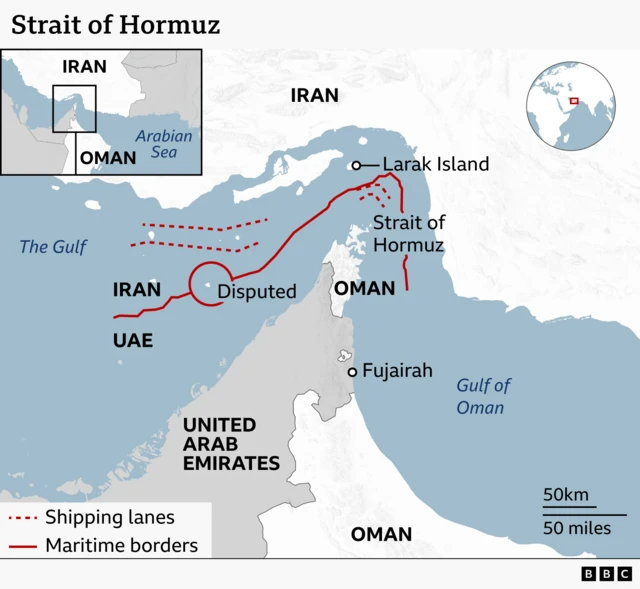
    Iran's National Security Committee has approved a plan to toll vessels crossing through the Strait of Hormuz, the semi-official Fars News Agency reported on Monday.

    An annotated map of the Strait of Hormuz that shows shipping lanes and maritime borders.
  10. Israel aims to keep security control over a swathe of southern Lebanon after war endspublished at 05:10 BST

    Israel's Minister of Defence has said a buffer zone will be set up inside southern Lebanon and that Israel will keep security control over a swathe of the territory, even after the end of the current war against the armed group Hezbollah.

    Israel Katz said the area to be occupied would go up to the Litani River - about 30km from the border with Israel. The plan has drawn criticism from the UN, European nations and Canada - who called it "a violation of territorial sovereignty".

    Katz said more than 600,000 displaced Lebanese residents would be "completely prohibited" from returning to that area until the safety of residents of northern Israel was guaranteed. He added that all the houses in Lebanese villages near the Israeli border would be demolished, "according to the model of Rafah and Beit Hanoun in Gaza".

    The BBC's Hugo Bachega in Beirut told the Global News Podcast, external what that could mean for Lebanon.

  11. Brent crude makes highest monthly gain since 1990 Gulf warpublished at 04:37 BST

    Osmond Chia
    Business reporter

    The price of Brent crude oil to be delivered in May rose by a record 64% in March - the highest monthly gain since the Gulf war in 1990.

    The global benchmark for oil is a contract to buy a barrel of Brent crude one month in the future. When this price rises, it typically pushes up fuel prices too as oil is a key component in its production.

    On Wednesday, the price of Brent for June delivery was trading 1.2% higher to $105.36 (£79.61).

    Brent's previous highest monthly gain was in 1990 during Iraq's invasion of Kuwait, which disrupted the global supply of energy and sparked fears of a broader Middle East conflict, said Alberto Bellorin from InterCapital Energy.

    These conditions mirror those seen in the ongoing conflict with Iran, which has driven up oil prices as markets take account for the heightened geopolitical risk, he said.

    Oil prices are likely to continue to rise if shipping flows remain disrupted and if the conflict does not ease, said Goh Jing Rong from the Singapore Management University.

    Meanwhile, Asian stock markets jumped this morning after President Donald Trump said the US will leave Iran in "two to three weeks".

    Japan's Nikkei 225 index gained by 4%, while the Kospi in South Korea rose by more than 6%.

    Read more here.

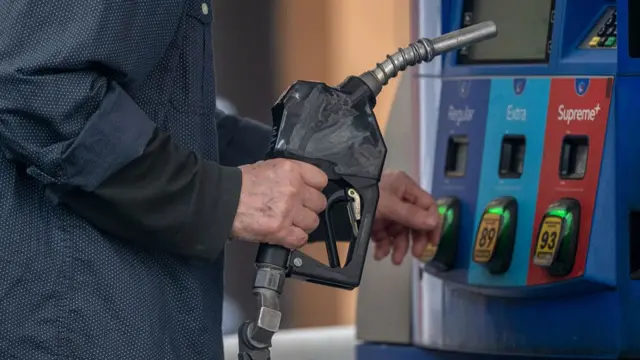
    A driver refuels a vehicle with unleaded petrol at a gas station in New YorkImage source, Getty Images
  12. Tanker hit by projectile off coast of Qatar, UK maritime agency sayspublished at 04:08 BST

    A tanker has been hit by an "unknown projectile" off the coast of Qatar's capital of Doha, according to the UK Maritime Trade Operations.

    The agency says the vessel was struck "on the port side causing damage to hull above the water line", but all crew members were reported as safe.

    It adds that authorities are investigating the incident and there is "no environmental impact" from the incident.

    The attack comes a day after a tanker transporting two million barrels of oil from Kuwait and Saudi Arabia was hit by an Iranian drone strike while it was docked off the coast of Dubai.

    A fire broke out and was later extinguished, with all crew members safe and uninjured, according to local authorities.

  13. China steps up efforts to push for ceasefirepublished at 03:48 BST

    Laura Bicker
    China correspondent

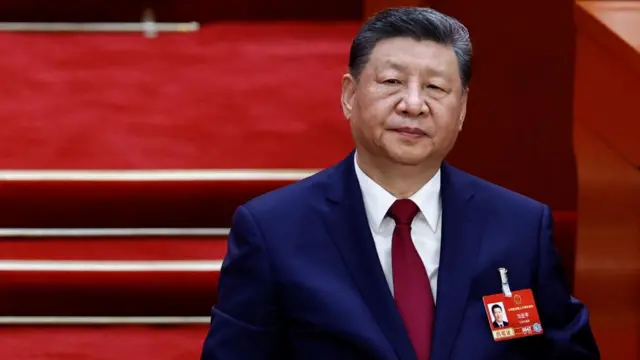
    Chinese President Xi Jinping attends the closing session of the National People's Congress (NPC)Image source, Reuters

    China and Pakistan have presented a five-point plan to try to end the war in Iran which includes an immediate ceasefire and the reopening of the Strait of Hormuz.

    The initiative was drafted after Pakistan’s foreign minister flew to Beijing to ask for Chinese support for the country’s efforts to negotiate an end to the war.

    China’s Foreign Ministry said the two were making “new efforts towards advocating for peace”.

    China’s response to the war in Iran has so far been quite muted. Beijing has a stockpile of oil and is more insulated than many other Asian countries from shortages. But there are already fears that China’s industrial heartland which forms the factory of the world will be impacted long term if this crisis continues.

    The war in Iran jeopardises something President Xi covets - stability. Beijing needs a stable global economy if it is to continue growing and exporting goods.

    Now, a month into the conflict, with petrol prices continuing to climb, the Chinese government is stepping up efforts to push for a ceasefire.

    The Chinese government has tried the role of peacemaker in the Middle East before, with limited success. In 2023 it brokered a deal between Saudi Arabia and Iran which did result in a resumption of diplomatic ties. A year later it hosted leaders from 14 Palestinian factions which resulted in a national unity government.

    There are few signs anyone is responding to the plan for now, but pushing forward this initiative allows President Xi to play the role of neutral broker and peacemaker - and once again stand in contrast to the leader of the other major superpower.

  14. Rubio: 'We can see the finish line'published at 03:22 BST

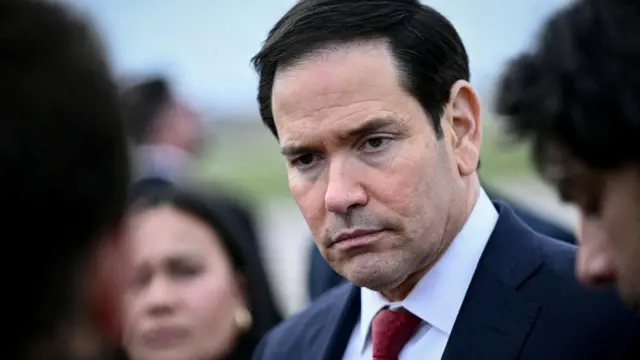
    Marco Rubio looks straight at the camera, wearing a dark suit, red tie and white shirtImage source, Reu

    US Secretary of State Marco Rubio says the US is exchanging messages with Iran and that an end to the war is in sight.

    "There are talks going on," he tells Sean Hannity on Fox News. "There is the potential for direct meeting at some point. We're always going to be open for that."

    But, he adds, President Trump is not going to allow "fake negotiations to be used as a delay tactic, to buy more time".

    While he says he doesn't want to put a timeline on it, "we can see the finish line", Rubio tells Hannity during the interview.

    The secretary also criticises Nato, saying the US may have to re-examine whether or not the alliance "that has served this country well for a while is still serving that purpose".

  15. What we learned from Trump's latest Oval Office remarkspublished at 03:01 BST

    Kwasi Gyamfi Asiedu
    Live reporter

    A few hours ago, we heard from Donald Trump at the White House.

    Here is a round up of what he said:

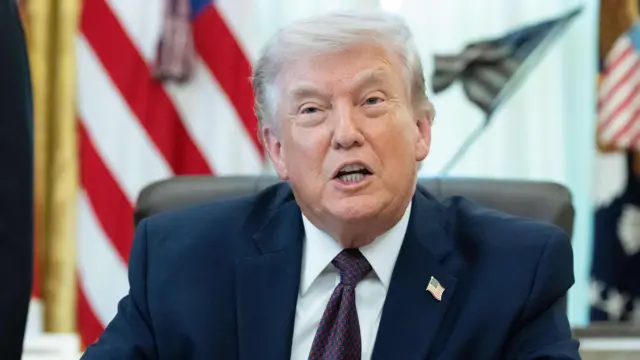
    • Trump told reporters the US "will be leaving [Iran] very soon" and US military action could end as soon as "two or three weeks"
    • He says the US has achieved the goals set before airstrikes against Iran began late last month in conjunction with Israel. He says the primary goal of curtailing Iran's ability to obtain a nuclear weapon has been reached and the US was now "finishing the job
    • Trump says the US now dominates Iranian skies and has also achieved regime change following the killings of many senior political and military leaders. He described the new leaders in Tehran as "much less radicalised" and "more rational" compared to their predecessors
    • He said once the US was sure Iran would not be able to "come up with a nuclear weapon" then "we'll leave whether we have a deal or not. It's irrelevant now, it's possible that we'll have a deal because they want to make a deal".
    • He went on to say Iranian leaders are "begging to make a deal" with the US to end the war, which has previously been denied by Iran
    • He adds that the war could end without a deal brokered between both sides
    • On the war's impact on rising fuel prices, the president says they will come down as soon as the US ends its military actions
    US President Donald J Trump gives remarks from the Oval Office.Image source, EPA
  16. Beirut rocked by 'heavy' strikespublished at 02:43 BST

    Lebanon's capital Beirut has been hit by heavy airstrikes in which Israel's military says it struck a Hezbollah commander and another senior figure.

    The IDF says it conducted "two separate attacks" across Beirut overnight.

    Smoke columns were seen rising from the Jnah neighbourhood on the outskirts of southern Beirut, while multiple "heavy" explosions shook parts of the city, according to security officials speaking to Reuters.

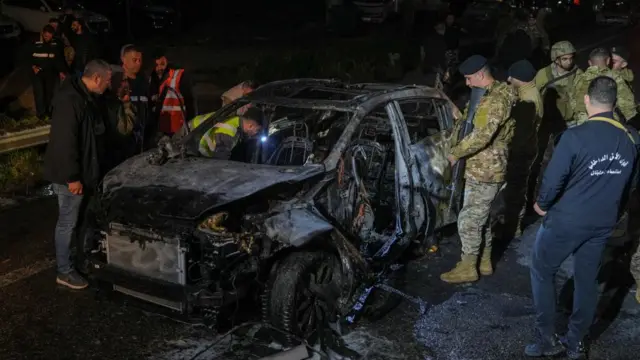
    A car travelling south of Beirut was hit by multiple missiles launched by an Israeli drone, Lebanese state media reported.

    Earlier on Tuesday, Lebanon's Ministry of Health said at least seven people had been killed by Israeli strikes in the country's south, including a paramedic.

    The strikes are the latest in an escalating Israeli offensive in Lebanon which has killed at least 1,200 people and displaced 1.2 million others.

    Emergency personnel operate around a burned car following a targeted Israeli strike, amid escalating hostilities between Israel and Hezbollah, as the U.S.-Israel conflict with Iran continues, in Khaldeh, Lebanon, March 31, 2026.Image source, Reuters
  17. Trump to give 'important update on Iran' on Wednesday nightpublished at 02:26 BST

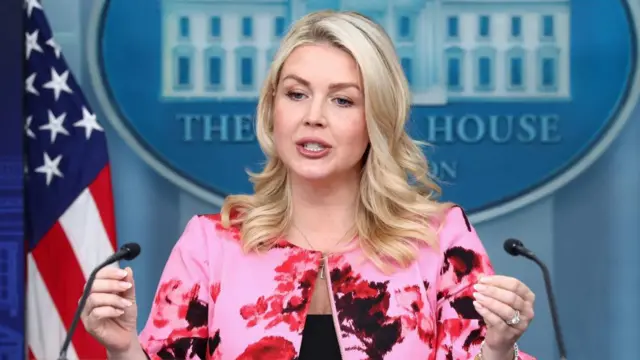
    As we reported earlier, President Donald Trump is set to "provide an important update on Iran" on Wednesday evening, White House Press Secretary Karoline Leavitt said.

    The address to the nation will be at 21:00 ET (02:00 BST, 01:00 GMT).

    Leavitt did not give any further information.

    White House Press Secretary Karoline Leavitt holds a press briefing in the James S. Brady Press Briefing Room at the White House in Washington, D.C., U.S., March 30, 2026.Image source, Reuters
  18. Iran factory destroyed in earlier strikes used for chemical weapons, not medicine, Israel sayspublished at 02:08 BST

    The Israeli military has provided a statement relating to earlier strikes on a medicines manufacturer in Iran.

    Earlier, a factory owned by the Tofigh Daru Research and Engineering Company was destroyed in an air strike, prompting Iranian Foreign Minister Abbas Araghchi to accuse Israel of "openly and unashamedly bombing pharmaceutical companies".

    The Israel Defense Forces (IDF) says the manufacturer supplied fentanyl to the organisation behind Iran's nuclear weapons programme – SPND (Organization of Defensive Innovation and Research).

    The IDF says the factory "presented itself as a civilian company" while it would "conduct research and development of chemical warfare agents".

    Iran and Israel's statements have not been verified by independent sources.

  19. Iran has 'necessary will' to end conflict, says Iranian presidentpublished at 01:46 BST

    John Sudworth
    Senior News Correspondent

    Iran has the "necessary will" to end the war with the United States and Israel as long as certain conditions are met, the country's president Masoud Pezeshkian said on Tuesday.

    The comments, which boosted markets in the US, were made in a phone call between Pezeshkian and the President of European Council, and originally reported by Iranian state media.

    Though the markets may have seen a glimmer of hope in the comments, especially as they came from a man long seen by many in the west as a moderate, the post of President is a subordinate one in a system long run by hardline clerics.

    The claim there is a "will" to end the war anyway also came with heavy caveats - namely that guarantees are put in place that there will not be a return to conflict.

    On the face of it, that doesn’t appear to change much, as calls for non-aggression guarantees had already been included in Iran's reported response last week to America’s 15-point peace plan.

    And the powerful Islamic Revolutionary Guard Corps are certainly not offering olive branches, with new threats to widen the retaliation to include US tech companies.

  20. Iran war could be costing the US up to two billion dollars per day, experts saypublished at 01:44 BST

    Sakshi Venkatraman
    US reporter

    The war in Iran could be costing the US as much as $2bn (£1.5bn) per day, experts who tracks the economic toll of global conflicts tell the BBC.

    Stephanie Savell, director of Brown University's Cost of War project, says between weapons and military spending, damage to US assets, and other line items, the war has already cost Americans tens of billions of dollars.

    "Every day that the war is ongoing is adding a huge amount to the public debt," Savell tells me.

    The Pentagon earlier this month told Congress that the first six days of the war had cost $11.3bn, US media reports. Savell believes that number is higher in reality.

    Harvard University defence budgets expert Linda Blimes says the war is likely already costing around $2bn per day.

    That level of cost is always passed down to the average American, Savell says, noting the war has already caused an "upheaval" to gas prices. There are also possible impacts when it comes to inflation, business uncertainty and insurance costs in the long run.

    The White House also said earlier this month that it is seeking $200bn (£150bn) more for the war in Iran, which Savell said is a massive number.

    "It really does cement that the war is ongoing," she said.