Summary

  1. US-Iran dicussions 'ongoing' as US blockade remains in placepublished at 22:29 BST 15 April

    Jack Grey
    Live reporter

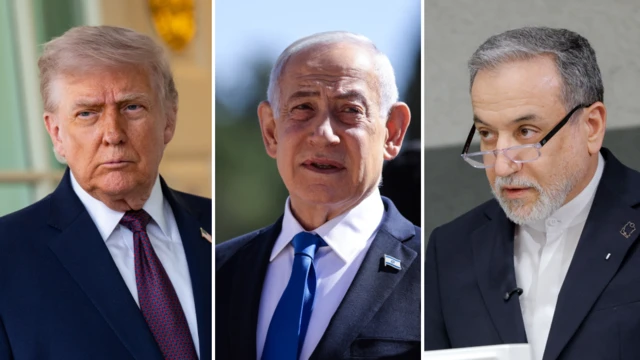
    A composite image of (from left to right) US President Trump, Israeli Prime Minister Benjamin Netanyahu and Iranian Foreign Minister Abbas AraghchiImage source, Getty Images

    The White House says the US remains "engaged" in "productive and ongoing" discussion with Iran, while a US blockade of all ships entering or exiting Iranian ports remains in place.

    Here's are the key developments from across the day:

    US-Iran talks

    • The White House has denied reports that the US formally requested to extend the two-week ceasefire agreement with Iran
    • Press Secretary Karoline Leavitt said the US "feels good" about the prospect of a deal, but says no date has been set for further negotiations
    • Meanwhile in Iran, a delegation from Pakistan - which has acted as a mediator in US-Iranian talks - arrived in Tehran for further discussion with the Iranian regime

    US blockade

    • The US-enforced blockade of any vessels entering or exiting Iranian ports remains in place, with the White House saying it is now "fully implemented" and providing no indication of how long it will remain
    • US Central Command reported that no ships have got through blockade since it came into force, adding that ten vessels had complied with orders to return to Iran
    • BBC Verify has identified several ships in the region turning off their trackers, having their signal jammed, or “spoofing” them in attempt to hide their location

    Israel-Hezbollah conflict

    • Fighting between Israel and Hezbollah has continued in Lebanon, with Israel Defense Forces (IDF) chief of staff Eyal Zamir describing all of southern Lebanon below the Litani River as a "killing area" for Hezbollah
    • Israeli Prime Minister Benjamin Netanyahu says his nation is "prepared for any scenario" with regards to the war, adding that Israel's goals remain aligned with those of the US
    • It follows talks between Israel and Lebanon on Tuesday, which Lebanon said were "productive" and which Israel said showed both nations were on the "same side of the equation"

    We're pausing our live coverage for the moment. For more on the war, read our our chief international correspondent's latest dispatch from Iran:Under fragile ceasefire, Iranians wonder if US deal can be done.
  2. US 'must comply' with Lebanon's inclusion in ceasefire, says Iran parliament speakerpublished at 22:28 BST 15 April

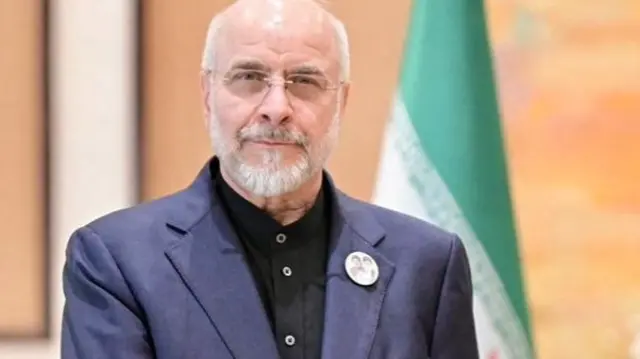
    Iranian Parliament Speaker Mohammad Bagher Ghalibaf picured in Islamabad, Pakistan, April 11, 2026Image source, Reuters

    Iran's Parliamentary Speaker, Bagher Ghalibaf, says the US "must comply" with a ceasefire agreement that includes Lebanon.

    In a statement posted on X, he says the completion of a "comprehensive ceasefire in Lebanon" will be down the the "steadfast struggle" of Hezbollah, the Iran-backed group based in Lebanon.

    He says Iran and the "Axis of Resistance" - a term for Iran-backed groups in the region, including Hezbollah, Hamas, Yemen's Houthis and Iraqi Shia militias - are "one soul, both in war and in ceasefire".

    "American should withdraw from 'Israel First' mistake," Ghalibaf concludes.

  3. White House gives no indication of Iran war costpublished at 22:23 BST 15 April

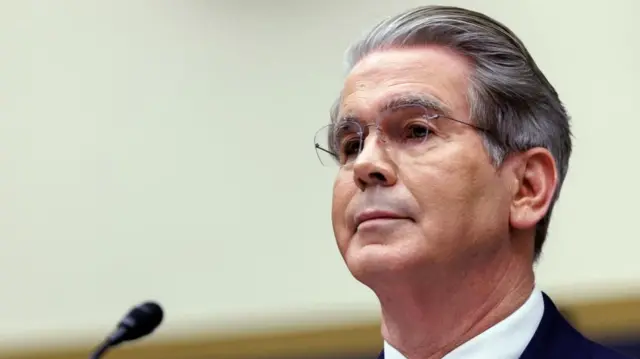
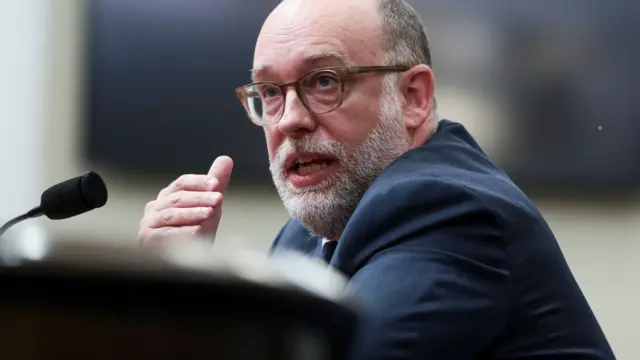
    Office of Management and Budget (OMB) Director Russell Vought appears before House Budget Committee hearing on the Trump administration's 2027 budget request, on Capitol Hill in Washington, D.C., U.S., April 15, 2026Image source, Reuters

    A White House representative has told congress that the administration is "still working" on the financial cost of the war with Iran.

    White House budget director Russell Vought was appearing before congress to ​discuss President Trump's proposed budget for the 2027 fiscal year, which includes $1.5 trillion (£1.1tn) for defence spending.

    Vought is asked by Texas Congresswoman Veronica Escobar how much the White House will be asking for to fund the war in Iran, referencing reports that place that figure at about $100bn.

    "We're not ready to come to you with a request, we're still working on it.," replies Vought.

    Asked if he has a ballpark figure, Vought says he does not. Asked if the figure is higher than $50bn, Vought reiterates: "I don't have a ballpark for you".

  4. What is China's role in the Iran war?published at 22:03 BST 15 April

    The BBC's security correspondent Frank Gardner explains how the world's second-largest economy fits into the Gulf conflict.

    For one, China is the biggest customer of Iran's oil, making the US blockade of Iran's ports a major flashpoint at the moment.

    Watch below for his full analysis:

    Media caption,

    Frank Gardner: What is China's role in the Iran war?

  5. US says it intercepted cargo vessel attempting to evade blockadepublished at 21:52 BST 15 April

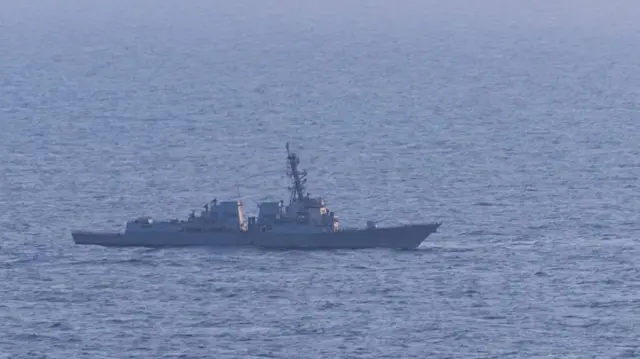
    Image of US destroyer the USS Spruance pictured in the ocean from a fair distance awayImage source, CENTCOM
    Image caption,

    The US says the "guided-missile destroyer" USS Spruance intercepted an Iranian-flagged ship attempting to evade its blockade

    US Central Command (Centcom) says it intercepted an Iranian-flagged cargo vessel that attempted to evade its blockade of all ships entering or exiting Iranian ports.

    Centcom says the the ship was intercepted on Tuesday after departing the Iranian port city of Bandar Abbas and exiting the Strait of Hormuz.

    It says US Navy destroyer USS Spruance "successfully redirected the vessel", which is now returning to Iran.

    Centcom adds that it has now successfully turned 10 vessels back to Iran and says none have broken through the blockade since it was implemented on Monday.

  6. US stocks hit record highs as investors bet on peace in Iranpublished at 21:29 BST 15 April

    Archie Mitchell
    Business reporter

    US stocks reached record highs on Wednesday as investors expressed hope ongoing talks could bring about peace in the US-Israel war in Iran.

    After strikes on Iran began on 28 February, the major Wall Street indexes saw sharp falls amid fears a long conflict could lead to an economic downturn.

    But, with the US hailing recent peace talks as “productive”, the S&P 500 and Nasdaq Composite hit record highs.

    The S&P 500 rose by 0.8% on Wednesday to sit above 7,000 points for the first time. It was at 6,878 points when the strikes began.

    The Nasdaq rose by 1.6% on the day to 24,016 points, also a record and comfortably above pre-conflict levels.

    Another major index, the Dow Jones Industrial Average (DJIA), has yet to return to its pre-war levels, and remained flat on Wednesday.

  7. IDF chief approves plans for further fighting, says spokespersonpublished at 21:01 BST 15 April

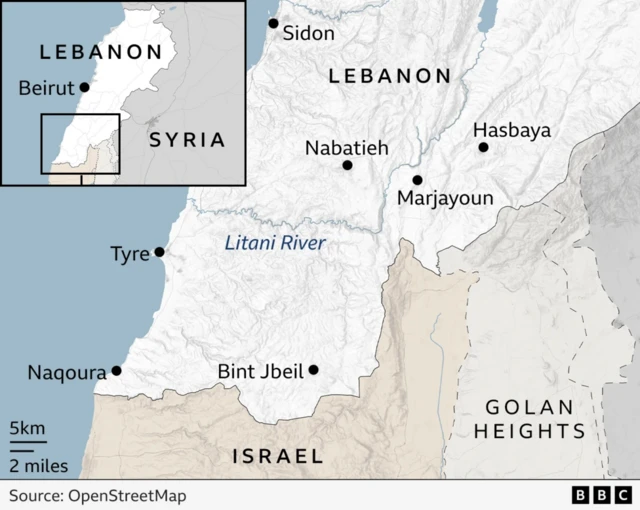
    Israel Defense Forces (IDF) spokesperson Effie Defrin says its chief of general staff, Eyal Zamir, "has approved plans for further fighting both in Lebanon and in Iran".

    The chief of staff has also declared "all territory of southern Lebanon until Litani River line" as a "killing area for Hezbollah terrorists", he adds.

    Defrin says the IDF has killed over 1,700 Hezbollah members in its military operation in Lebanon so far, and that it is "going to continue and persecute [Hezbollah] wherever they hide".

    A map of southern Lebanon showing towns, rivers and borders near Israel and the Golan Heights. Major towns are marked with black dots, including Sidon on the coast in the north, Nabatieh inland, Hasbaya to the east, Marjayoun slightly southwest of it, Bint Jbeil near the southern border, and Tyre and Naqoura along the Mediterranean coast. The Litani River is labelled in blue, flowing down from north and then turning abruptly and heading west to the Mediterranean Sea. The southern border with Israel is shown, and the Golan Heights lies to the southeast. An inset map in the top left highlights Lebanon’s location within the wider region, showing Beirut and the border with Syria. A scale bar indicates distances of 5km and 2 miles. Source: OpenStreetMap.
  8. War powers vote in US Senate fails, againpublished at 20:34 BST 15 April

    Ana Faguy
    Reporting from Capitol HIll

    For the fourth time, a resolution aimed at limiting President Donald Trump's ability to wage war in Iran has failed in the US Senate, as the conflict nears its seventh week.

    The war powers measure was rejected in a 52-47 vote largely along party lines. Had it passed, it would have halted US military action in Iran without congressional approval.

    Democrats have said they plan to bring similar measures on a weekly basis to get lawmakers on the record about the strikes.

    "If we're unsuccessful [with the votes], at least we'll make clear to the American people who owns this war," Senator Tim Kaine, of Virginia, told the BBC ahead of the vote.

    Most Republicans blocked the resolution on Wednesday, but some said they would consider changing course if the war reached the 60-day mark, the deadline for congressional authorisation for continued military operations.

    Senator Josh Hawley of Missouri told the BBC that the administration is currently in compliance with the war powers resolution, prompting his vote against the measure on Wednesday.

    But if the administration cannot show it's drawing down on the conflict and get a 30-day extension of congressional authorisation, Hawley said that is when he wants to see the Senate vote on a war powers resolution.

  9. Iran suspends exports of petrochemicals products ‘until further notice’published at 20:06 BST 15 April

    Ghoncheh Habibiazad
    Senior reporter, BBC Persian

    Iranian outlets have reported that the country has suspended exports of all petrochemical products “until further notice” to meet “domestic needs”.

    Since the war began, Israel has claimed responsibility for attacks on a number of petrochemical complexes in Iran, including in Asaluyeh and Mahshahr, both in the country's south.

    Iranian outlet Jamaran says facilities, such as Fajr Energy Persian Gulf in Mahshahr, and Mobin Energy and Damavand Energy in Asaluyeh have been “severely damaged”, with production halted at more than 50 petrochemical complexes across the two regions.

    Products from this industry range from plastics to fertiliser, meaning the impact could affect several industries and jobs within Iran.

  10. US Treasury announces new Iran-related sanctionspublished at 19:56 BST 15 April

    Scott Bessent stands at a podiumImage source, EPA/Shutterstock
    Image caption,

    US Treasury Secretary Scott Bessent

    The US Treasury has announced a series of new sanctions against individuals, organisations and vessels linked to Iran.

    Three people, nine vessels, and 17 entities - which can mean companies or organisations - have had sanctions placed on them, according to the update on the Treasury website.

    It follows an announcement from Treasury Secretary Scott Bessent a short while ago, that the US would not be renewing a waiver on sanctions that had allowed for the purchase of Russian and Iranian oil floating at sea.

  11. Analysis

    Little new information from the White House on talkspublished at 19:42 BST 15 April

    Bernd Debusmann Jr
    reporting from the White House

    We've just wrapped up a briefing at the White House.

    The US public learned little from that briefing with regards to the potential for future talks or a timeline for the conflict to end, with Leavitt saying only that the US remains "engaged" in the talks and that conversations are "ongoing".

    Similarly, Leavitt declined to put any timeline on the US naval blockade, leaving open the possibility of an open-ended military commitment to enforce it in the long-term.

    While President Trump had earlier suggested that other nations would join in the enforcement of the blockade, we heard nothing about that today, despite Leavitt saying it was now fully implemented.

    Much more clear is that the White House is seeking to calm the nerves of Americans who are growing increasingly anxious that the conflict will have an impact on wallets, most notably when it comes to the petrol pump.

    But while Bessent said he was "optimistic" that gas prices would fall, he provided few details as to why he believes that.

  12. Israel is prepared for any scenario, says Netanyahupublished at 19:27 BST 15 April

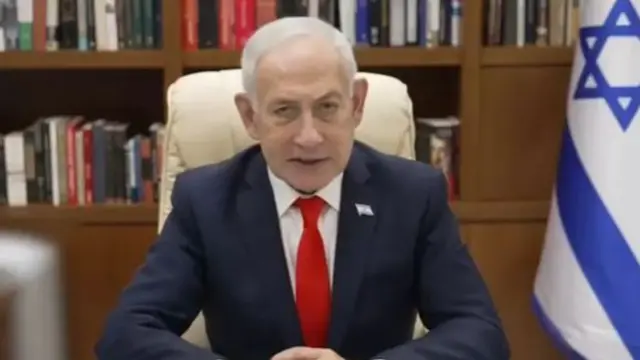
    Netanyahu speaks to camera as he sits at his deskImage source, @netanyahu via X

    Israeli Prime Minister Benjamin Netanyahu says his country is "prepared for any scenario" in regards to the war in Iran and Lebanon.

    In a video address, Netanyahu says that Israel is "on the verge of eliminating" a "major Hezbollah stronghold" in Bint Jbeil, southern Lebanon.

    The prime minister confirms that he has asked the Israel Defense Forces (IDF) to also "continue securing the security zone" in this area and to "extend it eastward".

    Netanyahu also says Israel's goals in the war remain aligned with those of the United States.

    "It is still too early to say how this will end or even how it will progress. In light of the possibility that the fighting may resume, we are prepared for any scenario," he says.

  13. Discussions for second round of talks ongoing, says White House - what else?published at 19:15 BST 15 April

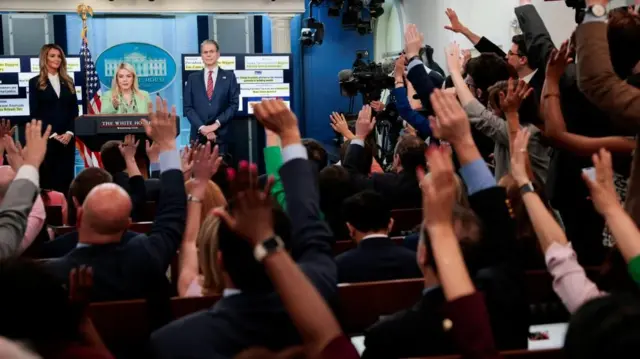
    A large group of members of the press raise their hands to ask questions in the White House briefing roomImage source, Reuters

    We've just finished covering a briefing at the White House. While not substantively on the Iran war, Press Secretary Karoline Leavitt and US Treasury Secretary Scott Bessent did answer a few questions on it.

    Here's a look back at the key bits:

    • Bessent said any movements in the price of oil would depend on how negotiations with Iran go, but added he was "optimistic" that petrol prices in the US will fall back to $3 a gallon by late September
    • Plans for another round of in-person peace talks are still being discussed, and would likely be held again in Islamabad, Pakistan, Leavitt said
    • The US has asked Middle East countries to freeze Iran's Islamic Revolutionary Guard Corps (IRGC) bank accounts, and will consider secondary sanctions if they don't, Bessent said
    • President Xi Jinping has assured Trump that China is not supplying Iran with weapons, and Chinese banks have been warned about holding Iranian funds, Leavitt said
    • The US will not be renewing temporary waivers allowing the purchase of Russian and Iranian oil, Bessent said
    • Leavitt said she did not have a timeline for the duration of the ongoing US naval blockade of Iranian ports
  14. Leavitt says Iranian port blockade now fully implementedpublished at 19:03 BST 15 April

    A reporter asks Leavitt how long the US navy blockade of Iranian ports will go on.

    She says she will "never set timelines on behalf of the president", but notes that the operation has now been fully implemented.

    The blockade is being enforced against vessels of all nations that are entering or departing Iranian ports, she says.

    For vessels transiting the strait outside of the ports, US forces are supporting freedom of navigation, she adds.

    The briefing concluded shortly afterwards.

    We'll bring you a recap of the key points in a moment.

  15. Waivers allowing purchase of Russian and Iranian oil won't be renewed - Bessentpublished at 19:02 BST 15 April

    Bessent stands at a podium in the White HouseImage source, Reuters

    Bessent says that the US government "will not be renewing the general licence on Russian oil", nor one on Iranian oil.

    These were temporary waivers of sanctions that allowed for the purchase of Russian and Iranian oil that was already at sea at the time.

    Bessent clarifies that those waivers were on "oil that was on the water prior to March 11th, so all that has been used".

  16. Chinese banks have been warned about holding Iranian funds - Bessentpublished at 18:55 BST 15 April

    Leavitt and Bessent are asked if Trump's threats of a 50% tariff on China are still on the table.

    Leavitt says President Xi Jinping assured Trump "they are not supplying Iran" with weapons in this conflict.

    Bessent says two Chinese banks got letters from the US treasury that if they can prove there is Iranian cash in their accounts the US is willing to slap secondary sanctions on those banks.

    He did not identify the banks that received the letters.

  17. Bessent says 'Operation Economic Fury' under way against Iranpublished at 18:51 BST 15 April

    Treasury Secretary Scott Bessent says "Operation Economic Fury" is now under way, with the US putting financial pressure on Iran.

    He says Iran made the mistake of bombing other nations in the Middle East, and those countries are now being "more transparent" about the Iranian funds in their banking systems.

    The US has requested that those nations freeze the funds of the IRGC leadership, Bessent says.

    He adds that countries are being cautioned against buying Iranian oil. If they have Iranian cash in their banks, the US will consider secondary sanctions.

  18. White House says talks with Iran 'productive and ongoing'published at 18:50 BST 15 April

    Leavitt is next asked about the Iran ceasefire, and says that reports the US has asked to formally extend it are "not true".

    "We remain very much engaged in these talks," she says, and conversations are "productive and ongoing".

    On reports that there are in-person talks being planned, she says "those discussions are being had but nothing is official until you here it from us here at the White House".

    "We feel good about the prospects of a deal", Leavitt says, adding that it's "in the best interests of Iran" to meet Trump's demands - which she says he's made "very clear".

    If talks happen, they would "very likely" be in the same place they were last time - Islamabad - she says.

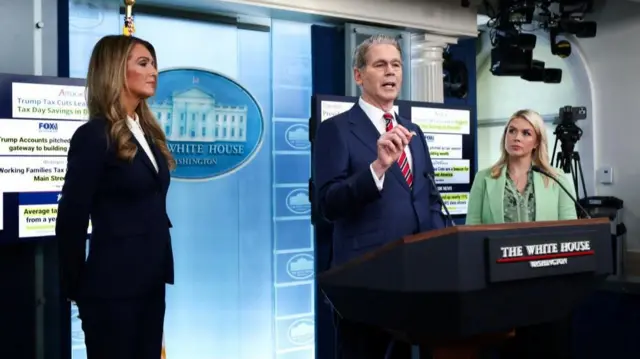
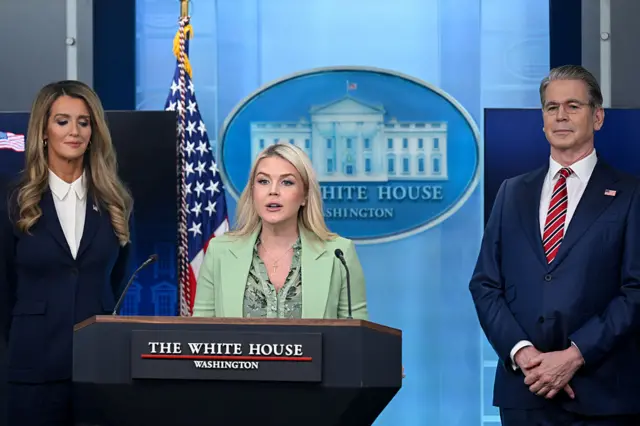
    Three people in suits stand in front of a blue backdrop with the White House logoImage source, Getty Images
  19. Bessent 'optimistic' US petrol prices will fall before late Septemberpublished at 18:43 BST 15 April

    After an early section of the briefing focused on domestic issues, the news conference touched on the economic impact of the war in Iran - specifically, the price of oil.

    Bessent is asked when US drivers will begin to see lower petrol prices which have gone up considerably since the start of the war.

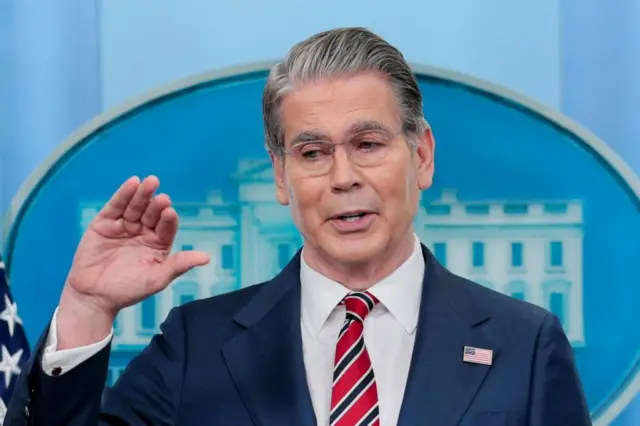
    He says prices will depend on how Iran negotiations go and that the US has obeyed the ceasefire conditions although the Strait of Hormuz hasn't been fully reopened.

    "I am optimistic that sometime between June 20 and September 20, we can have $3 gas again," he says.

    A man with grey hair and a red, white and blue striped tie wearing a blue suitImage source, Reuters
  20. White House briefing under way - watch and follow livepublished at 18:20 BST 15 April

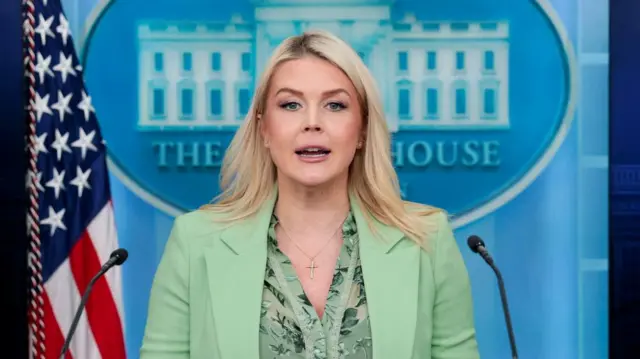
    White House Press Secretary Karoline Leavitt speaks during a press briefing at the White House in WashingtonImage source, Reuters

    A briefing from White House Press Secretary Karoline Leavitt has just started.

    Leavitt is joined by Treasury Secretary Scott Bessent and is expected to speak mainly about domestic issues (specifically taxes as 15 April is Tax Day in the US).

    It's likely, though, that reporters will get the opportunity to pose questions about the war in the Middle East, too.

    We're listening across and will bring you the key lines. You can also watch live at the top of the page.