Summary

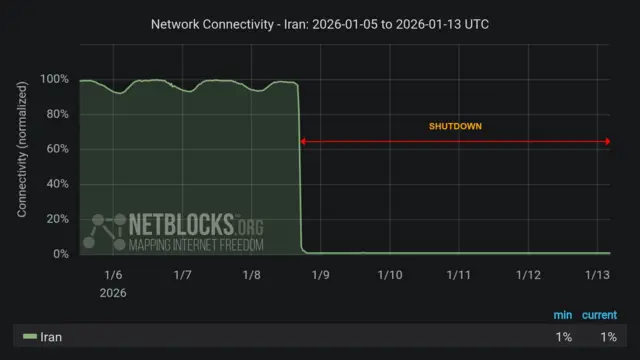
  • Iran has been without internet for more than 100 hours, but we're verifying any footage that does emerge of anti-government protests

  • One newly shared video shows hundreds of protests clashing with security forces in the north-western city of Urmia

  • We're debunking claims that a woman fatally shot by an ICE agent in the US had a criminal record

  • Plus the team are listening to the Scottish government's Budget later to fact-check key claims

  • BBC Verify uses open-source intelligence, satellite imagery, fact-checking and data analysis to help report complex stories

  • This feed is where we post our work throughout the day

  • Get in touch with us by following this link

  1. Verifying protest footage in Minneapolis and Iranpublished at 18:00 GMT 13 January

    Aisha Sembhi
    BBC Verify journalist

    We’re closing up our live page shortly, so here’s a quick recap of what the BBC Verify team has been working on today.

    Our coverage started with work monitoring protests in Iran amid a nationwide internet blackout that has lasted for over 100 hours. Here's an overview of what we looked into:

    The team has also examined new videos showing US federal agents using pepper spray and tear gas against protesters in Minneapolis, and debunked false claims about the woman fatally shot by an ICE agent last week.

    And our fact-checkers have been diving into the numbers behind the Scottish government’s annual budget, looking into how Holyrood’s spending is increasing and assessing the impact of the “mansion tax”.

    BBC Verify Live will be back with more tomorrow.

  2. Has Trump met his pledge on lowering petrol prices?published at 17:35 GMT 13 January

    Tom Edgington
    BBC Verify senior journalist

    As protests over ICE tactics continue to dominate the headlines, the Trump administration been highlighting its economic record on the official White House X account.

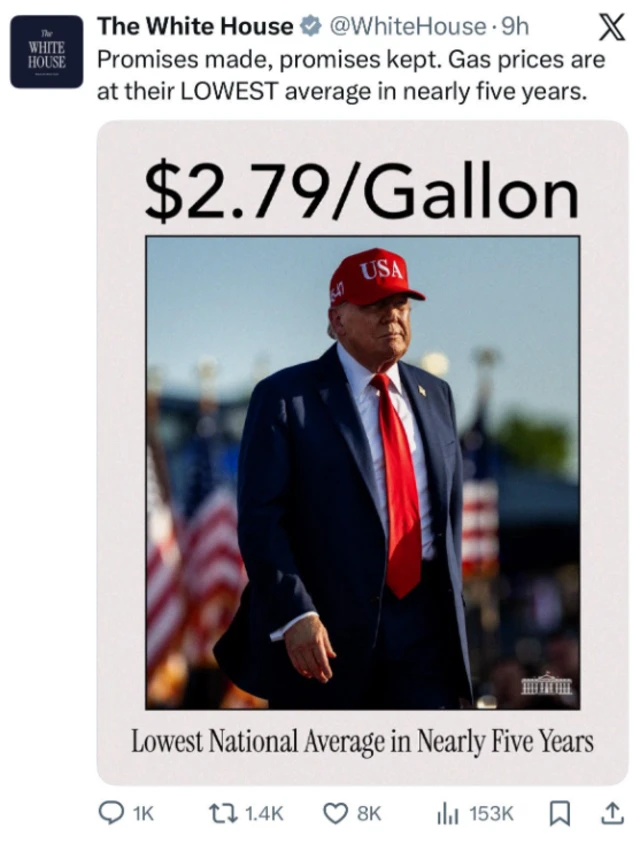
    In a post about gasoline prices, the White House declared “promises made, promises kept” alongside a photo of Donald Trump.

    It claimed prices had fallen to $2.79 (£2.42) a gallon (3.8 litres), the “LOWEST average in nearly five years”.

    A screengrab of the White House X post. It has a picture of Trump and the text: "Promises made, promises kept. Gas prices are at their LOWEST average in nearly five years. $2.79/Gallon USA Lowest National Average in Nearly Five Years"Image source, X/@WhiteHouse

    The five year claim is correct, according to data from the American Automobile Association (AAA).

    Last week the AAA said 2026 had started with the lowest national average petrol price since March 2021.

    This morning the AAA’s website reports a national average price of $2.82, only marginally higher than the figure cited by the White House.

    This compares to the national average price of $3.07 a gallon a year ago and down from a record high of $5.17 in June 2022, under the administration of former president Joe Biden.

    However, while the average petrol price has fallen, it is still above Trump’s campaign pledge to get gasoline to under $2 a gallon.

  3. How are Scots taxed compared with the rest of the UK?published at 17:33 GMT 13 January

    Phil Sim
    Scotland political correspondent

    Scotland has its own income tax system with six different bands ranging from 19% to 48%.

    The Scottish government calls it a more progressive system, because it taxes those with the broadest shoulders more heavily than average and lower earners.

    The SNP has pledged that a majority of Scots will pay less income tax than they would if they lived elsewhere in the UK.

    They have sought to achieve this by raising the thresholds where lower rates kick in, while freezing those for the higher rates.

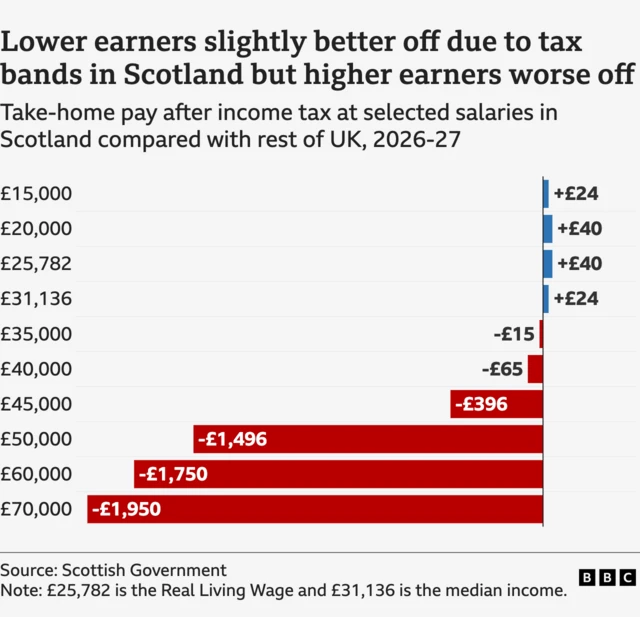
    Forecasts suggest that 55% of taxpayers in Scotland will pay slightly less - although by a margin of at most £40 a year.

    They suggest that someone earning £50,000 will pay almost £1,500 more than if they lived in the rest of the UK - with ministers arguing this is in return for better-funded public services.

    A horizontal bar chart showing take-home pay after income tax at selected salaries in Scotland compared with the rest of the UK in 2026-27. The chart shows that lower earners are slightly better off due to tax bands in Scotland but higher earners are worse off. Scottish taxpayers take home up to £40 more per year than their counterparts elsewhere in the UK at selected salaries up to £31,136 (the median salary in Scotland). But they take home increasingly less at higher salaries, up to nearly £2,000 extra for those earning £70,000.

    All of this is based on forecasts from the Scottish Fiscal Commission - and data on tax actually collected in 2023-24 showed that slightly more Scots overall had actually paid more tax than they would if they lived elsewhere in the UK.

    Updated forecasts for 2024-25 suggest that the SNP goal would only be met if you factored in deductions for things like pension relief.

    Ministers have given themselves a bit more margin for error this year, and are confident their promise will be delivered based on the latest estimates.

  4. No evidence for Renee Nicole Good’s alleged ‘criminal record’ sheetpublished at 16:27 GMT 13 January

    Lucy Gilder
    BBC Verify journalist

    Animage claiming to show that the woman shot and killed by a US immigration officer last week had an extensive criminal record has been widely shared on social media.

    It lists offences for which Renee Nicole Good had supposedly been arrested in the past, including “battery of a police officer” and “interfering with medical treatment”.

    But there are several incorrect details in the image, including her supposed date of birth. US authorities say Good was 37 years old , externalwhen she was killed, external and therefore could not have been born in October 1980, as the image claims.

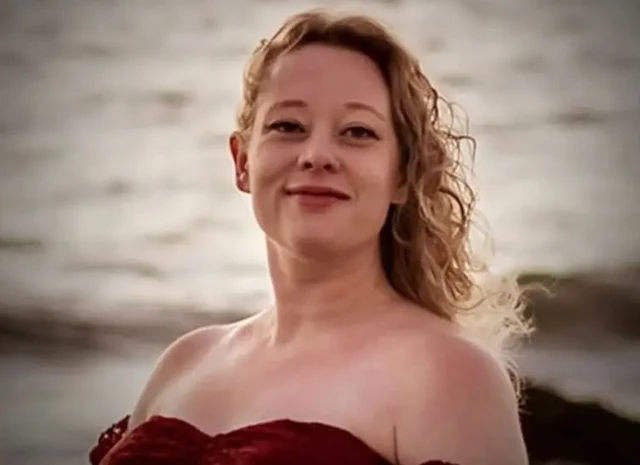
    A photo of Renee Nicole GoodImage source, Renee Nicole Good

    Also, her name and middle name are the wrong way round. The image lists her as “Good, Nicole Renee”.

    And there’s no publicly available evidence that she committed, or was even accused of committing, the crimes it lists.

    BBC Verify searched US public records databases for the name “Renee Nicole Good” and three other surnames she is reported to have previously used, “Ganger”, “Sheppard” and “Macklin”.

    We found a profile for someone that included all of those names and other details matching what we know about Good, such as her approximate year of birth and places she has lived.

    It lists one offence, “fail to have vehicle inspected”, allegedly committed in Virginia in 2017.

    We searched another database of US court records and only found a 2019 filing in Virginia for a bankruptcy case involving a person called Renee Nicole Good.

  5. What will be the impact of Scotland's mansion tax?published at 16:26 GMT 13 January

    Phil Sim
    Scotland political correspondent

    The plan for a mansion tax was one of the more eye-catching announcements in the Scottish Budget.

    A budget of £5m has been put aside for a “targeted revaluation” of certain properties, in a bid to create two new council tax bands targeting houses worth more than £1m by 2028.

    This will be done by reassessing some of the most valuable properties and reallocating those worth more than £1m into one of the two new bands.

    The money raised from those increased rates would go directly to local councils and some may benefit more than others, based on where the highest value properties are.

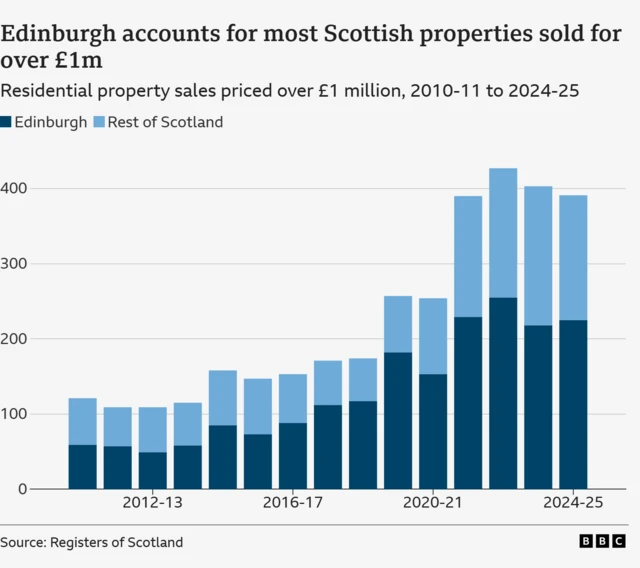
    Registers of Scotland said there were 391 properties sold for more than £1m in 2024-25 - and more than half of them were in Edinburgh.

    A stacked bar chart showing the number of residential properties sold for over £1m in Scotland from 2010-11 to 2024-25, broken down by sales in Edinburgh and the rest of the country. Total sales for over £1m have increased by just over 100 per year in the early 2010s to around 400 each year since 2021-22. Edinburgh accounts for more than half of these high value sales.

    However there will not be a broader revaluation of Scotland’s properties, meaning the rest of the council tax system will remain based on house prices determined in 1991.

    The Scottish government has estimated that a nationwide revaluation would see roughly half of Scotland’s homes change council tax band, and that kind of upheaval has long been seen as a barrier to reform of the levy

  6. How much money can the Scottish government spend?published at 16:26 GMT 13 January

    Phil Sim
    Scotland political correspondent

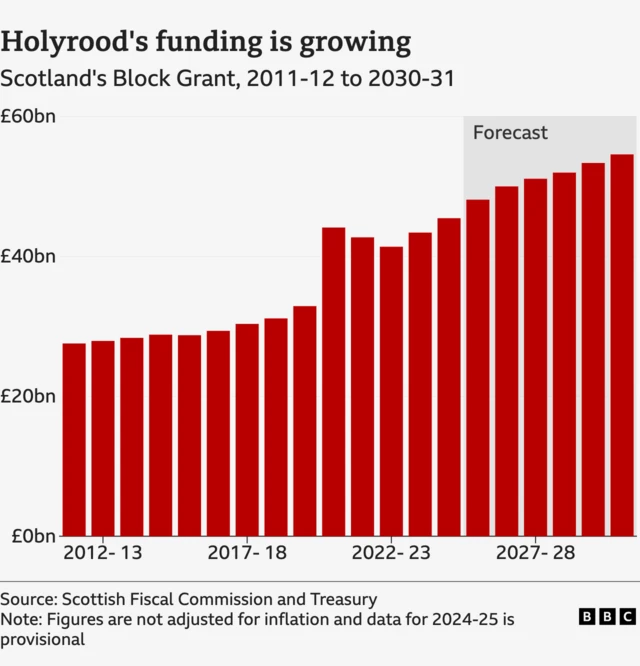
    We've also been following as the Scottish government is setting out its budget plans for the year ahead, with around £68bn of funding set to be decided.

    Holyrood’s budget is chiefly based on a block grant from Westminster, made up of Scotland’s share of UK-wide revenues and spending on devolved areas by the UK government, as well as devolved levies like income tax and some borrowing.

    The political dispute over the budget often extends to the overall size of the funding settlement.

    Over recent years there has been steady growth in the block grant, following a spike during the Covid pandemic.

    This followed years of more or less flat budget settlements during the austerity era, but the current trend of increases is currently forecast to continue.

    ALT text: A bar chart showing the size of Scotland's block grant by year, from 2011-12 to 2030-31. The block grant was around £28bn in 2011-12 and increased steadily to £33bn in 2019-20. It then rose sharply to £44bn in 2020-21 before falling back to £41bn in 2022-23. It is set to rise to almost £55bn by 2030-31. Figures are provisional for 2024-25 and forecasts from 2025-26 onwards. The data has not been adjusted for inflation

    In the UK budget in November, Chancellor Rachel Reeves announced an extra £821m of funding for Holyrood.

    But the SNP-led Scottish government notes that is spread over a number of years, and points to added costs like increased employer National Insurance Contributions for public sector staff to argue that the increase looks relatively small.

    Scottish Labour meanwhile want to make the figure look as big as possible, so prefer to add together all £5.2bn of the increases to the block grant announced since their colleagues took power at Westminster.

    These two parties of government will continue to dispute how much money there is, but ultimately the biggest debate will be over how it is spent.

  7. ICE agents seen using pepper spray on protesterspublished at 16:19 GMT 13 January

    Jake Horton
    BBC Verify

    A video we verified posted online from Minneapolis yesterday shows an agent deploy what appears to be pepper spray at a protester.

    Protesters are heard shouting “get out of here” and “shame on you” as agents drive down a residential street. One agent is then seen deploying what appears to be pepper spray in the face of a man who is shouting at him.

    The man who been sprayed says “I need help” as the agent gets into an unmarked car and drives away. This is a tactic which has been seen elsewhere in the city in recent days.

  8. Examining ICE tactics used on Minneapolis protesters following Renee Good shootingpublished at 16:18 GMT 13 January

    Jake Horton
    BBC Verify

    Protests have continued in Minneapolis since Renee Good, 37, was shot dead by an immigration agent in the city nearly a week ago.

    Immigration and Customs Enforcement (ICE) are still operating in the city despite mayor Jacob Frey asking the organisation to leave. The state of Minnesota is also suing the Trump administration in an attempt to block the surge of immigration agents across the state.

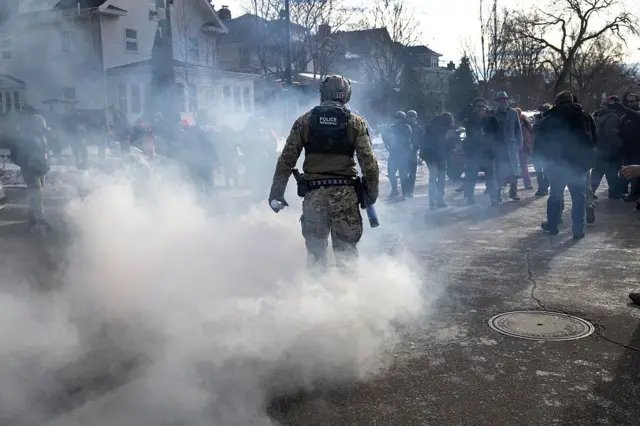
    We’ve verified a video posted online yesterday that appears to show ICE agents using tear gas on protesters.

    In the footage, 10 agents walk towards a crowd of protesters. There's then a loud bang and we see smoke rising. The protesters shout “Go, go, go” and “Get out of here” at the agents, who then walk away from the crowds.

    This is a tactic we’ve seen agents previously use in other US cities, as BBC Verify’s special investigation into ICE last year showed.

    “It’s an indiscriminate weapon," Dr Rohini Haar, an expert in tear gas explained. “So you can’t really target that towards an individuals that’s posing a threat or are causing harm. It will hit everyone in the area.”

    The Trump administration has called protesters “professional agitators” and say they are interfering with their immigration enforcement operations.

    Tear gas has been deployed in Minneapolis as federal agents clash with residentsImage source, Getty Images
    Image caption,

    Tear gas has been deployed in Minneapolis as federal agents clash with residents

  9. Tracking cargo ships and tankers at Iran port as US tariffs announcedpublished at 15:45 GMT 13 January

    Thomas Spencer & Emma Pengelly & Barbara Metzler
    BBC Verify journalists

    President Donald Trump has said countries doing business with Iran will face a 25% tariff on trade they do with the US.

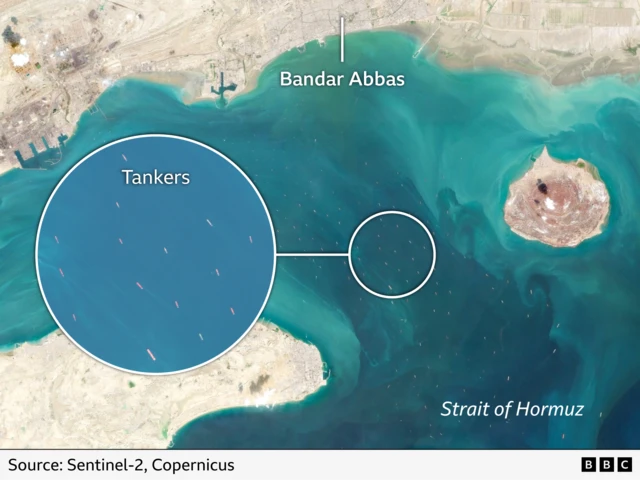
    It’s too early to tell the impact of these tariffs, but we’ve been using satellite images to look at how busy the Iran ports have been in recent days.

    One photo taken yesterday shows a number of cargo ships and tankers near Hormuz Island, an area serving the key port of Bandar Abbas in central southern Iran.

    Satellite image shows tankers near Iran port Bandar Abbas

    BBC Verify has been able to identify some of the vessels that appear in the above satellite image are on the US sanctions list.

    Not all of those pictured are visible on MarineTraffic, which tracks ships broadcasting their position using Automatic Identification System (AIS) location data.

    When vessels stop transmitting their location movements can still be checked using radar and optical satellite imagery. They can also spoof their location by broadcasting fake locations to appear where they are not.

    US authorities have previously said that sanctioned or so-called “shadow fleet” tankers often disable or tamper with AIS to conceal port calls and other activities linked to Iranian oil exports.

  10. Widely-shared AI-generated video claims to show protests in Iranpublished at 13:37 GMT 13 January

    Aisha Sembhi
    BBC Verify journalist

    As our team monitors videos emerging of protests in Iran, we have found fake or misleading videos shared online alongside real footage.

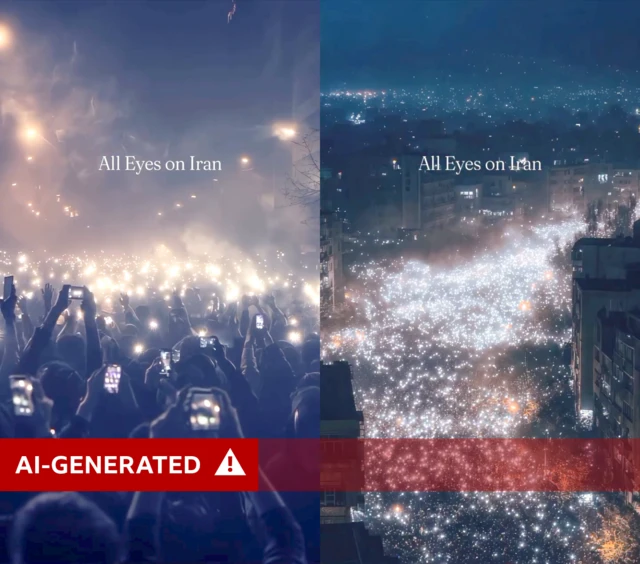
    Some of these false videos have been generated using AI - including this one showing masses of people filling a street with raised phones lighting up the crowd, with the words “All eyes on Iran”.

    A composite image showing two screengrabs from an AI-generated video posted to Instagram. The screengrabs show masses of people with phone torches lighting up the crowd, and the words 'All Eyes on Iran'.

    We know it’s not real because we carried out reverse image searches on several frames of the video and it led us to the original post on Instagram, which has now been viewed over 61 million times.

    In the description of this post, the creator said the video was a “digital tribute” to the current protests in Iran and that it was AI-generated.

    Despite the clip being fake, it’s been shared widely on X, TikTok and Facebook, with some of these reposts gaining hundreds of thousands of views.

  11. Verified videos show protests in Tehran and Urmiapublished at 13:19 GMT 13 January

    Emma Pengelly and Ghoncheh Habibiazad
    BBC Verify and BBC Persian

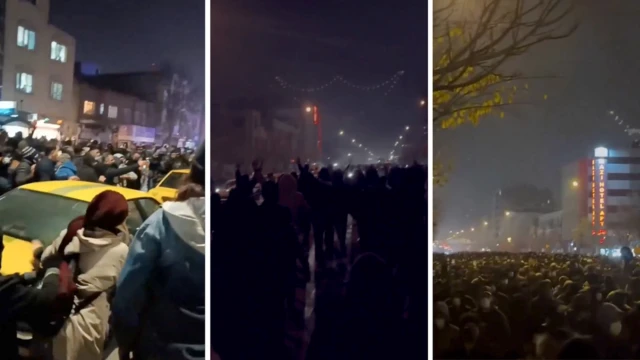
    The latest three videos from Iran we have verified show protests in the capital Tehran and the north-western city of Urmia.

    Two clips filmed in Tehran show large crowds filling a major road and chanting against security forces. They can be heard accusing the security forces of being “dishonourable”, a phrase regularly used by Iranian protesters.

    In Urmia, a video shows some protesters clashing with members of the security forces in riot gear.We’ve confirmed the precise location each video were filmed by matching surrounding buildings, businesses and road layouts to those visible in satellite imagery.

    Using screengrabs from the footage to check when the videos were shared, we found each first appeared online last night.

    However, this doesn’t necessarily mean they show events from yesterday. Due to the internet shutdown imposed by the Iranian government it’s difficult to be precise about the exact date these videos were filmed as they may have been uploaded with a delay.

    (Left) protests in Urmia, (centre and right) protests in Tehran
    Image caption,

    (Left) protests in Urmia, (centre and right) protests in Tehran

  12. Satellite images show extensive new clearance underway in Rafahpublished at 13:19 GMT 13 January

    Benedict Garman
    BBC Verify senior journalist

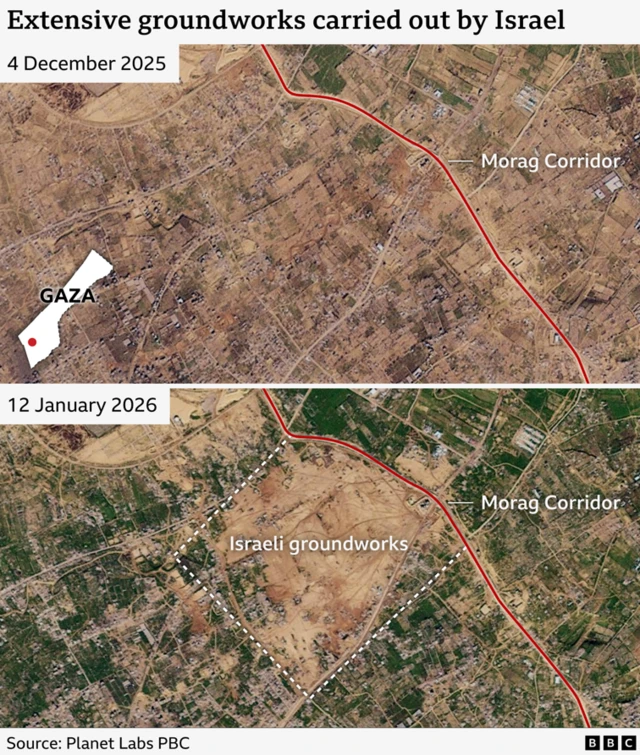
    New satellite imagery shows Israel is removing rubble and flattening an extensive area of Rafah in southern Gaza.

    The new clearance operation is happening in a part of north Rafah adjacent to an Israeli military route from Israel to the mediterranean sea known as the Morag Corridor. The buildings in this area were already systematically demolished by Israel.

    Comparing satellite photos captured on 12 January with images from 4 December shows groundworks covering an area spanning about 250 acres (1 sq km). High resolution satellite imagery also shows excavators and other heavy construction equipment in use there.

    From the images alone it’s unclear what this ground is being prepared for.

    Side-by-side image of satellite images, one from 4 December 2025 shows a large area of Rafah with lots of rubble and former agricultural land the second from 12 January shows a lot of that has been cleared and bare earth left behind
  13. Analysis of the Scottish Budget this afternoonpublished at 13:19 GMT 13 January

    Anthony Reuben
    BBC Verify senior journalist

    We’ll be working on analysis of the Scottish Budget with our colleagues in Scotland this afternoon.

    The speech will be delivered at Holyrood at 14:20 GMT and cover the Scottish government’s spending plans on devolved areas such as health, transport and education for the 12 months from April.

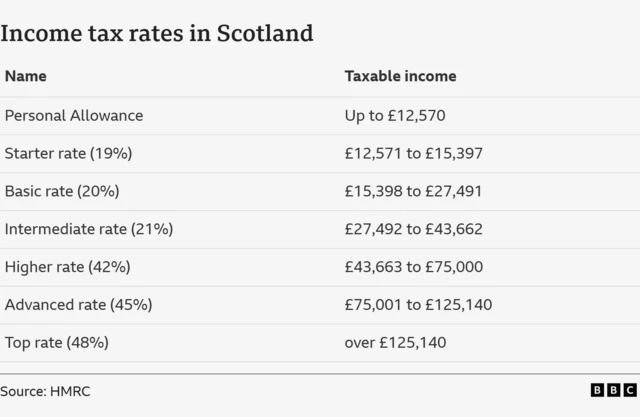
    The Scottish government also has some powers over setting income tax. Working out the impact of any changes to the tax system can be complicated, because Scotland currently has six tax bands, unlike England, Wales and Northern Ireland, which have three.

    Table showing income tax bands in Scotland: Personal allowance up to £12,570, Starter rate (19%) £12,571 - £15,397, Basic rate (20%) £15,398 to £27,491, Intermediate rate (21%) £27,492 to £43,662) Higher rate (42%) £43,663 to £75,000) Advanced rate (45%) £75,001 to £125,140 top rate (45%) over £125,140

    People earning less than about £30,000 in Scotland pay slightly less income tax than they would in the rest of the UK, according to the Scottish government, external, while those earning more than that pay more.

    The announcements come only four months before the elections to the Scottish Parliament.You can read more about what is expected from the budget here and you can follow the BBC’s live coverage of it here.

  14. Watch: Mortuary videos show how deadly Iran crackdown has becomepublished at 12:11 GMT 13 January

    Merlyn Thomas
    BBC Verify correspondent

    As anti-government protester have swept through major cities and towns across Iran, BBC Verify has been examining disturbing footage from a mortuary in Tehran, showing scores of bodies.

    These images could hold crucial clues about what's really happening inside Iran.

    Media caption,

    Mortuary videos shows violent government crackdown in Iran

  15. Iran holds pro-government ralliespublished at 11:28 GMT 13 January

    Ghoncheh Habibiazad & Shayan Sardarizadeh
    BBC Verify & BBC Persian

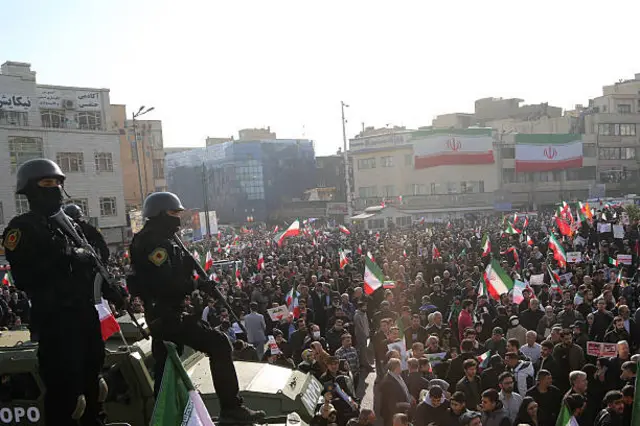
    Iran held pro-establishment rallies across the country yesterday, attended by thousands. BBC Persian has seen text messages inviting people to take part in these events.

    State TV channels this morning continued to praise the “high turnout” at the state-organised rallies yesterday.

    The Fars news agency, which is close to Iran’s powerful Islamic Revolutionary Guard Corps (IRGC), claimed that around three million people had participated in yesterday’s march in the capital Tehran in support of the establishment.

    But this figure has been disputed by foreign-based Iranian fact-checking platform Factnameh.“This figure is implausibly exaggerated, and it can be stated with confidence that the actual number was several dozen times lower,” it said on its X page.

    Security forces seen holding guns as people gather waving Iranian flags at a pro-government rally in TehranImage source, Getty Images
    Image caption,

    People gather at Enghelab Square after a government call to rally in Tehran

    A number of online users also questioned several photos shared by state TV and pro-government agencies of crowds in Tehran’s Enghelab Square, claiming that they were old and dated back to crowds at the funeral of top Iranian commander Qasem Solemiani who was assassinated by the US in January 2020.

    But reverse search indicates the photos are recent, and we were able to match them with aerial videos of yesterday’s rally broadcast by state TV.

  16. Internet shutdown in Iran for more than 100 hourspublished at 11:24 GMT 13 January

    Adam Durbin
    BBC Verify Live senior journalist

    Verifying material from Iran has been increasingly difficult in recent days because the government has imposed a total internet blackout, restricting our ability to get a full picture of the scale of events.

    The shutdown has hampered our ability to pinpoint exactly when a lot of protest footage was recorded, as Iranians cannot easily share video and images as events are developing on the ground or in their immediate aftermath.

    This means video is often shared days after it was recorded when individuals manage to find other ways to connect to the internet.

    Monitoring service Netblocks has been tracking the lack of connectivity, the impact of which you can see below:

    Graph shows internet outage in Iran from 8 JanuaryImage source, Netblocks
    Image caption,

    The state-imposed internet outage has lasted days

  17. Tuesday on BBC Verify Livepublished at 11:23 GMT 13 January

    Adam Durbin
    BBC Verify Live senior journalist

    Good morning from BBC Verify Live.

    It’s been more than 100 hours since the internet blackout was imposed in Iran amid the wave of anti-government protests. It has prevented much of the footage of deadly protests from getting out but we’re monitoring the videos that have emerged, including a clip showing hundreds of protests clashing with security forces in the north-western city of Urmia. Large pro-government rallies have also been held in Iran - we are analysing the footage of the demonstrations covered by state media.

    We’re also looking into more incidents from the US state of Minnesote involving ICE agents following the fatal shooting of Renee Good last week. False claims about Good’s criminal record have been shared on social media, while a video reportedly showing ICE agents detaining a teenager inside a shop has gone viral.

    Plus, the team will monitor announcements from the Scottish government’s Budget later this afternoon, fact-checking claims and giving key context around the numbers from SNP finance minister Shona Robison.