Summary

  • Finance Secretary Shona Robison says her 2026-27 Budget is one which will "provide for a stronger NHS and investment in Scotland's infrastructure"

  • Two of the six Scottish income tax bands will be raised by 7.4%, meaning 55% of workers in Scotland will pay less tax than if they were living elsewhere in the UK

  • A mansion tax, similar to a plan for England, will be introduced by April 2028 and be applied to properties worth more than £1m

  • Robison also announced plans for a private jet tax

  • This is the last Budget before the Holyrood elections in May, setting out how the SNP administration intends to spend about £68bn

  1. Scottish Budget - the headlinespublished at 18:25 GMT 13 January

    As our live coverage comes to a close, here's a quick catch-up on the main things we learned from today's Budget:

    • Scotland's finance secretary promised relief for some income tax payers with a raising of the threshold on the lower rates by 7%.
    • Shona Robison said 55% of workers in Scotland would pay less tax than if they were living elsewhere in the UK.
    • She said her government was committed to ending the "8am rush" for a GP appointment, with £36m to begin the roll-out of high street walk-in GP clinics
    • The cabinet secretary insisted her government provided the "best cost of living support in Britain" as she detailed around £68bn of spending plans
    • There's support for some families on benefits, with the weekly Scottish child payment - payable to parents in receipt of certain benefits - being boosted to £40 for those with a baby under the age of one from 2027.
    • Breakfast clubs will be available in every primary school from next year - it means children can be dropped off earlier
    • There will be a 15% non-domestic rates relief in 2026-27, worth £138m over three years for retail, hospitality and leisure premises
    • Investment in railways, the ferry fleet and nearly £200m for the dualling of the A9 and key sections of A96
    • A mansion taxis coming in and will be applied to properties worth more than £1m as well as a levy for private jets. These measures have been welcomed by the Greens
    • Businesses will benefit with a package of relief to counter a controversial property revaluation - the Liberal Democrats want to see more done for this sector
    • Overall, the Conservatives called the proposals predictable and cynical while Labour saidthey don't meet people's aspirations

    That's all from us on the live page team, thank you for joining us. Paul McLaren and Calum Watson were today's editors. The writers were Craig Hutchison, Megan Bonar and Katy Scott.


  2. What happens now?published at 18:09 GMT 13 January

    Angus Cochrane
    BBC Scotland News

    MSPs will begin debating the proposed Budget early next month. A final vote, when ministers hope to pass it into law, is scheduled for 25 February.

    The government has a minority in parliament, with the SNP group having been cut to 60 MSPs.

    The government would need the votes of five other MSPs to get to a true majority of 65 - or they could try to reduce the numbers on the other side by convincing MSPs to abstain.

    Last year, the Budget was passed with the support of Green and LibDem MSPs, who negotiated concessions with the government.

    Scottish Labour abstained on the vote, and it has been speculated that the party could do the same again this year after leader Anas Sarwar said his MSPs would not make the Budget fall.

  3. Scotcast: Unanswered questions about the ‘mansion tax’published at 18:03 GMT 13 January

    Shona Robison’s announcement of two new council tax bands for homes worth more than £1m is eye-catching.

    Mairi Spowage, director of the Fraser of Allander Institute, told the BBC’s Scotcast there were questions about how the policy would work and how much it would raise.

    “What we really want to see in Scotland is a valuation of the whole property tax base, because we know that over half of homes are in the wrong council tax band at the moment," she says.

    "So it's disappointing to see this being targeted just at the top end of the valuation.

    “Also, council tax is a local authority tax. So to what extent this is actually going to generate more income for the Scottish government?

    “I'm not sure how that can work. Will it be a sort of negotiation between local government and Scottish government about this revenue?”

    You can hear the full Scotcast interview on the key budget announcements on BBC Sounds.

  4. Analysis

    Cultural sector needs all the help it can getpublished at 17:56 GMT 13 January

    Pauline McLean
    BBC Scotland Arts Correspondent

    a male and female dancer on stage in Cinderella costumesImage source, Gavin Smart/Scottish Ballet
    Image caption,

    Scottish Ballet is one of the five national companies who receive their funding directly from the Scottish government

    There was some cheer in the cultural sector with the promised extra £20m for Creative Scotland’s multi-year programme which provides funding for 263 organisations.

    The Art Works development in Granton, which will provide publicly-accessible storage for the national collections, will receive an extra £11.65m while the Kings Theatre in Edinburgh will get an extra £1.25m in its final push towards reopening.

    But that’s just a small part of a huge cultural jigsaw which continues to struggle with energy costs, inflation and a squeeze on local authority funding. Individual artists and organisations, who are not part of the multi-year system, are directed to open funding which is being reduced by inflation and extra demand.

    Scottish Ballet is one of the five national companies who receive their funding directly from the Scottish government but they say rising costs and inflation mean their core grant is worth around 36% less than it was 15 years ago.

    Their director Christopher Hampson warned that “skyrocketing costs" may make it impossible to tour widely.

    Alasdair Mackie, chief executive of the Royal Scottish National Orchestra, said his organisation faced “existential questions” if more funding was not forthcoming.

  5. 'We're not really in a better place' - business ownerpublished at 17:51 GMT 13 January

    Alan Henderson owns cafes, pubs and restaurants in Aberdeen.

    He told BBC Radio Scotland's Drivetime programme it's good that the Scottish government recognises there are issues in the hospitality sector.

    But he adds that, due to the revaluation of non-domestic rates, this will just be "taking in one hand and paying back in the other" in many cases.

    For his businesses, he says the new relief announced will roughly cover his increased costs so "we're not really in much of a better place".

    "I don't think it's the big cash-saver many businesses were perhaps looking for," he adds.

    Leon Thompson, executive director of UK Hospitality Scotland, echoes his concerns.

    "The measures announced today really don't go far enough to support our businesses," he adds.

  6. Parents' charity reacts to breakfast club extensionpublished at 17:43 GMT 13 January

    Susie Forrest
    BBC Scotland News

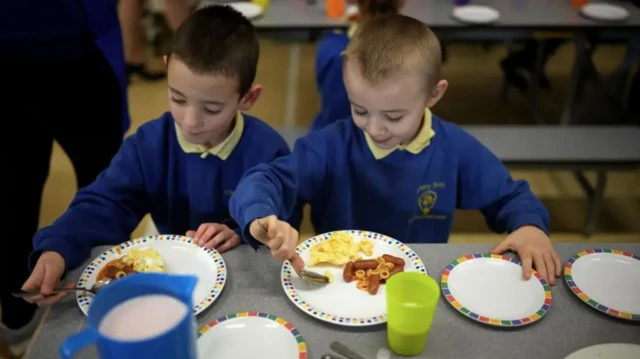
    two boys in school uniform eat sausage and eggs breakfast in a school canteenImage source, Getty Images

    With last year's Budget, the government extended free school breakfast clubs to thousands of primary school children from disadvantaged backgrounds.

    At that time, nearly half of Scotland's schools were already providing food before the start of lessons. This year, there's a promise to push this offer out to all primary schools.

    Universal benefits like this are aimed at providing help not just to families struggling with the cost of living, but also those juggling work commitments, because an extra hour of supervised childcare means the option of an early school drop-off. So they might hope it's a vote-winner.

    Parents' charity Pregnant Then Screwed welcomed it, along with new investment in wraparound childcare and the increase in the Scottish Child Payment for parents with babies.

    But they said it was "disappointing" to see no new funding to reduce the "crippling" cost of childcare for the majority of Scottish families.

    “Parents in Scotland feel they are falling behind the rest of the UK when it comes to childcare support", says their head of policy, Carole Erskine.

    "We had hoped for more from the Scottish government in this budget to address these concerns.”

  7. Analysis

    How will the gap between government expenditure and income be filled?published at 17:40 GMT 13 January

    Douglas Fraser
    Scotland business & economy editor

    Last year, Audit Scotland was warning of a £4.7bn gap between forecast expenditure and income by the end of this decade. The Spending Review, published today alongside the budget for next financial year, puts a new complexion on that, with some ideas of how that gap can be closed.

    One way of closing it is by reducing the amount of capital spend over the next few years.

    Some of the gap has been closed by changed UK and Scottish government policy. They're not as far apart on welfare benefits as they were, though Holyrood is still on course to spend £1.1bn more on welfare benefits, and rising, than it receives from the UK Treasury earmarked for that purpose.

    Shona Robison is aiming for £1.5bn in efficiency savings. Because health and social care is close to 40% of all spending, it is required to make a large share of those savings, at more than £300m per year.

    The record of achieving those targets is very poor, points out the Scottish Fiscal Commission. Health boards are more likely to require bailouts.

    Even with those efficiency gains, the rising demands on health and social care are expected to see it get more than £1bn from the day-to-day budget by the end of the decade. Social justice, including welfare benefits takes nearly £1bn more per year, while the plan is for local government to take a sizeable real-terms cut, of nearly £500m.

    The Scottish government also intends to dip into its reserve, to use its limited borrowing powers, and the windfall gain from ScotWind - more than £800m raised by auctioning Crown Estate Scotland leases for the seabed, all of that profit then handed to Holyrood.

    Using that to plug gaps in day-to-day spending is not seen as a clever use of a windfall, but it's been a feature of recent years budgeting.

  8. Analysis

    Funding for justice falls well short of what was asked forpublished at 17:33 GMT 13 January

    David Cowan
    Home Affairs Correspondent, BBC Scotland

    Funding for Police Scotland, the Scottish Fire and Rescue Service and Scottish Prison Service has gone up, but in all cases it's fallen short of what they were asking for and the consequences aren't immediately clear.

    Chief Constable Jo Farrell hasn't received the extra £33.7m she wanted to boost her workforce by an extra 850 officers and 348 civilian staff.

    The £81.7m uplift for policing, taking it to a record £1,729m, doesn't match the £104.9m she said Police Scotland needed to "stand still" and meet unavoidable cost pressures such as pay awards.

    We're waiting for a response from the force.

    The Fire Service said it needed an additional £31m of resource funding to avoid further reducing firefighter numbers and £61m of capital funding to repair its stations.

    Its budget is going up by £23.8m.

    The budget for the Scottish Prison Service has gone up by £124.3m to £1,012.3m.

    But that's at least £20m less than it was looking for, as it tries to cope with record levels of overcrowding, build new prisons and repair existing jails.

    When she gave evidence to Holyrood's justice committee, Justice Secretary Angela Constance had warned that it was unlikely they would be able to give everybody everything they had asked for.

    And that's what has happened.

  9. Charity calls for more to be done to tackle poverty in Scotlandpublished at 17:32 GMT 13 January

    The reaction to the draft Scottish Budget continues to come into the BBC thick and fast.

    Chris Birt from the Joseph Rowntree Foundation tells Radio Scotland's Drivetime programme he is dissapointed with the measures announced.

    "I don't think this budget was bold enough to meet some of the struggles people across Scotland are facing."

    Ahead of the Holyrood election in May he wants to see a stronger grip from all the parties on these issues.

    He does welcome the focus on babies with the Scottish Child Payment increase, which will put around £600 a year extra into the pockets of low income families.

    However it does not go far enough, he adds.

  10. Robison defends income tax and child payment measurespublished at 17:24 GMT 13 January

    Andrew Kerr
    BBC Scotland political correspondent

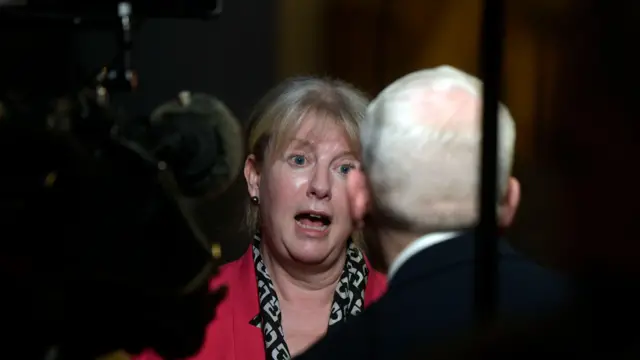
    Shona Robison addresses a journalist with white hair who is facing away from the camera and towards her. He stands next to a camera pointed at Robison. She has tied back fair hair and wears a pink blazer and black and white shirt.Image source, PA Media

    The finance secretary has been speaking to journalists outside the chamber at Holyrood following her Budget speech.

    Shona Robison denied the raising of the income tax thresholds was a pre-election "bribe" or that it was a "panicked measure", as people struggle with the cost of living crisis.

    She told the BBC: "It is absolutely a measure that has listened to the people of Scotland.

    "There are a number of measures in here that we know will be welcomed by the people of Scotland - investment in public services and help with the cost of living. We've listened to what people are saying."

    With some pressure groups saying the government's actions on child poverty are "tepid" and that a "lot of work needs to be done", the finance secretary responded: "Scotland is the only part of the UK where child poverty rates are falling.

    "That does suggest that the measures that we have taken and are taking are having an impact, putting food on the table of families, keeping people's heads above water."

  11. Analysis

    Who will benefit most from the income tax changes?published at 17:16 GMT 13 January

    Douglas Fraser
    Scotland business & economy editor

    As a tax giveaway, it's not huge - £50m handed to income taxpayers by raising two of the lower thresholds by more than inflation.

    The point at which you start paying 21 pence in each extra pound earned, up from 20 pence, goes up by slightly more than £2000 from £27,492 to £29,527. That's a reduction in an annual tax bill of just over £20.

    But the stealth tax on higher rates goes on. As people's income goes through the higher rate of income tax, remaining at £43,633, they'll pay 42 pence on each extra pound earned.

    The same effect can be felt on higher bands, the net effect of tax giveaway and additional tax take by 2027-28 comes to £72m. As the stealth tax continues and draws in more than a fifth of income tax payers, the Scottish Fiscal Commission forecasts it will raise a net £200m by 2028-29.

    There are broader measures of how tax and benefit changes in this budget will affect households, and that distribution is thought to mean 62% of households will be better off or unaffected by changes. The biggest gainers will be families.

  12. Budget should have been bolder, says poverty charitypublished at 17:12 GMT 13 January

    The Star Project in Paisley helps local families living in poverty.

    Manager Heather Kay told BBC Radio Scotland's Drivetime programme she regularly sees people who are struggling with heating and food costs and are "very much in crisis".

    She says: "We would have loved to have seen a budget which would have meant they felt less fragile and more secure.

    "We don't think it's going to put money in people's pockets straight away."

    She welcomed the Scottish Child Payment increase but says it doesn't come into force for a year and only applies to children under the age of one, adding: "We would have liked that to be bolder."

  13. Analysis

    Schools will welcome funds for additional support pupilspublished at 17:06 GMT 13 January

    Susie Forrest
    BBC Scotland News

    The growing number of children who need additional support for learning (ASL) has been putting increasing pressure on teachers and local authority budgets.

    So schools will welcome a commitment of £57m investment for additional support needs within the education budget.

    In 2024/25, a record number of pupils were designated as having additional support needs (ASN) - nearly 300,000, or 43% of the total school population.

    Last year, the Auditor General reported that between 2020 and 2024, specific funding for ASL provision from the Scottish government had remained static at £15m - amounting to a 15% real-terms decrease after inflation.

    And parents of children who need extra help at school have been calling for much better support.

    So they'll be hoping to see that extra cash make an impact in the classroom.

  14. BBC Verify

    Average earners in Scotland to pay slightly less income tax than in Englandpublished at 16:59 GMT 13 January

    Phil Sim, Scotland political correspondent

    Scotland has its own income tax system, which has moved in a distinctive direction with six different bands ranging from 19% to 48%.

    The Scottish government calls it a more progressive system, because it charges more to those with the broadest shoulders while charging average and lower earners less.

    The SNP has pledged that a majority of Scots will pay less income tax than they would if they lived elsewhere in the UK.

    They have sought to achieve this by raising the thresholds where lower rates kick in, while freezing those for the higher rates.

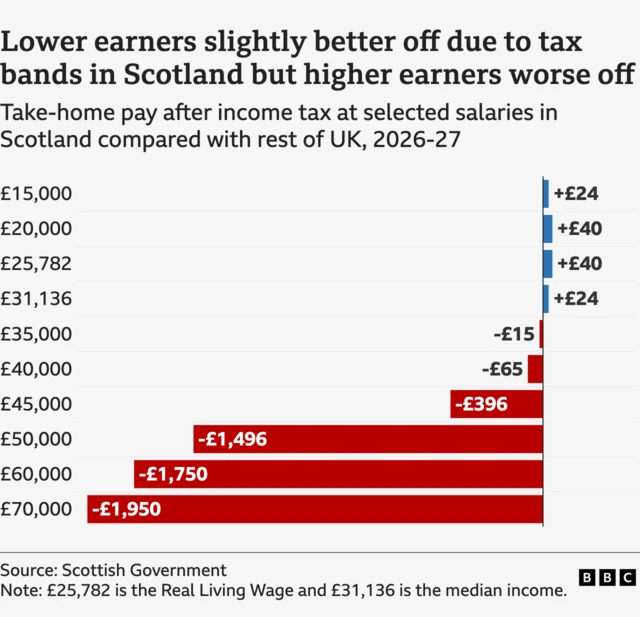
    Forecasts suggest that means 55% of taxpayers in Scotland will pay slightly less - although only by a margin of at most £40 a year.

    They suggest that someone earning £50,000 will pay almost £1,500 more than if they lived in England - with ministers arguing this is in return for better-funded public services.

    A horizontal bar chart showing take-home pay after income tax at selected salaries in Scotland compared with the rest of the UK in 2026-27. The chart shows that lower earners are slightly better off due to tax bands in Scotland but higher earners are worse off. Scottish taxpayers take home up to £40 more per year than their counterparts elsewhere in the UK at selected salaries up to £31,136 (the median salary in Scotland). But they take home increasingly less at higher salaries, up to nearly £2,000 extra for those earning £70,000.
  15. Scotland's new income tax thresholdspublished at 16:52 GMT 13 January

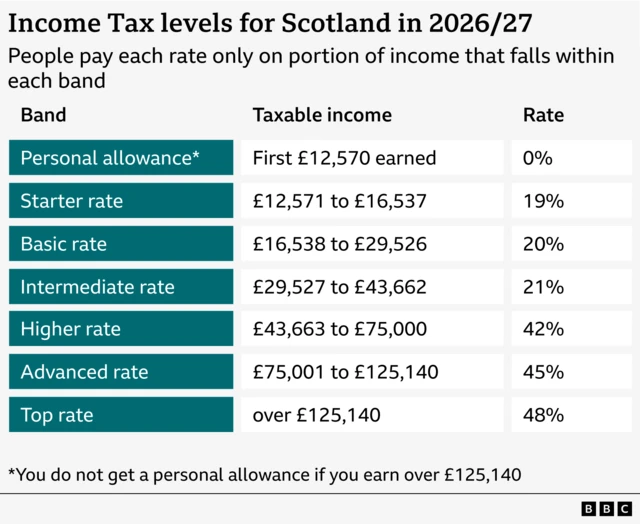
    The finance secretary announced changes to two of Scotland's six income tax bands.

    The threshold for the basic and intermediate rates will rise by 7.4%, in effect cutting tax for lower earners.

    However, the higher, advanced and top rate thresholds will be frozen at the current rates until at least 2028-9, meaning anyone whose income rises above £43,663 will begin to pay tax at 42%.

    planned income tax rates for 2026/7
  16. Analysis

    Cutting year-long NHS waits is still a big askpublished at 16:49 GMT 13 January

    Claire McAllister
    BBC Scotland News

    The Budget didn't bring any clarity on the future of five delayed NHS treatment centres.

    We do know a £1bn capital budget will be spent on replacing and repairing some existing hospitals.

    While four national treatment centres (NTCs) are up and running, there is still a question mark over plans in Livingston, Perth, Aberdeen, Ayr and Cumbernauld that were put on hold in 2024.

    A total of £34m has already been spent developing plans for them.

    Funding issues remain “challenging” so these projects are now being reconsidered as part of a wider look at infrastructure plans across NHS Scotland.

    These had been sold by the Scottish government as the solution to tackling long waits for elective surgeries and diagnostics.

    One in nine of the population is on a waiting list for NHS care and without significantly increasing additional capacity, First Minister John Swinney’s promise to eradicate waits of over a year by March is a big ask.

  17. 'This is a missed opportunity to support small businesses' - FSBpublished at 16:47 GMT 13 January

    The Federation of Small Businesses says the Budget does not go far enough to protect small businesses from "further damaging tax rises".

    Scotland chairman Guy Hinks says the new measures are just "a drop in the ocean" and will simply complicate an "already difficult-to-navigate system for limited benefit".

    He urges the Scottish government to reconsider its approach and bring forward measures to provide "genuine support" to the smallest employers.

    "This is a missed opportunity to back the businesses that anchor high streets and local communities," he adds.

  18. Budget 'good news for education' says teaching unionpublished at 16:42 GMT 13 January

    EIS general secretary Andrea Bradley has welcomed the budget saying it includes “some significant good news for Scottish education”.

    She says a 2% increase in local authority funding will help deliver a reduction in teacher’ class contact time and better provisions for children with additional support needs.

    Bradley added that breakfast clubs will have a positive impact of young people's learning- but they would like to see fully funded free-school meals for all nursery and school children.

    She also welcomed “a much-needed” increase in funding for colleges.

  19. BBC Verify

    How much money can the Scottish government spend?published at 16:41 GMT 13 January

    Phil Sim, Scotland political correspondent

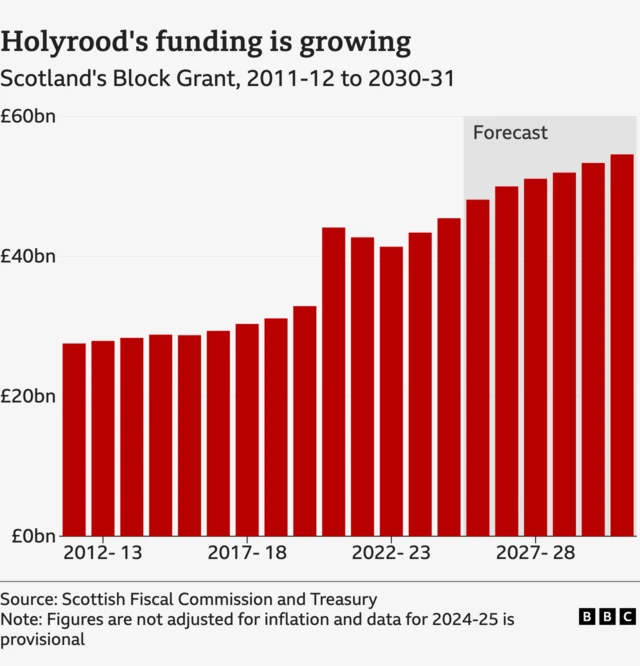
    Today, the Scottish government set out its budget plans for the year ahead, with around £68bn of funding allocated.

    Holyrood’s budget is chiefly based on a block grant from Westminster, made up of Scotland’s share of UK-wide revenues and spending on devolved areas by the UK government, as well as devolved levies like income tax and some borrowing.

    The political dispute over the budget often extends to the overall size of the funding settlement.

    Over recent years there has been steady growth in the block grant, following a spike during the Covid pandemic.

    This followed years of more or less flat budget settlements during the austerity era, but the current trend of increases is currently forecast to continue.

    A bar chart showing the size of Scotland's block grant by year, from 2011-12 to 2030-31. The block grant was around £28bn in 2011-12 and increased steadily to £33bn in 2019-20. It then rose sharply to £44bn in 2020-21 before falling back to £41bn in 2022-23. It is set to rise to almost £55bn by 2030-31. Figures are provisional for 2024-25 and forecasts from 2025-26 onwards. The data has not been adjusted for inflation

    In the UK budget in November, Chancellor Rachel Reeves announced an extra £821m of funding for Holyrood.

    But the SNP-led Scottish government notes that is spread over a number of years, and points to added costs like increased employer National Insurance Contributions for public sector staff to argue that the increase looks relatively small.

    Scottish Labour meanwhile want to make the figure look as big as possible, so prefer to add together all £5.2bn of the increases to the block grant announced since their colleagues took power at Westminster.

    These two parties of government will continue to dispute how much money there is, but ultimately the biggest debate will be over how it is spent.

  20. What was in the Scottish Budget - a quick catch-uppublished at 16:38 GMT 13 January

    If you’re just joining us, here's a quick catch-up on the main things we learned from today's Budget:

    • Scotland's finance secretary promised relief for some income tax payers with a raising of the threshold on the lower rates by 7%.
    • Shona Robison said 55% of workers in Scotland would pay less tax than if they were living elsewhere in the UK.
    • She said her government was committed to ending the "8am rush" for a GP appointment, with £36m to begin the roll-out of high street walk-in GP clinics
    • The cabinet secretary insisted her government provided the "best cost of living support in Britain" as she detailed around £68bn of spending plans
    • There's support for some families on benefits, with the weekly Scottish child payment - payable to parents in receipt of certain benefits - being boosted to £40 for those with a baby under the age of one from 2027.
    • Breakfast clubs will be available in every primary school from next year - it means children can be dropped off earlier
    • A mansion tax is coming in and will be applied to properties worth more than £1m as well as a levy for private jets. These measures have been welcomed by the Greens
    • Businesses will benefit with a package of relief to counter a controversial property revaluation - the Liberal Democrats want to see more done for this sector
    • Overall, the Conservatives called the proposals predictable and cynical while Labour said they don't meet the aspirations of the people