BBC Review
Intelligent readings that show how varied the composer was in his dark, impulsive heart.
Daniel Ross2010
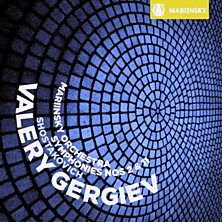
This disc, the second in Valery Gergiev and his Mariinsky Theatre Orchestra’s series of Shostakovich pairings, brilliantly balances two opposing symphonies. The experimental, impish and thoroughly odd second symphony was composed to mark the 10th anniversary of the 1917 Russian revolution, while the expansive and hugely intricate 11th marries tonality and brave, bracing idealism in a portrait of the 1905 revolution. Gergiev, ever the astute interpreter, carves intelligent readings that show just how varied the composer was in his dark, impulsive heart.
The second symphony, a petite one-movement work, could loosely be described as a realist tone poem, informed as much by Liszt as the revolution itself. Beginning with a sequence of darkly chaotic, building atonality not dissimilar from the opening of Haydn’s Creation symphony, this is Shostakovich clamouring for originality and giving conventional structures a hearty throttle, before succumbing to the usual by tacking on a distinctly populist choral finale. Rather unsurprisingly, it was one of Shostakovich's most poorly received works for this capitulation.
Gergiev and the Mariinsky aren’t blind to the rather jarring shift, and actually go some distance to restoring the balance – the opening burrows around, searching for any kind of tonal handle to grasp as the score suggests, but that choral finale is made to be as brutal and powerful as possible. It renews this curio, giving it some innovative context rather than veering haphazardly from dark beginning to light conclusion.
There’s comparatively far less an interpreter can do with the 11th symphony, though, due to its mammoth scale and emotional range. Absolute faithfulness is the more usual tack for orchestras approaching it, and the Mariinsky is no exception. Early care is taken with maintaining an atmosphere of stillness in the opening Adagio, stillness that is designed to evoke the frosted streets of St Petersburg with due starkness. In fact, so much latent menace stalks the movement that when the thunderous percussion arrives in the second movement it’s a real shock to the eardrums, and a welcome one at that.
Closing with a funereal cor anglais solo that appears to make time stand still, bell chimes and a typically bravura finale, the 11th as imagined by Gergiev succeeds in teasing cinematic minutiae from every available pore. Not only has he and his attentive orchestra faithfully and artfully scaled one of the composer’s highest peaks with the 11th, they’ve gone some way to invigorating a less popular work with the second. And that, all things considered, is impressive.
 This work is licensed under a Creative Commons Licence. If you choose to use this review on your site please link back to this page.