BBC Review
Technical challenges are shaken off like rainwater, everything a joyous blur.
Daniel Ross2010
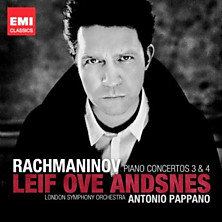
Few pieces in the piano repertoire are as iconic as the Rachmaninov Concertos, and Norwegian Leif Ove Andsnes darn well knows it. Even the manner in which this recording is packaged oozes seriousness and reverence, with Andsnes’ hard face glaring at us from the sleeve and monochrome close-ups of his hands adorning the inlay. Aptly, he has treated the Third and Fourth with due respect for the most part, but there is a delicious mischief to some of it that the composer himself would most definitely have endorsed. This is by no means a po-faced imitation of what has gone before, more an excitable toe-dip into some enjoyable interpretative ideas.
From the very outset, Andsnes cannot wait to let rip. The solemnity of that most famous of opening phrases in the third concerto’s Allegro Ma Non Tanto is almost resignedly hurried out of the way so that he can light the touch paper and travel straight to the heart of the firework – he verily cascades through the passages that immediately follow. Perhaps a subtler contrast would have worked better. As the LSO swells through the romanticism and grandeur of Rachmaninov’s divine accompaniment, Andsnes is always on hand to re-instil cosh-like formality when needed. To say he has the whole by the scruff of the neck would be an understatement, and it has to be a positive.
Things are necessarily different when it comes to the troubled Fourth concerto. Rachmaninov wrote many revisions of the work when it received poor reviews, its jazz influences and tendency to break character sitting uneasily with much of the listening public. Andsnes tackles this interpretative minefield a little more tentatively, which actually results in some stunning, delicate melody work in the languorous second movement and real fire in the finale. He is nothing if not thorough, as well as thoroughly sensitive when it counts.
Both of these works show Andsnes at his most attentive, certainly, making this disc a very entertaining reading. His energy is boundless and sure to get him into trouble at times, but overall the sheer verve is irresistible. Technical challenges are shaken off like rainwater, subtler sections are given the requisite grace and poise, and everything else in between is a joyous blur.
 This work is licensed under a Creative Commons Licence. If you choose to use this review on your site please link back to this page.