Tony Hall speech at the launch of the BBC’s Annual Report and Accounts 2016/17
Tony Hall, Director-General of the BBC - Wednesday 19 July 2017
Published: 19 July 2017
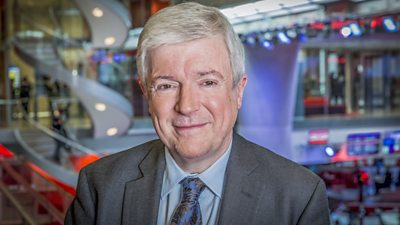
We need to employ the very best. They help make the BBC what it is... But of course we all appreciate that we are dealing with the public’s money... This is not something we take lightly.
Check against delivery
Thank you, David. And let me start by reflecting on what the annual report says about us editorially and creatively.
First of all, there is a proper pride in what our journalists and teams in news and current affairs have achieved over the past year. I don’t think any of us who have worked in news can remember such a tough and challenging period.
They have responded with incredible professionalism and resilience - often working in unimaginable circumstances. I realise how difficult it will have been in your newsrooms too.
The last few months have seen the terrorist attacks in Westminster, Manchester, London Bridge and Finsbury Park, the surprise election campaign and, of course, the terrible tragedy of Grenfell Tower.
BBC teams have proved once again why our news services are the most trusted in the country - and around the world - and why the authority and expertise of our news talent is so highly valued.
World-class creativity
And it has been a fantastically impressive year in creative terms too. Let’s take a look at some of the highlights…
[SHOWREEL]
Watching that, I’m really proud of what we have achieved.
On screen, 19 out of 25 Baftas went to the BBC; great new comedy like Phoebe Waller-Bridge’s Fleabag; fantastic returning drama like Happy Valley with Sarah Lancashire; world-class investigative reporting like Panaroma’s investigation into prison abuse.
It’s a sign of just how good your natural history programming is when Planet Earth II’s snakes vs iguana chase wins TV’s “must see” moment. Especially in year that saw Ed Balls dancing Gangnam Style and Danny Dyer discover that he’s royalty.
It’s also a fantastic tribute to the work of the BBC Three team that they were named Royal Television Society channel of the year. Going online was a really bold, really important decision, and this represents a fantastic validation in its first year.
On air, this year has seen both the best of the old and the best of the new. On Radio 4, In Our Time celebrated its 750th edition and Desert Island Discs reached its 75th Anniversary when Kirsty Young cast away David Beckham with only 115 England caps for company. Meanwhile, Radio 1 became by far the biggest radio service on YouTube, with over 3.5 million subscribers and more than a billion views since launch.
And of course we've had a remarkable sporting year. Take your mind back to Rio, for example, and an extraordinary performance by Team GB and BBC.
As I said a couple of weeks ago, I don’t believe we could have set out our stall any more strongly or ambitiously under our new Charter.
Reinventing the BBC
And of course, winning that Charter was also a major achievement of last year.
With that behind us, we have the chance to set our sights high for the next 11 years. To get the whole of the BBC behind a really clear, really ambitious goal.
And the challenge I have set us for the next few years is to reinvent public service broadcasting for a new generation.
This is our biggest priority, and every part of the BBC will need to play its part.
For example, last year we spent a great deal of time rethinking our role for the very youngest in our society. That’s why a couple of weeks ago I was so pleased to be able to announce our biggest investment in Children’s services in a generation - an extra 34 million pounds over three years.
It’s a great example of the strategy we have set out to 'ride two horses' in the years ahead: Continuing to do brilliant things on our traditional channels and services. But also working to be truly outstanding in the digital space - where our audiences increasingly are, where we face huge competition for their attention, and where we have the chance to serve them in incredible new ways.
In the last year we've also made great strides in what we believe will be perhaps the single most important factor in successfully reinventing the BBC. And that’s making the very most of new technologies to personalise our content to each user.
So that you get everything you want - plus everything you might like or need to know - all in one place, all tailored uniquely to you.
This is something that we have put right at the top of our agenda. And you’ll be hearing a lot about in the weeks and months to come.
Serving the UK at home and abroad
But reinventing the BBC is not just about revolutionising how we are used by our audiences.
It is also about doing more for the whole of the country, at home and abroad.
I profoundly believe Britain will need the BBC more than ever in the years ahead. And we can do more than ever before for Britain.
We have a vital role to play as an engine room of British creativity and a champion of British content. As a force for good for the UK around the world.
That’s why I was so proud at the end of last year to be able to announce the historic expansion of our World Service - the biggest in some 70 years. An extra 85 million pounds a year.
It’s allowing us to offer independent, impartial journalism around the globe. In fact, we are now reaching a record weekly audience of more than 372 million around the world - a rise of 7 per cent year-on-year.
But here at home too, what we do to bring the country together and reflect all its voices is increasingly invaluable.
We already make more programmes outside London, and broadcast more local and nations output, than any other broadcaster.
But we are determined to rise to the challenge of better reflecting and representing a changing UK.
Now we have announced our biggest investment in Scotland, Wales, and Northern Ireland for decades - including a new channel for Scotland.
And, in our Annual Plan, we’ve set out our creative plans for all three.
A strong record on efficiency
Of course, all of these investments are underpinned by our continued progress in driving savings and efficiencies across the BBC.
Anne will say more in a moment, but I’m pleased with what we have been able to achieve - not just to live within our means, but to bring down barriers to creativity.
We have delivered £172 million of annual savings during 2016/17.
We have reduced overheads to industry-leading levels: just five per cent of our total costs.
We have cut our property bill by approximately £90 million in six years. In fact, our property footprint is now around 40 per cent smaller - a significant achievement in any business.
We have all but halved the number of senior managers in eight years, and reduced management layers, divisions and boards. And Delivering Quality First, the savings plan we began in 2011, has now exceeded its £700 million per year target.
In short - the proportion of the licence fee spent on overheads is at a record low, and the proportion spent on content at a record high.
Of course, there is much more to do. We know there will be more challenges ahead.
There is no resting place, and the environment is getting tougher and tougher. The market around us is now vastly more global and competitive. More and more of the big global players are moving into areas which we used to think of as our preserve.
A decade ago we might have been up against ITV or Sky or commercial radio. Now it’s Netflix, Amazon and Apple. And they’re willing to invest huge amounts of money with no certain return in an attempt to capture market share - pushing up costs across the board.
You only have to look at the skyrocketing costs of sports rights or drama to see we are now in a world of incredible competition and hyperinflation.
A competitive BBC
This is the context in which we have to view the figures we’re publishing today on talent pay.
It illustrates the scale of the challenge we have in delivering world-class content - for everybody - and competing for the talent that will help us achieve just that.
Let me be clear that, in all the negotiations with the Government about our Royal Charter, we said it would be wrong to put the names of our talent against what they're paid.
I want to stress that we do believe in transparency.
In fact, uniquely in the media, we have published not only the salaries of senior managers earning over £150,000, but also what we've been paying talent in bands for the last seven years - only without naming them. We've always said that giving names could be inflationary, that in the end it would drive up salaries by setting benchmarks and raising expectations, pushing up wages at a time we’re bringing costs down, and undermining the competitiveness of the BBC.
We’ve said that, in effect, it represents a “poacher’s charter”, that allows other media or technology companies to pick off people they might want. In other words, it’s not good value for our audiences.
But in the end the Government insisted. So today we are publishing the names of everyone who has been paid more than £150,000 from the licence fee in the last year.
People working for BBC Worldwide are not on the list because they're a commercial company. People who are now working for BBC Studios are on the list this year - but they won’t be next year, because they too are working for a commercial company. And of course anyone who's working for an indie won’t be disclosed for exactly the same reason.
Looking at the list we've published, I think there are some important points to make.
Let me say, straight away, we need to employ the very best - stars, great presenters, writers, actors, correspondents - talented people in front of the camera or microphone are critical for our relationship with audiences.
We need to employ the very best. They help make the BBC what it is. That’s the business we’re in. But of course we all appreciate that we are dealing with the public’s money. We’re talking about what, to lots of people, are large sums. This is not something we take lightly.
That’s why we always try to pay people at a discount to the market. It’s why the bill for top talent is down by 10 per cent year on year - down by a quarter over the last five years. And the amount we pay the very highest earners has dropped by 40 per cent over the same period.
We’re not afraid to walk away if money becomes an issue. And that’s one of the reasons we’re the biggest investor in new British talent there is.
And, by the way, we are talking about a very small percentage of the talent that works for us - of the forty three thousand or so contracts we had with our talent last year, less than a quarter of one per cent were paid more than £150,000. And that’s how it should be.
You will of course draw your own conclusions. But a word of warning; comparing people’s pay is not straightforward. Very few do precisely the same thing - people working at the same show may have other, or different, commitments.
But one issue I think the disclosures highlight is the need to go further and faster on issues of gender and diversity. In over four years here, I have made this a particular priority of mine. We’ve made real progress.
It’s great to listen to the Today programme some mornings presented entirely by women. And when I said I wanted half the presenters on local radio breakfast shows to be women - we’ve done it.
At the moment, of the talent earning over £150,000 - two thirds are men and one third are women. Is that where we want to be? No. Are we pushing further and faster than any other major broadcaster? Most certainly.
We’ve already set a clear and strong target for what we want to achieve by 2020: we want all our lead and presenting roles to be equally divided by men and women.
This is already having an impact - of the top talent we have hired or promoted in the last three years, more than 60 per cent are women.
This broader target will have a profound impact not just at the BBC, but on the whole media industry. It’s going to change dramatically the market for talent in this country.
And, let me just add that I want to achieve right balance when it comes to BAME talent too. Here, we have a similarly tough target - 15 per cent by 2020. And, again that’s having an impact, with nearly 20 per cent of the leading talent we’ve hired or promoted in the last few years from BAME backgrounds.
Conclusion
Ultimately, our challenge is constantly to find the right balance between a BBC that is efficient and cost effective, and a BBC that can attract and keep the best talent and remain a creative powerhouse for Britain at this critical time.
We're here to provide great TV and radio programmes and the best digital services for everybody. And to do that you have to have the best people.
The quality of our presenters and correspondents is one part of the reason why BBC news, for example, remains the number one place the public comes when it matters - in the days after an election or referendum or the hours after a terrorist attack - to find out what’s really going on.
Why, when we have only have around two per cent of the total hours of TV sport broadcast, we have over 40 per cent of the audience. Why, even though we can’t compete with our rivals on budgets, we can still sweep the board when it comes to awards. And why we, uniquely, can bring people and this country together - in their millions.
Today the BBC costs less in real terms than it did 20 years ago. But now we offer four times as many television channels, twice as many national radio stations, plus iPlayer and everything we do with our apps and online.
In fact, for every hour that you watch, listen to, or use the BBC you're paying less than seven pence - which compares pretty well to the last box set I bought.
The Annual Report that we have published today makes me hugely proud of the BBC’s performance over the past year. But, more importantly, it makes me hugely confident about where we are headed in the years ahead.
