Television
Television
Published: 28 February 2017
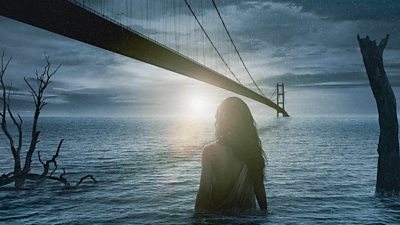
Flood, a four-part experimental project by playwright James Phillips, is the story of what happens to Hull when the waters overwhelm the city. Part three, Flood: To The Sea will broadcast on BBC Two as part of a series of Performance Live programmes for BBC Arts.
Flood: To The Sea is a story set in the aftermath of an apocalyptic event which has seen England engulfed by water and the English become refugees.
Performed in a dock in Hull on floating platforms, James Phillips’ Flood asks a simple question: what if the fleeing masses from our TV screens and Twitter feeds, in their boats and their orange lifejackets, had English accents?
Gloriana is one of three people in the water, struggling for survival. Gloriana doesn’t know her own name, known simply by her tattoos, and is found by fishermen’s nets at the bottom of the sea. She sees visions. She dreamed of the end of the world, of a city sinking.
In this 30 minute broadcast for BBC Two, Gloriana is the one who must decide whether there is hope, whether there is a future, and whether it is worth fighting for.
Flood: To The Sea was written by James Phillips, and produced by Leeds-based performance company Slung Low and Hull UK City of Culture 2017. Emma Cahusac is the Executive Producer for BBC.
Flood: To The Sea is one of a series of programmes for BBC Two called Performance Live – a two-year project, produced in partnership with Arts Council England and Battersea Arts Centre that will challenge a spectrum of exciting artists, producers and arts organisations to produce their own television programmes.
Yorkshire Wolds Way, BBC Two
A Clockwork Orange - BBC Philharmonic and BBC Radio 3
In the year in which we celebrate the centenary of Anthony Burgess’ birth, BBC Radio Drama in collaboration with the BBC Philharmonic, present a UK premiere of his cult novel A Clockwork Orange.
In 1987 Burgess published a dramatisation of his own classic text which included songs and music also written by the Manchester-born novelist and poet. This will be the first time Burgess’ Clockwork Orange music has been performed along with the play in the UK.
The radio theatre performance of ‘A Play With Music’, will also be the second time it has been performed since his death, and the first time his songs have ever been broadcast. It will be recorded with an audience in Hull University’s Middleton Hall on Saturday 30 September and broadcast on BBC Radio 3 in Drama On 3 the following evening (Sunday 1 October).
As well as including Burgess’ own songs, this dramatisation will include extracts from Beethoven’s symphonies performed by the BBC Philharmonic as described by Burgess in his dramatic text.
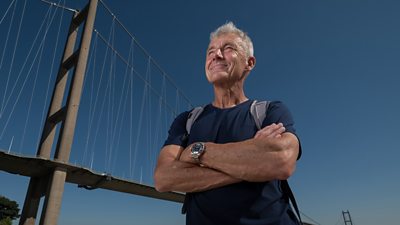
Two-part documentary series, Yorkshire Wolds Way, will explore one of the UK’s least-known National Trails stretching from the iconic Humber Bridge in East Yorkshire, to the North Yorkshire seaside resort of Filey.
Presented by Polar explorer and ocean diver Paul Rose, this 2 x30’ series follows him on his voyage of discovery as he swaps the world’s most remote islands and the ice caps of the Antarctica for 79 miles of gently rolling chalk hills and hidden valleys. Along his journey he meets local residents and wildlife, and experiences some unusual local customs.
Paul tries his hand at a number of popular pastimes that make the Yorkshire Wolds so distinctive and unique, including rowing a vintage boat across the Humber, moth collecting the Victorian way at Nunburnholme, hiding in a nuclear bunker at Duggleby and learning how to ride a penny farthing bicycle near South Cave.
He travels the Wolds Way from south to north, starting from the Humber Bridge near Hull, stopping off at towns and villages along the journey including South Cave, Market Weighton, Millington, Fridaythorpe, Wintringham, Ganton, finishing at the North Sea at Filey.
Commissioned for BBC Two, Yorkshire Wolds Way was produced and directed by Paul Greenan and was executive produced by Nicola Addyman, both from BBC Yorkshire.
One Bomb: The Hidden Histories Of The Blitz, BBC Two
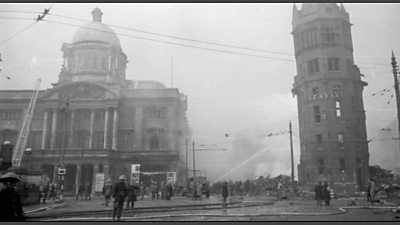
Hull’s story of the devastating Blitz bombing will be told in a 60 minute episode of One Bomb - The Hidden Histories Of The Blitz, a new four-part series for BBC Two in partnership with The Open University.
Hull’s experience of the Blitz has for a long time been recognised as unique. Between 1939 and 1945, Hull suffered 82 air raids and by the end of the war an estimated 1,200 people had been killed.
During the Second World War almost 100,000 high explosive bombs fell on Britain. They touched the lives of everyone. They levelled our cities and our society and they shaped our future in myriad ways. Every single bomb that fell has its own secret story waiting to be told.
In each episode of One Bomb - The Hidden Histories of the Blitz, a new 4x60 series for BBC Two in partnership with The Open University, the butterfly effect of one bomb - from initial impact right through to the wider consequences for modern Britain - is tracked, unveiling a complex chain reaction of personal, social and ultimately national stories.
Utilising a rich array of archive, from official incident reports and the extraordinary hand-coloured bomb damage maps drawn up at the time in the wake of the bombardment, to the letters, memoirs, memories and family stories of the residents of the streets each bomb fell, this unique new series will detail the true extent of the destruction and chart the effects on both the physical urban landscape and on the social landscape as never before.
The programme will also use the story of Hull as a springboard for a broader exploration throughout the series, to look at the strategic arguments that raged within the British war machine about the effectiveness of aerial bombing of civilian populations of which Hull was seen as a test case.
Patrick Holland, Channel Editor, BBC Two says: “I am delighted to bring One Bomb: The Hidden Histories Of The Blitz to BBC Two. It promises a unique exploration of the devastation caused by wartime bombing of UK cities, revealing the ways in which Britain was changed, both physically and socially, forever."
Tom McDonald, Head of Commissioning, Natural History and Specialist Factual, says: “With its unique starting point of a single bomb in each episode and the extraordinary new research underpinning this series, I believe this will be a truly distinctive take on one of the most devastating moments in our shared history."
Dr Chris Williams, Senior Lecturer in History and Media Fellow for the Faculty of Arts and Social Sciences at The Open University says: “The Open University has a rich curriculum focussing on the impact of war on twentieth-century Europe. We’ve also been committed to embedding original sources in our History students’ learning. One Bomb takes the viewer on a journey into the records of war, and shows how much we can learn from the historical record, both about the past, and about the present, and as a historian I am really pleased that the OU is involved.”
One Bomb - The Hidden Histories Of The Blitz is made by Wall to Wall and was commissioned for the BBC by Tom McDonald. The Executive Producer is Cate Hall and Series Producer is Tim Kirby. It was produced in partnership with the Open University. Dr Caroline Ogilvie is Head of Broadcast and Partnerships and the Academic Consultant for the OU is Professor Annika Mombauer, Professor of Modern European History.
Through The Lens Of Larkin, BBC Four
The Verb New Voices Scheme
Alongside The Hull 17, Contains Strong Language will showcase brand new talent through the Verb New Voices Scheme, which will announce three new writers from the area at the festival. In partnership with New Writing North, the BBC will provide mentoring and support for three new artists who will receive a package of development support, a targeted two-day workshop at the BBC, as well as professional development support with writing and performing across the year. The artists will also receive a broadcast on BBC Radio 3’s The Verb and will perform new work at the festival.
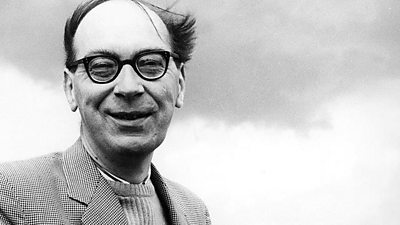
Philip Larkin is not only known as one of the 20th century’s greatest poets; he was also a lifelong keen amateur photographer, lavishing on his pictures the same kind of care and attention and eye for detail he brought to his verse.
In this 1x30’ documentary, Through The Lens Of Larkin, poet and Hull University academic John Wedgwood Clarke (Books That Made Britain) will get on his bike and follow in the tyre tracks of the man himself to explore the places and relationships which shaped one of the 20th century’s greatest poets.
John will explore Larkin’s relationship with Hull through the lens of the many photographs he took, from the shops and the docks, to the graveyards which fascinated him. He will take a journey around the area that he loved and disliked at the same time and meet the people who knew him best.
The numerous formal and informal pictures Larkin took of the places where he lived and worked, family members, and his long-suffering lovers, represent an unrivalled visual commentary on his life.
Commissioned for BBC Four, Through The Lens Of Larkin was produced and directed by Richard Taylor and was executive produced by Nicola Addyman, both from BBC Yorkshire.
Britain’s City Of Culture, BBC News Channel
BBC Look North in Hull will showcase the highlights of the city’s big year in a series of culture specials for the BBC News Channel called Britain’s City Of Culture.
Starting monthly on the weekend of 3-5 March, BBC Look North presenters Anne Marie Tasker and Kofi Smiles will host a half hour programme for BBC News Channel viewers across the UK. Also available on BBC iPlayer, the programmes will cover everything from opera and ballet to spoken word and street art, and conclude with a review of the whole year to run at Christmas and New Year.
Britain’s City Of Culture is edited by BBC Look North’s editor Jane Birch and Sam Taylor, executive editor of BBC News Channel.
The first episode will broadcast on Friday 3 March at 8.30pm; Saturday 4 at 2.30pm; Sunday 5 at 10.30am and 8.30pm.
