Interview with Dara Ó Briain
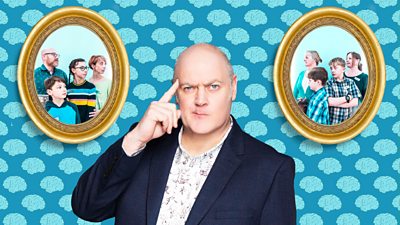
Dara Ó Briain is the host of The Family Brain Games on BBC Two.
Published: 5 June 2019
There’s another skill, which is a form of intelligence which anyone who lives in the world knows: how well you communicate, how well you respond to things and how well you read other people is a vital part of intelligence.
Multi-award winner Dara Ó Briain is a comedian, TV presenter and author of two science books for children. He is the host of the hugely successful Mock The Week, Blockbusters and a multitude of other shows including Stargazing Live. Dara is a graduate of University College, Dublin, where he studied Mathematical and Theoretical Physics. Whilst at university he was a debater with the Literary and Historical Society.
Does The Family Brain Games test intelligence in a different way to other shows?
The type of test we are doing with the families is very different to your standard quiz. These games have been devised specifically to test a much more broad span of different intelligences, but also with them working together. A lot of it comes down to family dynamics and a collective intelligence, because all the games were devised with help from Dr Adam Hampshire from Imperial College.
Will viewers get to see how the families react to all these different challenges?
The cameras stay rolling in between the games, so we see how they respond to the stress of the process and their performance. Imperial College have already tested them individually, therefore we already know who’s good numerically, who’s good geometrically, and who is good in terms of language. Rather than taking individual tests and then giving them an average to say, right your family is here, you put them all in a room and say right, now you all have to be able to communicate the relevant information.
Did you notice anything interesting about which family members did better at certain questions?
In the Simmons vs Smiths episode, the Simmons have a grandad, dad and two kids. It becomes a question what kind of intelligence your brain has when you get older. There’s quite a shattering graph that Hannah draws where she shows your crystallised knowledge - the stuff you learn that builds up over life and then sort of peels away towards the end. So that’s why, if you’re having a pub quiz, get mum and dad to answer the questions rather than the 14 year-old.
But your fluid knowledge - your ability to deal with a change in situation and react to it - sharply goes up in your teens and 20s and then equally begins to drop back down again. That’s why with the lateral questions the kids were the ones who were quicker.
Was there a particular strategy that worked well for the families?
It’s interesting: the families who were able to move out of what we would call the 'traditional hierarchies', such as dad will take the leading role in this, and mum will take the leading role in that, while the kids just stand there, were able to communicate very well and did very well.
What was the process for the families who applied to take part?
The process basically is that anyone who applied (and we put the net out really far and wide for this) was given a test set by Dr Adam Hampshire - ‘the Cognitron’. That test is asking for a different set of skills, so the families were all people who did broadly well on the shapes or the numbers etc. Some of them did spectacularly well on those, so we know great you’re all broadly very smart.
However, the point of the show isn’t just to get an average of that, because all the games are devised so they involve - for the most part -communication. So there’s this total other skill, which is a form of intelligence which anyone who lives in the world knows: that how well you communicate, how well you respond to things and how well you read other people is a vital part of intelligence.
What did you learn watching all these different families?
For the children, the smart money is on questions that involve lateral thinking: they’re quicker at seeing the change and they’re less trained into thinking one way, therefore they don’t get fooled by the tricks that the grownups get fooled by.
What do you enjoy about hosting this show in comparison to the other shows you present?
This show is interesting, just to see the experiment happening around you and to have a chat about the science - it’s a very different show to do. The questions are on screen so it’s not like I’m asking the questions - this wasn’t really a quiz-mastery type thing.
Do you get to discuss the science behind these tasks with Dr Hannah?
Yes, we’re there talking about how stress affects the brain and the plasticity of the brain, learning, memory, techniques of memory and all the things we wanted to get across in the show. In every show we tried to make sure we had something in it.