Crossing Divides: BBC brings together young Russians and Ukrainians
Five years after the Maidan protests and the start of the conflict in eastern Ukraine, BBC News Russian programme BBC Debates has brought together young people from Russia and Ukraine to discuss their perceptions of freedom, of their countries, leaders and governments - and ways to get their messages through to the opposite side.
Published: 4 March 2019
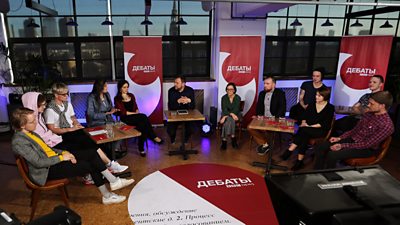
There aren’t many places where Ukrainians and Russians can meet and talk, and there is a lot of misconception on both sides... this edition of BBC Debates is a rare chance for audiences on both sides to see young people in conversation.
Filmed in London and presented by BBC News Russian’s Oleg Antonenko, the programme is part of the BBC’s Crossing Divides season of programmes which explores how people can be brought together across lines that divide them in a fragmented world. The BBC News Russian programme aimed to create a safe space where the young participants could connect and have a calm conversation about some of the fundamental issues facing their societies.
BBC News Russian Editor Jenny Norton comments: “There aren’t many places where Ukrainians and Russians can meet and talk, and there is a lot of misconception on both sides. To be shown in Russia and Ukraine, this edition of BBC Debates is a rare chance for audiences on both sides to see young people in conversation.”
The participants representing Russia are: Beijing University graduate student and participant of the Russian students’ 2015 video message to their Ukrainian counterparts Kamil Galiev (via Skype); graduate student at the Financial University under the Russian Federation Government, youth activist Lidia Godunova; graduate student at the Financial University under the Russian Federation Government, writer Daria Osinina; London-based graduate student, art critic Denis Stolyarov; creators of YouTube channel Cheburussia TV, Artyom Frantsuzov and Filipp Chekunov.
The participants representing Ukraine are: journalist and graduate student, Yulia Abibok; co-organiser of the Russian Language Days initiative in Lviv and Director of the Educational Centre for Human Rights, Volodymyr Beglov; Yevhenii Bulda of Kyiv Polytechnic Institute, participant of the Ukrainian students’ 2015 video message to their Russian counterparts; Yelena Korotkova, philology student at Mykolaiv National University; creators of YouTube channel Problematics, Anton Kuksa and Serhii Orlovsky.
As the BBC Debates participants heard each other and argued with each other, they also urged dialogue, understanding and empathy:
- "Neither in St Petersburg nor in Moscow is there an understanding that a war is going on in the east of Ukraine and that your citizens are dying. Your boys go to Donbass to work. Our boys and girls go to Donbass to fight for their country."
- "I ask you very much not to deny the Russians their humanity. Death of any person and death of any Russian in Donbass - even if it’s a mercenary who goes there to kill, and gets killed - is still a grief of the Russian state and of all our society."
- "We are growing up, we will have children. What kind of a world will they live in if we can see that the neighbouring country hates us?"
- "You have problems in your country and we have problems in our country… You shouldn’t see us as those aggressors, because just like you, we want to make sense of this situation and we want there to be peace for all."
- "It is not ‘our’ problem, but it is your problem as well, and I would like the Russians to realise this fully, as only then we might be able to solve it."
Summing up the conversation, Oleg Antonenko said: "I wish you all… to be really free and to be the ones who will shape the future of your countries."
This edition of BBC Debates will be published on the BBC News Russian YouTube Channel on Monday 4 March and will be aired by the BBC’s rebroadcasting partner channels including Moscow-based TV Rain (21.00 local time, 18.00 GMT on Monday 4 March), Berlin-based OstWest (19.10 local time, 18.10 GMT on Friday 8 March) and Estonia’s ETV+.
The BBC’s Crossing Divides will run across the year on TV, news, radio and online starting from Monday 4 March. It will bring people from conflicting sides together despite their differences whether social, ethnic, political, religious, geographical or generational.
BBC News Russian connects with its audiences via its website bbc.com/russian and social media platforms such as Facebook, VKontakte, Instagram, Twitter, Telegram, YouTube, Google+, LiveJournal and OK.ru.
BBC News Russian is part of BBC World Service.
LN