Annie Costello lived on Canning Street (no 48) when I first knew her and she then moved to 156 Bedford St South.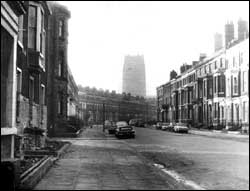 | | Canning Street 1974 |
Her door was always open, most definitely not because of her friendly nature, but because she told us that she was a Romany, and as such could not be fenced in. So this woman of indeterminate age would take a coal axe to every lock that was ever fixed to the front door of the house. Local legend had it that reminding the staff of the Housing Department that you lived in the same building as Annie Costello was a sure way of getting re-housed quickly. Her ground floor flat consisted of a living kitchen and a living bedroom. The rooms were alive, mice, bedbugs, fleas, flies all visited and most of them stayed. Every morning Annie got dressed up in several layers of clothing, none of it very clean, and then under her coat she put on her market-trader's pinny. No market stall for her though. Oh, no. As the car horns chimed out rush hour she would wander along to the corner of her street and the main road, and loiter. When a passer-by approached, she would block his way and demand assistance across the road. Having delivered her safely to the other side, the good Samaritan would then be relieved of his loose change - "Got ten pence, lad?". She was never known to fail. When greeted with a mumbled apology for having no change of a pound, she could produce 90p from the pocket of her pinny with the speed of light. Then she would loiter on that side of the road until another hapless pedestrian came along, ask for help back across the road and then repeat the demand for money. She could keep this up all day, every day - and usually did. 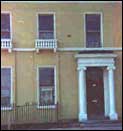 | | Falkner Street |
In the shimmering heat of the 1976 drought, Annie devised an extra little earner - she would sit on the steps leading to her ever-open front door, and request help from anyone around to get her to the corner. There she would perform the usual routine; and then once she was safely returned to "her" side of the road she would loiter on the corner and add a request for assistance back to her steps from the next passer-by. This brought in a small fortune, and gave her a bit of breathing space and somewhere to sit between road crossings. I don't remember anyone ever complaining about her. She was as much a part of the place as the architecture, but not quite as magnificent, and was tolerated by all the residents.A visit by mandarins, including the Minister for Merseyside, didn't bother her at all - she still begged for ten pence off them as they were swept past, and got her money by using her knack of having the change ready. This character of Liverpool died almost 20 years ago.
Story courtesy of Val Horton
|






