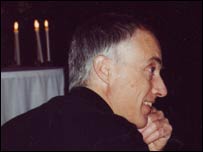
I was lucky enough to interview Andy Vivian, a BBC journalist whose career has taken him from New York to the Middle East, from Newsbeat to hard-hitting current affairs programme 'The World Tonight'. Andy now works for BBC Radio Gloucestershire, and was recently awarded local radio reporter of the year. I talked to him about his career, his daily work, and his tips for budding journalists. Andy says he became a journalist "by accident really". He had never planned on a career in journalism, and even started a degree in medicine before switching to the social sciences. He later decided he wanted go into drama production, and was accepted into a BBC training programme, from which point he eventually crossed over into journalism.
But how did he get accepted onto that much-coveted BBC training scheme? Q: In a competitive post-grad world, what gave you the edge? A: As a student I had done a lot of recording; just for fun really. I'd been an assistant roadie with the musical group I belonged to, so I'd dabbled in the world of audio producing. That and the fact that I'd done VSO (Voluntary Service Overseas) where I'd helped produce plays for a school in Papua New Guinea. So I'd already been involved in drama production. Basically I proved I had a background of being involved and interested in things relevant to my chosen career.
Andy soon moved to current affairs working on BBC 4's high profile 'The World Tonight', where he made his way up the ladder to the heights of Deputy Editor. The programme was at the forefront of the fast-paced news reporting, interviewing politicians, world experts and leaders. Q: What was it like working in the world current affairs? A: It was a hothouse - and the thought of the programme falling apart used to really worry me! Until the day one wonderful editor took me aside and said "Andy, it's OK to have the odd crap programme; it happens." I tried not to take it quite so seriously after that!
During this time, Andy went on several BBC attachments. He spent time in Parliament, worked on the TV show 'Nationwide' and was stationed in New York, which he admits was 'an amazing period'. Q: So what made you leave all this behind, and take the unusual step of moving to local radio? | "I've realised that no one is going to die if I have a bad programme; it’s not like being a heart surgeon." | | Andy Vivian |
A: That's something people really don't understand about me. But I had reached the point where the next stage would be management, and I didn't want that. My children were young and my wife and I decided we didn't want to live in London for the rest of our lives.
Andy then moved to district reporting, and after 10 years of production and editing, moved to in front of the microphone. Q: What's working for local radio like? A: Well, it's a lot harder! Q: Really? A: God yeah! Instead of being responsible for an hour-and-a-half a week, I am responsible for three hours a day! Q: But there must surely be less pressure? A: I do feel less pressure but maybe that's also because I am older. I've realised that no one is going to die if I have a bad programme; it’s not like being a heart surgeon. Q: What's the best thing about the job? A: Local radio is great because I can spend an afternoon driving through the Forest of Dean, meeting and interviewing local people. There's also rarely a day that doesn't end with some satisfaction. Much of the work is for next-day deadlines; it's immediate gratification. Q: So what's the downside? A: The hours of a district reporter are very long. Sometimes, at 10pm when a story's finally finished, you think 'thank god we got there!' Q: Why radio? A: There's room to go into things deeper than you can in TV. And even though radio's audience is small, it is dedicated. You feel within a limited world you can have slightly more impact. Especially local radio - there's no local TV in the same way so there's quite a lot of stories only covered by the commercial station or me. Q: What are the difficulties of radio journalism? A: It's true writing for radio is a particular skill and I find it very hard. To condense a complicated story into 40 seconds is really, really difficult. Q: What makes a good journalist? A: You need to give people their own say - the best journalists are unassuming. What matters in journalism is not the content but how you tell it. Good journalism will avoid cliches and make people think and question their assumptions. Still think you've got what it takes? |