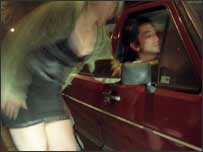
Two adults enter a room, agree a price, and have sex. Has either committed a crime? No victims, right? Prostitution’s one of our world’s oldest professions – even biblical texts are rife with mentions of immoral prostitutes. While talk in the ineties was all about decriminalising and liberalising prostitution, European countries have in recent months begun talking about a crack down. Having leafed a report which mentioned how a sizeable percentage of 16 to 24-year-olds who visit brothels are university students, I thought it a good idea to visit one. In a spirit of intrepid journalism and I admit a little curiosity I visited one of Leicester’s many massage parlours. Entering through a thick beaded curtain, I was led upstairs by a thirty something woman, in threadbare stockings and a black leather mini skirt, who led me to a seat, invited me to flip through a stack of porn magazines and told me she’d be back in a few minutes. Whilst waiting I spent most of my time listening to a receptionist answer a dozen calls and dealing out descriptions of her girls. A few moments later K presented herself and led me a few steps down a dimly lit hall. As soon as she’d closed shut her bedroom door K sat on her settee and began listing out her price range, as though flipping through a menu, including what she thought I could afford (I admit I looked a little raggedy). 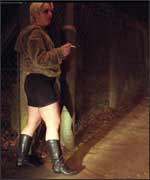 | | Andre’ explores the sex industry |
When I told her I wasn’t interested and just wanted a few questions answered, she fidgeted uneasily and warned me that I’d better not try anything weird. It turned out she was a 44-year-old (not 34) ex-hospital worker, but had quit her job a couple of years earlier when she’d figured out she could earn a week’s worth of a legitimate pay check in a good solid day at an massage parlour. When I asked her if she’d ever had any trouble with Leicestershire’s police, she answered that quite a few were among her regular clients. “That’s how you make money,” she smiled sarcastically, “you’ve got to build up your regulars”. Last April, a police civilian worker has escaped jail after he admitting running a brothel in Leicestershire. Paul Bailey, 35, a Leicestershire Police employee, admitted living off the earnings of prostitution. So admittedly I wasn’t surprised. When I asked about health risks K answered, “It’s not too bad, I mean, after all condoms are universal, now, yeah? Most boys seem all right, anyway…” She again asked me whether I was sure I wasn’t interested in anything at which point I assumed it’d been a pretty slow day. Sex industries have exploded across Britain. It’s now become an £800 million a year business – a two-fold increase over earlier years. An influx of Eastern European women, particularly from Bulgaria, Romania and former Soviet republics have flooded into London, running internet shops, sauna massage parlours and occasionally street walking. Immigrants have a particularly hard time finding well paying jobs in Western Europe – whereas language and talent skills are not prized in sex trade circles. As Easterners move in, Londoners move out into nearby counties, setting up shop in once unlikely places such as Lincoln, Glastonbury and Highbridge, in sleepy suburbs. Nestled between whitewashed picket fences and boarding schools, prostitution’s made its mark. | "Whilst waiting I spent most of my time listening to a receptionist answer a dozen calls and dealing out descriptions of her girls." | | Andre’ Naffis |
Access to sex for sale has never been easier - via internet, top-shelf magazines, or even specialised guides such as McCoy's, which brags on its cover: ‘448 massage parlours, 38 escort agencies, 144 flats, 341 working ladies, erotic parties, dominatrices, and working twosomes.’ It’s a slave trade that’s routinely forcing women into degrading positions, out of which few are lucky enough to escape. Russia’s recently had to own up to a brewing crisis of returning thirty-somethings who’ve had their lives taken away from them and aren’t able to readapt themselves in society. Once single mothers discover they can make a lot more at a massage parlour or as an escort than they can at a checkout lane, little choice is left them if in a moment of crisis. Our modern world’s based on a principle that people can buy and sell whatever they wish – it’s perhaps not surprising then that sex tops the list. Britain so far lacks a nationwide policy on kerb crawlers and pimps, leaving England and Wales’ 43 police forces to themselves, overlooking serious problems and skimming around an iceberg’s tip. Unfortunately criminalizing prostitution would only endanger women. Instead of receiving regular medical check-ups and benefiting from legal protection, working conditions would likely only worsen. Society would be better served by looking into what motivates men to buy sex and women to offer, instead of criminalizing exploited streetwalkers, who’ve enough to worry about. Sex laws differ around Europe: - In Britain, prostitution isn’t illegal if the prostitute works independently without disturbing public order. Men who are found buying sex several times in prostitution areas (Liverpool) can be fined. It’s a crime to advertise, run a brothel or recruit for prostitution. 80,000 women currently work as prostitutes in Britain.
- In Greece, brothels are not allowed within 200 metres of public buildings. Athens considered a proposal for a new law to halve the distance to facilitate prostitution during this summer's Olympics, but instead decided against.
- In the Netherlands, prostitution is legally defined as a profession and prostitutes join the Service Sector Union. They’ve been required to pay income tax since 1996. Brothels employ around 30,000 people.
- In Sweden, it has been illegal to buy or try to buy sexual services since January 1999. Prostitution’s considered an expression of unequal relations between men and women.
- Germany passed a law in December 2002 that gave prostitution legal recognition. Cologne has legalised ‘drive-in’ brothels, with covered parking, bedrooms and showers.
- France recently (2003) cracked down on soliciting and outlawed commercial sex with vulnerable women (including, strangely enough, pregnant women).
|
|