Image: Getty
INTRODUCTION
Do you get on with people from different generations at work? There are lots of stereotypes about different generations. But are older and younger workers really that different? In this episode, Pippa and Phil talk about generations in the workplace, with Grace Lordan, director of the Inclusion Initiative at the London School of Economics.
TRANSCRIPT
Phil
Do you get on with different generations at your work?
Grace Lordan
And really, if you find yourself leaning on a stereotype, regardless of what age you are, stop yourself in those tracks because this is really unhelpful.
Pippa
Today we'll be talking about how generational differences impact work.
Phil
Hello and welcome to Learning English for Work, our podcast to help you improve your business English. I'm Phil.
Pippa
And I'm Pippa. You can find a transcript for this episode to read along on our website: bbclearningenglish.com.
Phil, you and I are from slightly different generations, not to give our ages away.
Phil
No, no. But yes, there is a difference.
Pippa
Um, but we get on all right, don't we?
Phil
I think so, I've always worked with people who were different ages to me, whether they're a lot older than me or a lot younger than me.
Pippa
Mhm. That's interesting. See, I have worked in places before where most people were a similar age to me, but I really like working in our team where we have lots of different ages, because I think it's good to have different perspectives and people at different points in their life. I think sometimes you can assume that the way you think is the way everyone thinks, and so it's useful sometimes to, um, be working with people who don't think that way or who have slightly different perspectives.
And there are often a lot of stereotypes and generalisations associated with different generations at work. So, for example, people might think that older generations can't use technology, and people might think that younger generations maybe don't take work seriously enough.
Phil
But are these stereotypes true? That's what we'll be trying to find out today.
Pippa
Yes. And to help us is Grace Lordan, director of the Inclusion Initiative at the London School of Economics.
Grace Lordan
So people have been interested in a long time in understanding the differences of workers of different ages inside of the workplace. And typically to do this we rely on these kind of buckets of generations. So we have Generation Z, who was born between 1997 and 2004. Millennials, 1981 to 1996. Generation X, 1965 to 1980 and Baby Boomers, 1946 to 1964.
As an economist, I'm really interested in how these different generations navigate the workplace. So in terms of their productivity, their career progression, their experiences in the workplace, and there are differences. And I'm also really interested in thinking about how those differences impact productivity within the organisation and within teams. And if there's things that we can do about it that allow all the generations to be happier. So I'm not interested in changes that will make one generation miserable and another happier. But if there's things that we can do that will make all the generations happier, then I like to recommend to organisations that they do those things.
Pippa
Mmm, yeah. And in terms of those differences between generations, I suppose we see a lot of media articles about, you know, sort of stereotyping certain generations as certain kinds of workers. And I certainly see sort of social media, a bit jokey, sort of talking about differences between generations in the workplace. Do you think that bears out in the research that you've done and that others have done, or do you think that actually people have more similarities than they think?
Grace Lordan
So I think firstly, the belief bears out. So the belief is well and truly alive. And actually when I give talks on this, I usually start by saying in all of the areas of inclusion, so if we take race, LGBTQ+, gender, generations as four, generations is the only one where making jokes about particular generations that rely on ill-founded stereotypes is acceptable. So the beliefs are really entrenched, and I think it's really problematic because you can imagine if somebody believes about you that you're lazy, then they're going to internalise that belief about you and confirm their own belief. If someone believes about you that you don't want to adopt AI, people are going to internalise that and that belief is going to impact you in the workplace.
What I can say is that on the individual side, much like the comparisons between men and women, if there are differences, these differences are much smaller than what we might think. The only place where I see differences that are very credible at the moment are on self-reported beliefs regarding progressive beliefs. So in general, Gen Z, the youngest population, do tend to want much more progressive change in the workplace and push for much more progressive change as compared to Gen X and Baby Boomers. But I would be really cautious when interpreting that this is about Gen Z being special, and they're going to hold this trait for the rest of their life course, because the best evidence that we have are that the younger generations are always more progressive.
Pippa
So what Grace is saying is there aren't as many differences between generations as we might think, but the problem is that we believe that there are big differences between generations. We believe in the stereotypes and the jokes.
Phil
Yes, and it's interesting what Grace says about younger workers, Gen Zs, being progressive, that they might not stay that way as they get older. I think sometimes we forget that attitudes can change over time.
So I want to know how does all this impact on work, Pippa?
Pippa
Good question. Well, Grace says that generational divides in the workplace, where some generations don't feel included, can cause lower productivity.
Grace Lordan
If we look at the workers as a whole, 25% of the workforce self-report low levels of productivity. So that's people assessing that inside in their job they have low levels of productivity. This is substantially higher for Generation Z and the Millennials, for the younger generation. So about 37% for Generation Z and 30% for Millennials.
Pippa
Grace has found that younger people feel they are less productive. But she's also found that if managers are able to include all generations, they can improve productivity.
Grace
Yeah. So first is getting meetings right and making sure that you equalise voice and that younger generations' voices aren't lost. The second is getting feedback right. So there's really good evidence that this one-to-one feedback that individuals get is going to be much higher quality if you have higher levels of affinity with your manager, so if you're much more friendly with your manager. What that means is that if you're from a different generation, you're much less likely to get direct feedback, which is beneficial to you, and also feedback delivered with empathy, which is what we want.
And the third thing is really to encourage autonomy. And what that really means is that you let younger generations get on with their tasks. You let them make mistakes, but that you're there to support them when they make those mistakes, you're there to support them when they need help and you're there to support them if things are going wrong in their life outside the workplace as well. And I think if we get those three things right, meetings, feedback and autonomy, giving more autonomy and giving more trust across generations, we'll definitely see a happier workforce. And I would bet as well we'll see some increases in productivity.
Pippa
And what do you think will be sort of the future challenges in this area?
Grace Lordan
I mean, one of my biggest concerns for the younger generation at the moment relates to AI. A lot of the jobs that people did as entry-level jobs where they got really good training and really good grounding for long-run careers, are now being substituted by artificial intelligence inside in companies. Now organisations are saying that this won't impact the number of people that they're hiring. But the data is starting to tell a different story. So one of my kind of big concerns for the younger generation is making sure that they get that first job, a job that they like, a job that they feel comfortable and they feel respected, but also that they pay attention to that they're in a job that gives them growth opportunities.
Pippa
Mmm, yeah. And we've talked a lot about sort of younger generations, but I wonder how this applies to older generations, especially people in those generations who maybe aren't in top management roles but are kind of still working with younger people at those lower down roles. I wonder how that is impacting them.
Grace Lordan
I think our research, in the first and in the second year of the Generations Hub at the Inclusion Initiative, demonstrated quite clearly that if somebody takes seriously having inclusive leadership practices, the differences in the age that they might perceive to be large actually go away inside an organisation, and it really opens the door for hearing diverse perspectives from the younger generation. It really opens the door from the younger generation, listening to people who have longer tenure inside organisations. And all of that is better for the individuals and better for the organisation itself.
Pippa
Yes, it's kind of like a mutual respect of one, experience, but then two kind of that youth and energy that comes from those younger generations.
Grace Lordan
Absolutely, absolutely. And really, if you find yourself leaning on a stereotype, regardless of what age you are, stop yourself in those tracks because this is really unhelpful. It's unhelpful for society because it creates divisions that aren't actually really there. And actually when differences are there, they're usually helpful if you lean into them with curiosity. So there's a lot that younger people can learn from individuals who've been in the workplace 10, 20 plus years. And equally, there's a lot that older generations can learn from the younger people who are coming in about where the world should go and how they can also help the young people get to where they want to go.
Phil
It seems an obvious observation that we can learn from different generations, but it's interesting that in lots of organisations, different generations don't feel like they understand one another.
Pippa
Yes, and Grace mentioned artificial intelligence, AI, being a bit of a danger when it comes to different generations at work. And we know that there are a lot of potential challenges in work in the future because of AI. We did an episode all about that. So listen back to that episode if you missed it.
Phil
And that's it for this episode of Learning English for Work. Find more programmes to improve your business English on our website, bbclearningenglish.com.
Pippa
We'll be back next week to talk more about the future of work. Bye for now.
Phil
Bye.
Now try this...
Discover all our latest programmes.
Explore other topics.
ሐድሽ ፓድካስትታት ተመልከት Work in the future
How can we stay cyber safe?
Episode 251201 / 18 Nov 2025
Pippa and Phil talk about how to avoid scams and hacking.
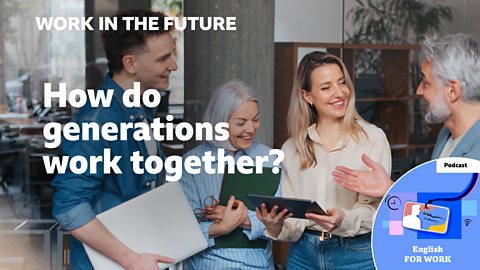
How do generations work together?
Episode 251124 / 24 Nov 2025
Pippa and Phil talk about older and younger people in the workplace.

Should we work fewer hours?
Episode 251117 / 17 Nov 2025
Pippa and Phil talk about flexible work and whether it benefits employees.
Does office design impact our work?
Episode 251110 / 10 Nov 2025
Pippa and Phil talk about offices and how they are changing.
Will AI take over our jobs?
Episode 251103 / 03 Nov 2025
Pippa and Phil talk about how AI might change the world of work.
What is wellbeing at work?
Episode 251027 / 27 Oct 2025
Pippa and Phil talk about how the way you feel affects the way you work.

How do you network online?
Episode 251020 / 20 Oct 2025
Pippa and Phil talk about using social media to build your career.
Is working from home here to stay?
Episode 251013 / 13 Oct 2025
Pippa and Phil talk about hybrid work
What will work be like in the future?
Episode 251006 / 06 Oct 2025
Listen to the trailer for our series about the future of work