The Reading Room

Intermediate level

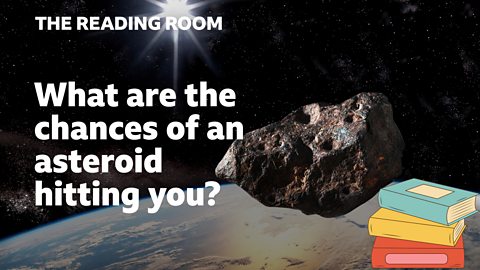
What are the chances of an asteroid hitting you?

Episode 251109 / 09 Nov 2025

(Image: Getty)
___________________________________________________________________

More articles
_________________________________________________________

Hard: Upper intermediate level and above, B2 and above 

Introduction

Read the article and answer the questions below. To listen to this article,click here for an audio download.

Read 

1 An asteroid ended the age of the dinosaurs 66 million years ago. Could something as catastrophic as that happen again?

2 Asteroids are something astronomers closely track. Recently, the asteroid named 2024 YR4 made headlines for its tiny, but real, chance of colliding with Earth in 2032. In February 2025, Nasa increased the impact probability of this asteroid hitting us to 2.3%. Scientists have calculated that YR4 is between 40m and 90m in diameter. It would have the power of a nuclear bomb if it was to hit Earth, causing severe damage if the impact was in a populated area. However, Dr Robert Massey of the Royal Astronomical Society urges calm. He said he is not "losingsleep over" the asteroid, but stresses that funding planetary defence and spotting potential threats is essential.

3 So what are asteroids? They are fragments of rock left over from the creation of the solar system 4.6 billion years ago. They frequently orbit close to Earth pushed by the gravity of other planets, though it was only in the late 1900s that scientists were able to systematically track near-Earth objects and learn this. They found that asteroids of more than 40m across, that's large enough to destroy a city, cross the Earth's path within lunar distance several times a year.

4 The chance of an asteroid being large enough to penetrate our atmosphere intact and destroy a city is likely to happen once in every hundred years. In 1908, an asteroid exploded over Siberia, injuring people and buildings across more than 500 square kilometres. However, actual impacts aren't as common as near-misses. For example, the asteroid Apophis raised alarms after it was discovered in 2004 because it was estimated to be around the size of a cruise ship. Even scarier, in 1994, the comet named Shoemaker-Levy 9 crashed into Jupiter, and, if it had hit Earth, all life would have been wiped out, just like the dinosaurs were.

5 So, it's safe to enjoy admiring the night sky because the chances of you being hit by an asteroid are very, very small, even if they're not zero.

Questions

1. Choose the best summary for the article.

a. Asteroids are more common than you think.
b. Asteroids are unlikely to impact you.
c. Asteroids are more of a danger than ever.

2. Choose the correct option based on the content of the article.

1. Scientists expect 2024 YR4 to hit Earth in the next ten years.
a. True
b. False
c. Not given

2. What does Dr Massey say is very important?
a. remaining calm in the event of an impact
b. ensuring budget is spent on space trips
c. continuing to research the likelihood of asteroid impacts

3. Asteroids come close to our planet because of…
a. the gravitational pull of Earth.
b. lunar forces impacting Earth.
c. the gravitational push from other planets.

4. What does 'this' refer to in the following sentence? …it was only in the late 1900s that scientists were able to systematically track near-Earth objects and learn this.
a. That asteroids regularly come close to Earth.
b. Gravity plays a role in the movement of asteroids.
c. That asteroids of 40m in diameter could destroy a city.

5. Apophis was a large asteroid that hit Earth in 2004.
a. True
b. False
c. Not given

3. Use the words from the list to complete the summary of the article.

A/an 1) ________ could 2) ________ humanity, but it's unlikely. 3) ________ are more common than impacts, though 4) ________ is something that money should be spent on because the chance isn't zero. An asteroid the size of YR4 could hit with the power of a 5) ________, for example.

planetary defence
near-misses
nuclear bomb
fragments
wipe out
asteroid
intact

Vocabulary

collide
hit

nuclear bomb
an explosive device powered by a nuclear reactor

impact
the force or action of one object hitting another

lose sleep
worry

fragments
pieces of something

orbit
follow a curved path around a planet or star

systematically
done in a way that follows and agreed method or plan

intact
complete; in its original state

near-miss
a situation where something almost hits something else

wipe out
completely destroy

Answers

1. Choose the best summary for the article.

b.The chances of you being hit are very, very small, but they're not zero.

2. Choose the correct option based on the content of the article.

1. b.False.In February 2025, NASA increased the impact probability of this asteroid hitting us to 2.3%.

2. c. …but stresses that funding planetary defence and spotting potential threats is essential.

3. c. They frequently orbit close to Earth pushed by the gravity of other planets.

4. a. They frequently orbit close to Earth pushed by the gravity of other planets, though it was only in the late 1900s that scientists were able to systematicallytrack near-Earth objects and learn this.

5. c.Not given. It says the asteroid raised alarms, meaning caused people to worry, but doesn't say if it hit Earth or not. The asteroid Apophis raised alarms after it was discovered in 2004 because it was estimated to be around the size of a cruise ship.

2.    Use the words from the list to complete the summary of the article.

An asteroid could wipe out humanity, but it's unlikely. Near-misses are more common than impacts, though planetary defence is something that money should be spent on because the chance isn't zero. An asteroid the size of YR4 could hit with the power of a nuclear bomb, for example.

Next

Listen to the article.

Learn lessons from the Moon in this 6 Minute English

Listen to news reports in The Listening Room.

ሐድሽ ፓድካስትታት ተመልከት The Reading Room