บทเรียน 19: A place to live
Goldilocks
เลือกบทเรียน
- 1Nice to meet you!
- 2What to wear
- 3Like this, like that
- 4The daily grind
- 5Christmas every day
- 6Great achievers
- 7The Titanic
- 8Travel
- 9The big wedding
- 10Sunny's job hunt
- 11The bucket list
- 12Moving and migration
- 13Welcome to BBC Broadcasting House
- 14New Year, New Project
- 15From Handel to Hendrix
- 16What's the weather like?
- 17The Digital Revolution
- 18A detective story
- 19A place to live
- 20The Cult of Celebrity
- 21Welcome to your new job
- 22Beyond the planets
- 23Great expectations!
- 24Eco-tourism
- 25Moving house
- 26It must be love
- 27Job hunting success... and failure
- 28Speeding into the future
- 29Lost arts
- 30Tales of survival
บทเรียนย่อย 2
You might say that English is too confusing and there are too many rules. Have you really got enough time to learn them all? Well, it can be very difficult, that’s true. But don’t make excuses – this session will help you understand the words too, very and enough.
คะแนนจากบทเรียนย่อย 2
0 / 8
- 0 / 4แบบฝึกหัด 1
- 0 / 4แบบฝึกหัด 2
- 0 / 0แบบฝึกหัด 3
แบบฝึกหัด 2
There's enough to study - but not too much!
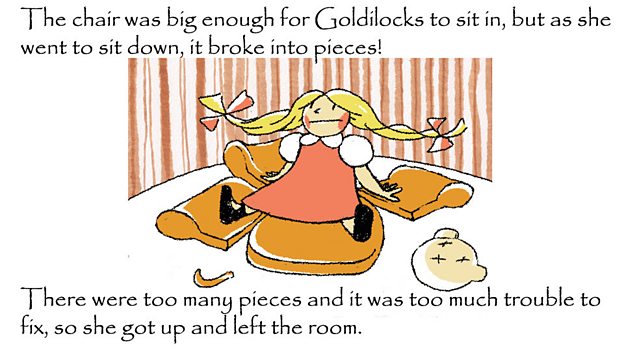
The chair was big enough to sit in…
We've looked at how the words too and very work with adjectives in English. Now we'll study three more patterns that use enough, too much and too many.
Have a look at this picture to see them all in use!
Read the text and try the activity
Enough
Let's start with enough. Have a look at this part of the sentence and think about the meaning.
The chair was big enough for Goldilocks to sit in...
Can Goldilocks sit in the chair? Yes, she can. Is the chair too big? No. Is the chair too small? No.
We use enough and not enough with adjectives in English to talk about the right amount of a thing or a quality. Take a look at some more examples.
- This computer is powerful enough for all your video editing needs. (The computer has the right amount of power to do all types of video editing.)
- It's not a great film really, but it was interesting enough to keep me watching for a couple of hours. (The film made me have the right amount of interest, even though it wasn't very good.)
- You must be over 1.5 metres tall to go on the rollercoaster - sorry, your kids are not tall enough. (The right height for the ride is 1.5 metres - the kids are under this height so they can't go on the ride)
The form is adjective + enough in positive sentences or not + adjective + enough in negative sentences.
Another way we use enough and not enough in English is with nouns, to say whether there is the right amount of something. Take a look at these examples.
- There was enough porridge for Goldilocks to satisfy her appetite. (She ate it all and wasn't hungry after - it was the right amount.)
- There wasn'tenough evidence for Inspector Stone to solve the case. (Inspector Stone didn't have the right amount of evidence to solve the crime.)
- Have you got enough time to complete all your tasks today? (Do you have the right amount of time to do it all?)
- Are there enough chairs for everyone to sit down? (Are there the right amount of chairs or do we need any more?)
- I haven't got enough money to buy lunch today! (I haven't got the right amount of money to pay for lunch.)
The form here is (not) enough + noun and it can be used with both countable and uncountable nouns.
Too much, too many
Now, let's look at too much and too many.
...there were too manypieces and it was too much trouble for Goldilocks to fix the chair.
Could Goldilocks fix the chair? No. Why? Because the chair was broken so badly that she couldn't fix it.
We use too much and too many in English to talk about an amount of something that causes a problem because it is more than we want or need. Take a look at some more examples.
- Some people think there are too many rules in English.
- There are too manypeople on the bus.
- There is too much salt in this soup.
- Chris feels sick. He ate too much chocolate.
We use too many with countable nouns, like rules and people. We use too much with uncountable nouns, like salt and chocolate.
Time for a quiz! Try to answer these questions about enough, too much and too many.
Quiz
4 Questions
Check what you've learnt about 'enough', 'too much' and 'too many'
ช่วยเหลือ
แบบฝึกหัด
Check what you've learnt about 'enough', 'too much' and 'too many'
คำใบ้
Is there the right amount of time, or is there a problem?Question 1 of 4
ช่วยเหลือ
แบบฝึกหัด
Check what you've learnt about 'enough', 'too much' and 'too many'
คำใบ้
Remember what goes after 'too' and before uncountable nounsQuestion 2 of 4
ช่วยเหลือ
แบบฝึกหัด
Check what you've learnt about 'enough', 'too much' and 'too many'
คำใบ้
Are there the right amount of cakes, or is there a problem?Question 3 of 4
ช่วยเหลือ
แบบฝึกหัด
Check what you've learnt about 'enough', 'too much' and 'too many'
คำใบ้
Remember the correct word order!Question 4 of 4
Excellent!เยี่ยม!แย่หน่อย!คุณทำคะแนนได้:
Next
Time to join Rob and Catherine for 6 Minute Grammar. They're clothes shopping - Catherine's going to a party and she needs something to wear. Find out if Catherine gets the right dress and check what you've learned about too, too much, too many, very and enough. That's a lot of grammar!
หลักไวยากรณ์จากบทเรียนย่อย
We use (not) enough with adjectives and nouns to talk about the right amount of something. (Not) enough comes after an adjective or before a noun:
Jenny: Did you buy that dress?
Sally: No, I didn't. It wasn’t big enough.Have you got enough money?
We have enough food.
There aren't enough chairs.We use too with much and many to talk about an amount or number of something that is more than we want or need. Too many goes with countable nouns. Too much goes with uncountable nouns.
There are too many people on the bus.
There is too much salt in this soup.
