บทเรียน 17: The Digital Revolution
'Used to' for past habits
เลือกบทเรียน
- 1Nice to meet you!
- 2What to wear
- 3Like this, like that
- 4The daily grind
- 5Christmas every day
- 6Great achievers
- 7The Titanic
- 8Travel
- 9The big wedding
- 10Sunny's job hunt
- 11The bucket list
- 12Moving and migration
- 13Welcome to BBC Broadcasting House
- 14New Year, New Project
- 15From Handel to Hendrix
- 16What's the weather like?
- 17The Digital Revolution
- 18A detective story
- 19A place to live
- 20The Cult of Celebrity
- 21Welcome to your new job
- 22Beyond the planets
- 23Great expectations!
- 24Eco-tourism
- 25Moving house
- 26It must be love
- 27Job hunting success... and failure
- 28Speeding into the future
- 29Lost arts
- 30Tales of survival
บทเรียนย่อย 3
We're off to Australia in this session! Read an article all about how mining has changed 'down under'. See how the past is compared to the present with used to. And Alice returns with a useful spelling tip.
แบบฝึกหัด 1
Robot trucks do the jobs Australians shun
Australia's newest mine workers
Take a look at the truck in the picture below and think about these questions:
- How big do you think this truck is?
- What kind of work is it used for? What can it do?
- How many people does it take to drive it?
อ่านเนื้อหาพร้อมทำแบบฝีกหัด
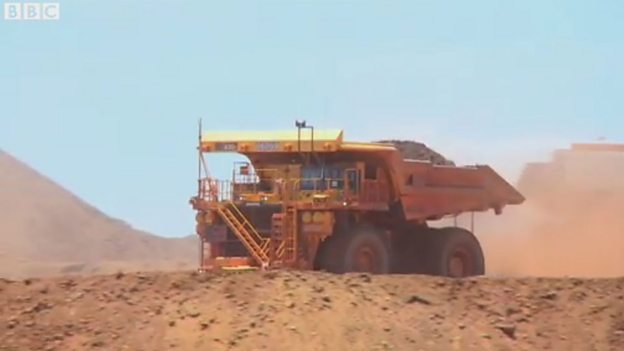
Image from an original BBC Click programme. Click is a BBC television programme covering news and recent developments in the world of consumer technology.
Here are the answers:
- This truck is an amazing 7 metres tall, making it one of the biggest trucks in the world.
- It is used in Australia for mining – it can drill holes, extract copper and iron, and carry heavy loads.
- Zero! This is a mechatronic truck and it works automatically.
Now, read this article about Australia’s mining trucks and try the activity below.
Modern technology means big change for Australia's miners
Think of Australia and you probably think of modern cities like Sydney and Melbourne, sunny weather, and the beach!
But Australia is one of the world’s largest countries - and the world’s biggest island. It has a huge interior with thousands of miles of beautiful, uninhabited space.
This huge space is also part of a problem for Australia. These vast areas are full of rich pickings – mainly minerals and metals – but there are few people who want to go and get them.
Mining companies used to rely on a few brave and adventurous workers who would come and live a thousand kilometres from the nearest town. However, now the Four Hope Iron Ore Mine in North-western Australia (which actually is 1,000km from the nearest town!) uses giant robots to do the jobs that people don’t want to do.
Mine workers used to drill holes and operate machinery to crush rocks. They also used to drive the trucks and the trains that transported the iron ore to the coast. Now, automated machines do all the dirty and dangerous work.
The robot trucks are not only useful for the difficult jobs though. They are also very efficient. When the trucks had human drivers, they used to use a lot more fuel and chemicals to extract minerals. Miners also used to dig more holes but the automated trucks are much more precise.
The mining companies used to pay much more in energy bills – saving energy is very important when crushing rocks uses 5% of the world's energy! This extra efficiency means the companies can make millions of dollars in extra profit.
These machines do not mean there are no human mine workers. People still work in the mining industry, but they are doing different jobs.
Miners and engineers used to fly to the mines and work away from their families for weeks at a time but now they can work from home as remote operators. Employees at the mining companies used to be trained in manual labour but now they are trained in remote control and computer operation.
As well as remote operators, experts in mechatronics also work for the mining companies. Mechanics and maintenance staff also work at the mine to look after the equipment. However, there are only a few of them. There used to be hundreds of people working there.
Australia's robots, then, may provide an insight into life and work in the future. No matter where the work is, we can live anywhere - near the mines or on the coast - and let the machines do the heavy work.
This article is based on an original BBC News story.
To do
What did you learn about the mechatronic trucks and how they have changed mining? Test yourself with this quiz.
True or false?
6 Questions
Read the statement about the article and decide if they are true or false
ช่วยเหลือ
แบบฝึกหัด
Read the statement about the article and decide if they are true or false
คำใบ้
Take a look at the beginning of the articleQuestion 1 of 6
ช่วยเหลือ
แบบฝึกหัด
Read the statement about the article and decide if they are true or false
คำใบ้
Look for where the words 'truck' and 'energy' are mentioned in the articleQuestion 2 of 6
ช่วยเหลือ
แบบฝึกหัด
Read the statement about the article and decide if they are true or false
คำใบ้
Look at the final three paragraphs of the articleQuestion 3 of 6
ช่วยเหลือ
แบบฝึกหัด
Read the statement about the article and decide if they are true or false
คำใบ้
Look for the word 'home' in the articleQuestion 4 of 6
ช่วยเหลือ
แบบฝึกหัด
Read the statement about the article and decide if they are true or false
คำใบ้
Look for the words 'manual labour' is mentioned in the articleQuestion 5 of 6
ช่วยเหลือ
แบบฝึกหัด
Read the statement about the article and decide if they are true or false
คำใบ้
Look for sentences with the words 'efficient' and 'profit' in the articleQuestion 6 of 6
Excellent!เยี่ยม!แย่หน่อย!คุณทำคะแนนได้:
Next
So far in Unit 17, you've seen a debate about change, studied the grammar of used to, and seen used to in an article. In the next activity, we'll join Alice again - not for an argument this time! She's here to remind you of an important spelling tip.
หลักไวยากรณ์จากบทเรียนย่อย
We use used to + infinitive for:
- things we did regularly in the past, but we don't do now.
- past facts which are no longer true.
I used to work at a restaurant, but now I work at a library.
NOT: I used to eat some cake last Saturday night. ('Saturday night' was just one time, so it was not something that happened regularly.)
Used to helps us to compare activities in the past and now. When we say used to, we do not do something now.
I used to work at a restaurant. I quit that job, and then got a new job at a library.
The different forms are:
positive: used to + infinitive
I used to live in Istanbul. Now I live in Columbia.
negatives & questions: did / did not / didn't + use to + infinitive
I didn't use to like sushi. Now I love it!Did you use to work in a restaurant?
Session Vocabulary
shun
avoid, ignore, or rejectmining
the process of removing valuable metals and minerals from the groundextract (verb)
(here) to remove minerals from rockmechatronics
a combination of mechanics, electronics, and computinginterior
(here) a central area, away from the coastuninhabited
where no-one livesrich pickings
a large amount of valuable resources or materialsefficient
using money and materials in the most effective way possibleremote
far away; in an isolated placemanual labour
hard, physical work which needs strength more than skillinsight
information and understanding
