บทเรียน 5: Go The Distance: Finding and using source material
เลือกบทเรียน
- 1Go The Distance: Choosing distance learning
- 2Go The Distance: Academic reading
- 3Go The Distance: Academic talk
- 4Go The Distance: Academic writing
- 5Go The Distance: Finding and using source material
- 6Go The Distance: Going the distance
- 7Go The Distance: Critical thinking
- 8Go The Distance: Social learning
- 9Go The Distance: Projects
- 10Go The Distance: Succeeding in exams
บทเรียนย่อย 3
Study Skills 5 – Using sources
Welcome back to our Study Skills series – where we've got the tips and knowledge to help you develop your academic skills and become a top-class distance learner. This time we're looking at how to find and use sources successfully in your academic assignments.
แบบฝึกหัด 2
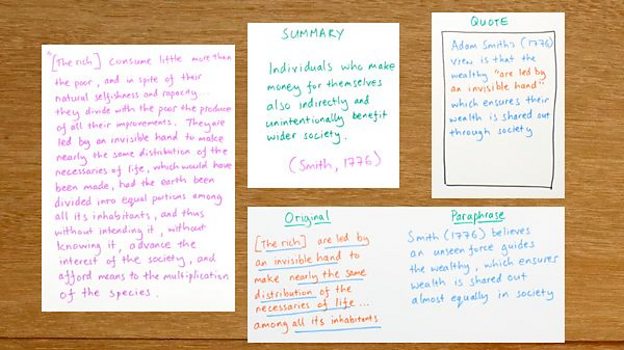
Paraphrasing, summarising, and quoting
Question 3 asked about paraphrasing, summarising and quoting in your academic assignments – did you pick up all the tips? Let's remind ourselves of the question first.
Question 3
What are the key features of these three types of reference – paraphrase, summary and quote?
To do
Check what you know by trying this activity.
ลองทำแบบฝีกหัด

Paraphrasing, summarising, and quoting
3 Questions
Check you've understood about paraphrasing, summarising and quoting by answering these questions.
ช่วยเหลือ
แบบฝึกหัด
Check you've understood about paraphrasing, summarising and quoting by answering these questions.
คำใบ้
You need a reference that is shorter than a paraphraseQuestion 1 of 3
ช่วยเหลือ
แบบฝึกหัด
Check you've understood about paraphrasing, summarising and quoting by answering these questions.
คำใบ้
If it is expressed well in the original text, you might want to use the exact words from the textQuestion 2 of 3
ช่วยเหลือ
แบบฝึกหัด
Check you've understood about paraphrasing, summarising and quoting by answering these questions.
คำใบ้
Remember that a quote is when you use the words from the text and not your own wordsQuestion 3 of 3
Excellent!เยี่ยม!แย่หน่อย!คุณทำคะแนนได้:
7 top tips for using sources successfully
You've nearly reached the end of this unit. At the bottom of this page you can find links to more useful study skills materials.
But before we finish, let's take another look at what we've learned about using sources. Check to see if you got all seven tips!
- Refer to other people's work in your assignments to show you've done research – but always acknowledge the source, otherwise it's plagiarism!
- You can give a short reference in the main text of your writing – make sure you include the author's name and the publication year for your source.
- In the reference list at the end of your essay you should include more information about your sources, like titles, chapters, publishers.
- Summarise long source texts – take the main ideas and express them in a shorter form.
- Paraphrase sections of the source text – rewrite them in your own words, changing the vocabulary and grammar.
- You might want to quote something from a source text directly – especially if it is expressed concisely or is a well-known fact or theory.
- Don't rely on quotes too much! They should only be used as evidence to support your own points.
Find out more
Visit our partner The Open University for more study tips – just click on the 'Where next?' link.
Where next?

Session Vocabulary
Find out more about distance learning – visit our partner,The OU
____________________
To help you understand the tips in this Study Skills video, here are some key words and their definitions:
plagiarism
copying some else's work and pretending it is your ownto reference
to mention something and show the sourceto paraphrase
to repeat something using different words