บทเรียนย่อย 11
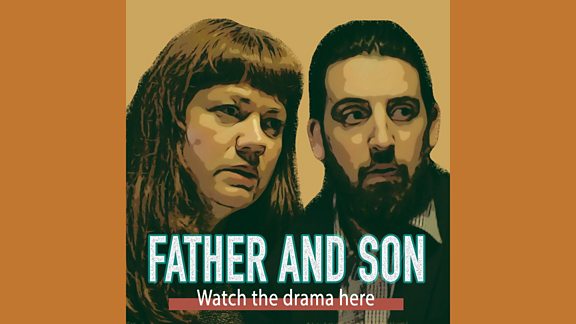
Watch our new crime drama, Father and Son and then learn more about the people involved with the making of it.
คะแนนจากบทเรียนย่อย 11
0 / 0
- 0 / 0แบบฝึกหัด 1
- 0 / 0แบบฝึกหัด 10
- 0 / 0แบบฝึกหัด 2
- 0 / 0แบบฝึกหัด 3
- 0 / 0แบบฝึกหัด 4
- 0 / 0แบบฝึกหัด 5
- 0 / 0แบบฝึกหัด 6
- 0 / 0แบบฝึกหัด 7
- 0 / 0แบบฝึกหัด 8
- 0 / 0แบบฝึกหัด 9
แบบฝึกหัด 4
Father and Son: Meet the writer!
Part One
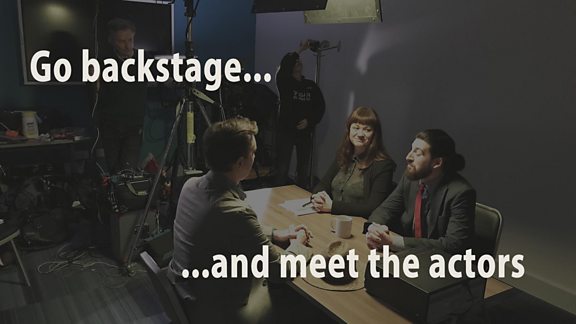
In our first meeting with the writer of the drama, Samara MacLaren, we find out how she gets her ideas for writing a new story and what the story writing process is.
รับชมวิดีโอพร้อมทำแบบฝีกหัด

Hi! I'm Samara MacLaren and I'm a writer and an actor. And I'm the writer of Father and Son.
So, sometimes I start with a character, a really clear character, that I then try and find a story for: I think about where he or she might be going and things that might happen to them. Sometimes I start with a scene: so, something that might just be out of my head, or something that I've witnessed or seen that... a scene between two or three people that has really caught me that I then want to, kind of, extrapolate a bigger story out of. And the third way, which is what I did for Father and Son actually , was – we planned it really rigorously. So, before I did any writing, before I – kind of – decided on fleshing out the characters, we... we really rigorously planned the whole – the whole thing, because it was... it was going to be so tight in terms of how many episodes and the length of each episode. The structure was really, really key.
After planning it out in detail – so, first of all I, sort of, planned the... the real story in terms of what really happened – the crime – and then we looked at how we would see that story, how that story would develop on screen and how the detectives would discover, bit by bit, how it would be revealed to us. And then looking at the structure of the whole series – so, where have you have the... the turning points, where you have the... the cliffhangers, the hooks – and then doing that for each episode. So, each episode, even though they're only five minutes long, each one needs to have a hook at the beginning – something that's going to take you into the story – and then a cliffhanger at the end that's going to keep you watching. So, only once I'd developed all of that planning, then did I sit down and write them, and actually the writing was then... felt really straightforward because by the time I got to that stage, I had a clear idea of who my characters were and I had their voices. Pretty, pretty much from the first couple of episodes, I felt I had their voices quite clearly. And so then it's a process of... I wrote three or four episodes, sent them off, we talked about them and then I wrote the next three episodes, sent them off, a few more notes – not many notes, to be honest. And then the final episodes: I delivered them and any changes or any notes that needed to be made, I made them. I mean, I think often in writing for screen you go through many, many drafts. This process – I redrafted them as I was going along. So, I was editing and redrafting as I wrote, so by the time it got to delivering the actual scripts, we didn't have to redraft any.
The more individuality you can give somebody, whatever that is, the clearer they will become. So, whether that's knowing that the sandwich that they like eating is egg mayonnaise and tomato, or they always listen to a certain song when they're in the shower, or a piece of clothing that has a, sort of, special connection. It doesn't really matter what it is, but I think the more concrete, specific, individual details you can give somebody, the clearer they will become. And I think with any character, what you ideally want – and I've always felt this as an actor as well – is just the more you know about somebody, the more you... the more justice you can do them. So, often the work that you do in developing a character isn't... isn't obviously in the script. So, you might not show any of those details, but you will have a clearer idea of their voice once you have made those decisions about them. And a shortcut – a really good shortcut – for developing a character is just using people you know. I mean, I... I steal loads of things from my friends and family all the time.
So, I get my ideas from all sorts of places. Sometimes I steal things from my own life: so, something will happen to me and I think, 'Ooh, that's quite good. I'm gonna use that at some point,' and I just write down a quick little scene and I save it on my computer and I use it later on. Sometimes I take things from the news: so, a story pops up and – and often it's actually the people at the side of the story that I think are the most interesting. So, the main story might be, you know, a missing person, or a murder case, or whatever it is, and sometimes the story that I'm interested in is the... sort of, the periphery of it. So, I wrote a play a few years ago about the best friend of a girl who goes missing, and her experience of it. I think I'm just really interested in those kind of... the way people experience big events – who are on the edges of it.
Well, because I'm an actor, as I write I act it. So, I think that helps, because everything that I write I'm saying. I don't ever put anything on the page that I haven't tried out and acted it. So, I think... I think it's about understanding the character, getting their voice, so that you know the way they talk, and then... and then making sure that... that what you have written on the page does work, when it comes out of somebody's mouth. And I think sometimes that doesn't... it's not that – you don't always get that right. So, I think that writing good dialogue – it can be a sort of editing process. I think often I write much more than I need to: people are much more loquacious, wordy, than they... than they would be in real life. And then you, kind of, pare it back down, edit it down, make it... just simpler, more straightforward, more dramatic.