“Instead of being able to joke or say what I really think, I get stuck trying to find the right words, and that makes me more anxious. - Miguel, Spain
“I think one can be funny even when you don't know a language really well, you can still like find a way to bring some comedy into the room.” - Pepa, Peru
All episodes
_____________________________________________________________
Watch Georgie's video about English jokes
_____________________________________________________________
Introduction
Have you ever been in a group of friends and everyone laughs, but you didn’t understand the joke? Learn from experts about this topic and get tips on understanding humour and making people laugh when speaking English.
With Peruvian performer Pepa Duarte.
Reflect
Discuss in pairs/groups or make self-reflections.
Before listening:
- Do you understand jokes in English?
- Do you wish you could make people laugh when you speak English?
After listening:
- What do you find funny in your own language? Why is it funny? Can you explain?
- Can you think of a funny story you could tell in English? Practise with someone or film yourself and watch back.
_____________________________________________________________
Vocabulary
crackers
small parcels containing a gift and a joke, traditional at Christmas in the UK, that two people pull
introvert
someone who is shy and prefers to be alone than with a group of people
on the go
whilst moving, or without preparing
mindset
the way someone thinks
stand up comedy
telling jokes on a stage to an audience
empowering
makes you feel confident and powerful
_____________________________________________________________
Transcript
Hanan
Do you understand these jokes?
Beth
Neil. Tell me a joke.
Neil
What did the ocean say to the beach?
Beth
I don't know. What did the ocean say to the beach?
Neil
Nothing. It just waved.
Beth
Neil. Knock, knock.
Neil
Who's there?
Beth
Lettuce.
Neil
Lettuce who?
Beth
Let us in. It's cold out here.
Neil
Knock, knock.
Beth
Who's there?
Neil
Boo
Beth
Boo who?
Neil
Don't cry. It's only a joke.
Georgie
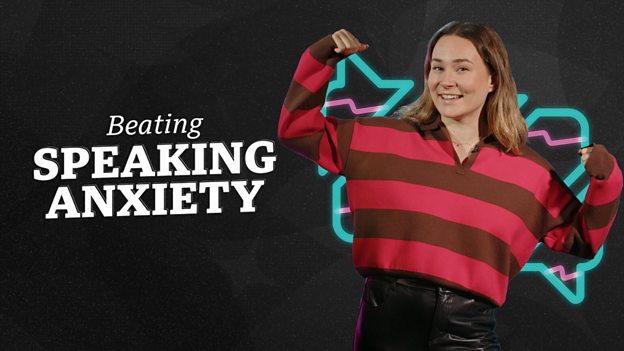
In today's episode, we're talking about being funny in English. Hello, and welcome to Beating Speaking Anxiety - our special series to help you fight your fears of speaking English. I'm Georgie.
Hanan
And I am Hanan. You can find a transcript of this episode to help you learn on our website, bbclearningenglish.com.
Georgie
Have you ever been having a conversation with friends, and suddenly everyone laughs and you don't know why? This can happen a lot when you speak a new language. This happened a lot to me when I lived in Spain. It feels like everyone's having fun and you can't join in.
Hanan
Yeah, I actually always have that or experience that around Christmas time when we pull crackers at the dinner table.
Georgie
Yeah. So crackers are something we have at the dinner table at Christmas. It's like a little parcel that two people pull. And inside you get a little gift and traditionally a joke. So, Hanan, what happened?
Hanan
Yeah. So, um, if we are with our Arab or European friends, I feel OK because none of us get the joke, which is usually very, um, has a deep root of, like, English tradition or like British culture. But if we are with our British friends, um, I see that they all got the joke and I didn't. So sometimes I feel it's easier and quicker to pretend that I am laughing or I'm enjoying it, to save them the embarrassment of explaining the jokes to me because I feel like sometimes explaining the jokes after saying it, it can kill the vibe a bit.
Georgie
100%, yeah.
Hanan
Even if you understand the joke in English, it can be even harder to try to make your own jokes. That's something that Miguel from Spain struggles with as part of his speaking anxiety.
Miguel
I check all the boxes of a stereotypical introvert. I am quiet, reserved and extremely shy.
Hanan
Miguel says he's a shy person, even when speaking Spanish.
Miguel
Even in Spanish, I struggle to speak up, not only in an unfamiliar situation, but strangely enough, I also get nervous when talking to friends if more than a few are paying attention to me.
Georgie
And of course, speaking in English makes Miguel feel even more shy, even with friends.
Miguel
It's even worse. Instead of being able to joke or say what I really think, I get stuck trying to find the right words, and that makes me more anxious.
Hanan
When he's talking in English, Miguel wants to be able to participate and make jokes, but his anxiety makes it too difficult.
Georgie
There are so many different ways of making jokes and playing with a language, and until you start learning these things, it's easy to feel excluded from the fun. Being able to laugh and have a joke with someone can be a really important and useful way to bond with them, especially if you consider yourself a funny person in your first language. So how can we try to be more confident making and understanding jokes in English? To find out, let's hear from someone who moved to the UK and has become fluent in English, including making jokes.
Pepa
My name is Pepa Duarte. I am originally from Lima, Peru. I am an actor. I also work as a theatre maker, so I produce, create, write my own shows.
Hanan
This is Pepa. She grew up in Peru and learned some English at school.
Pepa
I actually didn't feel that I learned anything as I graduated from secondary school. I didn't think that I was able to express myself in English or I, that I or I was able to understand it, really.
Georgie
When Pepa decided to do a master's degree in the UK, she studied more English to pass an IELTS exam. But Pepa says it wasn't until she moved to the UK that she realised how much she still had to learn.
Pepa
And I came to London not really knowing how to express myself just yet, more like I passed the exam and I was able to come, and then I guess the last part of my journey learning English was in the practice of not knowing what people were saying and sort of making it, you know, on the go.
Hanan
People found it really difficult to have everyday conversations in the UK and communicate with people. She's grown up hearing more American English in film and TV and found UK accents difficult to understand.
Pepa
You know, I wasn't even able to tell you something was English. I was a bit like very lost in everyday conversations.
Georgie
But Pepa carried on. Even though she was scared, she realised she had to keep trying to speak to people.
Pepa
I think it was a change of mindset that happened out of the need of surviving, really, um, because I had already paid for my master's degree, I was already here. I was sort of like, I came home one day and I was like, I haven't done all of these and, you know, made the impossible happen, which was moving to this country to then just keep my mouth shut because I'm scared of making mistakes.
Hanan
Pepa decided to change her mindset. She decided to change the way she thought about speaking in English.
Georgie
Yes, trying to speak even though she was making mistakes, trying to understand even if she found things difficult. And part of this was making jokes with people, something she would naturally do in her first language, Spanish.
Pepa
I think one can be funny even when you don't know a language really well, you can still like find a way to bring some comedy into the room. Um, you know, even with a very broken English.
Hanan
Pepa completed her master's and began working in theatre, and then she got the opportunity to try comedy on the stage.
Georgie
Pepa worked with an organisation called No Direction Home, which organises stand-up comedy nights for migrants and refugees in the UK. Stand-up comedy is where one person stands on a stage and tells jokes to an audience. It's scary stuff.
Pepa
Promising the audience that I'm going to make them feel one or another thing I think like is a really big thing to do. Like promising that you're gonna deliver something specifically which comedy does. It's kind of like you're coming, you're going to be laughing. If you don't laugh, you're sort of like, failed. So I found that very scary, let alone doing it in another language.
Hanan
As part of the experience, Pepa got some advice from a professional comedian, which helped her feel more confident.
Pepa
The process of being part of No Direction Home like gave us all a lot of confidence. Maybe you don't feel that you have as much vocabulary as some someone that is native, um, you can still find a way to be really funny. So it was just like a really empowering, um, space, and with people from all over the world, which was really exciting as well.
_____________________________________________________________
Watch an explainer video
_____________________________________________________________
Georgie
Now, you probably won't be standing on stage telling jokes, but being able to laugh with people can make us feel more relaxed when having everyday conversations. So what is Pepa's advice for overcoming that nervousness that she felt when she first moved to the UK? Well, for her it's all about practice.
Pepa
But practice from a from a playful kind of, um, starting point where you are like taking it as a challenge, as a game, as, like as a tryout. Language should be something flexible and fun and, um, and it's quite courageous, I think, as well. So, um, pushing yourself to try things rather than waiting for things to be perfect.
Hanan
Georgie, some of the jokes that we heard at the start of the programme could be quite confusing, and even scary. People might not get them. Should they be worried?
Georgie
No, you shouldn't be worried. Um, these jokes that we heard at the beginning are often based on wordplay and puns, so words that sound similar or can mean more than one thing. So one of the examples from the beginning, what did the ocean say to the beach? Nothing. It just waved.
Hanan
Well that's funny.
Georgie
Can you try and explain why it's funny?
Hanan
Because it just waved and it plays on the word here. Um, waves as, uh, like the ocean waves, but also waving your hand like goodbye or hello.
Georgie
Yeah, that's exactly right. Um, but these are always going to be difficult in your second language. But I think most of us know that humour doesn't have to be about using clever words. In fact, like Pepa said, you can find fun in the process of trying to communicate.
Hanan
That's it for this episode. If you want to learn more about improving your speaking and reducing your fears, Georgie's made a series of videos to go with this podcast with practical tips and activities.
Georgie
That's right, you can find them all on bbclearningenglish.com. Next time we'll talk about what to do when you feel like you're a bit stuck with your English and you're not getting any better, see you then.
Hanan
Bye bye.
Next
Watch the video to see learners in action.
Discover programmes to improve your skills.
최신 Beating Speaking Anxiety
How to be yourself in English
Episode 260310 / 10 Mar 2026
Do you feel like you can show your personality in English?
I'm scared I can't be myself - podcast
Episode 260309 / 09 Mar 2026
Georgie and Hanan talk about how to show your personality when you speak English.
How to celebrate your progress
Episode 260303 / 03 Mar 2026
Do you ever feel like you're trying really hard but can't see your progress?
I'm scared I'm not improving - podcast
Episode 260302 / 02 Mar 2026
Georgie and Hanan talk about what to do when you feel like you're not getting better at English.
How to show your funny side in English
Episode 260224 / 24 Feb 2026
Get tips for showing your sense of humour in English
I'm scared I won't get the joke - podcast
Episode 260223 / 23 Feb 2026
Georgie and Hanan talk about understanding and making jokes in English.
How to speak clearly in English
Episode 260217 / 17 Feb 2026
Tips for making sure your accent in English is easy to understand
I'm scared people won't understand me - podcast
Episode 260216 / 16 Feb 2026
Georgie and Hanan talk about accents and what to do when someone doesn't understand yours.
How to build your speaking confidence
Episode 260210 / 10 Feb 2026
The fear of public speaking is common even in a person’s first language, and in a foreign language, it can feel even scarier
I'm scared of speaking in front of people - podcast
Episode 260209 / 09 Feb 2026
Georgie and Hanan talk about public speaking and speaking in bigger groups.
What to do if you can't understand someone
Episode 260203 / 03 Feb 2026
How to get better at understanding people around the world
I'm scared I won't understand people - podcast
Episode 260202 / 02 Feb 2026
Georgie and Hanan talk about how you can improve your listening in real life conversations.
What to do when your mind goes blank
Episode 260127 / 27 Jan 2026
Tips for when you forget your words during a conversation
I'm scared I'll forget my words - podcast
Episode 260126 / 26 Jan 2026
Have you ever been having a conversation in English, and suddenly your forget your words?
How to fight the fear of mistakes
Episode 260120 / 20 Jan 2026
Understand the fear of mistakes and hear tips for how to overcome it
I'm scared of making mistakes - podcast
Episode 260119 / 19 Jan 2026
Does the fear of making mistakes stop you progressing in English?