_____________________________________________________________________________________________________
Download a free 6 Minute English worksheet and transcript!
Try our free interactive quiz!
______________________________________________________________________________________________________
Try more episodes of 6 Minute English:
______________________________________________________________________________________________________
Introduction
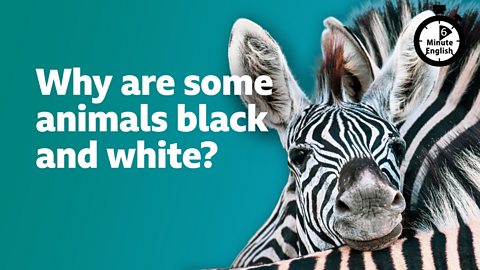
How many animals can you think of that are black and white? Zebras, penguins, orcas, snow leopards… there are loads! But have you ever wondered why these animals have developed such unique and striking appearances? Neil and Becca discuss this and teach you some new vocabulary.
This week's question
What is the scientific term for the theory that some animals are black and white to warn potential predators that they're dangerous or they taste bad?
a) camouflage
b) mimicry
c) aposematism
Listen to the programme to hear the answer.
Vocabulary
optical illusion
visual trick where your eyes and brain perceive something that is not really there, or see it differently from how it really is
a whole bunch of (something)
a lot of (something)
put off
cause to dislike, lose interest or not do something
giveaway
something that makes it easy for people to discover something secret or unknown
something clicked in my mind
used when you suddenly understand something
black-and-white
subject or situation where it is easy to understand what is right and wrong

TRANSCRIPT
Note: This is not a word-for-word transcript.
Neil
Hello. This is 6 Minute English from BBC Learning English. I'm Neil.
Becca
And I'm Becca. Neil, what do the following animals have in common? Zebras, giant pandas and magpies.
Neil
That's pretty easy, Becca. They're all black and white.
Becca
Right! But do you know why these animals evolved to be black and white?
Neil
Hmm. I'm not so sure. Probably something about survival.
Becca
That's usually the answer, isn't it?
Neil
It is.
Becca
The animal world is full of colour – shiny blue peacocks and bright green frogs. But in fact, hundreds of animal species are black and white. In this episode, we'll try to find out why, while also learning some useful new words and phrases. And remember, all the vocabulary from this episode is available on our website bbclearningenglish.com.
Neil
OK. Time for a question for you, Becca. According to one theory, some animals are black and white to warn potential predators that they're dangerous or they taste bad. But what is the scientific term for this? Is it:
a) camouflage,
b) mimicry, or
c) aposematism?
Becca
Well, Neil, I'm going to go with c) just because I've never heard of that word before.
Neil
OK. I like... I like your style! Some scientists think zebras' distinctive black-and-white stripes prevent bites from flies and other insects. Zoologist Dr Martin How tested this theory by covering horses, a close relative of the zebra, in stripes. Here, Martin discusses his experiment with Caroline Steel from BBC World Service programme CrowdScience:
Caroline Steel
Do we know what it is about the stripes that's putting them off? Is it somehow, like, visually confusing?
Dr Martin How
We originally set out to test whether maybe there were these optical illusions at play, so we did a whole bunch of tests where we tried different patterns of rugs, but it turned out that practically every high-contrast pattern, every black and white pattern we used, almost every pattern was really effective at stopping flies.
Becca
Martin conducted a whole bunch of – meaning a lot of – tests using different colours and patterns. Black and white stripes created an optical illusion, a visual trick that makes your eyes see things differently from how they really are. As a result, the flies were put off. They lost interest and didn't bite.
Neil
So, zebras' stripes confuse insects, telling them to look elsewhere for food. But are there other reasons animals are black and white?
Becca
Nobody who's seen giant pandas in a zoo would find them hard to spot. Against a grassy background, they stand out easily. But seen from a distance in the snowy mountain forests where they live, black and white makes the perfect disguise.
Neil
Here's Professor Tim Caro, a world authority on animal behaviour, explaining more to Caroline Steel for BBC World Service's CrowdScience:
Professor Tim Caro
The giveaway for me was 15 photos of giant pandas, taken either fairly close up or at a distance, and in two of those photos, I was unable to see anything in the picture other than rocks and snow. And then later on, I realised that in fact there was a giant panda in the centre of that picture some distance away. Immediately that... that clicked in my mind.
Becca
The pandas were so well camouflaged Tim couldn't spot them in the photos. That's when something clicked in his mind – a phrase used when you suddenly understand something after trying for a long time.
Neil
Tim understood that pandas use colour to hide. He calls this a giveaway – something that makes it easy for people to discover something secret or unknown.
Becca
So, are animals black and white to repel insects, like zebras, or for camouflage, like pandas? Let's give the final word to Hannah Rowland, a researcher into another black and white animal – penguins.
Hannah Rowland
Really, science never has a black-and-white answer – excuse the pun – about the... with penguins being black and white. It's often a very complex mixture of reasons.
Neil
The answer to why animals are black and white is not black and white – a situation described as black and white means one where it's easy to understand what's right and wrong.
Becca
In fact, there's no one reason why animals are black and white. Zebras avoid bites, pandas hide from predators and some animals, like skunks, warn other animals they're dangerous. It all depends on the specific animal.
Neil
And talking of skunks reminds me of my question, Becca. According to one theory, some animals are black and white to warn potential predators they're dangerous or taste bad. But what is the scientific term?
Becca
And I chose c) aposematism because I'd never heard of it before.
Neil
Well, that's a great way of choosing. And it's done well for you because you're correct.
Becca
Woohoo!
Neil
OK. Let's recap the vocabulary we've learned, starting with optical illusion – a visual trick where your eyes perceive things differently from how they really are.
Becca
A whole bunch of something means a lot of something.
Neil
If something puts you off, it causes you to dislike it or lose interest.
Becca
A giveaway is something that makes it easy for people to discover something secret or unknown.
Neil
The phrase something clicked in my mind is used when you suddenly understand something at last.
Becca
And finally, if you describe something as black and white, you mean it's easy to understand what is right and wrong. Once again, our six minutes are up, but head over to our website, bbclearningenglish.com, for a quiz and worksheet for this episode. See you there soon. But for now, it's goodbye.
Neil
Goodbye!
Next
Find an A-Z list of our programmes.
To learn English from news headlines, listen to Learning English from the News.
Practise your reading skills with The Reading Room.
최신 6 Minute English
Why are some animals black and white?
Episode 260305 / 05 Mar 2026
The answer is not as black and white as you might think!





Why are billionaires building bunkers?
Episode 260129 / 29 Jan 2026
Is the end of the world closer than we thought?

Scared of speaking English?
Episode 260122 / 22 Jan 2026
Beth and Pippa talk about why we often find speaking a new language scary.

What English phrases really mean
Episode 260115 / 15 Jan 2026
Why don't British people say what they mean, or mean what they say?